Showing posts with label South China Sea. Show all posts
Showing posts with label South China Sea. Show all posts
Wednesday, June 21, 2023
Neighborhood Watch Needed for the Region

Monday, August 15, 2016
RAND Report on Cyber War with China

What this report fails to address is the effect of deliberate attack and collateral damage on other countries. Cyber-attacks are difficult to confine to one geographic area and will likely effect interconnected international systems and national and local ones well away from the conflict. In addition both sides may well make use of cyber-attacks on third countries, as a way to send a low risk political signal.
Monday, June 27, 2016
21st Century Maritime Military Cooperation by Australia, USA and Japan

Speakers include:
ADM ret. (RAN) Chris Barrie, Adjunct Professor SDSC; ADM ret. (USN) Dennis Blair, Chairman and CEO Sasakawa Foundation; VADM (MSDF) Umio Otsuka, President JMSDF Command and Staff College; Dr. Jeffrey Hornung, Fellow Security and Foreign Affairs Program Sasakawa USA; Mr. Stanley Roth, Former US Assistant Secretary of State for East Asian and Pacific Affairs; Dr. Stephan Fruehling, Associate Professor SDSC; AMB Shingo Yamagami, Acting Director JIIA; VADM ret. (USN) Conrad C. Lautenbacher, Jr., CEO GeoOptics Inc.; Dr. Anthony Bergin, Deputy Director Australian Strategic Policy Institute; Dr. Toshio Yamagata, Director Application Laboratory of Japan Agency for Marine-Earth Science and Technology; Mr. Yoshikiyo Ono, Secretary General Japanese Shipowners’ Association; Dr. Carol Anne Clayson, Director Ocean and Climate Change Institute, Woods Hole Oceanographic Institute; Mr. Peter Jennings, Executive Director Australian Strategic Policy Institute; CAPT (MSDF) Katsuya Yamamoto, JMSDF Command and Staff College; RADM ret. (RAN) James Goldrick AO, CSC, Adjunct Professor SDSC; Dr. Isami Takeda, Professor of International Relations Dokkyo University; VADM ret. (USN) Robert Parker; Dr. Euan Graham, Director International Security Program at the Lowy Institute; ADM ret. (USN) Walter Doran, President Pacific Vision LLC; Dr. Brendan Taylor, Head of SDSC.
Tuesday, June 21, 2016
Is ASEAN about to break up?

Greetings from the Australian National University in Canberra, where Professor Kishore Mahbubani, from the National University of Singapore, is speaking on "Is ASEAN about to break up?". Professor Mahbubani attributed the recent peace in South-east Asia to the influence of the Association of Southeast Asian Nations (ASEAN). He suggested that such forums allow nations to communicate in a face-saving way. Also he suggested that Australia greatly benefited by not having to deal with refugees who would have been displaced by conflict. However, judging from other presentations at ANU, this period of peace may be coming to an end, with an arms race now taking place in the region and the potential for armed conflict in the South China Sea.
Professor Mahbubani predicted Australia will have a less comfortable time being a western country, with the rise of China, but will be better off due to ASEAN. He also suggested there would be rising geopolitical competition between the USA and China. He commented "This has surfaced first over the South China Sea" (perhaps this was a pun, as China built artificial islands, literally "surfacing").
Professor Mahbubani described last week's ASEAN-China meeting as "disastrous". Also he described a recent incident between Indonesian forces and Chinese fishing boats as "puzzling". However, I suggest that these are simply manifestations of an international dispute. The nations involved will test each other's resolve, both diplomatically and
militarily.
Professor Mahbubani suggested that many regional leaders are domestically focused. As a result they are neglecting international matters. Clearly this does not apply to all, particularly Singapore, which is regionally focused (and also upgrading its armed forces).
Professor Mahbubani said there was no surprise in Cambodia moving closer to China, while Vietnam moves closer to the USA, but ASEAN could survive this.
ps: I have suggested Australia could engage with the region throughon-line courses, in an "On-line Colombo Plan".
Professor Mahbubani predicted Australia will have a less comfortable time being a western country, with the rise of China, but will be better off due to ASEAN. He also suggested there would be rising geopolitical competition between the USA and China. He commented "This has surfaced first over the South China Sea" (perhaps this was a pun, as China built artificial islands, literally "surfacing").
Professor Mahbubani described last week's ASEAN-China meeting as "disastrous". Also he described a recent incident between Indonesian forces and Chinese fishing boats as "puzzling". However, I suggest that these are simply manifestations of an international dispute. The nations involved will test each other's resolve, both diplomatically and
militarily.
Professor Mahbubani suggested that many regional leaders are domestically focused. As a result they are neglecting international matters. Clearly this does not apply to all, particularly Singapore, which is regionally focused (and also upgrading its armed forces).
Professor Mahbubani said there was no surprise in Cambodia moving closer to China, while Vietnam moves closer to the USA, but ASEAN could survive this.
ps: I have suggested Australia could engage with the region throughon-line courses, in an "On-line Colombo Plan".
Tuesday, November 10, 2015
New Chinese Foreign Policy
 Greetings from the Australian National University in Canberra, where Ryan Manuel, postdoctoral fellow and Will Zou, Morrison Scholar at the Australian Centre on China in the World, are speaking on 'Xi Jinping's "New Confucian" Foreign Policy'. Ryan argues that the Chinese Communist Party sees itself as a moral player on the world stage. Xi Jinping needs to reflect this, combining messages for the Chinese domestic ears and for the world. An interesting point made in terms of the situation in the South China Sea was that China uses scale: one country sets the precedent by doing small small scale building on a reef, China then builds a large airstrip on another reef. He suggests that the Chinese response to the US sending one frigate will be to send a fleet.
One problem for researchers is to determine what is an authoritative Chinese foreign policy statement. Ryan showed a diagram of the Chinese government and commented the state component looks much like that of Australia, the difference being the overriding role of the party. The party Politburo Standing Committee issues "commands" equivalent to policy documents in the Australian system.
Ryan's analysis of 931 central decrees indicates that there are no authoritative foreign policy documents. He pointed out that the Chinese foreign minister has a relatively low rank in the government, compared to western equivalents. He conclusion was that it is Xi Jinping sets the foreign policy directly. An example "One Belt On Road" (September 2013) speech resulted in an action plan in 2015. However, Ryan did not indicate to what extent the action matched the original vision (in western government it is common for what is implemented to not match the original announcement).
Will Zou, addressed the question of what a Confucian foreign policy would look like. He carried out an analysis showed that Xi Jinping had used far more traditional Chinese sayings (such as "What matters most is harmony" and "It is the nature of things to be of unequal quality") than Hu Jintao. These were used particularly for USA, multilateral organizations and India. Will argues that therefore these speeches were intended for Chinese literate audiences and internal Chinese domestic audiences. The message is that China has its own culture which must be respected. This, I suggest, also is not different to western practice, where a leader will make a public speech in an international forum, but addressed at a domestic and internal government audience, drawing on national culture.
Will Zou, points out that Xi Jinping draws not just from Confucian sources. He quoted the People's Daily newspaper "We can already leave behind the experience and language of the west ...". This I suggest brings up a point in interpreting what a leader says: who actually wrote the speech? Leaders do not generally write their speeches and there is a team of people involved. There can be factions and differences of opinion within a leader's office. In answer to a question, Ryan said it was not possible to work out who wrote the speeches. However, I suggest it may be possible, I suggest, to carry out an analysis of speeches to determine who wrote which part and see what the factions are.
I had some insight into the Chinese government when I took part in a Beijing 2008 Olympics Organizing Committee meeting in 2003. Musch as might happen in Australia there were government, academic, business and media people involved. The Peoples Daily newspaper were providing the website for the Olympics. The closes equivalent of the Peoples Daily in Australia is the ABC, but the Peoples Daily is part of the government, rather than a media organization owned by the government. I asked Ryan if the way speeches are promulgated has changed and he said it had not: the text is put out and then the government system "kicks in" to interpret and "operationalize" it.
Will Zou, addressed the question of what a Confucian foreign policy would look like. He carried out an analysis showed that Xi Jinping had used far more traditional Chinese sayings (such as "What matters most is harmony" and "It is the nature of things to be of unequal quality") than Hu Jintao. These were used particularly for USA, multilateral organizations and India. Will argues that therefore these speeches were intended for Chinese literate audiences and internal Chinese domestic audiences. The message is that China has its own culture which must be respected. This, I suggest, also is not different to western practice, where a leader will make a public speech in an international forum, but addressed at a domestic and internal government audience, drawing on national culture.
Will Zou, points out that Xi Jinping draws not just from Confucian sources. He quoted the People's Daily newspaper "We can already leave behind the experience and language of the west ...". This I suggest brings up a point in interpreting what a leader says: who actually wrote the speech? Leaders do not generally write their speeches and there is a team of people involved. There can be factions and differences of opinion within a leader's office. In answer to a question, Ryan said it was not possible to work out who wrote the speeches. However, I suggest it may be possible, I suggest, to carry out an analysis of speeches to determine who wrote which part and see what the factions are.
I had some insight into the Chinese government when I took part in a Beijing 2008 Olympics Organizing Committee meeting in 2003. Musch as might happen in Australia there were government, academic, business and media people involved. The Peoples Daily newspaper were providing the website for the Olympics. The closes equivalent of the Peoples Daily in Australia is the ABC, but the Peoples Daily is part of the government, rather than a media organization owned by the government. I asked Ryan if the way speeches are promulgated has changed and he said it had not: the text is put out and then the government system "kicks in" to interpret and "operationalize" it.
Wednesday, June 10, 2015
Vietnam and the South China Sea Disputes

It seems to me that if Vietnam can agree a common position with other countries in the region there is the possibility of negotiating with China. Countries around the South China Sea probably do not want to have to be seen to be aligned with China or the USA in a great power dispute.
Last night in the presentation "A Small Navy in a Great War: Australians at sea, 1914-18" Dr David Stevens pointed out how the Royal Australian Navy (RAN) played a key role in South East Asia during WW1. He argued that the RAN was seen as separate from the Royal Navy and so was seen separate, to some extent, from the great powers involved in the European conflict. Australia was able to play this role as in the years before WW1 it developed a small but powerful navy. This is detailed in his book "All Respects Ready: Australia’s Navy in World War One".

 The RAN is now developing a significant surface force of Amphibious Assault Ships, upgraded ANZAC class frigates, and Hobart class destroyers. These might be called on to play a role in the South China Sea, being more acceptable to all the parties involved than the presence of the US 7th Fleet. One way to make this more credible would be for Australia to modify its order for F-35A aircraft and take early delivery of a small number of F-35B aircraft to operate from HMAS Canberra.
ABSTRACT
Over the last few years, academic and public inquiry into the South China Sea disputes has increased significantly as tensions in this region have flared up without any signs of abating. However, much of the attention has naturally focused on a rising China, which is the most powerful claimant in the dispute and the potential disrupter of the regional order. Other smaller claimants have been largely overlooked, or have been studied within the context of China’s policy. This imbalance in the literature has the potential to distort the cycle of the actions and reactions which have shaped the dynamics of the disputes.
This research, which offers the view from a smaller claimant but a key rival to China, seeks to address this gap in the current discourse on South China Sea politics. Specifically, it will draw on a wide range of primary and secondary sources to trace and account for continuity and changes in Vietnam’s approach to its disputes in the South China Sea with an emphasis on the period between 1991 and 2011. It is argued that in this period, Vietnam oscillated between bandwagoning and hedging strategies to respond to China’s rising power and assertiveness in the maritime domain.
The study, which presents the case of Vietnam in the South China Sea, examines the way in which Vietnam has managed its relations with China. It offers a critical evaluation of the realist school in international relations about how a medium-sized state responds to a power transition in the region. Though the case of Vietnam is unique, it is indicative of how regional countries react to shifts in power relations and to changes in China’s foreign and security posture.
Thanh Hai Do is a PhD Candidate in the Strategic and Defence Studies Centre at the Australian National University. He is a recipient of the Prime Minister’s Australia Asia Award, and has commenced his doctoral studies in Australia in July 2011. Prior to this academic endeavour, Thanh Hai worked as a research fellow at the Diplomatic Academy of Vietnam.
Tuesday, April 07, 2015
Armed conflict in the South China Sea

Professor Buszynski said that clashes between some vessels was possible but outright war unlikely. He said this started as a post-colonial effort to define maritime boundaries which was put off until fishing and oil drilling right came up in the 1970s. The issue of sea lanes then arose. Lastly Professor Buszynski emphasized the strategic importance of the area to China and concerns Japan has over this.
Interestingly, Professor Buszynski claimed that China exaggerated the oil reserves of the area. However, independent oil and gas resource estimates indicate the South China Sea is minor in world terms.
Professor Buszynski characterizes China's claims to the South China Sea as based on history and those of the other countries on law.
Thanh Hai Do then discussed the Vietnamese perspective on the dispute. He pointed out that while countries of the region talk of peace and trade they are investing in sophisticated weapons. It occurs to me that Australia is part of this arms race, now having the most advanced amphibious warfare ship in the region (HMAS Canberra), building very advanced destroyers (with the option of anti-ballistic missile defence), has ordered stealth supersonic aircraft and, less credibly, is planning the world's most advanced conventional submarines.
Thanh Hai Do pointed out the importance of the South China Sea to regional and world trade. He then summarized harassment of non-Chinese fishing vessels by Chinese coastguard ships and interference in oil exploration.
An interesting aspect of the disputes is that China's use of large numbers of lightly armed coastguard type vessels might make the use of conventional warships in response ineffective. I suggest it might be useful for nations to instead adopt the equipment and tactics of the Sea Shepherd Conservation Society. The Society has experience in combating fishing operations of questionable legality using a combination of harassment and public relations. This might be done at arms length with countries of the region secretly supporting non-government organizations countering Chinese harassment by using the same tactics. These NGOs would be secretly supported with intelligence information from the military force of the region.
Professor Buszynski pointed out that claims to the South China Sea of countries apart from China are based on international law. He characterized the Chinese claims as being unclear and with disputes between different Chinese experts. However, none of this appears to me to be of much importance in an international dispute. The current oil dispute between Australia and Timor-Leste shows that even a country such as Australia, which normally supports the rule of law, will deviate from this and engage in questionable activities, when it has the military power to do so and a lrage economic incentive.
Professor Buszynski suggested that the South China Sea dispute may be used by the Chinese military to gain funding and a location for a navy to challenge the USA. He argued that the deep parts of the South China Sea could be used for Chinese ballistic missile submarines. This ambition may not be shared by other parts of the Chinese government.
Professor Buszynski commented that ASEAN does not have a unified position on the South China Se, with Vietnam and the Philippines not receiving support from other members, apart from some recent comments from Indonesia.
Professor Buszynski commented that other countries, including Japan and India will become involved if China presses its case. He suggested that in five to seven years, if the Chinese government is feeling secure, it may be prepared to negotiate an agreement.
Monday, April 06, 2015
Prospect of armed conflict in the South China Sea

Prospects of armed conflict over the South China Sea maritime dispute are more real than ever as regional tension has escalated to dangerous levels in recent years. The dispute affects not only the claimants involved, but also peace and security in the wider region. Hugh White estimates that it could turn into 'the biggest war for many decades, and possibly the biggest since the Second World War'. As such, it is important to be aware of its significance from a range of perspectives.
With this in mind, the ANU ASEAN Society invites you to join us in our first public lecture of the year - 'Prospects and Perspectives on the South China Sea Dispute'. We have invited three distinguished speakers who will help you gain greater understanding of dispute from the perspectives of some key actors including ASEAN, Vietnam, Australia and the US. The speakers are:
• Professor Leszek Buszynski - Lecturer at the National Security College. He has done research on the South China Sea for more than twenty years and is currently engaged in a project on the South China Sea and Australia's Regional Security Environment.
• Dr Andrew Carr - Research Fellow at the Strategic and Defence Studies Centre. His latest book Winning the Peace, Australia’s Campaigns to Change the Asia-Pacific examines how Australia has influenced Asia's security and economic order.
• Thanh Hai Do - PhD Candidate at the Coral Bell School of Asia Pacific Affairs. His thesis seeks to account for Vietnam's approach to claims in the South China Sea. Thanh Hai was Deputy Director of the Centre for Political and Security Studies at the Institute for Foreign Policy and Strategic Studies, a think-tank affiliated to the Diplomatic Academy of Vietnam.
The lecture will consist of presentations followed by a panel discussion during which you will be able to pose questions to our speakers.
There will be opportunity to interact with the speakers following the presentations.
Light refreshments will be provided.
Thursday, June 19, 2014
Bob Hawke on China's Foreign Policy
 Greetings from the Great Hall of the Australian National University, where former Prime Minister, Bob Hawke is speaking at the launch of the book 'China's Foreign Policy' by Stuart Harris. Mr. Hawke commented he had just made his 98th visit to China and his first was just after the Gang of Four were arrested in 1978. He emphasised China's attachment to a peaceful international environment. This contrasts with the general view at the Alliance 21 conference yesterday, which assumed aggressive posture by China in the East and South China seas. Mr. Hawke nominated Deng Xiao Ping's reforms of the Chinese economy as the greatest single decision by a leader in the 20th Century (I am not sure that historians would agree with this). Mr. Hawke argued that China was not a threat to the Western world. Mr. Hawke then mentioned the South China Sea. He said that Chinese officials had said they were interested in joint development of resources. However, this seems at odds to the current confrontation taking place between Chinese warships around a oil exploration rig in waters claimed by Vietnam. Mr. Hawke claimed that China never had a warm relationship with the Soviet Union and this was just a matter of convenience. This seems at odds with history, where China and the Soviet Union provided personnel in support of North Korea.
Professor Stuart Harris has a less glowing view of China, pointing out that it will have more cohesive power, but at least in the short term this will be used to address issues close to China. Professor Harris cautioned that misunderstandings could lead to conflict, as they did in world war one.He pointed out that both the Chinese and US government contain differing views on how to resolve their conflicting interests.
At question time Mr. Hawke was asked about the current government's foreign policy. He expressed concern about the current prime minister's enthusiasm for describing Japan and Australia as close allies. He also cautioned that future wars still run the risk of nuclear escalation.
Tuesday, July 23, 2013
Australian Deputy Commanding General for Operations US Army Pacific
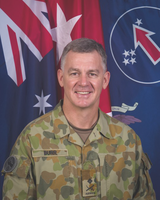
Greetings from the Australian National University in Canberra, where Major General Rick Burr, Deputy Commanding General for Operations, U.S. Army Pacific, is speaking on "The U.S. Army in the Indo-Asia Pacific: Implications for regional security"General Burr, is an Australian Army officer, commanding US forces. He commented that he wears an Australian Army uniform (the same uniform I wore at Exercise Tandem Thrust 97), but with a US shoulder patch. He mentioned the US Asia-Pacific re-balance. Also he commented that the Asia-pacific is seen as a air force, navy and marine area of operations, but there are large armies in the region and so a potential area for operations of the US Army. Forces previously earmarked for Afghanistan are now back in the region (about 80,000). One HQ is in Brisbane currently for exercise Talisman Saber 2013. Two brigades are based in Alaska, one of which flew for 17 hours to parachute into Queensland on Saturday.
While Major Burr made the case for the US Army in the region, it remains the case that the US Marines, and the US 7th Fleet remains the core US force for the pacific. The US Brigade parachuted into Queensland, for example, could only survive in a hostile military environment for a matter of hours without support from the US Navy. General Burr described the Pacific as a "logistics theater".
The US Army is working with the Chinese military on disaster response exercises. The first exercises was in China last year and the next will be in the USA.
One point which occurs to me is that the Australian Army shares many issues with the US Army in confronting the Pacific theater. The Australian Defence Force has no distinct marine forces, unlike the USA and UK. It is therefore expected that the Australian regular army will undertake littoral operations. Australia has recently made a large investment in equipment for amphibious operations, with the purchase of the former UK landing ship dock RFA Largs Bay (L3006) and two new Landing Helicopter Dock Ships (essentially mini-aircraft carriers) under construction in Spain and Australia. However, the Australian Army has no recent experience in operating with the navy and conducting amphibious operations. I asked the General about this and in response he pointed out the that US Army has around 700 of its own ships and so considerable experience in the marine environment.He saw the Exercise Talisman Saber as the primary way for the Australian Army to learn littoral skills.
It should be noted that some US Army ships are Australian designed. These are the the Fortitude class Joint High Speed Vessel (JHSV) from Austral in Perth and similar designs from Incat Australia, in Hobart.
While Major Burr made the case for the US Army in the region, it remains the case that the US Marines, and the US 7th Fleet remains the core US force for the pacific. The US Brigade parachuted into Queensland, for example, could only survive in a hostile military environment for a matter of hours without support from the US Navy. General Burr described the Pacific as a "logistics theater".
The US Army is working with the Chinese military on disaster response exercises. The first exercises was in China last year and the next will be in the USA.
One point which occurs to me is that the Australian Army shares many issues with the US Army in confronting the Pacific theater. The Australian Defence Force has no distinct marine forces, unlike the USA and UK. It is therefore expected that the Australian regular army will undertake littoral operations. Australia has recently made a large investment in equipment for amphibious operations, with the purchase of the former UK landing ship dock RFA Largs Bay (L3006) and two new Landing Helicopter Dock Ships (essentially mini-aircraft carriers) under construction in Spain and Australia. However, the Australian Army has no recent experience in operating with the navy and conducting amphibious operations. I asked the General about this and in response he pointed out the that US Army has around 700 of its own ships and so considerable experience in the marine environment.He saw the Exercise Talisman Saber as the primary way for the Australian Army to learn littoral skills.
It should be noted that some US Army ships are Australian designed. These are the the Fortitude class Joint High Speed Vessel (JHSV) from Austral in Perth and similar designs from Incat Australia, in Hobart.
Tuesday, July 16, 2013
U.S. Army in the Indo-Asia Pacific
Major General Rick Burr, Deputy Commanding General for Operations, U.S. Army Pacific, will speak on "The U.S. Army in the Indo-Asia Pacific: Implications for regional security" at the Austr5laian National University in Canberra, 5:30pm 23
Event Details
About the Event:
This lecture will draw on Major General Rick Burr's experience as an Australian in the position of inagural Deputy Commanding General for Operations, U.S. Army Pacific. This has given Burr a unique perspective on the role of the US army in the Pacific. Burr will discuss how the US army operates in this region, how it views the changing regional security environment and the implications for regional security and especially Australia.
About the Speaker:
Major General Rick Burr is the inaugural Deputy Commanding General for Operations, U.S. Army Pacific. As an Australian Army officer he brings unique perspectives and experiences to this appointment.
Major General Burr’s previous assignment was Commander of the 1st (Australian) Division and Deployable Joint Force Headquarters, and he also has extensive multinational command and operational experience with Special Forces.
In 2008 he was the inaugural Commander of ISAF SOF, comprising all Special Forces assigned to the International Security Assistance Force in Afghanistan. He has commanded the Special Air Service Regiment, and the Australian Special Forces Task Groups in Afghanistan (2002) and Iraq (2003).
Major General Burr has held a number of key staff appointments, including Military Assistant to the Chief of Army, Director General of Preparedness and Plans for the Army, a senior adviser in the Department of Prime Minister and Cabinet, and Director General of Military Strategic Commitments in Defence Headquarters.
Wednesday, July 10, 2013
China New Model for Growth Creates Tension

Greetings from the Australian National University in Canberra, where Chen Yuming, Chinese Ambassador to Australia is launching the book "China: A New Model for Growth and Development". The Ambassador said that China will not repeat the mistake of other countries as they developed, with hegemony, but with a peaceful, responsible and open country. However, there are tensions.
For the last few weeks I have been attending seminars at and near the ANU on strategic, legal and security issues. Many of these have addressed China.

On 28 June Admiral Dennis C. Blair (USN Retired) is talked on "What should we do about China?".
On 20 June Dr Christopher Ward talked on "South China Sea: The disputes and prospects for international law". He pointed out problems with the vagueness of China's claim to most of the South China Sea.
On 22 August a panel of experts discussed possible military conflict, as a result of the USA's ‘pivot’ to Asia. The event announcement, somewhat provocatively, had a photo of a US Carrier strike group, the symbol of American power in the Pacific, on the announcement. Coincidently in 1997, I visited the USS Blue Ridge, flagship of the 7th Fleet, when on exercise with Australian Defence Force.
China: A New Model for Growth and DevelopmentTable of Contents
- China’s New Strategy for Long-term Growth and Development - Ross Garnaut, Cai Fang and Ligang Song
- New Institutions for a New Development Model - Dwight H. Perkins
- The New Normal of Chinese Development - Yiping Huang, Cai Fang, Peng Xu and Gou Qin
- The End of China’s Demographic Dividend - Cai Fang and Lu Yang
- Chinese Industrialisation - Huw McKay and Ligang Song
- China’s Saving and Global Economic Performance - Rod Tyers, Ying Zhang and Tsun Se Cheong
- Growing into an Innovative Economy - Yixiao Zhou
- China’s Agricultural Development - Li Zhou
- Rural–Urban Migration - Xin Meng
- Reforming China’s Public Finances for Long-term Growth - Christine Wong
- Changing Business Environment in China - Xiaolu Wang, Jingwen Yu and Fan Gang
- Will Chinese Industry Ever Be ‘Green’? - Shiyi Chen and Jane Golley
- Can China Achieve Green Growth? - Yongsheng Zhang
- China’s Climate Change Mitigation in International Context - Ross Garnaut
- China’s Energy Demand Growth and the Energy Policy Trilemma - Simon Wensley, Stephen Wilson and Jane Kuang
- Financial Constraints on Chinese Outward Direct Investment by the Private Sector - Bijun Wang, Miaojie Yu and Yiping Huang
- Determinants of Chinese Exports in Information and Communication Technology (ICT) Products - Kunwang Li and Bingzhan Shi
The Chinese economy is undergoing profound change in policy and structure. The change is necessary to increase the value of growth to the Chinese community, and to sustain growth into the future. The changes are so comprehensive and profound that they represent a new model of Chinese economic growth. This book describes the replacement of an old uninhibited investment expansion model of growth, by transition to modern economic growth and provides insights into recent changes and where they are likely to lead. These include requirements for building the new institutions including its public finances for future growth, adjustments in its savings, industry and agriculture, changes in its demographic structure, business environment, and pattern of rural-urban migration, prospects for ‘green growth’, its energy policy dilemma and the climate change mitigation strategy, and changes for China’s interaction with the international economy through its overseas investment and trade in high tech products. China’s adoption of a new model of economic growth is of immense importance to people in China and everywhere. This book is an early attempt to take a close look at many of the features of the new model.
Tuesday, July 09, 2013
ANU Preparing Australia to Face The Next Enemy
Greetings from the Australian National University in Canberra, where Dr Robert O'Neill, Planning Director for the US Studies Centre (University of Sydney) is speaking on
"Defence 2013 - preparing to face our next enemy". Dr O'Neil pointed out tht since 1945 wars had been confined to a small number of nations, constrained by international law and public opinion. However, environmental pressure over resources such as water are a source of international tension. Hunger may reduce the restraints on war.
Dr O'Neil suggested that conditions could be more dangerous for Australia due to its sparse population and natural resources. He commented that the rise of China, India and Indonesia were to be welcomed, but that the ADF would need to be strengthened.
Dr O'Neil suggested that Australia needs to prepare to go to war with little allied support, in a scenario reminiscent of the novel "Tomorrow When the War Began". He argued for making crossing the norther sea air gap and establishing a beachhead in North West Australia. This would be to deter attack using advanced weapons on a limited scale.
Dr O'Neil called for a "brains trust" with input from the existing defence related university centres, ADF personnel, junior politicians and journalists. Given the importance of cyber-security and the use of the Internet for propaganda, I suggest that computer professionals could be added to this list. Some years ago, when a public servant at the Department of Defence I took part in a workshop at the Australian Defence College, Western Creek, with ADF personnel, security personnel and foreign affairs. Also I observed the use of the Internet at a joint Australian-US Amphibious exercise.
For the last few weeks ANU has had several public seminars each week, which seem to be around common themes of regional strategic issues, particularly tension in the South China Sea. Many also have dealt with amphibious warfare. It may be no coincidence that the ANU is now training senior Australian Defence Force (ADF) personnel and the ADF is working out how to conduct Amphibious Operations.
It seems to me that an issue which Australia needs to plan for now is how to "turn back boats", if a new Collocation government orders this. Such an order would place the Royal Australian Navy (RAN) in a difficult situation. If those seeking asylum on a vessel refuse to turn it away from Australia it is difficult to see what practical and legal steps the RAN could take. In addition to resistance by the asylum seekers, the security forces of a country they were turned to may intervene. The RAN could detain the passengers and crews of a boat but it would not be feasible to safely "turn" them anywhere. ADF personnel need to therefore carefully consider what orders would be lawful to obey. It is difficulty for the ADF to be seen to be prepare options for a future government, or deciding what orders it will obey. However, that is a role which a university think thank can assist with.
Dr O'Neil suggested that conditions could be more dangerous for Australia due to its sparse population and natural resources. He commented that the rise of China, India and Indonesia were to be welcomed, but that the ADF would need to be strengthened.
Dr O'Neil suggested that Australia needs to prepare to go to war with little allied support, in a scenario reminiscent of the novel "Tomorrow When the War Began". He argued for making crossing the norther sea air gap and establishing a beachhead in North West Australia. This would be to deter attack using advanced weapons on a limited scale.
Dr O'Neil called for a "brains trust" with input from the existing defence related university centres, ADF personnel, junior politicians and journalists. Given the importance of cyber-security and the use of the Internet for propaganda, I suggest that computer professionals could be added to this list. Some years ago, when a public servant at the Department of Defence I took part in a workshop at the Australian Defence College, Western Creek, with ADF personnel, security personnel and foreign affairs. Also I observed the use of the Internet at a joint Australian-US Amphibious exercise.
For the last few weeks ANU has had several public seminars each week, which seem to be around common themes of regional strategic issues, particularly tension in the South China Sea. Many also have dealt with amphibious warfare. It may be no coincidence that the ANU is now training senior Australian Defence Force (ADF) personnel and the ADF is working out how to conduct Amphibious Operations.
It seems to me that an issue which Australia needs to plan for now is how to "turn back boats", if a new Collocation government orders this. Such an order would place the Royal Australian Navy (RAN) in a difficult situation. If those seeking asylum on a vessel refuse to turn it away from Australia it is difficult to see what practical and legal steps the RAN could take. In addition to resistance by the asylum seekers, the security forces of a country they were turned to may intervene. The RAN could detain the passengers and crews of a boat but it would not be feasible to safely "turn" them anywhere. ADF personnel need to therefore carefully consider what orders would be lawful to obey. It is difficulty for the ADF to be seen to be prepare options for a future government, or deciding what orders it will obey. However, that is a role which a university think thank can assist with.
As the Australian Defence Force prepares to leave combat operations in Afghanistan in 2014, a question arises as to who our next enemy might be. For what contingencies should the ADF train? How should our forces be organized, equipped, commanded and deployed in the interval between 2014 and the next possible assignment? Shall we prove to be very good at preparing to fight our latest war, which will probably never repeat itself, or might we be able to take a well-founded look into the future and prepare the ADF for the challenges it will actually have to face?
Releasing his Centre of Gravity Paper Dr O'Neill will explore the challenges facing the ADF today and how they should prepare to face the next enemy. Previous Centre of Gravity papers can be downloaded from http://ips.cap.anu.edu.au/sdsc/centre_of_gravity.php
About the Speaker:
Dr Robert O'Neill, AO is Honorary Professor at the US Studies Centre. O'Neill served as Planning Director for the Centre before its CEO was appointed.
One of the world's leading experts on strategic and security studies, O'Neill previously served as Director of the International Institute for Strategic Studies in London and then as Chichele Professor of the History of War and Fellow of All Souls College at Oxford University. Earlier in his career, O'Neill was Head of the Strategic and Defence Studies Centre at the ANU.
Professor O'Neill's extensive record of public service includes appointments as Chairman of Trustees of the Imperial War Museum, Chairman of the Council of the Centre for Defence Studies, King's College, Chairman of the Sir Robert Menzies Centre for Australian Studies in the University of London, and Chairman of the Council of the Australian Strategic Policy Institute. He is a member of the Board of Directors of the Lowy Institute for International Policy.
A prodigious author and editor, O'Neill wrote the Official History of Australia's role in the Korean War, influential reports for the Ford Foundation on reducing levels of conflict in the Asia-Pacific region, as well as dozens of academic books and innumerable articles and essays. Professor O'Neill is a Fellow of the Academy of Social Sciences in Australia and a Fellow of the Royal Historical Society in Britain.
O'Neill is a graduate of the University of Melbourne and the Royal Military College of Australia. A Rhodes Scholar, he received his PhD in Modern History from Oxford University
Friday, June 28, 2013
What Should We Do About China?
Greetings from the Australian National University in Canberra, where Admiral Dennis C. Blair (USN Retired) is speaking on "What should we do about China?". Admiral Blair started by saying he would later speak about the "young man" Edward Snowden (who allegedly leaked intelligence from the NSA). However, he then returned to the advertised topic, saying that "China is so large and diverse you can find evidence to support any assertion about it". The task, he suggested, was to find what was most significant. He characterized China's leadership as driven by domestic issues and what is in China's interest, not some rigid ideology. However issues such as the sovereignty of Taiwan remain. Admiral Blair asserted that countries in the region need to be thing about what to do about the Taiwan issue.
Admiral Blair said that China's ambitions would expand as its economic and military power increases. He asserted that China's ballistic missiles were intended to intimidate nations which might wish to intervene over Taiwan. He further said that China's aircraft carriers were more for show than military use. This seemed to me to be a bit glib. China's first aircraft carrier (Shi Lang), is clearly a learning exercise. With its spacecraft, China has shown it can adapt and improve on existing technology obtained from other countries. China now has a operational spacecraft, the Shenzhou, while the USA has none.
Admiral Blair was the co-chair of the Commission on the theft of American intellectual property, which reported in May 2013 for the National Bureau of Asian Research.
At question time one of the audience took the Admiral Blair to task about the USA's condescending attitude to China. He conceded in reply that there tended to be a "dialogue of the deaf" with both countries tending to state positions, rather than having a genuine dialogue.
In answer to another question Admiral Blair suggested that international treaties to limit weapons in space and cyber-warfare were possible. I suspect that the prospects for cyber-warfare controls are limited.
In the last few months ANU has hosted a series of talks by Australian and US strategic experts about regional issues including the South China Sea. It would be interesting to hear the views of their Chinese counterparts and others in Asia.
ps: The ANU Strategic & Defence Studies Centre has a Centre of Gravity Series of papers.
Admiral Blair said that China's ambitions would expand as its economic and military power increases. He asserted that China's ballistic missiles were intended to intimidate nations which might wish to intervene over Taiwan. He further said that China's aircraft carriers were more for show than military use. This seemed to me to be a bit glib. China's first aircraft carrier (Shi Lang), is clearly a learning exercise. With its spacecraft, China has shown it can adapt and improve on existing technology obtained from other countries. China now has a operational spacecraft, the Shenzhou, while the USA has none.
Admiral Blair was the co-chair of the Commission on the theft of American intellectual property, which reported in May 2013 for the National Bureau of Asian Research.
At question time one of the audience took the Admiral Blair to task about the USA's condescending attitude to China. He conceded in reply that there tended to be a "dialogue of the deaf" with both countries tending to state positions, rather than having a genuine dialogue.
In answer to another question Admiral Blair suggested that international treaties to limit weapons in space and cyber-warfare were possible. I suspect that the prospects for cyber-warfare controls are limited.
In the last few months ANU has hosted a series of talks by Australian and US strategic experts about regional issues including the South China Sea. It would be interesting to hear the views of their Chinese counterparts and others in Asia.
ps: The ANU Strategic & Defence Studies Centre has a Centre of Gravity Series of papers.
Thursday, June 20, 2013
What is Happening in the South China Sea?
Greetings from the Australian National University in Canberra, where Dr Christopher Ward is speaking on "South China Sea: The disputes and prospects for international law". His first point was that while the media concentrates on disputes between China and Taiwan, Philippines, Vietnam, Brunei and Malaysia, there are also disputes between all these countries. The disputes are due to possible oil and gas under the South China Sea. Disputes cover the Scarborough Shoal, Sprately Islands, Natuna Islands, Paracel Islands and the Gulf of Thailand.
China's claim to most of the South China Sea is based on the "Nine-dotted line", which was drawn up by the then Kuomintang government of the Republic of China in 1947. Dr Ward pointed out problems with the vagueness of this claim. He explained that determining maritime claims are based on an area around islands, but this requires a determination first as to what is an island and who claims it.
Dr Ward pointed out that Vietnam lost the Battle of the Paracel Islands to China in in 1974, however modern international law does not recognize a change of sovereignty by conquest.
Dr Ward pointed out that the International Court of Justice does not take into account shows of military force, or existing mineral extraction in the area. He suggested that a dispute between all the claimants in the South China Sea would be two complex to resolve by the court. However, he suggests Arbitral tribunals might be used, as allowed under Internationale law. He described the Philippines request fro such a tribunal to be cleverly designed. There is a description of the case in "The Philippines v . China Case and the South China Sea Disputes", by Robert Beckman, Director, Centre for International Law, National University of Singapore, March 13-15, 2013.
Dr Ward suggested the obvious solution was for the countries to put their claims aside and agree to exploit the resources jointly, as with the Timor Sea Treaty between Australia and East Timor.
While international law play some role in such disputes, I suggest that military projection also plays a role. An arms race is taking place in Asia, with nations acquiring maritime weapons systems, including submarines, aircraft carriers, patrol aircraft, anti-ship missiles and ships. Australia has ordered two Canberra class Landing Helicopter Dock (LHD) ships and Hobart class air warfare destroyers. Only lacking are F-35B short takeoff and vertical landing (STOVL) aircraft to form a carrier battle group. Australia is already planning to order the conventional variant of the F-35, and as the recent decision to order the "G" variant of the F/A-18F shows, such decisions can be made quickly. The UK changed its order from the F-35B, to F-35C and then back to F-35B.
China's claim to most of the South China Sea is based on the "Nine-dotted line", which was drawn up by the then Kuomintang government of the Republic of China in 1947. Dr Ward pointed out problems with the vagueness of this claim. He explained that determining maritime claims are based on an area around islands, but this requires a determination first as to what is an island and who claims it.
Dr Ward pointed out that Vietnam lost the Battle of the Paracel Islands to China in in 1974, however modern international law does not recognize a change of sovereignty by conquest.
Dr Ward pointed out that the International Court of Justice does not take into account shows of military force, or existing mineral extraction in the area. He suggested that a dispute between all the claimants in the South China Sea would be two complex to resolve by the court. However, he suggests Arbitral tribunals might be used, as allowed under Internationale law. He described the Philippines request fro such a tribunal to be cleverly designed. There is a description of the case in "The Philippines v . China Case and the South China Sea Disputes", by Robert Beckman, Director, Centre for International Law, National University of Singapore, March 13-15, 2013.
Dr Ward suggested the obvious solution was for the countries to put their claims aside and agree to exploit the resources jointly, as with the Timor Sea Treaty between Australia and East Timor.
While international law play some role in such disputes, I suggest that military projection also plays a role. An arms race is taking place in Asia, with nations acquiring maritime weapons systems, including submarines, aircraft carriers, patrol aircraft, anti-ship missiles and ships. Australia has ordered two Canberra class Landing Helicopter Dock (LHD) ships and Hobart class air warfare destroyers. Only lacking are F-35B short takeoff and vertical landing (STOVL) aircraft to form a carrier battle group. Australia is already planning to order the conventional variant of the F-35, and as the recent decision to order the "G" variant of the F/A-18F shows, such decisions can be made quickly. The UK changed its order from the F-35B, to F-35C and then back to F-35B.
Tuesday, May 28, 2013
South China Sea and International Law
Dr Christopher Ward of Wentworth Selborne Chambers, will speak on "South China Sea: The disputes and prospects for international law "at The Australian National University in Canberra, 5:30pm, 20 June 2013.
South China Sea: The disputes and prospects for international law
Lecture
Thursday, 20 June 2013 - 5:30pm - 6:30pm
Speaker: Dr Christopher Ward, Wentworth Selborne Chambers (Sydney)
An introduction to the numerous and overlapping disputes in the South China Sea, and the international legal framework within which they sit.
Dr Ward is a barrister based in Sydney with an extensive specialist practise in public international law. He has appeared in many contentious cases in fields including maritime boundaries and human rights. He is a visiting Fellow at the Centre for International and Public Law at the ANU and is the President of the International Law Association (Australian Branch).
Wednesday, August 22, 2012
Challenges for the USA in East Asia
 Greetings from University House at the Australian National University in Canberra, where a panel of experts is discussing possible military conflict, as a result of the USA's ‘pivot’ to Asia. The panel is chaired by Andrew Carr.
The event announcement, somewhat provocatively, had a photo of a US Carrier strike group, the symbol of American power in the Pacific, on the event announcement. Coincidently in 1997, I visited the USS Blue Ridge, flagship of the 7th Fleet, when on exercise with Australian Defence Force.
 The first speaker is Professor Anatol Lieven, Department of War Studies, King's College London and author of Anatol Lieven is author of Pakistan: A Hard Country
 . He started that even if Romney wins the US election, it will make little difference to US foreign policy. But Dr. Lieven asked if the PLAN would intervene in Indonesia in the event of unrest which threatened ethic Chinese. He also pointed out that Vietnam is likely to be allied with the USA in the future, due to its strategic location.
The second speaker Dr Benjamin Schreer asserted that Australia did not need to spend any time working out if it would support China or the USA in any hypothetical conflict, as Australia has already decided to back the USA.
Professor John Hart detailed the US presidential system, with its system of an electoral college. He argued that Obama is vulnerable due to a small margin in some states. He pointed out the Romney was "playing the China card", although this is likely just election rhetoric, with President Clinton's rhetoric on Chinese human rights disappearing after a week in office. Professor Hart described Paul Ryan as "a disastrous choice", as his policies will not be popular with Florida voters.
In my view, the "pivot" to Asia by the USA was dramatically announced by President Obama to the Australian Parliament, on 17 November 2011, a few km from where I am sitting. President Obama underlined his words by addressing US and Australian troops in Darwin. He emphasized that Australia had joined the USA in in every major conflict of the past hundred years. By doing so in Australia, there was tacit endorsement of the US pivot, by Australia and commitment to support the USA militarily in any conflict in Asia.
In supporting the USA in Asia, Australia needs to keep in mind the limits to US military power. The USA has 11 carrier strike groups. Of these only the U.S. Seventh Fleet is dedicated to the Western Pacific. The U.S. Fifth Fleet patrols the Persian Gulf and East Africa and might transit the Indian Ocean in an emergency. This was demonstrated in 1996, when the Nimitz battle group transited at speed from the Persian Gulf, to support Taiwan during the 1995–1996 Taiwan Strait Crisis. However, the USA has a relatively small number of groups to cover the globe. An determined enemy could exploit tension, or manufacture it, in several locations, to tie down US forces.
With the delivery of two Canberra class Landing Helicopter Dock (LHD) ships and Hobart class air warfare destroyers, Australia will have the nucleus of a carrier battle group. This would require the addition of the F-35B short takeoff and vertical landing (STOVL) variant of the Lockheed Martin F-35 Lightning II. Australia has not ordered the F-35B, but a variation in the order for the F-35A would be relatively simple (the UK has demonstrated this by changing its F-35 variant order twice). Apart from future us with the F-35B there is no credible explanation for Australia ordering two ships equipped with ski-jump ramps for STOVL aircraft. The ramps severely reduce the effectiveness of the ships as helicopter carriers and could have been easily omitted during construction. The Air Warfare Destroyers would also need to be equipped with anti-ballistic missiles, which they are designed for, but which have not been ordered.
I asked the panel what effect the current arms race in Asia, with nationals purchaing submarines, aircraft carriers, blasitc missile systems. Dr Schreer pointed out that it will decades, if ever, before the PLAN have a credible aircraft carrier. He expressed concern about a lack of procedures for de-conflicting in the South China Sea, where tensions could escilate, simply because the forces involved do not have procedures for communication with each other in the event of an incident.
Dr Schreer asserted the US carrier strike groups will remain an effective tool and the USA would not tolerate one being sunk. However, it occurred to me that a determined enemy may instead target an allied aircraft carrier, or helicopter ship, of Japan, South Korea or Australia, to send a message to the USA.
Subscribe to:
Posts (Atom)