Showing posts with label Royal Australian Navy. Show all posts

Thursday, March 16, 2023

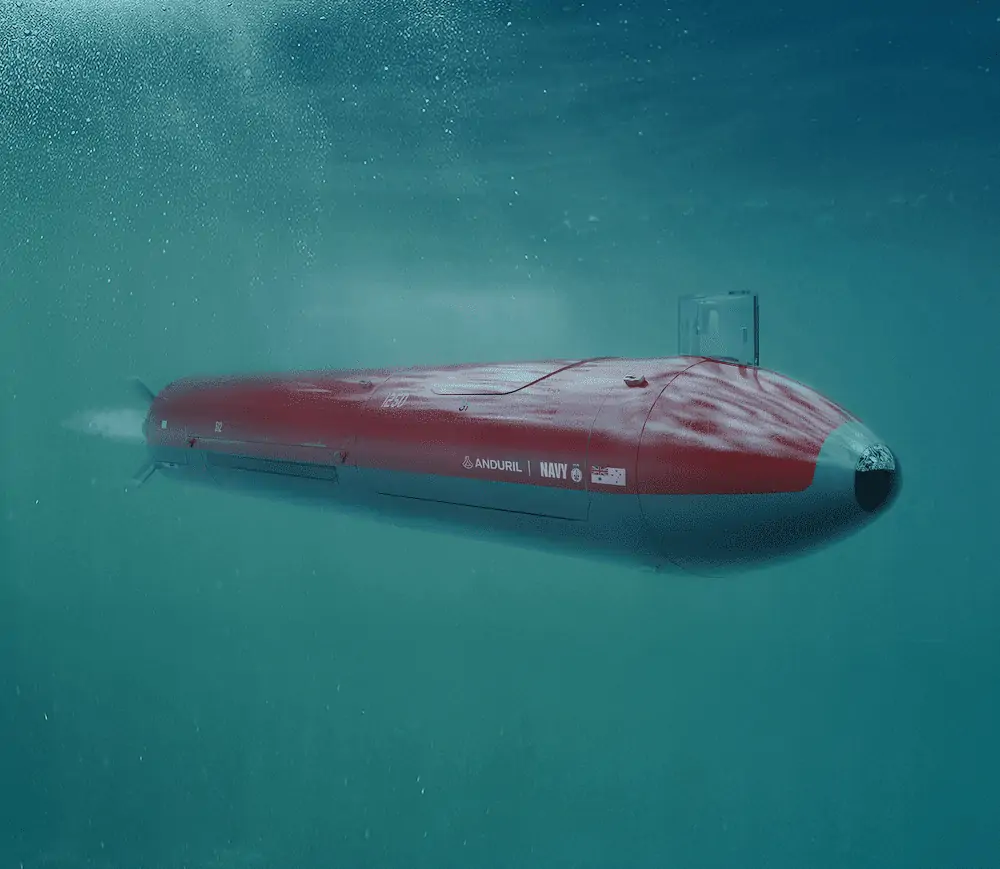
Plan C for AUKUS Submarine Project: Buy Just Three Submarines Armed with Drones

On 4 Mar 2023 the Australian government announced a plan to acquire three US Virginia class nuclear-powered submarines from 2030, with modified UK Astute "AUKUS" class submarines built in Australia from 2040. If there are delays with the AUKUS class, Australia has the option to purchase another two Virginia class submarines from the USA. However, I suggest the Australian government have a third option ("Plan C"): accelerate the development of drones, to arm the submarines and operate alongside them. If the drones prove successful, Australia could stop acquisition at three Virginia class, not purchase any more crewed submarines, and not build any. 

The largest of the drones would be ocean going robot submarines, capable of conducting surveillance, launching weapons, and perhaps even carrying small raiding parties. The robot submarines would be small enough to be transported by cargo aircraft, and could be maintained from, and carried on Australian made high speed transport ships. 

The smaller drones would be the size of mini, lightweight, and full size torpedos. Some drones would operate as smart mines, then attack as torpedos. Others would provide aerial surveillance, and attack. These drones could be launched from submarines, ships, and aircraft.

Monday, June 06, 2022

Turkish Drones for Australian Aircraft Carriers?

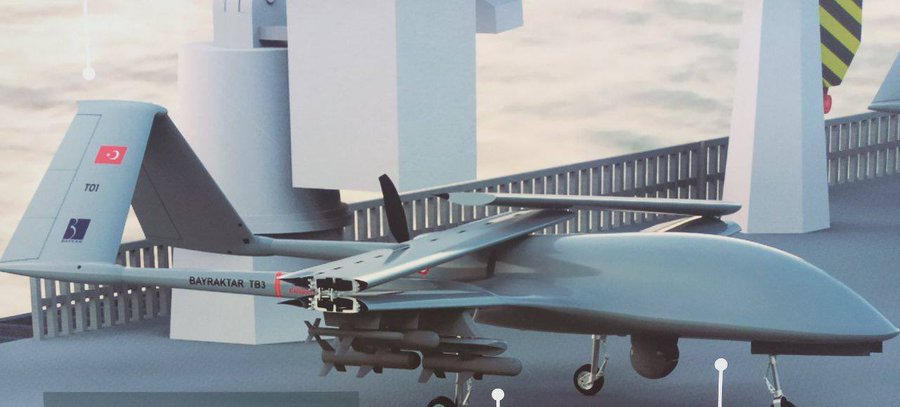
Baykar Bayraktar TB3,
photo from Ali Özkök
The Chinese Navy's southern fleet have released a video showing the aircraft carrier Shandong, with seven drones on the flight deck (Drones deployed on aircraft carrier Shandong,  Liu Xuanzun, Global Times, Jun 05, 2022 09:36 PM). These are relatively small UAVs. However, I suggest Australia could acquire much larger armed drones for shipboard use. These could be the Baykar Bayraktar TB3, which is a shipboard version of the TB2 which has been operating successfully in Ukraine. The TB3 was modified to operate from the Turkish  amphibious assault ship, TCG Anadolu, which is to the same design as Australia's HMAS Canberra and Adelaide. 

photo by Selçuk Bayraktar

Turkey is also developing the jet powered supersonic stealth Baykar Bayraktar Kızılelma UAV. Turkey was forced to adapt UAVs for  shipboard use, after the USA decided not to supply F-35B aircraft. Australia is hosting the development of the Boeing MQ-28 Ghost Bat (aka Loyal Wing-man). The MQ-28 is a similar size and configuration to the Kızılelma, and it may be possible to adapt the MQ-28 for operation from Australian ships.

Friday, May 27, 2022

Optionally Crewed Submarines for the Australian Navy?

In the 2022 Australian election campaign, the Australian Liberal Party has proposed an "Autonomous undersea warfare capability for Australia's navy" as part of its electoral platform (5 May 2022). The Liberal Party lost the election, but there is merit in the new government implementing this idea. Rather than a purely autonomous craft, I suggest optionally crewed submarines, with the ability to carry about seven people (three crew and four special forces passengers). Australia could acquire a dozen such submarines and two submarine tenders to support them, for the cost of one Collins size boat. This would also ease staffing, as the submarines would require far fewer crew.

The proposed submarines would be eXtra Large Autonomous Underwater Uninhabited Vehicles (XLAUVs), designed to operate in Australia's large maritime region. These could be developed using an engineering approach similar to that of the SpaceX Dragon spacecraft. SpaceX took the approach of first proving an uncrewed cargo version of their spacecraft, before adding manual controls and seats. With a submarine this would allow for more rapid development and operational use.

Such a small craft could be used for the same primary roles as a full size submarine:  surveillance, deployment of mines, and delivery of special forces. They would not be carry large conventional torpedoes, for a direct attack. However, they could deploy self-propelled smart mines in this role, with the submarine leaving the vicinity before the attack, to increase its chances of survival.

Cosmos-class submarine, 
Pakistan Navy, 
CC BY-SA 4.0, 2018 
Mini-subs, such as the Cosmos-class submarine, are about 110 tons, with a complement of 14, allowing for 6 crew, and 8 special forces passengers. XLAUVs under development are about half this size. They would be able to be operated with a smaller crew, as the autonomous systems would require less manual supervision.

XLAUVs and mini-submarines have a shorter range than conventional and nuclear submarines. The range can be extended by the use of submarine tenders, to refuel, rearm, and exchange crews, closer to the area of operation. The tenders would be able to be designed and made in Australia, derived from Australian stealthy warship and fast military transport ship designs developed for the US military. 


Saturday, May 07, 2022

HMAS Assault


Greetings from the Port Stephens Community Arts Center, at Nelson Bay, New South Wales, Australia. The meeting rooms of the center are named after Australian warships, with the shield of each ship. It turns out that during WWII this was the sick bay for HMAS Assault, a training center for amphibious warfare. A "stone frigate" in navy jargon, the building is actually made of wood, as many hastily constructed military building were, but is in remarkably good condition. The art of amphibious assault was revived by the ADF a few decades ago,  with the acquisition of specialized ships.

Sunday, May 31, 2015

Opportunity for Australian Defence Industry in Turkish Landing Ship Project

Spanish warship Juan Carlos L-61 visiting Istanbul.
Turkish company Sedef  have been selected to build a amphibious assault ship for the Turkish Navy in Istanbul. The ship will be based on Navantia's design of the  Juan Carlos I for the Spanish Navy.

The HMAS Canberra recently commissioned by the Australian Navy  is based on the same design (referred to by the RAN as "landing helicopter dock ships"). The superstructures for Canberra and sister ship Adelaide (now under construction) were built in Australia and there may be scope for Australian industry to assist with the Turkish build.
Cutaway Diagram of HMAS Canberra LHD Ship

Tuesday, April 21, 2015

Propose Australian Defence Force Adopt Common Uniform

This is to suggest that the Australian Air-force and Navy adopt the same Australian Multicam Camouflage Uniform (AMCU) as the Australian Army. The RAAF's recently introduced blue General Purpose Uniform (GPU) should be discontinued as it makes personnel very visible.

Tom Worthington in Disruptive Pattern Camouflage UniformAustralian air-force personnel previously wore the same Disruptive Pattern Camouflage Uniform (DPCU) as the Australian army (the photo shows me wearing the DPCU at a military exercise).


The Royal Australian Navy personnel wear a gray version of the DPCU. There was some logic to the Navy wearing a gray version of the distinctive Australian DPCU, as it showed them to be Australian personnel (the gray background is to hide grime from shipboard duties).

The new RAAF GPU is a blue version of the  Australian Multicam. The RAAF claim this is a "provides a unique and easily identifiable Air Force presence ... still effective in meeting service requirements ... non-warlike environments...". However, the Multicam pattern is worn my many nation's military and similar patterns by potential foes. When rendered in blue the pattern does not look distinctly Australian. The blue color provides no value as camouflage and would make RAAF personnel very obvious targets.

Australian Army, RAAF and RAN personnel are increasingly operating in a joint environment and one where the distinction between peace and war-fighting are blurred. It makes little sense for the joint logistics system to have to carry three uniforms, identical except for color, two of which are unsuitable for use in an operational environment.

The idea that RAAF personnel would wear a uniform not suitable for combat on a peacekeeping operation does not accord with modern practice. A militia force is not going to send advance warning of hostile intent and then politely wait while the RAAF personnel change out of their blue uniforms into camouflage, before attacking. Instead RAAF personnel will be targeted first, as they will be most visible.

A better alternative would be for the Australian Army, Navy and Air Force to wear the same camouflage uniform, with service specific head-wear and patches. The uniforms should also have removable high visibility markings. All services will require high visibility patches on their clothing for some duties, for example on the flight deck of an amphibious ship.

Friday, June 28, 2013

What Should We Do About China?

Greetings from the Australian National University in Canberra, where Admiral Dennis C. Blair (USN Retired) is speaking on "What should we do about China?".  Admiral Blair started by saying he would later speak about the "young man"  Edward Snowden (who allegedly leaked intelligence from the NSA). However, he then returned to the advertised topic, saying that "China is so large and diverse you can find evidence to support any assertion about it". The task, he suggested, was to find what was most significant. He characterized China's leadership as driven by domestic issues and what is in China's interest, not some rigid ideology. However issues such as the sovereignty of Taiwan remain. Admiral Blair asserted that countries in the region need to be thing about what to do about the Taiwan issue.

Admiral Blair said that China's ambitions would expand as its economic and military power increases. He asserted that China's ballistic missiles were intended to intimidate nations which might wish to intervene over Taiwan. He further said that China's aircraft carriers were more for show than military use. This seemed to me to be a bit glib. China's first aircraft carrier (Shi Lang), is clearly a learning exercise. With its spacecraft, China has shown it can adapt and improve on existing technology obtained from other countries. China now has a operational spacecraft, the Shenzhou, while the USA has none.

Admiral Blair was the co-chair of the Commission on the theft of American intellectual property, which reported in May 2013 for the National Bureau of Asian Research.

At question  time one of the audience took the Admiral Blair to task about the USA's condescending attitude to China. He conceded in reply that there tended to be a "dialogue of the deaf" with both countries tending to state positions, rather than having a genuine dialogue.

In answer to another question Admiral Blair suggested that international treaties to limit weapons in space and cyber-warfare were possible. I suspect that the prospects for cyber-warfare controls are limited.

In the last few months ANU has hosted a series of talks by Australian and US strategic experts about regional issues including the South China Sea. It would be interesting to hear the views of their Chinese counterparts and others in Asia.

ps: The ANU Strategic & Defence Studies Centre has a Centre of Gravity Series of papers.
Wednesday, April 17, 2013

US, Australian UK Naval Interoperability for the Next War

Greetings from the Australian National University in Canberra, where Steven Paget is speaking on "The Special Relationship at Sea: Naval Gunfire Support Interoperability during the Korean, Vietnam and Iraq Warsnot only to the nations navies require compatibility with each other, but with other forces of their own and each other countries. Not all ships in warfare are operated by the navy. There are ships operated by coastguards, the army, reserves, the army and civilian contractors. In previous times these ships were not considered combatants and were assumed to be kept safely in the rear. But just as a front line is less clear in modern land warfare it will be less clear in future naval warfare. Also navies will need to cooperate with forces they do not entirely trust. In the case of Australia,  the RAAF are purchasing US aircraft with minimal customization, providing good interoperability. However, the RAN is purchasing Spanish ships with a mix of European and US weapons systems, which will make interoperability more complex. Also the two new RAN two Canberra Class Landing Helicopter Dock ships (LHDs) will create complex issues. These ships are purpose designed for amphibious assault in the littoral zone, transporting, supporting the Australian Army and acting as the flag ships for support vessels. 

One of hallmarks of modern naval operations – from the 1991 Gulf War to ongoing anti-piracy operations in the Gulf of Aden – is the formation of multi-national task forces to pursue common interests. In particular, the navies of Australia, the United States and the United Kingdom have a long history of operating together which continues to this day. This trend is set to continue given the reduction in fleet sizes worldwide, which may see allied nations seeking to build complimentary force elements that can produce combined capabilities.
In this public lecture, Steven Paget will explore the cooperation between the Royal Australian Navy, the United States Navy and the Royal Navy in the provision of naval gunfire support to operations ashore in the conflicts in Korea, Vietnam and Iraq. These historical case studies will open a window on the broader issue of interoperability between the three navies and assess the effectiveness of their efforts to work together, and what lessons can be learned for future operations.
Steven Paget is a graduate of St Andrews University and a doctoral student in the Strategic and Defence Studies Centre at ANU. In 2012 he was awarded the Royal United Services Institute of Australia’s Leo Mahony Scholarship to support the research on which this lecture is based.

Wednesday, April 10, 2013

Australian and US Naval Gunfire Off Korea

Steven Paget, will speak on "The Special Relationship at Sea: Naval Gunfire Support Interoperability during the Korean, Vietnam and Iraq Wars
One of hallmarks of modern naval operations – from the 1991 Gulf War to ongoing anti-piracy operations in the Gulf of Aden – is the formation of multi-national task forces to pursue common interests. In particular, the navies of Australia, the United States and the United Kingdom have a long history of operating together which continues to this day. This trend is set to continue given the reduction in fleet sizes worldwide, which may see allied nations seeking to build complimentary force elements that can produce combined capabilities.
In this public lecture, Steven Paget will explore the cooperation between the Royal Australian Navy, the United States Navy and the Royal Navy in the provision of naval gunfire support to operations ashore in the conflicts in Korea, Vietnam and Iraq. These historical case studies will open a window on the broader issue of interoperability between the three navies and assess the effectiveness of their efforts to work together, and what lessons can be learned for future operations.

Steven Paget is a graduate of St Andrews University and a doctoral student in the Strategic and Defence Studies Centre at ANU. In 2012 he was awarded the Royal United Services Institute of Australia’s Leo Mahony Scholarship to support the research on which this lecture is based.

Thursday, December 20, 2012

Australian Army Planning for Marine Operations

The Australian Army is restructuring to have three "manoeuvre brigades" which can operate with the Navy for amphibious operations under "Plan Beersheba" (with details in Army News). This will require the Army to relearn old skills. With the delivery of two Canberra class Landing Helicopter Dock (LHD) ships and Hobart class air warfare destroyers, Australia will have the nucleus for amphibious operations. However, Australia will not have fixed wing aircraft to operate a US style carrier strike group.

Friday, August 03, 2012

Spanish Supply Ship Borrowed by Australian Navy

Spanish Navy Combat Supply Ship CantabriaThe Spanish Navy's Combat Supply Ship Cantabria will operate from Australia, February to November 2013. There are five ships designed by the Spanish company Navantia, to be delivered to the the Royal Australian Navy in the next few years: two Canberra class Landing Helicopter Dock Ships and three Hobart class destroyers. This makes the deployment of Cantabria, which was also designed and built by Navantia, a useful exercise for the RAN to get used to Spanish ships.

The RAN will also need new submarines to replace six Collins Class boats. Assuming the Navantia vessels under construction work well, a low risk option would be to buy submarines from the same company. S-80 Class Submarines, are now under construction by Navantia, for the Spanish Navy. This may not be the most advanced submarine available and has a shorter range than ideal for Australia, but would be affordable and have a reasonable chance of operating reliably. The first few boats could be built in Spain and later ones in Australia.