 |
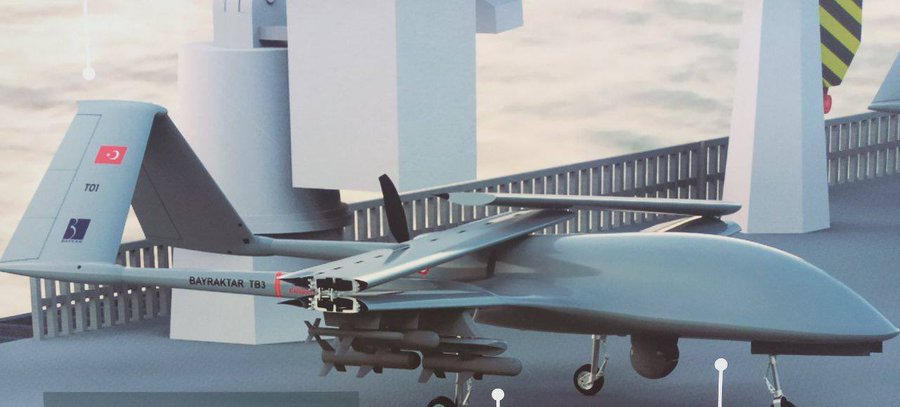
| Baykar Bayraktar TB3, photo from Ali Özkök |
 | |
photo by Selçuk Bayraktar |
|
| Baykar Bayraktar TB3, photo from Ali Özkök |
| |
photo by Selçuk Bayraktar |

While an interesting academic argument, I am not sure that the wording of the ANZUS treaty would have much to do with what Australia would do. The only time the treaty has been invoked was by Australia on 14 September 2001, after terrorist attacks on New York and Washington. This was an attack by a non state actor, based outside the Pacific, on the US Atlantic seaboard. If Australia would act similarly over Taiwan would perhaps depend more on the likely reaction of Australian popular opinion, than the wording of the treaty.
On 24 April Australian PM, Scott Morrison said a Chinese military base at the Solomon Islands would be a "red line": saying "We won't be having Chinese military naval bases in our region on our doorstep." This is a very serious statement, given the last time a regional power attempted to establish a base around the Solomon Islands was May 1942, resulting in the Battle of the Coral Sea. The USA and Australia met the Japanese Navy, with 13 ships sunk, and more than 1,500 lives lost.
The Australian Government has been investing in billions in big weapons systems. But the Ukraine conflict has demonstrated the value of small smart systems. Perhaps there could be government funding to provide an Australian stockpile of carbon fiber, & other materials needed for airborne & underwater drones.
Companies such as Carbonix could buy from the stockpile at a discounted price, to keep the stocks fresh. In time of need, the government would order military drones made using the materials.
The avionics could be made just-in-time by companies like Core Electronics, from a stockpile of components.
This way the military could have a supply of up to date drones, suited to whatever situation arises.
The same could be done for underwater drones (UUVs). Imagine the number of small robot submarines which could have been built with the
$5B Australia is paying for French non-nuclear, non-submarines. ;-)
 |
| FOR THE WARFIGHTER |
_-_1.jpg/450px-USNS_Spearhead_(JHSV-1)_-_1.jpg)


Speakers include:
ADM ret. (RAN) Chris Barrie, Adjunct Professor SDSC; ADM ret. (USN) Dennis Blair, Chairman and CEO Sasakawa Foundation; VADM (MSDF) Umio Otsuka, President JMSDF Command and Staff College; Dr. Jeffrey Hornung, Fellow Security and Foreign Affairs Program Sasakawa USA; Mr. Stanley Roth, Former US Assistant Secretary of State for East Asian and Pacific Affairs; Dr. Stephan Fruehling, Associate Professor SDSC; AMB Shingo Yamagami, Acting Director JIIA; VADM ret. (USN) Conrad C. Lautenbacher, Jr., CEO GeoOptics Inc.; Dr. Anthony Bergin, Deputy Director Australian Strategic Policy Institute; Dr. Toshio Yamagata, Director Application Laboratory of Japan Agency for Marine-Earth Science and Technology; Mr. Yoshikiyo Ono, Secretary General Japanese Shipowners’ Association; Dr. Carol Anne Clayson, Director Ocean and Climate Change Institute, Woods Hole Oceanographic Institute; Mr. Peter Jennings, Executive Director Australian Strategic Policy Institute; CAPT (MSDF) Katsuya Yamamoto, JMSDF Command and Staff College; RADM ret. (RAN) James Goldrick AO, CSC, Adjunct Professor SDSC; Dr. Isami Takeda, Professor of International Relations Dokkyo University; VADM ret. (USN) Robert Parker; Dr. Euan Graham, Director International Security Program at the Lowy Institute; ADM ret. (USN) Walter Doran, President Pacific Vision LLC; Dr. Brendan Taylor, Head of SDSC.
"New and complex non-geographic security threats in cyberspace and space will be an important part of our future security environment. The cyber threat to Australia is growing. Cyber attacks are a real and present threat to the ADF’s warfighting ability as well as to other government agencies and other sectors of Australia’s economy and critical infrastructure." (Page 17).
"2.5 Cyber attacks are a direct threat to the ADF’s warfighting ability given its reliance on information networks. State and non-state actors now have ready access to highly capable and technologically advanced tools to target others through internet-connected systems and we are seeing greater use of offensive cyber operations. This trend is likely to continue." (Page 53)
"2.51 Cyber threats also have impacts well beyond Defence, with the potential to attack other Australian government agencies, all sectors of Australia’s economy and critical infrastructure and, in the case of state actors, conduct state-based espionage including against Australian defence industry. The Australian Signals Directorate detected over 1,200 cyber security incidents in 2015, including attacks on government agencies and non-government sectors. Australian defence industry was one of the key non-government sectors targeted in that period, along with energy, banking and financial services, communications and transport. Cyber attacks also threaten Australia’s secure access to the global communications system which is critical to Australia’s prosperity." (page 54)
"3.19 To counter the growing threat of cyber attack, the Government is improving our national cyber security capabilities. Defence’s cyber security capabilities will be strengthened to protect the ADF’s warfighting and information networks. Defence will contribute to the Government’s enhanced national cyber security efforts, which include better coordinated cyber security capabilities and working with industry and academia to counter the threat of cyber attack." (Page 75)
"4.19 The Government is committed to ensuring that Australia can address the growing cyber threat including through enhanced cooperation with the United States and our other international partners. Defence makes a critical contribution to Australia’s whole-of-government cyber-security efforts, ensuring the integrity of Australian government information and systems. This includes the invaluable work of the Australian Signals Directorate. Defence will continue to work closely with other agencies to protect Australian interests in the cyber domain, including through the multi-agency Australian Cyber Security Centre.
4.20 The Government will strengthen Defence’s cyber capabilities to protect itself and other critical Australian government systems from malicious cyber intrusion and disruption. Enhancing the resilience of Defence networks, including networks used by our deployed forces, and the capability of the Australian Cyber Security Centre are key areas of focus in strengthening Australia’s cyber defences. This will include considerable new investment in strengthening the Defence cyber workforce, including new military and APS positions and training programs.
4.21 The Government will also establish a research and development capability to help strengthen the defences of the ADF’s military information systems against cyber attack." (Page 90)
"6.17 Within this total workforce of around 18,200 FTE, enhancements to intelligence, space and cyber security capabilities will involve 800 new APS positions. Four hundred new positions will be created in information technology support, simulation, support to Navy engineering and logistics, security, force design and analysis, and strategic and international policy, including civilian policy officers posted overseas." (Page 152)
Table of Contents
Minister’s Introduction 9
Executive Summary 13
Strategy 14
Australia’s strategic outlook 14
Australia’s defence strategy 17
Capability 18
A more capable, agile and potent future force 18
Australian defence industry and innovation 20
Shipbuilding 21
Defence posture – more active and internationally engaged 21
International engagement 22
Defence preparedness 22
People 23
Resources 24
Reform 24
Funding 24
Implementation 25
Chapter One: The Government’s Approach to Defence 29
The purpose of this Defence White Paper 29
Why now? 30
Managing strategic risk 32
Chapter Two: Strategic Outlook 39
Australia’s security environment 39
2016 DEFENCE WHITE PAPER4
TABLE OF CONTENTS
The United States and China 41
The rules-based global order 44
The threat of terrorism and foreign terrorist fighters 46
State fragility 48
Military modernisation 49
Cyber and space 51
Regional security environments 53
Australia’s borders and offshore territories 53
Our immediate neighbourhood 54
South East Asia 56
Indonesia 59
North Asia 60
South Asia and the Indian Ocean Rim 61
The Middle East 63
Weapons of Mass Destruction 64
Chapter Three: Australia’s Defence Strategy 67
Australia’s Strategic Defence Framework 68
Strategic Defence Interests 68
A secure, resilient Australia, with secure northern approaches and
proximate sea lines of communication 68
A secure nearer region, encompassing maritime South East Asia
and the South Pacific 69
A stable Indo-Pacific region and a rules-based global order 70
Strategic Defence Objectives 71
Deter, deny and defeat attacks on or threats to Australia and its national
interests, and northern approaches 71
5
Make effective military contributions to support the security of maritime
South East Asia and support the governments of Papua New Guinea,
Timor-Leste and of Pacific Island Countries to build and strengthen
their security 74
Contribute military capabilities to coalition operations that support
Australia’s interests in a rules-based global order 75
Implications for force structure and force posture 77
Chapter Four: The Future Australian Defence Force 83
Designing the future force 84
Capability priorities 86
Intelligence, Surveillance and Reconnaissance, Space, Electronic
Warfare, and Cyber Security 86
Maritime Operations and Anti-Submarine Warfare Forces 89
Strike and Air Combat 94
Land Combat and Amphibious Warfare 97
Key Enablers 100
Air and Sea Lift 106
Industry, innovation, research and development 108
A new approach to Australian defence industry policy 108
A new approach to defence innovation 111
Shipbuilding 113
Chapter Five: Positioning Defence for Tomorrow’s Challenges 117
International engagement 117
International defence relationships 120
The Australia-United States Alliance 121
New Zealand 124
Indonesia 125
2016 DEFENCE WHITE PAPER6
TABLE OF CONTENTS
The South Pacific 126
Timor-Leste 128
South East Asia 128
North Asia 132
South Asia 134
Global relationships 135
Defence preparedness 140
Current operations 141
Chapter Six: People 145
Growing the integrated Defence workforce 146
Permanent Australian Defence Force 146
Reserves 148
Australian Public Service 149
Recruiting the people we need 150
Developing our people 152
Retaining our people 153
Defence culture 154
Looking after our people 156
The Defence community 159
Delivering the future workforce 160
Chapter Seven: Reform of Defence 165
The First Principles Review – The Government’s reform program 165
A strong strategic centre 168
Capability development life cycle 170
Corporate and military enablers 172
Implementing the First Principles Review 174
7
Chapter Eight: Funding Defence 177
The Government’s plan for funding Defence 177
The funding model 177
How will Defence funding be spent? 181
Budgeting in Defence 182
Chapter Nine: Implementing this Defence White Paper 185

 Australian air-force personnel previously wore the same Disruptive Pattern Camouflage Uniform (DPCU) as the Australian army (the photo shows me wearing the DPCU at a military exercise).
 The Royal Australian Navy personnel wear a gray version of the DPCU. There was some logic to the Navy wearing a gray version of the distinctive Australian DPCU, as it showed them to be Australian personnel (the gray background is to hide grime from shipboard duties).
 Greetings from the Australian National University in Canberra, where Robert Ayson and Desmond Ball are speaking on the alarming topic of "Escalation in the East China Sea: A Political and Military Possibility". Their thesis is that a dispute between China and
Japan in the East China Sea could result in a way which draws in the USA. A lack of crisis management and China’s command and control system's vulnerability could result in their use of nuclear weapons. Professor Ball stated that the USA had plans for "limited" use of nuclear weapons against China, including in a conventional war between China and Japan. Attacks on US undersea surveillance systems around China, some of which are collocated with Japanese facilities may also provoke a nuclear response on Chinese mainland bases. Knowing this China would then be tempted to make a preemptive nuclear strike. One area for concern is that the PLAN (Cihinese Navy) may become overconfident in its abilities.
Greetings from the Australian National University in Canberra, where Robert Ayson and Desmond Ball are speaking on the alarming topic of "Escalation in the East China Sea: A Political and Military Possibility". Their thesis is that a dispute between China and
Japan in the East China Sea could result in a way which draws in the USA. A lack of crisis management and China’s command and control system's vulnerability could result in their use of nuclear weapons. Professor Ball stated that the USA had plans for "limited" use of nuclear weapons against China, including in a conventional war between China and Japan. Attacks on US undersea surveillance systems around China, some of which are collocated with Japanese facilities may also provoke a nuclear response on Chinese mainland bases. Knowing this China would then be tempted to make a preemptive nuclear strike. One area for concern is that the PLAN (Cihinese Navy) may become overconfident in its abilities. Australian planners should assume that China and Japan may not be able to continue avoiding minor hostilities over their conflicting East China Sea claims.
Australian planners should also assume that initial hostilities between Japan and China could easily escalate into a much more serious conflict, potentially involving the United States and possibly crossing the nuclear threshold.
Australian policymakers and decision-makers should encourage their Chinese and Japanese counterparts to treat the Sino-Japanese relationship as an adverse partnership involving common as well as competing interests.
Robert Ayson and Desmond Ball will speak on "Escalation in the East China Sea: A Political and Military Possibility" at the Australian National University in Canberra, 5:30pm, 11 November 2014.
Event Details
Presented by the Strategic & Defence Studies Centre
Even if the leaders of China and Japan can lessen the significant political tensions between North Asia’s two biggest powers, the East China Sea dispute could still spark a bilateral war which might also bring in the United States. A recent spate of near misses shows that a minor armed clash is eminently possible. Nationalist sentiment and the lack of crisis management mechanisms could make restraint difficult once this occurs. Japan’s reluctance to use force may be less extensive than some assume and its connections to US strategy and C4SIR systems increase the prospects of early American participation. China’s command and control vulnerabilities could create serious pre-emption pressures if Beijing thought a larger conflict was possible. Moreover American attacks on China’s C4SIR systems and its conventional maritime and missile forces might create perverse incentives for China to use its nuclear weapons early while it was still confident in its physical ability to do so.
Australian defence planners should not assume that China and Japan are going to be able to keep their tense relationship in the East China Sea below the threshold of armed violence. Neither should they assume that China, Japan, and the United States will find it easy to avoid a very serious escalation once minor hostilities have occurred. This seminar presentation marks the launch of a new SDSC Centre of Gravity paper by Robert Ayson and Desmond Ball entitled "Escalation in North Asia: A Strategic Challenge for Australia", based on their forthcoming Survival article "Can a Sino-Japanese War Be Controlled?".
 Senator David Johnston, Minister for Defence, will launch the book "Australia's Defence: Towards a New Era?
 " by Peter Dean, Brendan Taylor and Stephan Frühling, at the Australian National University in Canberra, 2 October 2014. It will be interesting to see if the book deals with Cyber Warfare.

Armed conflicts are currently occurring in various regions of the world and the need to protect innocent victims of these conflicts has never been greater. Women are particularly vulnerable in times of conflict and the recent Global Summit to End Sexual Violence in Conflict, co-chaired by William Hague (United Kingdom Foreign Secretary) and Angelina Jolie (Special Envoy for the UN High Commissioner for Refugees) brought together 1,700 delegates and 129 country delegations to consider ways in which women could be better protected. The Summit agreed on practical steps to tackle impunity for the use of rape as a weapon of war, and to begin to change global attitudes to these crimes.

Book Launch of Defence Planning and Uncertainty: Preparing for the next Asia-Pacific War, by Dr Stephan Frühling
Launched by: Mr Dennis Richardson, AO Secretary of DefenceDescriptionHow can countries decide what kind of military forces they need, if threats are uncertain and history is full of strategic surprises? This is a question that is more pertinent than ever, as countries across the Asia-Pacific are faced with the military and economic rise of China. Uncertainty is inherent in defence planning, but different types of uncertainty mean that countries need to approach decisions about military force structure in different ways. This book examines four different basic frameworks for defence planning, and demonstrates how states can make decisions coherently about the structure and posture of their defence forces despite strategic uncertainty. It draws on case studies from the United States, Australian and New Zealand, each of which developed key concepts for their particular circumstances and risk perception in Asia. Success as well as failure in developing coherent defence planning frameworks holds lessons for the United States and other countries as they consider how best to structure their military forces for the uncertain challenges of the future. ‘Stephan Frühling has written by far the most insightful book to appear for many years on the ubiquitous and eternal challenges of defence planning …Frühling provides an exceptionally rigorous yet clear guide to the ways in which we can strive to conduct prudent defence planning despite our uncertainty: his is a landmark work that deserves a readership in many countries.’ – Colin Gray, Professor of Politics and International Relations, Reading University, UK.
Stephan Frühling is Senior Lecturer in the Strategic and Defence Studies Centre, Australian National University, Australia. He is a member of the Government’s external panel of experts to assist with the preparation of the 2015 defence white paper.
Please join us for drinks and canapes after the launch.
Reviews:
‘Stephan Frühling's book examines the challenges of defense planning through an enlightening and insightful series of case studies. It provides scholars and policy-makers alike a rigorous and rich understanding of an important and under-examined field.’ – Thomas G. Mahnken, US Naval War College
‘Stephan Frühling has written by far the most insightful book to appear for many years on the ubiquitous and eternal challenges of defence planning. Few subjects as critically important as this have attracted so little disciplined and persuasive scholarly effort. Fruhling explains that defence planning is about the attempted management of risk in an unavoidably uncertain future, and that the risk management process is essentially always political. No matter how advanced the methods employed to try and reduce uncertainty, the inconvenient fact remains that because the future has yet to happen, thoroughly reliable knowledge about its dangers is unknowable now. Defence planning always is conducted in the context of an incurable ignorance about a future that has not occurred. Fruhling provides an exceptionally rigorous yet clear guide to the ways in which we can strive to conduct prudent defence planning despite our uncertainty: his is a landmark work that deserves a readership in many countries.’ – Colin Gray, Professor of Politics and International Relations at Reading University, UK
‘Stephan Frühling has provided a thoughtful and thought-provoking work on defense planning at a time when the Pentagon needs it most. With the United States planning a major reorientation of its defense posture toward Asia following over a decade of war in Iraq and Afghanistan, Pentagon planners are once again brushing up on strategy. They would do well to include Stephan Frühling's Defense Planning and Uncertainty among their readings.’ – Andrew Krepinevich, President of the Center for Strategic and Budgetary Assessments (CSBA), USA
