Showing posts with label Turkey. Show all posts

Thursday, November 20, 2025

Despatch Australian Made World's Largest Battery Ship to Türkiye as Climate Talks Venue

This is to suggest the Australian Government borrow Hull 096 from Tasmanian shipbuilder Incat and send it to Türkiye as a venue for climate change negotiations. The world’s largest battery powered ship, which can carry 2,100 passengers is being completed for service in South America. The vessel could be temporarily renamed "Australia". This would send a message to the world that Australia is serious about renewable energy. 

There is a precedent for the use of an Incat high speed ferry as a venus at an international event. During the Sydney Olympics, Austrade organised Business Club Australia, aboard an Incat ferry at Sydney's Darling Harbour. I was a guest onboard and spoke to Robert Clifford AO, Chairman of Incat on the bridge. 


Monday, June 06, 2022

Turkish Drones for Australian Aircraft Carriers?

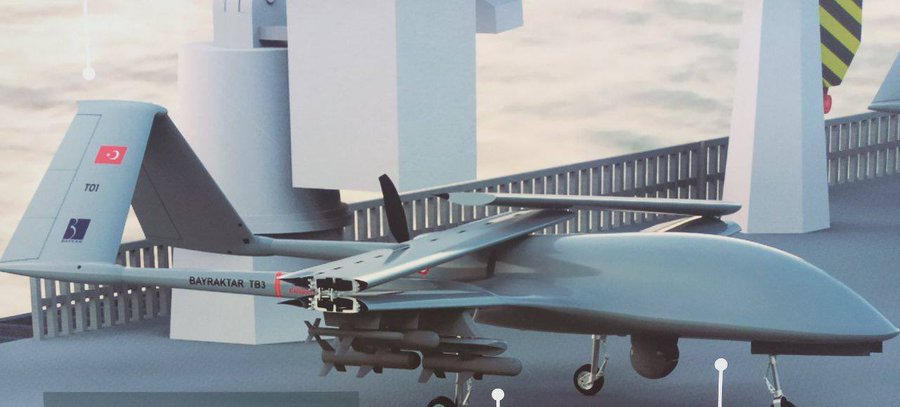
Baykar Bayraktar TB3,
photo from Ali Özkök
The Chinese Navy's southern fleet have released a video showing the aircraft carrier Shandong, with seven drones on the flight deck (Drones deployed on aircraft carrier Shandong,  Liu Xuanzun, Global Times, Jun 05, 2022 09:36 PM). These are relatively small UAVs. However, I suggest Australia could acquire much larger armed drones for shipboard use. These could be the Baykar Bayraktar TB3, which is a shipboard version of the TB2 which has been operating successfully in Ukraine. The TB3 was modified to operate from the Turkish  amphibious assault ship, TCG Anadolu, which is to the same design as Australia's HMAS Canberra and Adelaide. 

photo by Selçuk Bayraktar

Turkey is also developing the jet powered supersonic stealth Baykar Bayraktar Kızılelma UAV. Turkey was forced to adapt UAVs for  shipboard use, after the USA decided not to supply F-35B aircraft. Australia is hosting the development of the Boeing MQ-28 Ghost Bat (aka Loyal Wing-man). The MQ-28 is a similar size and configuration to the Kızılelma, and it may be possible to adapt the MQ-28 for operation from Australian ships.

Sunday, May 31, 2015

Opportunity for Australian Defence Industry in Turkish Landing Ship Project

Spanish warship Juan Carlos L-61 visiting Istanbul.
Turkish company Sedef  have been selected to build a amphibious assault ship for the Turkish Navy in Istanbul. The ship will be based on Navantia's design of the  Juan Carlos I for the Spanish Navy.

The HMAS Canberra recently commissioned by the Australian Navy  is based on the same design (referred to by the RAN as "landing helicopter dock ships"). The superstructures for Canberra and sister ship Adelaide (now under construction) were built in Australia and there may be scope for Australian industry to assist with the Turkish build.
Cutaway Diagram of HMAS Canberra LHD Ship

Monday, March 18, 2013

Ships, submarines and aircraft: Naval and aerial aspects of the Gallipoli War

Greetings from the Australian National University in Canberra, where Professor Serhat Güvenç, Kadir Has University, Istanbul is speaking on "Ships, submarines and aircraft: Naval and aerial aspects of the Gallipoli War". Professor Güvenç discussed the arms race with Dreadnought battleships before World War Two. In 1911 Dodecanese Islands were lost by the Ottoman Empire. In 1913 the Ottomans outbid Greece and Russia to purchase a British dreadnought, the Sultan Osman-i Evvel, but the ship and another was retained by the UK. The German battlecrusers SMS Goeben and Moltke escaped the British Mediterranean fleet to Ottoman territory and were  transfered to Ottoman control. Professor Güvenç argued that these circumstances effectively decided the Ottaman's would side with Germany, against the UK.

Heavy artillery from the German armoured cruiser Roon, 1915 mounted onshore at Gallipoli
Only obsolete ships were used for the UK's Gallipoli Campaign as the Ottamans were seen as not having a significant military force. The available Ottaman ships were required to counter the Russian threat. Instead Gallipoli was defended with shore mounted obsolete naval guns and sea mines. Guns and mines were carefully positioned in anticipation of the likely lines of approach for UK ships. The UK forces used Greek  (notionally neutral) islands. Professor Güvenç argued that the Minelayer Nusrat while a small ship was very significant to the Gallipoli War. One aircraft available to the Turks, was also significant in providing advice on the status of the mines. Australian submarine AE-2 penetrated to the Sea of Marinaras, which was a morale boost for UK forces, but not militarily significant. German submarine U-21 was more effective in forcing K ships from the Gallipoli area. UK submarine E-11 in the Marmara Sea severely disrupted Turkish shipping (and attacked a train with gunfire).

Professor Güvenç argued the Turks won the Gallipoli War because they had better military leadership, but also were well prepared. The Ottoman Empire in effect won their war with Russia, but ultimately lost with the allied victory in WWI. From another perspective the modern Turkish state arose partly from Mustafa Kemal Atatürk's rise to prominence in the Gallipoli War.

Canberra Class Landing Helicopter Dock ships
Professor Güvenç's analysis of the Gallipoli is significant not only historically but for the world today. One lesson is that major warships are at a disadvantage in the littoral zone close to shore. Ships are vulnerable to relatively unsophisticated sea mines, land based aircraft and gunfire. Large ships are also vulnerable on approach to shore from submarine attack. There are significant issues for Australia, which has ordered two Canberra Class Landing Helicopter Dock ships (LHDs). These ships are purpose designed for amphibious assault in the littoral zone as flagship of an Expeditionary Strike Group (ESG). But the LHDs are very vulnerable and must be protected by mine-clearing, anti-submarine and anti-aircraft defenses. This will require a significant investment by Australia, not only in ships, but in specialized highly trained personnel. Australia is building Hobart-class Air Warfare Destroyers and upgrading Anzac-class frigates, to provide air defense, but does not have sufficient mine or submarine countermeasures.
The Gallipoli Peninsula stands as one of the earliest theatres of joint military operations in the modern era. At Gallipoli, both the Allies and the Ottomans employed their naval, land and air power assets in pursuit of a decisive victory. The campaign, which opened with a naval assault to force a quick capitulation of the Ottoman Empire, turned into a massive land campaign as a result of the allied amphibious landing. However, the naval assault failed, and degenerated into a war of attrition waged increasingly by submarines and aircraft to the end of World War I.
This presentation has three objectives. The first is to provide an overall assessment of the factors that contributed to the Ottoman decision to go to war. The second is to discuss the reasons how and why the submarine and aircraft, as new and largely untested weapons, gradually succeeded the battleship, as principal means of warfare upon which both sides continued to rely until the end of the conflict. The third objective is to discuss the legacy of the Gallipoli Wars in shaping the contours of the subsequent Turkish War of Liberation and the Republic of Turkey.
Dr Serhat Güvenç is an Associate Professor of International Relations at Kadir Has University, Istanbul.  He has a BA in International Relations and an MA in European Studies from Marmara University, Istanbul and a PhD in Political Science and International Relations from Bosphorus University. He has worked at Koç University, Istanbul Bilgi University and the University of Chicago as a Visiting Assistant Professor of History in 2006.
Dr Güvenç’s research interests include Turkish defence policy and modern Turkish military/naval history. He is the author of Ottomans’ Quest for Dreadnoughts on the eve of the First World War, Istanbul: Is Kultur Yayinlari, 2009, and Turkey in the Mediterranean during the Interwar Era: The Paradox of Middle Power Diplomacy and Minor Power Naval Policy, Indiana: Indiana University Turkish Studies, 2010 (co-authored with Dilek Barlas). He has published in the Middle Eastern Studies, International Journal of Naval History, Uluslararasi Iliskiler (Turkish Journal of International Relations), Exotierika Themata (in Greek) and the Journal of Strategic Studies. He guest-edited a special issue of Uluslararasi Iliskiler on the 60 Years of Turkey’s NATO Membership.

Tuesday, April 03, 2012

Digital-Political Fantasies in Istanbul

Itır AkdoğanItır Akdoğan's work "Digital-Political Fantasies in Istanbul:
An analysis of the perceived role of ICT in changing institutional politics, activism, and identity
" is available in full on-line. This looks at how political activists, and others, view the role of information and communication technologies (ICT) in modern Turkey. This 205 page PHD thesis is remarkable for being very readable (1.6 Mbytes of PDF).

I encountered the politics of ICT in Turkey first hand, in 2008, when I presented a seminar to the Kandilli Observatory and Earthquake Research Institute, Boğaziçi University, Istanbul on Internet based systems for emergency warning. While using ICT for earthquake warning may seem a technical topic, it is steeped in social and political issues.
Digital-Political Fantasies in Istanbul:
An analysis of the perceived role of ICT in changing institutional politics, activism, and identity


Akdogan, Itir
University of Helsinki, Faculty of Social Sciences, Department of Social Studies, Media and Communication Studies

This research analyses how different groups of people perceive the role of new information and communication technologies (ICT) in social change, and how they make sense out of these claimed changes in society.

There are claims for social change in many areas. This research frames its analysis in three areas of social change namely the local-global relation; politics and the political, and ICT. The study first looks at the theoretical discussions on how different perspectives conceptualize social change in these areas. The theoretical framework then looks at the three dimensions that emerge from the interaction of these three areas; institutional politics, activism, and identity.

There are different frameworks for making sense of social change. Lacanian fantasy is one that allows deeper analysis of perceptions and fluidity between the various perceptions. As all fantasies are frustrated, the concept also allows a critical analysis. The theoretical framework finally also looks at what fantasies the theoretical discussions create, regarding social change in the above three areas and dimensions.

At the empirical level, the research focuses on the perceptions of the role of ICT in the changing institutional politics, activism, and identity in Istanbul from the local-global relation, politics and the political, and ICT perspectives. The research then discusses what fantasies come out of these perceptions.

The research uses the grounded theory methodology. This is a methodology that allows researchers to discover new concepts that are not initially included in the theoretical framework so that they can extend and develop their theoretical frameworks. Once researchers find a new concept, they first need to theorize it by going back to the theoretical level, and analyse the empirical data deeper after that theorization. Fantasy is the new concept that was grounded in the empirical data of this research. That is how the concept was first theorized and used for the deeper analysis of the empirical data. The study collected the empirical data from 57 in-depth interviews with institutional politicians, activists, and ordinary citizens that each primarily fed one dimension of the study. The research also used secondary data for the chapter of the contextual background on Istanbul and Turkey.

The results of the analysis suggest that all three groups in Istanbul create fantasies in their perception of the role of ICT in social change. The research concludes that institutional politicians, activists, and ordinary citizens all create fantasies of political power, technological power, and harmony. The research also concludes that among the different groups there are variations and contradictions in the fantasies that all are frustrated by several local challenges, especially the political culture.

URN:ISBN:978-952-10-7883-5
http://hdl.handle.net/10138/30110
Date: 2012-03-24

Friday, August 05, 2011

Turkey in the Modern World

The Cambridge History of Turkey: Volume 4, Turkey in the Modern Word covers the period from the nineteenth century to the resent day. This includes the turbulent period of the collapse of the Ottoman empire, the Young Turks, the Turkish Republic and militarily coups, the Kurdish and Islam issues. There is some repetition as authors on different topics cover the same period. I found the chaopted on the struggle for independence, art and novels and Istanbul of most interest. One point I would disagree with is Sibel Bozdoğan's description of the Kocatepe Mosque as being postmodern because it has a supermarket in the complex. Having a bazaar associated with a mosque was not unusual in ancient times to help pay for the upkeep of the building and the supermarket is essentially just a modern equivalent.

Sunday, May 17, 2009

Melbourne Thessaloniki sister cities

Melbourne Thessaloniki sister cities stele in Lonsdale Street, Melbourne, AustraliaTaking a break from the State Library of Victoria , I went around the corner to Lonsdale Street for a coffee and baklava. On the footpath at the corner with Heffernan Lane I found a marble stele (pillar) engraved with a relief of Saint Demetrius on the other with Alexander the Great, and the words "Melbourne - Thessaloniki sister cities. From the Prefecture of Thessaloniki during the Psomiadis Administration". This affiliation happened in 1984. but the monument was only unveiled 11 November 2008.

Demetrius and Alexander are two of Thessalonik's best known residents; another beingAtatürk Museum, 24 Apostolou Pavlou St., Thessaloniki, next to the Turkish Consulate. Birthplace of Mustafa Kemal Atatürk Mustafa Kemal Atatürk. I went to the church dedicated to Demetriusis a few blocks away, the birthplace of Atatürk (now in the grounds of the Turkish Embassy) when on a visit to Thessalonik. It is a curious echo to see a reminder in Melbourne.

Sunday, March 22, 2009

Science in Islam Hapmered by Poor PR

The Collins Class Submarine StoryScience and Islam: A History by Ehsan Masood (Icon Books Ltd , 2009) gets a good review in New Scientist ("Time to acknowledge science's debt to Islam?, Jo Marchant 25 February 2009). Both the book and the reviewer look for explanations for science not being as prominent in the Islamic world. However, I doubt this is a real phenomenon and may be just bad marketing on the part of science. As an example I visited the Museum of Technology and Islam the day after it opened in Istanbul. By now I assumed I would easily find details of the museum and its fascinating exhibits on the web. But the museum seems to be hard to find and Masood's book has no mention of the Museum.

Saturday, March 21, 2009

Turkish undersea railway earthquake warning system

According to International Railway Gazette, the control centre for the new Marmaray rail tunnel linking the European and Asian part of Istanbul will receive earthquake information from the Kandilli Early Warning System. The railway runs under the Bosphorus in a very earthquake prone region. The trains will be automatically stopped by the control centre when an earthquake warning is received. The tunnel is equipped with flexible joints and flood gates to protect against earthquakes. Last year I visited the Kandilli Observatory and Earthquake Research Institute, at Bogazici University who run the earthquake warning system for Turkey and looked at their warning system and discussed how to use new technology to get emergency information out quickly. The Institute provides a very valuable service.

Wednesday, March 04, 2009

International Emergency Management Society 2009 Conference

The International Emergency Management Society 2009 Conference is being held in Istanbul, Turkey 9 to 11 June 2009. This is an appropriate location, given Turkey's experience in emergency management. Last year I visited the Kandilli Observatory and Earthquake Research Institute, to talk about Wireless Internet for Emergencies for use in Tsunami warning. If visiting Istanbul, also take some time to see the city.

Unfortunately, the conference web site has not been optimised for fast download or easy viewing, the web designers need to apply the lessons of emergency web design to their own site. The web site has an animated flash header, which takes a long time to load and then distracts the viewer from the content. The main menu items scroll partly off the screen when selected.

The conference call for papers, at 3.8 Mbytes of PDF for a 2 page phamplet is excessively large. The document appears to have been provided as an image with no text, so that in addition to being a large file, taking a long time to download, it cannot be copied, indexed, searched or translated by web software. But then the call for papers is now closed.

Sunday, November 02, 2008

Istanbul Kadiköy to Kartal Metro

International Railway Journal's October edition features "Building Istanbul’s Kadiköy - Kartal Metro" as an online supplement. In May I saw the work under way from the window of the Thessaloniki to Istanbul Train. At the time I assumed this was some of the work for the Marmary Rail Tunnel, but it is work to link up other parts of Istanbul's public transport.

The IRJ's articale is also interesting for the way it is provided as an online suppliment to the print jounal. The article is listed in the table of contents of the print edition, with a note saying "online edition". Presiumbly this is desinged to encourage people to read the online version. The online version is provided using Nxtbook Media, with Adobe Flash. This provides a facsimilie of the print edition, which is hard to use compared to ordinary web pages and which takes a long time to load on a slow Internet connection.

Thursday, July 17, 2008

Malaysia, Turkey and Greece - Technology and Travel


From mid May to June 2008 I traveled to Malaysia, Turkey and Greece. Highlights were a nighttime train from Greece to Turkey, ferries to the Greek Islands, opera at the Athens Acropolis, attending a Greek wedding and visiting the new Istanbul Museum of The History of Science and Technology in Islam. This was mostly for a holiday, but along the way I attended a corporate governance conference in Malaysia, presented at the World Congress on Information Technology, looked at ICT Education in Malaysia and gave a seminar on how to set up the Tsunami warning system for the Eastern Mediterranean.

Other travelogues:

Europe:

Asia and Pacific

This video presentation contains images that were used under a Creative Commons License. Click here to see the full list of images and attributions:

https://link.attribute.to/cc/1790707

Thursday, July 03, 2008

Excellent Thessaloniki to Istanbul Train

Thessaloniki to Istanbul sleeper compartmentPerhaps it is a mark of how cheap some of the hotels I stayed in were, but the third most comfortable accommodation in Turkey or Greece on my recent trip was the Thessaloniki to Istanbul sleeper train "Friendship Express" (Dostluk/Filia Ekspresi). The train is run by Turkish railways (with the national crest etched in each window). It leaves Thessaloniki (Selanik), Greece, about 8pm, taking 12 hours. The route is Thessalonik, Kiklis, Rodopolis, Serres, Drama, Xanthi, Komotini, Alexandroupolis, Pythion, Uzunköprü, Pehlivanköy, Alpullu , Istanbul and is an excellent tourist trip.

Rusted Steam Engine at ThessalonikiThe train has air-conditioned one or two person sleeping compartments. There are no sit up compartments and so the only seats are the ones in the sleepers which convert into bunk beds. In theory the train is non-smoking, but a cabin full of smokers was tolerated by the conductor (the compartments have individual air conditioning controls and opening windows and so this was okay).

There is no dining car on the train and the only food and drink was some sandwiches, soft drinks and canned/bottled drinks sold by the conductor (in what seemed to be an unofficial entrepreneurial activity run from a supermarket shopping trolley).

Sunset over Northern GreeceThe two person compartments have two very wide comfortable seats, a wash basin (with mirror and power points), cupboard, bar fridge and luggage rack. The conductor brings sheets and pillows as the train is leaving, with the passengers are left to make their own beds. The fold down top bunk is easy to set up and there is a ladder for climbing up.

Drama Station Northern GreeceThe carpet of the compartment looked like it was new and the fittings were a little warn but very clean and everything worked. This contrasted with most of the hotels I stayed in in Greece and Turkey, which were dirty, with broken non-working fittings. While small, the compartments are well designed so that everything fits (unlike hotels with poorly laid out fittings). The decision to fit a bar fridge seems an odd one as it dictates the cupboard it is in must be very deep and so takes up about one third the available floor space in the compartment.

There is a toilet at each end of the compartment and, apparently a shower (I didn't try it). The highlight of the train are the large windows (with an opening section at the top for ventilation. The fist few hours of the trip (and last few) and in daylight, providing excellent views of the Greek and Turkish countryside. Even after sunset it was possible to lie in bed and look out at the light of towns and moonlight on the countryside.

The ride is very comfortable and the carriages must have excellent shock absorbers. The last portion of the trip is on the same line used by the old local Istanbul suburban train which rattles and bumps along, in contrast to the express. Apart from the lack of luxury add-ons, the train is as comfortable as the Indian-Pacific. Being able to lock the door, brush your teeth, set the air conditioning and e down looking at the passing lake in the moonlight was blissful.

The quality of the train is let down by the poor customer relations and management. Turkish State Railways (TCDD/DDY) has a difficult to work web site, which is reported to only work with some browsers. The Thessaloniki station has only one ticket window for international bookings and this seems to be open odd hours and unattended much of the time when it is supposedly open. I looked over the attendant's shoulder as they made my booking and they seemed to be using a very user friendly web based interface, which makes me wonder why that is not available to the customers directly.

The train makes two customs/passport stops at about two AM. The frist stop is for Greek customs and is relatively painless. Your passport is collected and taken away. Some time later the official knocks on the door and hands back the passport after looking you up and down.

The catch is that after the train starts and you have started to get back to sleep, the train stops again at Turkish customs. An official again takes your passport. Citizens of some nations, including Australia, are required to purchase a visa, which requires leaving the train and walking across the tracks to the office and lining up. An acquaintance told of how the fell down from the high train step half asleep, injured themselves and received little help. Fortunately I had already obtained a visa on the way into Turkey and so did not need to alight; there was just a visit from the customs officer to look at our bags in the compartment. If planning to travel on the train it would be worth getting your visa in advance.

Perhaps this customs system is needed for non-express trains, where people can get on and off trains at intermediate stations and an hour's hold-up does not add much to the journey. But it does not seem to make a lot of sense to subject the passengers of the premium express train like this. It should be possible to have some of the formalities done at either end of the journey and for the officials of both countries to broad the train and carry out their checks in transit.

Apart from the stops for customs, there were some other stops of 20 minutes or so waiting from stopping trains to clear the track. Along much of the line on the Greek side, there was track work underway to replace the old steel sleepers with concrete ones and with new tunnels. The new track seems to have the curves banked at an angle for high speed trains, to the point where it was noticeable against the horizon (about the same tilt as I experienced in a Swedish X2000 tilt train). It seems likely that the speed of the train will be able to be increased considerably when this track work is finished. However, the quality of the track dropped considerably in Turkey and there were few signs of upgrades there.

Friday, June 27, 2008

Sultan Hostel Istanbul

The Sultan Hostel, Istanbul, is a classic hostel, from the rooftop garden overlooking the Sea of Marmaris (and the Blue Mosque), to the dubious plumbing. The best part of the hotel were the very helpful staff, with useful tips, such bas taking the metro to the airport, not the slow tourist bus.

The street cafe is a great place to meet other travelers (you will not meet a local unless they are trying to sell you a carpet or a trip to Anzac Cove). The rooftop cafe is blissful in the twilight. The free cybercafe is hectic. The rooms are cramped, but usable. The bathrooms are improved after a recentl renovation, but not without problems: some helpful person had straightened out the flexible drain under the handbasin, which removed the trap and allowed smells to come up the pipe.

According to the Lonely Planet guide, some rooms have excellent views of the sea. I didn;t see one of those. One room had a view of a brick wall, while another had a much more pleasant view of the internal courtyard behind the busy street. More of an issue than the view is the noise from the rooftop cafe and adjacent ones at night. The top floor rooms are just under the cafe and very noisy. The best solution to this is, of course, to join the party. ;-)

The Bridge: A Journey Between Orient and Occident

Cover of The Bridge: A Journey Between Orient and Occident by Geert MakGeert Mak has written the book "The Bridge: A Journey Between Orient and Occident" about the Galata Bridge in Instanbul. I crossed the bridge a few weeks ago. It is not a great bridge, in terms of engineering or architecture. What Mak concentrates on is the culture of the parts of the city connected. One aspect of the bridge is that it is lined with food stores underneath and people catching fish on top. The new Istanbul tram crosses the bridge and ferries to Asia cross underneath.

The book was featured on the ABC Radio:

A bridge between orient and occident - Geert Mak

Dutch writer, journalist and historian Geert Mak has written several books exploring particular places, including Amsterdam and Jorwerd: The death of The Village in Late Twentieth Century Europe. His latest book is called The Bridge and in it he focuses on one bridge in the city of Istanbul and the people who cross it, who work on it and who are drawn to it.

From: The Books Show, Radio National ABC, 26 June 2008


See also: Travel books about Istanbul.

Thursday, June 19, 2008

Islam Science Museum

Look out for the mural on the wall of the Islam Science Museum about the history of flight on one of the walls of the museum: it starts with an ancient figure with cloth wings strapped to their arms and works it way through the centuries to a F35 stealth fighter, just glimpsed disappearing off the other end of the mural. If it seems fanciful to include an F35 in a mural about Islam, keep in mind that Turkey is a member of NATO and has advanced military aircraft.

One of the best exhibits of the museum for me were the Astrolabes, which were the notebook computers of the ancient world, used for calculating the position of the planets. Like a notebook PC, these were expensive and intricately made devices.

Some of the mundane aspects of the museum could be improved. As an example the toilet doors have difficult to operate fragile looking locks which should be replaced before they break. The liquid soap dispensers could be moved 100 mm closer to the mirrors, so they drip soap into the hand basin, not onto the bench.

The museum could do with a gift shop/cafe, ideally near the entrance/exit. The globe of the ancient world which features outside the museum would make a good logo for the organisation and in miniature would make a good souvenir to sell in the gift shop.

The door to the museum is difficult to find and some banners would be useful. This might be combined with some umbrellas and a kiosk.

There are stone towers of the original building used as stairways at regular intervals. These are dark and would benefit from a skylight or light tube directing natural light into the building (suitably filtered to protect the exhibits).

The multimedia content showed on screens in the museum are excellent. This might be combined with the text information to provide an online resource for schools. To save on the cost of maintaining this information, the same content as used in the museum could be used online.

An online catalog would also benefit visitors who have difficulty reading the signs in the museum, due to eyesight or language difficulties. They could have the text displayed on a hand held device, translated into their language or read out to them through a headset. This is commonly done in large museums, but at great expense with the special guide material needing to be prepared and provided on specially rented electronic devices. Instead the museum could simply make the same catalog content for people to use on their own devices.

Long Distance Turkish Bus

The International Istanbul Bus Station (Uluslararsi Istanbul Otogan) is a wonder of the modern world. This is a three story circular structure which can cater for thousands of passengers and hundreds of buses at once. The buses are serviced on the lower levels, with workshops and stores selling bus spare parts and accessories. The higher level has stores, barbers and cafes servicing the drivers and passengers. The top level has shops the bus company offices, waiting rooms and bays for buses.

I went looking for a cyber cafe while waiting for a bus and descended one level down, into something resembling a scene from the movie Blade Runner. The dimly lit concrete corridors had all sorts of shops, bus parts and people sitting around drinking and eating. There was the risk of turning a corner and being in the path of an oncoming bus, or tripping over a pile of spare parts in the dark.

The cybercafe turned out to be on the open top level, directly opposite where I started. For two Turkish lire, I was able to check my mail in comfort and quickly download a week's worth of MP3.

The Turkish long distance buses are large, comfortable and smoke free. As well as the driver, there is an attendant who checks tickets and serves free drinks and snacks. There was no toilet on the Metro bus I traveled on, but it stopped every few hours at a bus station, equipped with toilets and cafes. The first time the bus stopped I was worried that it would leave without me. But I worked out that at major stops the bus was washed, in a ritual similar to the washing of an elephant, and I had until this was finished.

One surprise was at some point in the night the bus stopped at the water's edge; a car ferry arrived and the bus was transported across a large body of water. I still have no idea of what or where this was.

Monday, June 02, 2008

Istanbul by Ferry, Funicular and Antique Tram

Istanbul is a treat for the light rail enthusiast. As well as the modern metro and light rail transit system, there are two antique tourist trams and two funicular railways (cable drawn train up a steep hill). You can take the metro from the airport into the city and then change to the LRT to go over the Gatata Bridge to Kabatas. You then change to the funicular up to Taksim Square. One disappointment is that the funicular is entirely underground.

European Shore Funiculars

You then walk across the square to the antique tram stop for a ride part way down the hill to Tunel. In contrast to the very modern and spacious funicular, the tram is a little rattler, with the driver having to continuously ring the bell to get pedestrians, cars and scooters out of the way as it runs down the street.

At Tunel there is what looks like a bank with the glass missing from the windows, which is the entrance to the second funicular back down the hill to Karakoy. This also is underground and was recently refurbished. You can then get back on the LRT, or walk back across the Gatata Bridge, looking at the hundreds of keen anglers catching what look like sardines.

Asian Shore Tram

There is another antique tram of the Asian side of Istanbul. Take a ferry to Karakoy, then walk up the main street to the bus interchange in Karakoy Square. The tram does a loop up the hill to the trendy suburb of Moda and then back in a loop down and along the waterfront.

The metro, LRT, funiculaie,trams and ferries all use the same ticketing system, with tokens or the electronic Akbil. It is curious to get on an antique tram and press the smart chip Akbil device into the electronic reader, squeze past the driver on the tiny wooden platform and then see him turn a large worn brass handle to put the tram in motion.

Wednesday, May 28, 2008

Architecture of Istanbul

The Istanbul Lonely Planet City Guide told me to prepare to be stunned by Aya Sofia, but it turned out to be a bit of a disappointment. Like St. Peter's Basilica in Rome, it is a vulgar display of wealth for a religion which supposedly values humility. What is remarkable is that such a building has survived this long, but in a sense it hasn't. The original dome fell down in an earthquake after 30 years and was replaced. The building is still being repaired today, with descendents of the stonemasons who build the place no doubt thanking the vanity of the commissioner's of the building and the folly of the architect for more than a thousand years of repair work.

It was good to be able to freely walk around such a famous and ancient building, but I worried if the visitors had a little too much access and would be wearing out the floor, as well as damaging other artifacts. There were signs that the building is carefully monitored, with corner reflector stickers on the columns, so a laser can accurately measure any movement. It is a shame that the repair work on the building is hidden away as I found it the most interesting part. There were also some glimpses out onto the roof, covered with plants and small trees.

Sultan Ahmed Mosque (Blue Mosque) was a little more to my tastes. This is still a working place of worship. I was worried all the tourists would intrude, but there is a well regulated system to keep them out of the way of the worshipers. The unadorned grey stone was more aesthetically pleasing than Aya Sofia's gold mosaics. The mosque is one big carpeted room, with one may pushing a very old upright vacuum cleaner from one end to the other, in what must be a full time job. It was disappointing to see the tourists who had been politely asked to wear head scarves removing them as soon as they got in the door. On the way out I made a donation (entry is free) and was surprised to get a receipt and a small book of translations from the Koran.


Outside the Blue Mosque, between it and Aya Sofia are a set of wooden covered concrete benches. Each evening at 9pm there is a free sound and light show about the building of the mosque. The commentary is in a different language each evening: French, German, Turkish and English. The light show is a bit dull (they need to invest in some lasers) and the sound track is a bit scratchy, but it is worth sitting there in the twilight.

While the Church and Mosque are Istanbul's big tourist attractions, I found the modest secular buildings more interesting. The Basilica Cistern, Grand Bazaar and many lesser buildings share the same design as these grand buildings: a shallow brick dome, supported by columns, but only a few meters across. To make a larger building the basic unit is repeated on a grid pattern, making a building of any size, with a roof of hundreds of dozens.

Basilica Cistern

In the bazaar, the columns are brick, in the cistern they are recycled stone ones from demolished buildings. The cistern is a disused part of the water supply being an enormous underground rectangular water tank, long forgotten under a city square. It is entered from what looks like a public toilet, but leads down into the large cool, dim space. This is a good place to escape the heat, noise and carpet sellers of the streets above.

The floor of the cistern has a few cm of water over it, with fish swimming around. There are elevated walkways between the columns for the visitors. Colored lights have been installed to accentuate some rows of columns giving interesting reflections in the water. There is water continually dripping from the ceiling. Over the walkways there have been plastic sheets attached between the columns to keep the visitors dry. These are formed into tent like structures matching the dome of the roof and fit in with the architecture.

One section of the floor has been drained so that two Medusa statutes in the base of two of the columns can be seen. There is a cafe near the exit, which appears to have a stage for musical performances built out over the water. The drinks are expensive, but it is worth it to be able to sit in this amazing space.

Grand Bazaar

The Grand Bazaar appears the prototype for the world's shopping malls. There is a grid pattern of arcades with shops on either side. Commodities are grouped in different areas (gold, leather and so on). The building is a simple square module repeated, adjusting for the sloping ground. It is worth looking up at the roof, to see how it changes in the different bazaars.

Around the Grand Bazaar are others for spice, clothes, even electrical goods and hardware. As you get away from the tourist areas, there are the shops which the locals buy things in, including shops servicing the traders, selling plastic disposable containers and ones making the gillers that fast food is cooked on. These stores lead out onto the waterfront, where there is the suburban bus station.