Showing posts with label Sri Lanka Trip 2013. Show all posts

Saturday, May 11, 2013

Temple of the Sacred Tooth in Kandy

The Temple of the Sacred Tooth in Kandy, Sri Lanka, is something like the Vatican combined with the Tower of London. It is not only a center of religions worship, but control of the relic it houses is traditionally central to political power in the country. The temple has been attacked by truck bombs in the past and there are now several layers of security. But unlike in the capital Colombo, the guards appeared to be unarmed and while observing security protocols were friendly.

As with most temples in Sri Lanka, visitors are required to remove the shoes. This can be very uncomfortable for those not used to walking barefoot on hot stone (I am still recovering from burnt feet).

The Relic of the tooth of the Buddha is not seen by the visitors, just the golden casket it is held in and only for a few seconds by each visitor. What I found of more interest was the library with its palm leaf books. The leaves are long rectangles, held together with a string through two holes and with wooden covers. A stylus is used to inscribe the leaves.

Also of interest near the back entrance to the complex was the gardener's depot. Alongside a pile of clippings and a modern tractor, there was an
elephant. A thousand years ago I expect the only difference would have been an extra elephant in place of the tractor.

The complex is adjacent to Kandy Lake, an artificial reservoir, with the Biso ulpen ge (Queens bath) bathing pavillion. Unlike the Temple of the Sacred Tooth, this was deserted and was open to wander around. One section appeared to be occupied by a miniature navy, with a gray military looking power boat.; But this turned out to be the gardeners who zipped across to a small island, did some pruning and zipped back.

Anuradhapura to Colombo train

Having been on one long distance Sri Lankan train (Colombo to Kandy), the next journey was a little easier. Anuradhapura's railway station looks larger than the capital city's but there are just covered platforms behind. This makes it much easier to navigate as it is bright and airy. The Anuradhapura to Colombo serivcde has no observation car, but the normal first class carriage was comfortable enough, and had the advantage of seats facing forward.

The first class was just next to the buffet car and the staff came through offering food and drink, as well as the independent vendors at some stations. For those wanting even more catering, there are stores at the major stations. The seasoned travelers would saunter over, order food and drink and then casually savior their food, as the guard's wistle indicated the train was about to leave. They would sip the last of their beverage from the saucer (to cool it) and then casually walk over and board the now moving train.

What you mostly see from this train are rice paddy fields, worked by mechanical two-wheel tractors (with the operator walking behind). There is the occasional water buffalo team still in use. The hand hoes used today look very much like those in the Sigiriya Museum from a thousand years ago (I don't know if there are any in the Anuradhapura Museum as it is closed for renovation). Everywhere there are irrigation channels, carefully laid out to direct the water to the paddies, and as importantly, to carry it away.

Colombo to Kandy by Train

Ferdinando Prasanna at the Rail Tours office, Colombo Fort Station.
The journey from Colombo to Kandy, starts at Colombo Fort Station, the main station of the country and a large steel structure from the early 20th century. You enter from the bustle of the road outside with taxis, buses and the market opposite. The hardest part of a railway journey in Colombo is buying a ticket. The simplest for the tourist is to buy a package from Ferdinando Prasanna at the tour office in the front of Colombo Fort Station.  The next hardest part (as many places) is finding your platform and carriage.

View out the back of a fist class observation car on the rears of the Colombo to Kandy train.
The bustling crowd seems to know where they are going, leaving the visitor lost. In this case it was not too hard to identify the observation car, as it is at the end of the long distance train and has rounded panoramic windows. What made this confusing was there was a locomotive attached to the car, but this turned out to be a shunter and was detached.

Under the platform canopy with no lights (until the locomotive was attached) the carriage was very dark. It helps to have a small flashlight to see you seat number.

Cow alongside Sri Lankan railway: Colombo to Kandy.While the observation car is first class and the best seats on the train, there is no air conditioning. A switch on the wall activites a gimbal fan on the celinging, but this might produce more noise than air. The windows can be lowered, which is better than air conditioning, when the train is underway, but watch you don't catch your fingers when lowering the heavy panel.

View from Colombo Kandy train in Sri Lanka.Settled in your seat you can watch the city roll by. Traveling by train you see a side of a city no visible by road. While the front of the building may be rendered and painted, often the back will be raw brick, with a lean-too of galvanized steel and, in rural areas, wattle and daub.

After a time the train leaves the city and there are fields and small towns. There is the occasional cow munching alongside the track.


Friday, May 10, 2013

Sigiriya Craft Village

Sigiriya Craft Village Hall
The Sigiriya Craft Village, on Sigiriya Road, Sri Lanka has a good collection of reasonably priced handicrafts. Unfortunately the Sri Lankan Traditional Industries and Small Enterprise Development Ministry Website incorrectly gives its addresses as at Sigiriya Rock (Lion Rock, සීගිරිය). However the craft village is about 3km east of the rock. There are small workshops for weaving, metal and woodwork.You can see something being made, talk to the artisans and then buy it. Unfortunately, perhaps because of the low costs, tour guides seem to be reluctant to take tourists to the village.

The community hall is one of the most impressive building I saw in Sri Lanka, it is not highly decorated, not large, but has a non-nonsense presence. The building is octagonal and of brick with a terracotta roof. The wooden beams holding up the roof can be seen from inside and daylight between the tiles. There is also a clerestory for extra light and air. The windows are unglazed with unpainted wooden bars. The floor is polished concrete.


Buying a Replacement Laptop Power Adapter in Sri Lanka

After chairing the Education Reform and Innovation session and speaking on "Synchronizing Asynchronous Learning" at ICCSE 2013 in Colombo, I left my HP DM1 laptop power supply in the conference venue. By the time I realized this everything from the conference had been packed away by the very efficient people from SLIIT. In the local paper there was a double page advertisement from a national chain of computer stores, including mention of replacement Hp Power Adaptors. As I was in Kandy the next day on a sightseeing tour, I asked the driver to take me to the computer store. He commented that computer gadgets were cheaper in Colombo. We found the store after a few phone calls.

Arriving at the store turned into something like a royal visit, with the driver phoning ahead to reserve parking (always a premium in any Asian city). The store security guard directed the car to a spot and then the store staff arrived with an umbrella. Explaining my need, by pointing to the power socket on the computer, I was directed from the glossy computer showroom, up to the less palatial service department on the top floor, where a computer support person, who had that world weary attitude of support staff worldwide, explained they did not have a HP power supply in stock.

I had noticed a smaller computer store packed with goods, next door. So I went in there. Again pointing to the socket on the computer, their technician offered me either a genuine HP power supply or a "universal" third party unit.

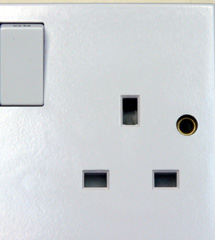
The universal unit was about half the price of the HP model, but has the worry of having the interchangeable plug fall off. So I bought the HP adapter. There was then the problem of a power cable. The store only stocked UK mains power cables, as used in newer Sri Lankan premises, so I had to also buy an adapter (about $US2) for the other Sri Lankan power sockets common in older buildings.

Now back in Australia I need to buy a clover-leaf  IEC 60320 C6 cable with an Australian mains plug, to replace the UK one.

Telecommunications for Traveling in Singaport and Sri Lanka

On a recent visit to Singapore and Sri Lanka I had the problem of how to get Internet and phone access. Gone are the days of having to pay a large deposit to have a local SIM card couriered for mobile access, or taking the hotel phone apart to connect a modem. It is possible to buy special travel SIMs. But as I make and receive few phone calls it was simpler to use the international roaming on Vodafone. Receiving or making a call while roaming can be expensive, but use of SMS is reasonable. There is the problem that each time you move more than a few km you can be on a different network which will send a "welcome to ..." message.

In Sri Lanka, I noticed Dialog was very common. As well as a mobile service (affiliated with Vodafone), Dialog also provide a CDMA service used for wireless home phones (common in guest houses) and solar powered public phones. For someone used to a wired infrastructure, it can be disconcerting picking up the phone in a hotel room and finding it is not plugged into anything.

On arriving in Sri Lanka, Dialog sent me a user id and password for their public WiFi hotspots with free credit. This service is common in guest houses and cafes. After using up all my credit I discovered that I just had to ask the guest house for their user id and password for free unlimited Internet access.

In contrast to the free Wifi in Sri Lankan guest houses,The Hotel Galadari in the Capital Colombo, charged $US7 a day for Internet access. This was available via Ethernet in rooms and WiFi in the public areas. But both the cable and wireless versions very slow (typically 40kbps).

While guest houses have free WiFi, getting it to work can be a problem. The service was not working in one location and when I asked about it the staff handed me the USB modem and router, suggesting I take it to my room and see if I could get it to work (I couldn't and suspect they had not paid the bill).

Singapore has very good free WiFi  in the airport. Previously this required registration, but is now available without. Similarly many cafes have free wifi.

Power for Traveling in Singaport and Sri Lanka

On a recent visit to Singapore and Sri Lanka I had the problem of how to recharge my laptop and phone. Both Singapore and Sri Lanka, being former British colonies, use UK power plugs, with large square pins. But Sri Lanka also uses a round pin plug. So I purchased Australian to UK and Australian to European power adapters.

The UK (BS 1363 Type G) adapter worked fine until I left it behind in a hotel. The problem was that the adapter, like most, was the same off-white color as a power point, thus easy to forget. I suggest buying a black one, so it looks like part of your computer power cable.

The next problem was the two different power plugs in Sri Lanka. The capital city, Colombo, seemed to use the UK plug, whereas the rest of the country had a three pin round unit. This looks a little like the European power plug but is not quite compatible. The three pin round sockets are not European ones, but a derivative of an old UK standard (BS 546 or Indian IS 1293).

I found I had to buy a local power adapter for Sri Lanka. There are adapters readily available for about $US2, but these are of questionable safety. The adapters are designed to take UK, European, US and Australian plugs. They have so many and so large holes in them that the plugs are not held firmly and large sparks can be seen when contact is lost.

In Singapore I purchased a Lifetrons 10.5W Travel Adaptor FG-2102PD. This is almost a cube with a US/UK,European and Australian socket on one side  and plugs for the same folding or retracting into the other sides. It is bulky and cumbersome looking but works okay. The unit is black and when plugged into my laptop cable it looks neat. It also has one high power USB socket and so can be used to charge a phone at the same time.

Sunday, April 28, 2013

Attitude Analysis and Development Tool from Sri Lanka

Greetings from the 8th International Conference on Computer Science and Education (ICCSE 2013) in Colombo, Sri Lanka, where V.Mohanadarshan is speaking on "Symphony: Attitude Analysis and Development Tool". The idea is to use games with a wholesome content to teach students good behavior and assess it. This may seem a little like brainwashing, but otherwise the child might only be exposed to games which do not include socially beneficial values.
The presence of good behavioural and positive attitudes in human beings is extremely important to lead a life of respect. This paper gives a detailed description about using an IT based solution for attitude development in children. The main goal of this tool is to encourage healthy attitude development in a child and to motivate good attitude based knowledge improvement through interactive learning environments. The tool developed is based on the affective domain of Bloom’s Taxonomy. It will deliver attitude development to children effectively, efficiently and interactively.
From: Symphony: Attitude Analysis and Development Tool, pp. 603-608. V.Mohanadarshan Sri Lanka Inst. of Info. Tech. S.I.Praveen Sri Lanka Inst. of Info. Tech. M.M.Shareek Ahamed Sri Lanka Inst. of Info. Tech. M.S.M.Zayan Sri Lanka Inst. of Info. Tech. Prasanna S.Haddela Sri Lanka Inst. of Info. Tech. P.Fernando Sri Lanka Inst. of Info. Tech.

Saturday, April 27, 2013

Automated Water Management System for Irrigation Department, Sri Lanka

Greetings from the 8th International Conference on Computer Science and Education (ICCSE 2013) in Colombo, Sri Lanka, where S.Lucksman is speaking on "Ralapanawa RND - Automated Water Management System for Irrigation Department, Sri Lanka". They are building a system to provide water supply information to farmers who use the water and government officials who manage it, using smart phones. An interesting question for me is if farmers can understand the same sort of tables and graphs which the government administrators are used to reading, or will new formats be needed.
Ralapanawa RND is a flood disaster management system with an automated water management componentfor water reservoirs. The system was implemented specifically aiming the requirements of Irrigation Department of Sri Lanka. In the rainy seasons of the year most areas of the country were affected by continuous floods and overnight rain. Many families were victimized by these chaotic disasters. Still there is no proper disaster warning or management system in Sri Lanka. This solution introduced in this paper is a fully automated water management system which will pre-warn far away before these kinds of disasters arise. The system also involves in automating manual driven functions currently undertaken by Irrigation Department management process. The system consist with a Electronic Embedded System (getting water levels from Tank) interconnected to a PC, Android and Windows Mobile Application for Mobility purpose, Telco Based SMS Application for famers, Centralized Web Service plus a Enterprise Web Site. Graphical Illustrations (Graphs and Charts), CCTV live Stream of Tanks, GPS positioning of Irrigators and many functionalities consist in this System.

From: Ralapanawa RND - Automated Water Management System for Irrigation Department, Sri Lanka., by  S.Lucksman Sri Lanka Inst. of Info. Tech. P.Subramaniyam,  H.Suntharalingam, S.G.S.Fernando, C.D.Manawadu Sri Lanka Inst. of Info. Tech. ICCSE2013 pp. 213-217.

Information Technology Education in Sri Lanka

Sri Lankan drummers at the opening of ICCSE 2013.
Sri Lankan drummers
at the opening of ICCSE 2013.
Greetings from Colombo, Sri Lanka, where I am attending the opening of the 8th International Conference on Computer Science and Education (ICCSE 2013).
We started with a display of traditional Sri Lankan dancing and drums, followed by the national anthem and the lighting of an oil lamp. In his opening speech, the Sri Lanka Minister of Technology Research and Atomic Energy, Patali Champika Ranawaka, emphasized the economic, environmental and social benefits of national investment in education.  The conference is organized by the China Research Council of Computer Education in Colleges & Universities, Foreign Affair Committee (CRC-CE), co-sponsored by IEEE's Sri Lankan chapter and hosted by the Sri Lanka Institute of Information Technology (SLIIT). I will chairing the e-learning session on Sunday and presenting on "Synchronizing Asynchronous Learning: MOOCs with Books".

Boats on Canal in Colombo
Yesterday, before the formal conference, we had a tour of the main campus of SLIIT. This private institution is affiliated with numerous Australian universities, some UK ones and accredited to deliver programs in Sri Lanaka. SLIIT focuses on ICT and business courses. The main campus looks like that of an Australian vocational institution in the tropics.

The introductory briefing was conducted in a small lecture room for about 72 students. Interestingly they had very narrow tables (about 300 mm, which was just enough to accommodate my laptop) each seating four students in a row. There is a raised stage at the front. Video projection is direct to a white wall, with a freestanding white-board alongside.

I noticed a sign about mid semester one hour  examinations. SLIIT use Moodle for e-learning, but the primary teaching mode appears to be face-to-face in conventional classrooms. There is also a library seating about 140. The library appears to primarily provide multiple copies of textbooks for the students.We also looked at several computer labs with desktop PCs with LCD screens.

I noticed one course offered was Introduction to Renewable Energy from Curtin University. There may be scope for offering my ICT Sustainability course to the engineering, ICT and business students.

SLIIT has a startup incubator "Conceptnursery.Com", where students can lease a small office to work on their own start-up company. This is more lavishly equipped than Australian equivalents such as Fishburners and Entry 29. SLIIT provide a lockable office big enough for four staff, whereas the Australian equivalents offer just a time-shared desk in an open office for the base level. SLIIT might consider this option, as it would allow for many more startups.

An interesting issue is what effect will e-learning have on institutions like SLIIT.  Currently SLIIT acts as a satellite campus and feeder to for overseas institutions. Students can complete lower level qualifications at SLIIT and also travel to the overseas institution for advanced studies. However, if students can undertake much or all of their studies on-line, there may be less need for these partnerships. However, I think it is more likely that the services offered at campuses will change, as they are in Australia, with fewer lecture theaters and more informal spaces for small groups of students.

Thursday, April 25, 2013

From a Film Set in Colombo

Greetings from the foyer of the Galadari Hotel by the beach in Colombo, Sri Lanka. I just arrived for ICCSE 2013, which starts tomorrow.It is a little surreal: there appears to be a wedding party having dinner in the restaurant on one side of me, while a young man with a very spiky hairstyle in an orange suit is being filmed on the other. I thought they might be making an advertisement for the hotel, as I stepped past a waiter standing in the middle of the foyer with a tray of drinks, looked around and found myself on camera.

Correction: it is not a wedding, the pianist (who was doing very sugary renditions of love songs, just broke into "Happy Birthday").

Just to add to the mix tomorrow several hundred computer scientists (mostly from China) are turning up. Should be entertaining.

Thursday, March 21, 2013

MOOCs with Books: Syncronisation of Large Scale Asynchronous e-Learning

This is to invite corrections and suggestions for my presentation "MOOCs with Books: Syncronisation of Large Scale Asynchronous e-Learning" for the 8th International Conference on Computer Science & Education (ICCSE 2013) in Colombo in late April (web slides also available). The basic idea is that use of "real time" delivery of e-learning places an unnecessary burden on the Learning Management System (LMS) and networks used and is also not good for the students. Most supposedly "synchronous" education, on-line and in the classroom, is not really "real time". Relaxing the restrictions this imposes on the system will allow millions of students to be accommodated and also provide better learning. An easy way to explain this is with the example of an eBook, which the student can download and read when they want, attempt the exercises in the book and check their answers. It is only after doing their "homework" that the student needs to interact with the LMS, their fellow students and perhaps a teacher. Rather than build complete new Learning Management Systems for MOOCs, packages such as Moodle, can be upgraded to handle the load, using existing technology, such as SCORM and HTML5.

 This started as a scholarly paper on "Synchronizing Asynchronous Learning". But since submitting the paper last year, I have given a few presentations on how to have large on-line courses scale (both in terms of software and pedagogy), under the title "MOOCs with Books", so I added this to the conference presentation as a postscript. If anyone is interested I can give a practice run of the talk in Canberra, Sydney or Singapore.
Description: On-line learning uses the terms synchronous and asynchronous to describe tools and learning activities. This research looks into the origins of these terms, their use today and asks if these are the correct terms to use and if the use of these terms has held up the development of better tools and techniques. It is proposed that the use of syncronisation of asynchronous learning is particularly applicable to address issues with large scale e-learning, such as Massive Open Online Courses (MOOCs).
Keywords: Asynchronous Learning; Synchronous Learning; Electronic Learning; Web Conference; Videoconferencing; Pedagogy; Massive Open Online Courses, MOOC.
Please cite as:
Worthington, T. (2013). Synchronizing Asynchronous Learning: Combining Synchronous and Asynchronous Techniques. In Proceedings of 2013 8th International Conference on Computer Science & Education (ICCSE), 26 Apr - 28 Apr 2013 , Sri Lanka.
Preprint available at: http://hdl.handle.net/1885/9556