Showing posts with label Cars. Show all posts

Sunday, March 23, 2014

Making a Smaller Seven Family Car

Recently I was asked for advice on a family vehicle to carry two parents, two children and, occasionally, two grandparents. I suggested a  2013 Kia Rondo Diesel or a 2012 Prius V. These have seven seats, are about the same size and fuel efficiency. The Kia was upgraded significantly in 2013. The Prius V has not changed much since it was introduced in 2012 and they age well, so there is little point getting a new one.

These are more car-like than the larger people movers and SUVs. The catch is, with all three rows of seats occupied, there is not much room for luggage. But most of the time you are likely to be using only two rows of seats and so have a very large boot. For Griswold holidays, you can add a roof-box ($1,000 with mounting bars).

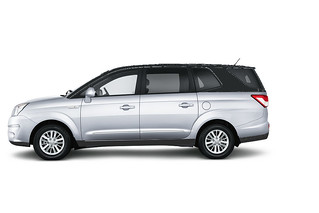
For something larger there is the 2013 Ssangyong Stavic. These are low priced, mainly due to the ugly front end of the previous model. The 2013 model looks bland, rather than ugly. But it still looks odd at the back, and too large for its tiny wheels. This might be improved with a Range-Rover-like colours scheme, with the lower edge of the vehicle painted black, along with the pillars, up to the roof rails.

Tuesday, February 21, 2012

Ford Backing Open Source Car Apps

Ford Motor Company are supporting the use of OpenXC open source hardware and software to build in car applications. The system interfaces to the CAN bus via the On Board Diagnostics (OBD-II) port and to a host computer using USB. This allows the computer to monitor car performance and other parameters. Currently supported are some recent US models of the Ford Focus, Mustang, Fiesta and Figo. The system is designed to initially interface to Android or Arduino hardware. Amazon sell some Arduino kits, but it is not clear if these are compatible with the Ford system.

Friday, January 13, 2012

Keyring Car Escape Tool

Recently I bought a Luminous Emergency Hammer and Seatbelt Cutter for my car. But there are also Pocket Size Car Rescue Tools, designed to go on a keyring. The most common model is the ResQMe Keychain LifeHammer. These have a spring loaded steel pin which is fired when the device is pressed against a car window, to shatter the glass. There is also a blade recessed in a slot for cutting a seat belt.

While these tools are designed to go on a keyring, perhaps it could be attached to a Heavy-Duty Retractable Key Chains Reel
clipped to the car. That way it would be on hand when needed. I noticed that the escape hammers in buses are similarly attached to steel cables to stop them being lost (or stolen).

Thursday, January 12, 2012

Glow-in-the-dark Car Emergency Hammer

Recently I purchased a Luminous Emergency Hammer and Seatbelt Cutter. This looks like a toy plastic hammer, but is a serious tool for escaping from a crashed car. The hammer has a sharp steel point designed to break a car side window (similar hammers are fitted to some buses). There is a blade in a slot in the handle to cut a seatbelt.

The hammer is intended to be mounted in a car, within reach of the driver. It should be noted if the seatbelt locks in an accident, the driver's reach will be very limited. The black plastic mounting bracket the hammer comes with has holes for bolting in place, but it also has four sharpened steel prongs which can be pushed through the carpet lining the passenger compartment of the car to fix it in place.

As all the lighting in a car may fail in an accident, the mounting bracket for the hammer has a luminous dot. The hammers are usually Safety Orange to make them easy to see in low light. The hammer I selected is yellow and the whole handle is made of glow-in-the-dark plastic, making it easy to find.

The hammer looks solidly built, with three steel bolts holding the two parts of the handle together. The seatbelt cutter is recessed so that a finger will not fit in the slot to be cut. The hammer has only a small amount of steel in the head and so is less heavy that a carpenter's hammer. The mounting bracket appears to hold the hammer firmly, but obvious it should not be positioned so it could fly forward in an accident and injure a passenger.

Friday, December 09, 2011

Renault Android Car Tablet Computer

Renault are reported to be integrating an Android computer in their cars. This will display ancillary information, such as fuel consumption and be used for entertainment. This is the approach most car makers are taking with an ancillary display in the center console, separate from the driver's display of speed and engine warnings. Ford have integrated their system into the vehicle, which provides for lower cost and a neater look, but using a separate tablet computer allows for more rapid upgrade of the computer. Numerous after-market suppliers are fitting Apple iPads to cars. iRoc appear to have adopted the approach of building an iPhone cradle into a car radio.Link

Thursday, April 14, 2011

Electric motorcycle with tablet computer dashboard

R3 Electric Vehicle Prototype from T3 Motion T3 Motion's R3 prototype electric car/motorcycle is reported to have a Galaxy Tab Android tablet computer docked in the dashboard for navigation and entertainment. The R3 has four wheels and two side by side bucket seats like a car, but T3 Motion claim that the rear wheels are so close together that it handles like a motorcycle and can be registered as one. This would be a lot more comfortable than the Piaggio MP3 three wheel motor scooter.

This is not the first electric car prototype to have a tablet Reva NXG Electric Carcomputer in the dashboard. The 2005 Reva NXG had an Indian made tablet computer in the dashboard. Unlike the T3 which has a conventional speedometer, the NXG used the computer screen for all car displays. The T3 seems a more practical idea, with the car not depending on the tablet computer.

A 7 inch screen will just fit in a "Double DIN" dashboard slot (twice the height of a regular car radio). There is an large market in double DIN retrofitted entertainment units for cars. No doubt that there will some of these devices including an android tablet computer function, or a docking station.

Monday, April 11, 2011

Problems with NRMA Website

The NRMA sent me a membership renewal notice. When I went to the web site I was told that I had to have a "profile" set up. When I went to do this, using the details on the renewal notice, I was told these were incorrect. It turned out that the postcode on the NRMA renewal was different to the one in the NRMA database by one digit. With the postcode corrected, the system dais it was sending me an email, but so far this has not arrived.

So then I tried setting up a direct debit payment. When I entered the web address on the renewal notice "mynrma.com.au/directdebit" I got:

Page not found

We're sorry you got lost. The page you were looking for appears to have been moved, deleted or does not exist.

But it appears it is not me who has lost there way, but NRMA with their customer service.

Thursday, October 14, 2010

Composite Materials to Reduce Carbon Emissions

Sivakumar Dhar Malingam presented a seminar yesterday on "Analysis of self-reinforced polypropylene based composite-aluminium hybrid structures" at the Australian National University. Material science is outside my usual area of interest but lightweight sandwiches of metal and plastic can be used to replace heavy panels in cars and aircraft to Reduce your Carbon Foot Print.

Such panels have been used for the skin of aircraft such as the Airbus A380. But mass production at low cost requires flat sheets of the material to be stamped quickly into complex shapes. Unlike plain sheets of steel or aluminium, the composite material (such as Twintex) tends to tear or wrinkle when stamped. The research is looking at how much heat is needed to to make the process work and how quickly the material can be deformed.

The research shows that moderate heat (enough to make the meta more malleable but not enough to melt the plastic layer) helps the process. While use for the mass production of car panels is a long wahy off and large passegner air caraft are not produced in sufficient numbers for mass production, the process might be applied to UAVs. Small pilot-less aircraft are being produced in increasing numbers and so mass production techniques could be applied. They would be small enough to be made with just a few stamped panels. A small UAV might be be made in just two pieces: top and bottom.

UAVs are not subject to the same safety requirements as passenger aircraft and so could be made with a new and relatively untested process. Complex blended wing shapes, designed for low radar cross section could be made to fine tolerances using a stamping process.

Thursday, September 30, 2010

Maruti Suzuki India Green IT Policy

I purchased a car sold in Australia as the Suzuki "Alto", which is made by Maruti Suzuki India. So it was interesting to find a slide presentation from the IT Enabling Green 2008 conference in New Delhi, entitled "Remuneration of Using Green IT", by Rajesh Uppal, Chief General Manager IT, at Maruti Suzuki India. One claim was that in in 1999, Maruti Suzuki India Limited was the first passenger car company in India to be certified for Environment Management Systems (EMS) to ISO 14001:1996.


Saturday, June 19, 2010

Suzuki Alto Glovebox or God Optional Extras

Suzuki Alto, Glove Box, Part Number: 990J0M68KP3-010When ordering a Suzuki Alto car I was asked about accessories. The car has no covered storage in the front, so I joked I would like an ashtray and a glove box as accessories, which the sales person found amusing. It turns out that Suzuki Alto Accessories include a glove box (Part Number: 990J0M68KP3-010) and an ash tray (Part Number: 99000-99012-83H).

Suzuki Alto, Ash Tray, Part Number: 99000-99012-83HRather than just providing a lid for the storage slot in the dashboard, the glove box is a whole new replacement unit. In contrast the ash tray appears to be designed to simply drop into one of the slots on the centre console.

As a customer I would have preferred the glove box and ash tray as standard, in place of the tachometer, fog lights and alloy wheels, which came with the Alto GLX model.

Maruti Suzuki Ganesha Car Accessory 99000M99573The Alto is made in India, where it is sold as the Maruti Suzuki A-star (the Indian Maruti Alto is a different car). There are Maruti accessories for the A Star, including leather seat covers and an "Exquisite range of coloured images of Gods on 24 ct. gold plated foils". Gods available include Ganesha and Jesus of Nazareth (as featured in many Indian vehicles).

The Australian model Alto has an air bag fitted to the dashboard passenger side and no objects should be placed on it. The seats also contain air bags, making fitting seat covers more difficult. Some seat covers are designed to split along the side to release an air bag, but the Alto seats have a plastic panel on the side which covers the air bag and may be blocked by the seat cover. As an alternative I purchased $45 sheep skin seat covers, cut a cross at the location of each air bag and folded the cover back behind the air bag surround. This ensures the cover does not impeded the air bag and looks tidy.

The Alto has limited space for back seat passengers, so a useful accessory might be removal of the storage shelf under the dashboard (or glove box). This would provide about 100 mm more space for the front passenger. It may allow them to put their seat further forward, providing more room for the rear passenger. This layout is used in the Toyota iQ micro-car (and the Aston Martin Cygnet derived from it). In the Also covered storage space could be provided in the centre console and with a drawer under the front passenger seat.

Thursday, June 17, 2010

Suzuki Alto Works Well

Suzuki AltoDespite my complaint that "Buying a car should not be so hard" I went ahead and bought a Suzuki Alto from National Capital Motors. The the GoGet Share Car scheme offers these cars for short term hire, but does not yet have any in Canberra.

The best features of the car, apart from the very low price, are the very small turning circle, the high (for a small car) driving position and the high safety levels (with 6 air-bags and complement of electronic safety aids).

The poorest features of the car are the lack of a lid for the glove box and the silly tachometer stuck on the dashboard. Apart from the tacho, the dashboard and instruments are well laid out. There are a minimum of switches and those there are are well marked.

The car is equipped well and mostly sensibly. I purchased the up market Alto GLX model, for the added electronic stability control. Unfortunately as a result I was also required to have mag wheels, fog lights and a tachometer, in the package. The mag wheels look silly on such a small low performance car and prevent the spare wheel being used easily (it is a full size spare tyre, but on a steel wheel). The tachometer serves no useful purpose and looks silly tacked on top of the dashboard. The fog lams are inconspicuous, but serve no useful purpose.

The Alto is smaller than my previous Daihatsu Sirion but has more room for the front passengers, trading back seat and luggage space. This is a reasonable compromise. But I could fit a folding bicycle in the Sirion, but can't in the Alto.

The vehicle seems very solid and well put together. The driving position is higher than many much larger cars, giving a good view of the road.

There are some curious omissions: there is no lid on the glove box allowing the contents to be visible from outside the car. This may be a security feature, as those in high crime areas have to leave their glove box open to show there is nothing worth breaking into the car to steal. Similarly there is no enclosed storage in the dashboard for coins.

ps: The lack of storage in the Alto may have advantages for fuel economy. When I emptied the Daihatsu I had 16 kg of material in the car, which would have increased fuel consumption:

Water: 4 kg
Street directory, torch, several pairs of glasses: 1 kg
Fire extinguisher, first aid kit, tow rope: 4 kg
Picnic rug, waterproof coat: 2 kg
Survival kit: 4 kg
Rubbish: 1 kg
Total: 16 kg

Sunday, May 16, 2010

Buying a car should not be so hard

Suzuki AltoMy Daihatsu Sirion is now 12 years old, so I thought it time for a new car. Daihatsu no longer sell cars in Australia, but there is the similar Suzuki Alto. This is an Indian made five door car with a three cylinder 1 litre engine, like the Sirion. It is sold in other countries as the as the Maruti Suzuki A-Star, Suzuki Celerio or Nissan Pixo. The Alto costs $AU12,000 drive away, for the cheapest model in Australia.

Being conscious of greenhouse gas emissions and limited fossil fuel supplies, I considered other options. The first option was not to buy a car at all and share one via the GoGet Share Car scheme. With car share I would pay a monthly fee and be given an electronic key which unlocks cars in reserved parking spaces around cities. GoGet happens to have the Alto in its fleet, as well as larger cars. But there is no share car near City Edge in Canberra.

The next option was to buy an electric car. I have had a test drive of the Mitsubishi i MiEV small electric car. This looked very practical, but is not yet available in Australia. Also if charged from ordinary coal sourced electricity it will be just as polluting as a petrol car and would cost about three times as much to buy.

The next option was a hybrid car. However, I only need a small car and there are no small hybrid cars on sale in Australia. Larger hybrid cars, such as the Toyota Prius, are not much more fuel efficient than a small conventional car and cost about three times as much. As I do not drive that much (bicycling to the office during the week), it is unlikely I would ever recover the additional financial or environmental cost of a hybrid car. Toyota did offer a start-stop system and regenerative braking on some of its small cars in Japan. This provides almost as much fuel efficiency as a hybrid car, without the cost of an electric motor or extra batteries, but these options are not avialable in Australia.

LinkThere is a new crop of Korean, Chinese and Indian small cars coming to Australia in the next year or so. These may include the Hyundai i10 and other City Cars. There is even the luxury Aston Martin Cygnet, based on a Toyota iQ. But none of these have arrived yet.

So I looked on the web for details of the Suzuki Also on sale in Australia, from places such as Rick Damelian and National Capital Motors. It looked relatively easy to buy an Alto, as there there are no engine options, one body style and just two gearboxes offered: manual and automatic, in two trim levels: GL GF and GLX. So apart from colour, there are only four options to choose from. All models come with 6 air-bags and anti-skid brakes. The most significant addition with the more expensive GLX model is electronic stability control.

However, going in to buy a car was still a very frustrating process. This started off well: I went in and had a test drive and was told of the features and options. The lack of options seemed to cause the sales-person some frustration, they kept asking what my requirements were, what might I use the car for? I replied I needed a small car to replace a Sirion. As there were only four Alto options to choose from, there did not seem much to discuss.

Australia has laws about truth in advertising and so car dealers are now required to advertise a "drive away" price. This seems to cause them considerable frustration. I was shown a price many thousands of dollars more than the drive-away price. To my surprise this was first set out on a sheet of ruled A4 paper, with all the various components adding to the cost itemised, leading to an absurdly high price, then various "discounts" subtracted. I was not sure if this was due to legal requirements to explain the details to me, or a sales trick to cause buyer confusion. With those options explained the same details were then presented to me on a computer printout (I hope they were the same details, as there were so many it was hard to tell). I then had to talk to three different people at the dealership, one of whom wasted a considerable amount of time trying to sell me useless add-on treatments for the car. Other staff did paperwork which did not seem to be something I needed to be there for.

The process of buying a car takes hours. In the case of an up-market model with many options this may make sense. But this in part seems a trick to keep the customer in the store so long that they have made such an investment in time, they feel obliged to buy. For a low cost car with few options, it cannot be economic to sell cars this way. It seemed to me that same sales process was being used, because that is how upmarket cars are sold. The sales person perhaps thought they were giving me good service, but it seemed more they were just going though the motions. I did not find this a pleasent experience.

For low cost cars what is needed is a streamlined process, where it is assumed the customer has looked at the few options available online in advance and just needs a test drive and some questions answered. That should reduce the price of a car by thousands of dollars and reduce the process to less than ten minutes.
Tuesday, February 02, 2010

Tata Magic Iris

Indian vehicle maker Tata have announced the Magic Iris, which is essentially a minivan version of the Tata Nano micro-car. Just as the Nano is intended to replace scooters for personal transport, the Magic Iris is to replace three wheel auto-rickshaws:
"The Tata Magic Iris, to be launched this year, is for public transportation, offering safer and more comfortable mobility for those who depend on three-wheelers. Its spacious car-like cabin can comfortably seat four passengers – three at the back and one in the front beside the driver. With its car-like on-road stability and sheet metal roof it provides car-like safety.

The 611-cc water cooled diesel engine, backed by a 10-litre fuel tank, is capable of running larger distances with a top speed of about 55 kmph and yet higher engine life. With its bouquet of features, the Tata Magic Iris will be the ideal small passenger carrier which will upgrade both the quality of public transportation and also the income of their owners. ...

From: Tata Motors Group displays the widest range of products and environment-friendly technologies at Auto Expo 2010, 5th January, 2010

Sunday, November 01, 2009

Car Share Example of Green Technology

Suzuki Alto GoGet Share CarIn the street today I notice a Suzuki Alto car, which is part of the GoGet Share Car scheme. This is a good example of how to use computers and telecommunications for improving the environment. After joining the GoGet scheme you book a car online and open it with an electronic key. This allows inner city residents to convinently share a car. Residents are more likely to forgo car ownership and use public transport if they have access to a share car when required. Also most of the cars such schemes use are small fuel efficient models, like the Suzuki Alto.

This is an example of reducing greenhouse gas emissions without the need for a large investment in new technology. The care share system uses conventional petrol powered cars and roads. There is a small investment needed in a web based booking system and the electronic keys for the cars. However, this is minor compared to the cost, for example, of electric cars or a metro system.

Friday, September 18, 2009

Holden Commodore US Police Cars

Prototype Pontiac G8 for LAPD According to media reports from the the Frankfurt motor show General Motors is planning to sell Australian made Commodore cars to US law enforcement agencies.

In March when speaking at a public safety communications conference in Sydney, I tried out several prototype police cars. One was a Los Angeles Police Department (LAPD) squad car (LAPD officers were speaking at the conference).

Touch screen in Prototype Pontiac G8 for LAPDThe vehicle was fitted with a large portrait format touch screen in the centre console, replacing the clutter of controls common in police vehicles. The Commodore is a large vehicle, allowing room for the equipment carried in police cars. There was also an upgraded electrical supply fitted.

While I only got to sit in the stationary LAPD car, I did have a ride in the back of one of the unmarked cars. This was fitted with discrete LED red and blue lights and also had recharging stations for police torches in the back. In place of the touch screen this car had a compact keyboard in a holster on the side of the transmission tunnel. The officer in the passenger seat could pull the keyboard out of the holster and put it on their lap, using the console mounted screen for looking up the police database.

The LAPD prototype was based on the US export version of the Holden commodore. The vehicle was branded as a GM Pontiac G8 for the US market. This was dropped after GM's financial difficulties. But the Commodore is still engineered for construction in left hand drive for the US market. As an example, the instrument cluster for the driver's side of the car is designed to be swapped with the glove box on the passenger's side. Also the handbrake on the driver's side of the transmission tunnel is swapped with a grab handle on the passenger's side. This would allow a small number to be made for US police use.

Monday, May 25, 2009

Open source consortium building car entertainment platform

The GENIVI Alliance is a non-profit consortium launched in March 2009. It aims to produce open source car entertainment systems based on Linux. Members include GM, BMW, Intel and Peugeot Citroen. Given cutbacks in the automotive industry it might be a good time for a cost-saving open source approach, as an alternative to initiatives like the Microsoft Ford Sync.

Friday, January 09, 2009

Internet car radio

Blaupunkt have demonstrated two internet car radios at the "Consumer Electronics Show" developed in conjunction Melbourne company MiRoamer. These have been described as the"World's first internet car radio, Aussie-style" (by Ty Pendlebury , 8 January 2009, Cnet Australia), but they require a bluetooth connection to a mobile phone to provide the Internet connection. The two radios are the Hamburg 600i (single-DIN) and New Jersey 600i (double-DIN). The smaller will cost about AU$600 in late 2009. They also have an AM/FM radio, CD and socket for USB flash memory.

Some of the radio broadcasting industry, particularly the ABC, see Digital Audio Broadcasting (DAB) as the future of radio. But Internet radio may well kill it off in Australia, before it starts.

The Blaupunkt units can't control an external smart device, such as an iPhone, iPpod or smart phone. The double DIN model will likely cost as much as some car dash computers. A better alternative might be a simpler device which just acts as a remote control for such a device and way to get the sound to the user, such as the Microsoft Ford Sync.

miRoamer are offering an Internet radio portal designed to make Internet radio easier to use. This has a free basic service and a premium paid service. It is not clear if the Blaupunkt radios are designed to work only with this Internet radio service, or can use others.

Thursday, November 06, 2008

Smart Cars Stacked in Sydney Again

Smart Cars Stacked in Railway SquareIn 2006 a company stacked six Mercedes "Smart Cars" about 12 m high in Sydney to promote their carsharing scheme. These schemes are becoming popular for people in the inner city who want occasional use of a car for short periods.

By the way the company doesn't normally park their cars in a stack in squares, they arrange to have reserved parking spots at locations around the city.

I was reminded of this recently, as the company sent me a note to say their web address has changed and on the web site I noticed they were going to do the car stacking stunt again. Has anyone see it in Taylor Square?

Tuesday, September 30, 2008

Are CB Radios Safer to Use While Driving?

Last night's premier of Top Gear Australia (derived from the BBC's "Top Gear" TV car show), had the three presenters Warren Brown, Charlie Cox and Steve Pizzati, driving in the Snowy Mountains while operating hand held CB radios. While this is not necessarily illegal, it is hard to see how talking on a two way radio would be less distracting that a phone. Perhaps this is an area for research.

According to the Roads and Traffic Authority (NSW), CB and two-way radios are not banned for drivers:
300 Use of hand-held mobile phones

(1) The driver of a vehicle (except an emergency vehicle or police vehicle) must not use a hand-held mobile phone while the vehicle is moving, or is stationary but not parked, unless the driver is exempt from this rule under another law of this jurisdiction.

Offence provision.

Note Emergency vehicle, park and police vehicle are defined in the dictionary.

(2) In this rule:
mobile phone does not include a CB radio or any other
two-way radio.

From: Australian Road Rules
Research has shown that talking on a phone impairs driving ability. It is not holding the phone in hand that is the problem, but having a conversation. Hands free phones cause similar impairment to hand held telephones. However, having a conversation with someone in the car may cause less impairment and conversing with someone in an adjacent car, as was the case in Top Gear, may be less of a problem.

One area which appears to have not been researched is the impairment from two way radios. Most two way radios are "simplex", that is the radio can only transmit or receive, it cannot do both at once. As a result the two parties have to take turns speaking and there are usually pauses in the conversation between. This makes for a stilted and unnatural conversation, but perhaps this reduces driver distraction.

Hands free kits for mobile phones in cars try to reproduce the free flowing two way conversation of a hand held phone. In practice this is limited by the noise level in the car and positioning of speakers. Less sophisticated kits, and those not well fitted, effectively operate as automatically switched simplex radios, cutting off the audio of the remote party while the driver is speaking. This is normally seen as a problem, but perhaps it increases safety.

Some CB Radios have the option of a tone at the end of a transmission to indicate the other party can now speak (commonly called "Roger Beep"). It may be useful to include this in hands free car kits to indicate to the remote party that the driver has finished speaking.

While the research is not clear on this point, some indicate that conversations with passengers in cars are less impairing as the passenger can see the traffic situation and so know when not to distract the driver. It may therefore be that a videophone showing the traffic, or a phone which detects the driver is busy and sends a synthetic voice or tone to say "driver busy" might help. Such a system might use a tone to indicate to the driver that it is not a good time to talk, or even switch off the microphone to stop them. The phone could detect when there is frequent breaking and use of turn signals, to indicate a high driver workload. Some hand held telephones, such as the iPhone, have accelerometers built in which could be used to to detect when the car is manoeuvring and so it is less safe to talk.

A simpler alternative might be to place a "Push to Talk" button on the car steering wheel. As with a two way radio, this button would need to be held down while the driver was speaking on the telephone. This would have the advantage that the driver would be only able to hold the button down and speak, when the car was proceeding in a uniform heading. As soon as the moved their hands on the wheel to change direction, the button would be released. This should have the effect of training the driver to not talk when manoeuvring.

Tuesday, August 26, 2008

Smarter Than Smart Car

In 2005 I suggested Diahatsu cut the back seat out of a Cuore to make a two seater car about the same length as the Smart Car. Toyota, who own Diahatsu, went one better by making the Toyota iQ which still has a back seat.

Toyota iQ CarAt 2980 mm the iQ is it 845 mm shorter than a Toyota Yaris , 120 mm shorter than the Tata Nano and 290 mm longer than the Smart. The iQ has a conventional front mounted engine like the Yaris, unlike the Smart and Nano's rear mounted ones. The iQ is made shorter by making the engine, dashboard and seat backs thinner. It also compromises on rear legroom.

Birth of the Beetle: The Development of the Volkswagen by Porsche, cover of bookThe car is described as seating thee adults and one child. When I first read this I thought of a small bucket seat sideways in the back, next to a full size one. In fact there is a conventional bench seat. It is just that there is not enough leg room behind the driver for an adult's legs. The rear adult passenger is accommodated by the front passenger pushing their seat forward.

The underside of the dashboard is higher on the passenger side to accommodate their legs, so they can sit further forward than the driver. This asymmetrical design is not a new idea: it was used on the second prototype
(Type 62 "Der Stuka") of the VW Kübelwagen military adaptation of the Volkswagen Beetle in January 1938 (mentioned on page 222 of "Birth of the Beetle"). The extra room was to operate a machine gun.

Reducing rear leg room in a small car makes sense, as most of the time the rear seat is not used. It seems likely that if the iQ is popular, other makers will adopt similar techniques to give more interior room. Modifying the engine to make it slimmer would be difficult, but thinner the dashboards and seat backs could be retrofitted to existing car designs.