Showing posts with label lighting. Show all posts
Showing posts with label lighting. Show all posts
Thursday, July 25, 2013
Brightest LED Light in Australia
Greetings from Security 2013 Exhibition at Darling Harbor in Sydney. There are security devices on display ranging from the low tech fence with pints on it, up to automatic infrared cameras. The notable display was Australia brightest LED security light (50,000 Lumen, 600 Watt), with it own water cooing radiator.

Saturday, September 29, 2012
Aldi $7.99 LED Lightbulbs
Aldi are listing LED Light Globes in their catalogue for sale from 6 October 2012 for $7.99 each. However, if these are only 3 Watt they are likely to give LED lights a bad name, as early dim compact fluorescent globes did. The 3 Watt globes are only bright enough for a small desk lamp or perhaps a chandelier.
In one of the photos in the printed Aldi catalogue I can see "Mueller Licht" printed on the globe. A web search showed this to be a German lighting company (although the globes are still likely to be made in China).
The Aldi catalogue has large and small Edison Screw and Bayonet globes, candle and spotlights. The Mueller Licht catalogue has these in 3, 7 and 10 Watt: 245, 500 and 850lm, equivalent to 16, 32 and 63W incandescent. There is no indication in the Aldi catalogue which wattage they are selling.
Also has GU10 and MR16 spotlights listed for $7.99, to replace Halogen down-lights.
The Aldi catalogue is expected to be on-line soon. Amazon.com also sell a large variety of LED Bulbs of variable quality.
In one of the photos in the printed Aldi catalogue I can see "Mueller Licht" printed on the globe. A web search showed this to be a German lighting company (although the globes are still likely to be made in China).
The Aldi catalogue has large and small Edison Screw and Bayonet globes, candle and spotlights. The Mueller Licht catalogue has these in 3, 7 and 10 Watt: 245, 500 and 850lm, equivalent to 16, 32 and 63W incandescent. There is no indication in the Aldi catalogue which wattage they are selling.
Also has GU10 and MR16 spotlights listed for $7.99, to replace Halogen down-lights.
The Aldi catalogue is expected to be on-line soon. Amazon.com also sell a large variety of LED Bulbs
of variable quality.
Monday, January 30, 2012
Osram LED Light-bulbs
 Bunnings Hardware are now selling three sizes of Osram Parathom LED light-bulbs in Australia. These are shaped like a conventional incandescent light bulb, with the lower section a metal heat sink painted white and the top a translucent hemispherical dome. They are all "Warm White" and rated to last 25,000 Hours and are avialable in bayonet and Edison screw fitting. The links in this post are to the Amazon German and UK web sites, as I have not been able to find these for sale on-line in Australia (but you would be better off going into a store in Australia, as the European prices seem very high).
The largest is a Osram Parathom 12 Watt LED
 for $29.90, equivalent to a 50 Watt incandescent bulb. This is about 20 mm taller than a standard bulb. I found this worked very well in a "Tastic" bathroom fan/heater. The dome projects down below the fan fitting, spreading light evenly around the room (better than the reflector bulb it replaced, which sent light straight down). It looks very bright in a small bathroom.
The 6 Watt is rated as equivalent to a 25 Watt incandescent bulb and is $17.90. It is the same size and shape as a standard bulb.
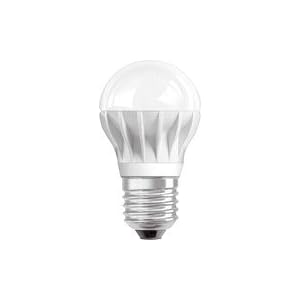 There is also an Osram 42780 Parathom 4Watt LED
 , shorter than a standard bulb.
All these bulbs direct very little light downwards, towards the base. They would be good for a ceiling fitting directing light downwards, or an up-light. They would not be as good for a fitting where the bulb lays on its side, or a desk lap where the bulb points upwards, but light is wanted downwards.
The bulbs look very well made with a very solid metal base and strong looking translucent cover (it is a shame to cover the unit with a shade, as they look like modern sculptures). The light is a pleasant color and very uniform. It will be interesting to see if they reach the 25,000 life: the electronics in LED lights tend to fail long before the LEDs themselves dim from old age. My bathroom light is used only about 30 minutes a day and so should last 100 years. ;-)
 The price of these bulbs is likely to come down rapidly in the next few years. I can recall when a compact florescent bulb cost $30 (they are now around $4).At the top end Philips are selling their Philips Master LED Bulb 12W at very high prices.
  There is also the Philips MyVision 9 Watt LED Bulb
 which looks very much like the Osram Parathom and is more reasonably priced.
What I have not seen so far is bulbs exploiting the unique characteristics of the LED. As an example, the LEDs are very small. It would be possible to build a bulb which had four or more separate LEDs, which from the factory would point out in all directions giving even light, but could be swiveled to point in one direction.
See also: "LED Lighting becomes main stream" at Ecologically Sustainable Sydney.
Sunday, August 28, 2011
Solar Street Lights in Afghanistan
 US Aid reports funding the installation of solar street lights in Afghanistan ("Tirin Kot Residents Enjoy Nightlife", 17 August 2011). Each streetlight has two 60 Watt photovoltaic solar panels and a 180 Ah sealed lead acid battery. The 30 Watt LED lamp illuminates about a 25 meter around it.
Solar street lights have the advantage that each unit is independent of mains power and each other. So the lights can be installed one at a time and start working immediately. However they are expensive to purchase compared to mains powered lights. A 30 Watt Solar Street Light
 is about $4,000. Also the batteries require to be replaced every few years.
The power produced by the solar panels can only be used for the individual street light. Much of the time the panel will be producing surplus power which cannot be stored by the on-board battery. One way to harness this would be to install a standard 12 Volt outlet on the base of the pole, so local residents could use surplus power to charge small appliances.
Monday, July 18, 2011
LED Chandeliers
 One use for LED lights is in a Chandelier. Tiny low voltage LEDs can be distributed around a chandelier far more easily than incandescent lights. The low voltage of the LEDs increases the safety and the low power use reduces the thickness of cable needed. The efficiency of the LEDs reduces the heat and so allows plastic to be used in place of glass. As the LEDs have a long life they can be built into the chandelier, rather than being user replaceable. Taking this to the extreme is the range of Schonbek LED Crystal Chandeliers
(the top of the range is the Da Vinci 72 LED DV3636A Single Tier Chandelier with Clear Spectra crystal).
 Older places of worship, such as the Sultan Ahmed Mosque (the Blue Mosque) of Istanbul have been retrofitted with incandescent lighting. These could benefit from fitting small LEDs with less obtrusive wiring.
LED Office Lights
 While there are LED Fluorescent Tube Replacement which can be used in existing "troffer" ceiling fittings in offices, it is more efficient to used LED panels in new installations. The fluorescent light fixtures contain reflectors and diffusers to spread the light from the florescent tube and also provision for replacing the tube. Instead there are LED recessed troffer fixtures, which have dozens of individual LEDs spread out over a panel which simply fits into the ceiling (such as the Maxxima 2000 Lumen LED Recessed Troffer Fixture). As the LEDs have a life in excess of 30,000 hours, they will last about ten years and so are unlikely to need replacing in the average life of a commercial building fit-out.
Replace your flourescent office fixture with the brand new Maxxima MLP-2X23000, 30 Watt 2'x2' recessed light fixture. With Maxxima's LED technology you will never have to worry about ballast replacement, mercury content, or constant bulb replacement. Our LEDs are rated to last more than 30,000 hours. This fixture is UL approved and is made to replace your current recessed office fixture. This fixture mounts by simply resting on your current drop ceiling in place of your current fixture.
From: Maxxima 2000 Lumen LED Recessed Troffer Fixture, 2011
LED solar street lights
The Australian Government's "Clean Energy Future" strategy includes incentives and direct support for energy saving initiatives. One of the easier areas for this is more efficient lighting. The "City Edge" apartment and townhouse complex, where I live in Canberra has solar powered street lighting, maintained by the body corporate. These have a low-pressure sodium (LPS) lamp and a solar panel on the one pole. More recent units offer a LED solar street light, all still on the one pole (such as the 90 LED cool white solar street light with arm by Tri North Lighting).These solar powered lights would normally be connected to the mains power supply to allow for long overcast periods (the batter allows for about five nights of power). They have lower energy use, but increased capital and maintenance costs, as the batteries need to be replaced regularly. Also as they are not designed to put excess electricity generated during the day back into the grid.
 It should be noted that the solar panel represents most of the cost of the solar street light. The same type of LED street lights (such as the 120 Watt double arm street light by Tri North Lighting) can be purchased without the solar panel, at a far lower capital cost. While such street lights come with a photocell to switch them off during the day, they could be made far more efficient with more intelligence and networking, which switches them to a dimmer setting in the absence of people and vehicles.
From: 90 LED cool white solar street light with arm by Tri North Lighting, 2011
From: 120 Watt double arm street light by Tri North Lighting
Sunday, July 10, 2011
LED Office, Factory, Retail, Street and Flood Lighting
 The carbon pricing announcement today by the Australian Government comes at a good time for the makers of LED lighting. While LEB bulb replacements are still too expensive for most home use, factories have ramped up production of lighting units for commercial, retail, outdoor and Street Lighting.
 While some 3 Watt and larger LEDs are available, the most common products are made with multiple 1 Watt LEDs. The LEDs are mounted on strips or panels and these panels then assembled into larger units, in may cases designed as direct Fluorescent Tube Replacement, sodium and mercury mercury vapor and other technologies.
There is scope for providing more efficient light distribution using LED's properties, for example, a hallway can be lit by a single continuous strip with hundreds of LEDs in it. The strip can be self adhesive and provides not only the mounting for the LEDs, but the fitting and the power cable. The LEDs will likely last the life of the average commercial building fit-out and so not need replacing in normal use.
LEDs also can be switched on and of quickly and more frequently than other lighting technologies and be dimmed easily. This allows for active lighting to save energy and to create a mood or sense of security. As an example in a hallway after hours the lights could be switched to a very low power level, then brighten when a person is detected. All lights need not go to full brightness, but instead only in the region around the person. As well as saving power, this should give a sense of security.
Monday, January 24, 2011
Sensor LED Light Strip Kit
 Jaycar Electronics sell a Sensor LED Light Strip Kit. This consists of a 300 mm flexible self adhesive strip with 12 LEDs in it, a PIR detector the strip plugs into and a 240 to 12 volt power supply.
The LEDs are rated at 130 lumen and are 2 Watt per strip. With the light spread out over the length of the strip they are more useful than one bright LED.
 The PIR detector is much smaller than those used for 240 lights, being about half the size of a matchbox.
I installed the strip under a shelf in my pantry. About the only problem is that the plug for the power supply is a little loose.
The lights are quite bright and so make the area above the shelf where they are installed seem dim. I might move them to the top shelf and install a second strip (extra strips can be purchased separately). The strips have a socket on one end and a plug on the other and up to six can be daisy chained together and run from one power supply.
 The Sylvania 72452 LED Motion Activated Guideway Lighting Kit
 provides similar features. But it has the LEDs in a rigid bar.
Sunday, May 30, 2010
Mains voltage LED Downlights to Save Energy
At the supermarket I noticed 3 Watt LED replacements for GU10 halogen down lights at $AU6.99 each. These were branded "Essential", Woolworths own brand (at the Town Hall Sydney store). Previously I tried the 3 Watt MR16 12 Volt Led. The two units appear similar, apart from the different pins in the base. They have a very well made, solid looking cast aluminium body, with one LED. The light from the 12 Volt unit is a soft yellowish colour, unlike the harsh blue tinge light of the Mirabella brand 1 Watt 12 Volt LED Diachronic lightr sold by Coles.
Sunday, May 09, 2010
LED Downlights to Save Energy
 At the supermarket I noticed 3 Watt LED replacements for MR16 halogen down lights at $AU11.99 each. These were branded "Essential", Woolworths own brand (at the supermarket in Westfield Belconnen, Canberra). Previously I tried a Mirabella brand 1 Watt 12 Volt LED Diachronic light for about AU$15, but it gave poor quality light and stopped working after a few months. The Woolworths units look a lot better made, with one LED in a substantial aluminium heat sink.
The units are claimed to be equivalent to a 20 Watt halogen unit (110 Lumen). If they last the claimed 30,000 hours, then they would be worthwhile.
There are very many 50 Watt downlights in Australian homes. If these were replaced with 3 Watt units, it would save a lot of energy and greenhouse gas emissions. This would be a more effective project for Australian Governments to subsidise, than the current solar power rebate.
Fitting these units would also reduce the prevalence of house fires caused by high wattage down lights over heating. The government might want to offer a set of these lights (and larger 240 Volt low energy florescent down lights) to all Australian householders.
Monday, January 04, 2010
Led Strip Lighting Around Flat Screen TVs
 The Philips Ambilight LCD HDTV
 range have lights around the edges and on the back which claimed to reduce eye strain and make the colours look better. There are numerous online discussions of using Led Strip Lighting for a similar effect, including suggestions by Ikea with their DIODER lights. Most of these do not automatically adjust the light level and colour as Phillips claim to do. But the effect might also be useful for desktop LCD computer screens, with the lighting strips providing subtle and efficient lighting for a desk. The lighting strips are now commonly available.
Tuesday, June 02, 2009
LED Downlights
 At Kmart I noticed a Mirabella brand 12 Volt LED Dichroic MR16 light for about AU$15. These are similar to units sold by Amazon.com as LED 1 Watt MR16 GU5.3 Base. These are claimed to use 65% less energy than an incandescent globe. It has 15 small LEDs in place of one halogen bulb and uses only 1.1 Watt, instead of the usual 50 Watts. But there are a few catches: The MR16 lights are usually halogen lights, not incandescent globes. The halogen lights are more efficient than normal globes and so the LEDs are less of an improvement than otherwise. Also the LEDs give much less light than a 50 Watt globe (only 15 Lx at 3 metres). They also have a very focused beam (15%) compared to other units.
The LEDs are described as "White" (6500K), but have a blue tint compared to halogen lights. Another catch is that the LEDs do not work well with electronic transformers or dimmers. I found that on its own the LED light would not work at all, but might work if there were several halogen lights plugged in parallel with it. The LEDs cannot be dimmed, they flickered if the dimmer was turned way down.
These units would have some uses. If there is an area with a very large number of down lights, the LEDs can be used to provide sufficient light and an aesthetic look.
 There are more practical units which use three 1 Watt LEDs but these cost around US$30 each (MR16 12V Warm White Light bulb). What might be more practical is to use lower power halogen lights (such as 20 Watt).
There are also 5 Watt halogen lights available, but these generally use a smaller fitting (MR11). Perhaps what is needed is a small metal disk to adapt the smaller MR11 to the larger MR16 fittings (an adaptor for the small electrical pins of the MR11 would also be needed). For less than $2 each, the power consumption of the lights could be cut by 90%. Of course it would be better to install the lower power MR11 in the first place, or even better another type of low power fitting. But there are many 50 Watt MR16 untis out there wasting power which could be converted.
Sunday, May 10, 2009
Combine photoluminescent and LED pathmarking systems
Photoluminescent strips provide an alternative to electrically illuminated signs and pathway lights in some circumstances. While lumescent exit sigens are available, these do not meet Australian standards. One approach might be to combine the luminescent function with LEDs. The luminescent material used in these signs is also fluorescent. A UV LED will cause the luminescent material to glow brightly while the LED is on, as well as recharge the material so it will glow brightly when power is off. This might remove the need for complex battery backup power supplies for such signs. The LED would ensure that the luminescent material was fully charged. UV LEDs are relatively inexpensive and very efficient (most "white" LEDs are actually UV LEDs with a white phosphor coating to convert the UV to visible light).
Monday, January 28, 2008
LINEARlight Flex LED Lighting
 OSRAM are offering flexible LEDs for commercial and home lighting, under the name "LINEARlight Flex". This consists of rolls of adhesive backed tape with LED lights every few cm. They have styles with the lights on the face of the tape or at the side and in colors as well as white. The have "CONNECTsystems" connectors and other accessories to power the lights and technical data available.
At present these systems seem to be design for accent lighting, not for general use. But as the cost of the LEDs goes down, and the price of electricity goes up, these could be sued for applications, such as offices and classrooms.
Tuesday, January 22, 2008
Waterproof LED lights
 Recently I came across LED lighting modules which are claimed to be water proof (rated to IP67). They come in strings of ten lights, each with three LEDs, sealed in resin. Each light is connected to the next with a short cable and these can be cut so they can be used separately, with each one working out at $2. The lights are bright enough for illuminating a stairway.
Endless possibilities - backlighting signs, strip lighting in stairwells & passageways, boats, garages etc. Supplied with 3 LEDs per module, 10 modules, with 500mm flying leads for termination. Each module is spaced at approximately 110mm between centres. Simply connect up a 12VDC 600mA supply and away you go.
Two types:
ZD-0490 10 x 3 LED Module White
ZD-0492 10 x 3 LED Module Blue• IP67 rated
• Waterproof and submersible
• Resin sealed
• Adhesive backed for quick installation
• Brightness per LED:
• White: 1200 - 1500mcd
• Blue: 600 - 800mcd
• Dimensions:
• Each module: 47(L) x 17(W) x 6(H)mm
• Total length: Approx. 1m
• LED spacing: 15.6mmFrom: IP67 LED Modules, Jaycar Electronics, 2007
Thursday, January 03, 2008
LEDs for office, home and classroom lighting
 Light emitting diodes (LEDs) are becoming affordable for general office, home and classroom lighting. They have about the same efficiency as compact fluorescent lamps and last much longer. There are now some LED replacement bulbs appearing to fit in ordinary light fittings. There are now also flexible strips of LEDs available which can be simply stuck to a surface. This allows more controlled lighting.
Griffith University's design guidelines recommend a maximum power density for lighting of 9 W/m² in general offices and classrooms, 5 W/m² in Corridors and 3 W/m² in stairway. It might be reasonable to aim to reduce this to 2 W/m² in offices and classrooms, by the use of more efficient directed light and task-lights, 1.5 W/m² in corridors and 1 W/m² in stairways.
LEDs have different characteristics to incandescent and fluorescent lamps. It may be more cost effective to build the LEDs into the fitting, instead of having a replaceable lamp. A LED will last about ten years when used for 12 hours a day. This makes it feasible to dispose of the whole fitting hen the lamp fails, particularly if the fitting consists of just a thin strip of plastic.
LEDs are small sources of light, usually about 2 mm square. So it has been difficult to make high intensity LEDs similar to halogen lamps or to cover a wide area like a fluorescent tube. There are now 1 Watt and 5 Watt LEDs available, but these require elelctronic circuitry to drive them and heat sinks to cool them. Instead what has become common is to group together a large number of low power LEDs (usually .1 Watt LEDs, each 5 mm in diameter of about 3 Lumen). When collected in a circle these LEDs are used to replace a spotlight, along a bar they replace a fluorescent tube and in a hemisphere they replace an incandescent bulb. The LEDs may be mounted on an ordinary light plug, allowing replacement in standard fittings.
While this overcomes some of the limitations of LEDs, this emulation of a conventional light does not exploit their features. It should also be noted that current LEDs at5 about 50 lm/W are only half as efficient as fluorescent tube lamps (70 lm/W). When a LED is placed in a conventional housing designed for an incandescent or fluorescent light, there is a further loss of efficiency.
However, LEDs operate at a safe low voltage, with each emitting a small amount of concentrated light and minimal heat. LEDs can be automatically connected in large numbers and on flexible substrates using equipment designed for assembling elelctronic circuits. This allows lighting fixtures with inbuilt lights which will provide light over a large but precisely controlled area.
 So an alternative for lighting might be to automatically assemble LEDs on sheets and strips, which could then be attached to a building. As an example strips can be stuck across a ceiling. There is no need for light fittings or wiring, the strip providing both the mounting and interconnect cable. These lights are provided in rolls and in strips with adhesive backing. The LEDs are being mass produced for backlights in LCD displays, and also as decorative undercar "neon" light strips for cars.
LED lights are not used for general office or classroom lighting due to the high levels specified in standards. This would result in a very large number of LEDs being needed. However, if the general lighting level was reduced and task lights used on desks, fewer lights could be used. As an example the Australian Standard AS 1680.2.2 - 1994 Interior lighting Part 2.2: Office and screen-based tasks specifies 300 to 400 lux Lux for task lighting and 160 lux for background illumination. However, the Australian Standard Building Construction Sites is 40 Lux for walkways and access areas and the future European standard for emergency lighting will be only 1 Lux.
A standard office has a ceiling made up of a 1200x600 mm grid. It would be convenient to attach the LED light strips to the grid (existing in-ceiling lights could be switched off but let in place). If attached along the 1200 mm sides of the grid, the lights would cover .6 of a square metre per meter. For walkway lighting at 40 Lux, the .1 Watt LEDs would need to be spaced 125 mm apart (8 lights per metre). If placed along the 600 mm sides, twice as many LEDs would be needed, about 60 mm apart. One or two strips could be used to illuminate corridors and stairways.
 Some flexible LED tapes are already available and retails at about AU$60 per metre, for 60 LEDs consuming 4.8W total. The strip has a self adhesive backing and operates on 12vdc. The tape is also sold in 50 metre rolls and is likely to be much cheaper in that form. However, this tape has a 120 degree viewing angle, so would scatter too much light and cause glare when used on a ceiling. Also it is perhaps a little too flexible for easy installation in long strips.
See also:
Wednesday, December 26, 2007
Computer screen mounted desk lamps?
 Philips "Ambilight" range of flat panel TVs have lights around the edges and on the back. The light level and color is automatically adjusted so the lights match the brightness and colour of the image on the screen. This is claimed to reduce eyestrain. If this works, perhaps the same technique could be applied to desktop LCD computer screens. Apart from reducing eyestrain, this might be a way to provide very power efficient lighting for offices, schools and homes.
The latest Philips "Ambilight" range of flat panel TVs have a translucent bezel around the screen with colored LEDs in it. These are adjusted to blend with the image on the screen. Perhaps the same approach could be taken with LCD screens in offices. A row of LEDs could be placed around the display. These would be automatically adjusted to suit the image on the screen and the room lighting level.
A much simpler approach would be to have some holes in the enclosure to let out some of the light from the back light of the LCD screen. Some Apple notebook computers illuminate the logo in the lid this way: the logo is made of translucent plastic, allowing the backlight to show through. Using this approach the lighting would not change color or brightness with picture content, as the Phillips system does, but would automatically change brightness in step with the backlight.
Both LCDs and the fluorescent back lights used in LCD panels are very efficient. If the lights on the screen could replace some (or all) of inefficient incandescent room lights, this would save on power. Lights on the screen could be powered from the screen power supply, from the computer or from a separate mains supply.
Of course, placing lights on the screen is contrary to usual recommendations for office lighting, which have the light at high intensity, above and behind the desk. However, these recommendations were developed at a time when office workers read from paper flat on a desktop of several square metres. These guidelines may need to be revised where an LCD screen and keyboard is used for most work, with a desktop area of one square metre or less
Lights on an LCD screen should be sufficient to illuminate one square metre or so of desktop used around it. This would be enough to see the keyboard in front of the screen and some paperwork on either side, plus use the telephone
An adjustable low power fluorescent or LCD task lighting, might be used to supplement the screen light. This could be USB powered, or from the screen or computer power supply, to prevent having to provide a separate mains power supply.
Low power room lighting
If each desk is provided with general and task lighting, then the room light can be lower. The room need only be bright enough to allow people to see their way around and prevent glare. This could be achieved by using low wattage LED or fluorescent lights which double as emergency lights. This could be used to lower the installation and running costs of the lights.
Offices are commonly equipped with two lighting systems: a high brightness mains powered one for everyday use and a low voltage battery backed system for emergency use. The mains powered system provides reading level light everywhere in the office. The emergency system provides only enough illumination to find your way to an exit. The emergency lights need only operate from batteries for a few minutes and so need not be efficient or provide glare free lighting.
The standard room lights could be replaced with efficient low wattage fluorescent or LED lights, designed to provide a comfortable level of illumination for general office use, but not bright enough for reading or close work. Some, or all, of these lights could have battery backup, so they would also be used as the emergency lights. The new lights might be retrofitted into existing fittings. Very small LED and fluorescent light fittings can be added to the existing ceiling surface or suspended from it. The lower power required would also allow less cabling to be used, lowering the installation cost.
Subscribe to:
Posts (Atom)