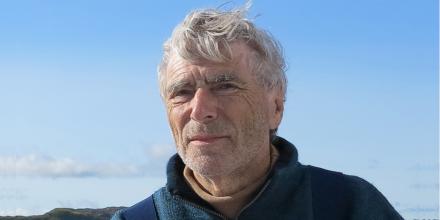
Greetings from the Australian National University in Canberra, where Alex Teytelboym from the University of Oxford is speaking on "Climate and Innovation". He started by pointing out that the commitments to emissions reductions made at the COP 21 Paris Agreement were not sufficient to limit global warming to 2 degrees. He suggested that most coal will have to be left in the ground and changes to development needed by next year to avert global disaster.
Dr. Teytelboym has carried out a detailed analysis of the development of green products, to see how new industries emerge (a "Green Complexity Ranking"). He found, not surprisingly, that Germany makes complex green products, whereas South Africa makes simpler ones. Surprisingly Australia ranks very poorly in production of both simple and complex green products, near the bottom of the list at 116 out of 117, between Trinidad and Panama. However, Dr. Teytelboym points out that Australia ranks well in the export of services, such as higher education.
Dr. Teytelboym has published papers on climate change. Interestingly, he has also published papers on Social Networks, but none on climate change and social networks. I suggest that just as major changes in emissions from vehicles with conventional internal combustion engines has been made possible by the addition of computer controls, ICT can be used more generally to reduce emissions. An example is a social networking applicaiton which introduces people so they feel confortable to share local co-working office or a ride-share vehicle. I discuss this in my course "ICT Sustainability: Assessment and Strategies for a Low Carbon Future".
Showing posts with label global warming. Show all posts
Wednesday, September 14, 2016
Tuesday, April 28, 2015
Ethics and Climate Change Prediction
Greeting from the Australian National University in Canberra, where Professor John Broome is speaking on "Ethics in the IPCC process" at the Centre for Climate Economics and Policy.
Professor Broome explained how the International Panel on Climate Change (IPPC) is an independent scientific organization, but taken notice of by the UNFCC, which is the relevant treaty organization on climate change. The IPCC has three working groups on science (WG1), impacts (WG2) and mitigation (WG3) of climate change. The main reports are the equivalent of 5,000 pages and there were 143,000 comments received.
Professor Broome went to 13 meetings of 4.5 days each and worked out he was responsible for a considerable amount of carbon emissions just commuting to the meetings. ;-)
The scientists are volunteers, not paid by their work. He commented that the structure of the reports had already been decided. The recommendations are checked word by word. There were two moral philosophers included. Professor Broome wrote on "Justice, equity and responsibility" (3.3, page 12) and Professor Lukas Meyer, Graz University, Austria on "Values and wellbeing" (3.4 page 20).
Professor Broome commented on the differences between the scientific authoring approach and that of philosophers (Aristotle never wrote any refereed papers). The philosophers wrote on justice and value, which the scientists accepted, eventually. Also he commented on how the scientists and other academics wrote the detail of the reports, but there was government and political input into summaries (which is all anyone reads anyway).
I have some experience of the process of developing international standards, but not on this scale. Also I have been working recently with educators who come from the social science and have a different outlook on the world to the "hard" sciences.
Professor Broome described how the final drafts were produced with the text on the screen using Microsoft Word track changes, color coded with changes. Controversial sections are sent to a smaller "contact group" in the case of the philosopher's section taking three and half pages for three pages of text. He described how other sections got cut down due to lack of time and people.
What I found most surprising about Professor Broom's presentation was that he was generally positive about the outcome of the IPCC process. This is despite at one point describing how Saudi Arabia attempted to have a graph "censored" from the report, as it showed how the rich nations had caused the global warming problem. The Netherlands delegate attempted to outmaneuver this by having another section inserted (but the Netherlands government was un-contactable and so their delegate could not get approval).
Professor
Broome described how some national delegations were in continuous voice
contact with their experts at home and sending screen captures, taking
instructions. If the process is to not be put on-line, then this
practice should be banned, as it is inequitable. However, it would be
better to put the whole process on-line.
If the IPCC is not willing to put their process on-line, then this could be done by volunteers. If the secretariat was not willing to cooperate, then volunteers amongst the delegates could transmit the video and audio from the meeting room. This could then be distributed publicly on-line and real time discussion rooms of experts, national representatives and the general public could debate the issues and make recommendations to the delegates.
It strikes me the IPCC process is similar
to an open outcry auction system, as previously used for commodity
trading. Such systems have mostly been replaced by on-line computer
based systems, which are more efficient and by having a lower
transaction cost, more equitable. The IPCC process excludes most of the
people in the world from participating, because they cannot afford to
attend the meeting.
If the IPCC is not willing to put their process on-line, then this could be done by volunteers. If the secretariat was not willing to cooperate, then volunteers amongst the delegates could transmit the video and audio from the meeting room. This could then be distributed publicly on-line and real time discussion rooms of experts, national representatives and the general public could debate the issues and make recommendations to the delegates.
Wednesday, April 22, 2015
Ethics of Climate Change Prediction
Professor John Broome will speak on "Ethics in the IPCC process" at the Centre for Climate Economics and Policy, Australian National University in Canberra, 5:30pm, 28 April 2015.
The Fifth Assessment Report is the first of the IPCC’s reports that has explicitly given a place to ethics. Two philosophers were included as Lead Authors for this purpose. However, an IPCC report is designed to be a review of scientific literature, and the process of writing it is organised with that aim in mind. Philosophy does not fit easily into that framework. Moreover, IPCC reports are commissioned by governments and must ultimately be approved by governments. Each sentence in the summaries for policymakers has to be explicitly approved by a consensus among all governments. This poses further difficulties for ethics in the IPCC, since ethics tends to be politically contentious.
Professor John Broome will describe how the process went from the point of view of a moral philosopher, and assess how successful the IPCC has been in its aim of taking account of the importance of ethics in responding to climate change.
John Broome is Emeritus White’s Professor of Moral Philosophy at the University of Oxford, and an Adjunct Professor at ANU. He was once Professor of Economics at the University of Bristol. For the IPCC’s Fifth Assessment Report, he was a Lead Author in Working Group 3 and a member of the Core Writing Team of the Synthesis Report.
Monday, February 16, 2015
Teaching materials on the science of climate change
The Australian Academy of Science has published "The science of climate change", a 44 page booklet intended to explain how global warming is cased by human activities. While too long and technical for the general public, this would be useful for students.
The booklet is available as a web page, and PDF documents (with and without references). I will be suggesting my ICT Sustainability students read Chapter One "What is climate change?", as it provided a good overview. Chapter three "Are human activities causing climate change?" would also be okay for the students (they have degrees in science and engineering), but is a bit too technical for the general public, with several graphs.
The web version of the booklet is well laid out and could be used with e-learning courses. The PDF versions have a portrait layout, with four narrow columns of text, making it hard to read. At more than 7MBytes each, the PDF versions are also too large (and by wasting computer resources will be contributing to carbon emissions). The version
without references is twelve pages shorter, but the file is not much
smaller (7.1 v 7.3 Mbytes). About 80% of the PDF files are taken up with excessively large images. I suggest AAS make the images smaller and reduce the PDF file to one third the size (and reduce carbon emissions).
It might also be useful to point out to school, VET and universality teachers, which parts which suit which level of students and include some student exercises. Almost none of the general public are going to read through 44 pages on climate change, but students may well read a dozen pages, if they will get a mark for it.
Friday, January 23, 2015
Global Warming Has Increased the Risk of Nuclear War
Perhaps there should be a standardized global "Hot Line" for use between nations. The hard part would be agreeing who could talk to who and having them train to use the system. Not much hardware or software is needed: the Moscow–Washington hot-line uses off-the-shelf text-chat and email software (such hot-lines don't use voice communication). However, such a system would have to operate in the face of cyber-attacks and electronic warfare, by the nations involved in the dispute and third parties.
Monday, July 08, 2013
Planting Trees Will Not Offset Fossil Fuel Emissions
Professor Mackey commented this was his first presentation using Prezi. He apologized if this made us seasick, but it was a very clear and interesting visual presentation (much better than another dull Powerpoint slide show).
The issue of carbon emissions is not just an academic one for ANU. The ANU student newspaper has a lead article criticizing thee university for increasing its investment in coal seam gas mining (ANU Turns Up The Gas, Woroni", Ben Latham, No 7, Vol 65, Thu 16). Research by Southern Cross University suggests that far more methane is leaking from coal seam gas mining than previously expected (Fugitive Emissions from Coal Seam Gas, Santos and Maher, 2012). So it appears possible that coal seam gas increases global warming, not reduce it.
Sunday, June 19, 2011
The Logic of Global Warming
Research School of Computer Science
The Logic of Global Warming
Vaughan Pratt, Emeritus Professor (Stanford University)
LOGIC AND COMPUTATION SEMINAR
DATE: 2011-06-23
TIME: 12:30:00 - 13:30:00
LOCATION: CSIT Seminar Room, N101, Computer Science and Information Technology Building, Australian National University, North Road, Canberra.
CONTACT: Malcolm.Newey@anu.edu.au
ABSTRACT:
When averaged over anything less than a decade, Earth's surface temperature is difficult to predict. Beyond that however, only three significant contributors to surface temperature are apparent from the global temperature record of the past 160 years, namely two ocean oscillations of apparently long standing, and the quite recent influence of greenhouse gases of human origin. I'll discuss approaches to estimating these including the robustness of such estimates and also look briefly at the more minor contributors to long term global temperature. The talk will be pertinent to Climatologists, Physicists, Engineers and Computer Scientists with an interest in global warming.
BIO:
Vaughan Pratt is an emeritus professor of Computer Science at Stanford University and historically interested in a large number of areas of the subject - architecture, algorithms, languages, systems and particularly the application of mathematics. More details of his achievements are available though Wikipedia. He will be visiting CECS for the week of 20-24 June.
Sunday, October 19, 2008
Digital Green Earth
In 'From Digital Economy to "Digital GreenEarth"' Yasuhiko ARAKAWA (Director, Institute for Nano Quantum Information Electronics) argues that ICT can create a low greenhouse gas emission economy in Japan by 2050. He predicts that online information requirements will increase 200 times from 2006 to 2025, so the energy use of the technology needs to be reduced. The estimate of a 200 fold increase is probably an underestimate, but even greater efficiency should be possible.
Professor ARAKAWA suggesters:
- Boosting energy efficiency of network infrastructure and servers
- Energy management in lighting and air conditioning
- Better Human Interfaces
- Innovative nanotechnologies.
Friday, March 21, 2008
Testing Heat Pump Water Heaters
The New Zealand Government has issued a request for tender for a test strategy for Heat Pump Water Heaters. There is a common Australia/NZ standard for these (AS/NZS 4234), but this has two climate zones unique to NZ, which the heaters need to be tested for. Heat pumps are very efficient for heating water, but have problems operating at low temperatures.
To develop a laboratory testing method that determines the key air-source HPWH performance characteristics of the common system Configurationsand to develop in parallel,TRNSYS models for the common HPWH configurations so they can accept the outputs of the HPWH performance testing methods.
The models are required to model the HPWH seasonal performance for the two NZ climate zones defined in AS/NZS 4234.
From: To develop an Air-Source Heat Pump Water Heater performance test and TRNSYS annual performance Model, ICNNZ Reference: 21289
Thursday, February 21, 2008
Garnaut Climate Change Interim Report
The interim Garnaut Climate Change Review, commissioned by Australian governments has been released. The suggested cuts in green house gas emissions are possible with minimal impact on our lifestyle and economy. Reducing energy use with computers, broadband and the Internet, could help. A further Draft Report will be released 30 June 2008 and a Final Report 30 September 2008.
Available are:
The full report is 64 pages long. All the documents appear to have been efficiently and carefully encoded in PDF, unlike many government reports. But the reports could do with shorter web addresses. They are about 150 characters long. Removing the duplicated text and "MicrosoftWord" would help, especially as the files are in PDF format, not Microsoft Word.
Here is the text of the executive summary:
Available are:
The full report is 64 pages long. All the documents appear to have been efficiently and carefully encoded in PDF, unlike many government reports. But the reports could do with shorter web addresses. They are about 150 characters long. Removing the duplicated text and "MicrosoftWord" would help, especially as the files are in PDF format, not Microsoft Word.
Here is the text of the executive summary:
This Interim Report seeks to provide a flavour of early findings from the work of the Review, to share ideas on work in progress as a basis for interaction with the Australian community, and to indicate the scope of the work programme through to the completion of the Review. There are some important areas of the Review’s work that are barely touched upon in the Interim Report, which will feature prominently in the final reports. Adaptation to climate change, energy efficiency and the distribution of the costs of climate change across households and regions are amongst the prominent omissions from this presentation.
Many views put forward in this Interim Report represent genuinely interim judgements. The Review looks forward to feedback from interested people before formulating recommendations for the final reports.
Developments in mainstream scientific opinion on the relationship between emissions accumulations and climate outcomes, and the Review’s own work on future “business as usual” global emissions, suggest that the world is moving towards high risks of dangerous climate change more rapidly than has generally been understood. This makes mitigation more urgent and more costly. At the same time, it makes the probable effects of unmitigated climate change more costly, for Australia and for the world.
The largest source of increased urgency is the unexpectedly high growth of the world economy in the early twenty-first century, combined with unexpectedly high energy intensity of that growth and continuing reliance on high-emissions fossil fuels as sources of energy. These developments are associated with strong economic growth in the developing world, first of all in China. The stronger growth has strong momentum and is likely to continue. It is neither desirable nor remotely feasible to seek to remove environmental pressures through diminution of the aspirations of the world’s people for higher material standards of living. The challenge is to end the linkage between economic growth and emissions of greenhouse gases.
Australia’s interest lies in the world adopting a strong and effective position on climate change mitigation. This interest is driven by two realities of Australia’s position relative to other developed countries: our exceptional sensitivity to climate change: and our exceptional opportunity to do well in a world of effective global mitigation. Australia playing its full part in international efforts on climate change can have a positive effect on global outcomes. The direct effects of Australia’s emissions reduction efforts are of secondary importance. Australia has an important role to play alongside its international partners in establishing a realistic approach to global mitigation. Australia can contribute to the development of clear international understandings on the four components of a successful framework for global mitigation: setting the right global objectives for reduction of the risk of dangerous climate change; converting this into a goal for stabilisation of greenhouse gases in the atmosphere at a specified level; calculating the amount of additional emissions that can be emitted into the atmosphere over a specified number of years if stabilisation of atmospheric concentrations is to be achieved at the desired level; and developing principles for allocating a limited global emissions budget among countries.
Australia should make firm commitments in 2008, to 2020 and 2050 emissions targets that embody similar adjustment cost to that accepted by other developed countries. A lead has been provided by the European Union, and there are reasonable prospects that the United States will become part of the main international framework after the November 2008 elections. Some version of the current State and Federal targets of 60 per cent reduction by 2050, with appropriate interim targets, would meet these requirements.
Australia would need to go considerably further in reduction of emissions as part of an effective global agreement, with full participation by major developing countries, designed to reduce risks of dangerous climate change to acceptable levels. Australia should formulate a position on the contribution that it would be prepared make to an effective global agreement, and offer to implement that stronger position if an appropriately structured international agreement were reached.
The process of reaching an adequate global agreement will be long and difficult. Australia can help to keep the possibility of eventual agreement alive by efficient implementation of its own abatement policies, and through the development of exemplary working models of cooperation with developing countries in regional agreements, including with Papua New Guinea.
Australia must now put in place effective policies to achieve major reductions in emissions. The emissions trading scheme (ETS) is the centre-piece of a domestic mitigation strategy. To achieve effective mitigation at the lowest possible cost, the ETS will need to be supported by measures to correct market failures or weaknesses related to innovation, research and development, to information, and to network infrastructure.
Establishing an ETS with ambitious mitigation objectives will be difficult and will make heavy demands on scarce economic and finite political resources. The difficulty of the task makes it essential to use the most efficient means of achieving the mitigation objectives. That means efficiency both in minimising the economic costs, and in distributing the costs of the scheme across the Australian community in ways that are broadly seen as being fair.
To be effective in contributing as much as possible to an effective global effort to avoid unacceptably high risks of dangerous climate change, soundly based domestic and international policies will need to be sustained steadily over long periods. Policy-makers will need to eschew short-term responses that seem to deal with immediate problems but contribute to the building of pressures for future policy change. The Review aims to provide the basis for steady long-term policy at Commonwealth and State levels, and for productive long-term Australian interaction with the international community on climate change policy.
From: Executive Summary, Garnaut Climate Change Review Interim Report to the Commonwealth, State And Territory Governments of Australia, February 2008
Friday, October 12, 2007
Nobel Peace Prize 2007 to IPCC and Al Gore
IPCC members such as Dr Rajendra K Pachauri, have done much hard work over many years to bring climate change to world attention. It seems odd that they all have to share half the prize with Al Gore, who produced little more than the Powerpoint presentation of an "An Inconvenient Truth" (and DVD). However, Mr. Gore's presentation probably had more effect on public opinion than all of the experts on the IPCC, as the Nobel committee notes:
... Through the scientific reports it has issued over the past two decades, the IPCC has created an ever-broader informed consensus about the connection between human activities and global warming. Thousands of scientists and officials from over one hundred countries have collaborated to achieve greater certainty as to the scale of the warming. Whereas in the 1980s global warming seemed to be merely an interesting hypothesis, the 1990s produced firmer evidence in its support. In the last few years, the connections have become even clearer and the consequences still more apparent.Some books available on the topic:Al Gore has for a long time been one of the world's leading environmentalist politicians. He became aware at an early stage of the climatic challenges the world is facing. His strong commitment, reflected in political activity, lectures, films and books, has strengthened the struggle against climate change. He is probably the single individual who has done most to create greater worldwide understanding of the measures that need to be adopted...
From: The Nobel Peace Prize for 2007, Media Release, Nobel Foundation, Oslo, 12 October 2007
- Reports of the Intergovernmental Panel on Climate Change, and discussion thereof
- Looking Back to Think Ahead: GREEN India 2047, P V Sridharan, R K Pachauri (1998) and Other books by R K Pachauri
- An Inconvenient Truth, by Al Gore (also DVD) and other books by and about Al Gore
- Global Warming and Global Warming in Australia
- The Nobel Peace Prize
Friday, March 23, 2007
Green office building opens in Canberra
AEI refurbished Block E of Trevor Pearcey House in the Bruce Technology Park. It has:
* hydronic heating and coolingAEI are aiming for a 75% reduction in energy use (and consequent reduction in CO2 greenhouse gas). What is most impressive is that they have done this within the restrictions imposed by an existing building which has to still fit in with the other building of the technology park.
* designated parking spaces for small cars and motorbikes
* bicycle racks for staff and visitors
* double glazing on windows and increased shading
* skylights
* added insulation and
* water tanks and water saving toilets and urinals.
From: Treavour Pearcy House, AEI
The building has been clad in insulation to reduce heating and cooling needs. But you can't notice the difference with the building next to it. If you look closely the AEI building looks smooth, whereas the one next door shows a rough painted brick surface. The AEI building actually looks slightly higher quality as a result.
It is a shame AEI couldn't make the building's green technology more visible from the outside. The back of the building is far more interesting than the front. The front looks like a bland technology park building. The back has the bicycle racks and water tanks. On the roof you can see the light wells and solar chimneys, as well as the evacuated tube solar hot water system. The Microsoft Technology Center in Cambridge UK made the bicycle racks a feature of the building (and easier to find when I wanted to park my bike). The energy and water efficient homes at the "Eco-living Exhibition" in Canberra made a feature of the solar chimneys and panels.
Offices in the center of the AEI building have conventional suspended ceilings. The architect has decided to leave the edges of the ceiling exposed, to allow natural ventilation. This is perhaps taking the industrial esthetic a little too far. It makes the building look half finished, with a rat's nest of cables and insulation exposed. Some sort of grille could have been used to cover the gap, allowing ventilation but providing visual continuity.
Conduits for power and computers are simply stuck to the concrete of the ceiling in most places. Having spent many hours with my head in ceilings and floors running computer cables through tiny holes, this is a great improvement. However, the architect might have done better to leave the concrete ceiling grey and used the hanging lights and cable ways to create a virtual ceiling. Looking up, you would see the bright white of the light fitting s and cable ways and not tend to notice the grey concrete above.
The building aims to maintain a temperature of 19 to 26 degrees C, which should be comfortable. The requirement for government buildings is 22 degrees plus or minus 1 degree and this tight range greatly increases energy consumption and cost, without providing much extra comfort. In fact the cold office on a hot day might not be as comfortable for the occupants.
The building uses a computer controlled system to open the windows at night in summer to cool it. I might see if some ANU students would like to do a project to interface the system and report the building status on the web (or even a mobile phone). The AEI building is by the same architects as the ANU's Ian Ross engineering building.
At the launch I bumped into Keith Price, who works on computer systems for the Centre for Australian Ethical Research. CAER are one of the occupants of the building and undertake research for AEI. The environment and ICT were an emerging theme at the ACS Conference last week. I suggested to Keith that perhaps we needed to form a Special Interest Group to address this in Canberra.
I am an AEI shareholder and have money in their ethical super fund. But while AEI's green credentials may be good, it can be frustrating difficult to put money into their fund. With other super funds I can simply use BPAY to electronically transfer money. AEI want me to set up a bank transfer and fill in a paper form. This is error prone and unnecessary and I suspect they are missing out on a lot of funds as a result. If you think e-payments are a trivial system see my discussion of the eighteen character problem.
ps: Apart from ICT for the environment, there is another computer connection to the AEI building. The building is named in honor of Dr Trevor Pearcey, Australian computing pioneer and one of the founders of the Australian Computer Society. In 1993 I took part in a future study for Canberra and wrote "Canberra 2020: World Information Capital" (published in Informatics Magazine, September 1993). This featured Trevor Pearcy House.
Monday, October 23, 2006
An Inconvenient Truth
The book "An Inconvenient Truth", by Al Gore, provides a lucid argument for action on global warming.
This "book of the film" is 328 pages long. But it is not an old fashioned academic book. It is more for a coffee table, with mostly large color photos, a few diagrams a minimum of very large text (much like a children's book). The last few pages provide a useful set of suggestions as to what the average person can do to save the planet.
There is no table of contents in the front and no index in the back of the book. About the only way to look for topics in the book is using Amazon's "look inside" feature. I used this to find there are six references to Australia and none to the Indian "Reva" electric car.
Al Gore probably has done more for the world by presenting this material than he was likely to do as President of the USA. It will be a better seller than previous books by Al Gore which were famously lampooned on "The Simpsons" for their dull earnestness. But still the DVD of the documentary film, directed by Davis Guggenheim, is likely to sell more than the book (you can also download the video).
There is also a web forum to discuss the issues.
Some other books on the topic:
Subscribe to:
Posts (Atom)