Showing posts with label Canberra. Show all posts

Friday, April 08, 2022

Canberra World Center

The Canberra Innovation Network and ActewAGL are running a competition for ideas for a Canberra of the future. So I submitted "Canberra World Center".

My "Canberra 2020: World Information Capital" is from a previous ACT Government future history project in 1993. In this I envisioned Canberra replacing New York as the headquarters of the UN. That didn't happen, but is something I envisioned in 1998 did happen, with CBRIN being set up.

Canberra World Center

Combine a new sustainable fast built conference center, with facilities for dozens of universities to provide blended learning.

Canberra needs a new conference center, but such buildings stand empty much of the year. Canberra is a center for learning, but COVID-19 has shown how we need more flexibility in where and how we learn. These needs can be answered with a combined conference center and multi-institution vocational and university campus. This facility will have large multi-purpose halls, which can be used for conferences and courses. 

Dozens of educational institutions will be permanently based at the center, sharing the facilities, and bring vibrancy, and cash-flow(1). Some students will be full time on campus, but many will come for a week or two per year, staying in the conference accommodation, between events. 

The conference center will be rapidly constructed using the latest in prefabricated sustainable materials (2). The center's roof can be covered with solar panels, making it capable of operating independently of the grid, and offering an emergency center in times of crisis.

The Adaptive City needs to re-imagine Canberra for living and learning in 2040. Canberra needs to operate how it plans. It needs a place, an idea for  business innovation, sustainability, to create, connect, and thrive.

Notes

1. SA Government's Torrens Building accommodates multiple universities: https://blog.highereducationwhisperer.com/2014/07/how-many-universities-in-torrens.html

2. The  ANU Marie Reay Teaching Centre, is build from pre-assembled wood panels. https://blog.highereducationwhisperer.com/2019/02/learning-to-teach-in-new-anu-teaching.html

Who will benifit?

People wanting to host, or attend, major national conferences will benifit from the facilities, as will universities and their students.

What is the problem?

Canberra lacks an up to date conference center, and somewhere for nimble post-COVID educational institutions.

How will it make Canberra Better?

A conference center will attract events, and visitors to the city. An education center will attract academics, support staff to live in Canberra, and students to come to study.


Sunday, September 12, 2021

Wollies Direct to Boot Worked Better Than Coles but there is Room for Innovation

Woolworths Direct to Boot Bay,
Tom Worthington CC-BY 12 September 2021
My second attempt to order groceries online from Coles failed, so I switched to Woolworths. The online ordering was much the same, but the collection process was much quicker, easier, and more pleasant. I received a text message telling me my order was ready for collection, to click when I departed, and click again when I arrived. As with Coles, I got lost in the car-park trying to find the collection bays. But this was in the open air, not an underground car park so much easier to see my way around, and it felt less oppressive (at the wonderfully named Spitfire Avenue, next to Canberra Airport). 

The bays were clearly marked, and the staff already on hand, so I was out in a couple of minutes (rather than 20 at Coles). They had a hand card with crates which fitted to it, rather than the wobbly trolley  Coles was using. All my order was there and the fresh items excellent quality. There seemed to be more plastic bags, but this may be because I had ordered frozen, and chilled food, with each category in a separate bag.

For me Woolworths wins hands down over Coles, assuming the ordering system keeps working. If not, is there a third alternative in Canberra? 

Perhaps the team at the Canberra Innovation Network, Innovation ACT and ANU TechLauncher could design an independent home shopping system. This might use a just in time picking system: when you told the system you were on your way, the picker would quickly go around the isles in a discount supermarket, picking the items, and be ready just as you pulled up outside. The picking service doesn't need to be owned by, or affiliated with, the supermarket.

Thursday, September 09, 2021

The Wheels Fell Off My Virtual Shopping Trolley in the Pandemic

The Coles error screen. 
It has taken me 18 months to get around to sign up for online grocery shopping. This is to avoid the Russian Roulette of stepping into a store. It is not so much fear of catching COVID-19 (I am fully vaccinated), as the inconvenience, if I have to isolate and be tested. I have been purchasing complex electronic devices online for a decade, but it has proved surprisingly difficult to buy basic groceries online.

Who?

My first thought was IGA, the small local supermarket, only 30 m from my door. Unfortunately, while it is part of a national chain, they don't offer online shopping. I did sign up for the IGA catalog, but they sent me so much spam I cancelled it. Unfortunately Aldi doesn't offer this service either (apart for buying Aldi gadgets). I am surprised no one has offered a third party delivery service, offering to buy items in Aldi then charging a premium but still "less than Coles & Woolworths" for similar items.

When? 

The next option was Coles, as recommended by a friend. It was reasonably easy to sign up and select items to purchase. I liked the option to list goods by unit price (so you get the cheapest apples per Kg first). However, when I went to select a delivery time I was shocked to find the first was not for a week and had to bid for a slot.

The popular times cost more, and like booking airlines seats. This created the anxiety that if I did not take one now, it would be gone. Going for the click and collect in store option was not much use, as the object of the exercise was not to enter a store. So I selected the option to have goods delivered to my car boot. But there are only a limited range of stores with this option. Curiously these were the larger ones. I would have thought any store with click and collect, would be able to do this.

Where?

The address given for pickup at my nearest Coles store was in a middle pedestrian mall. Detailed instructions to navigate to a special bay in the car-park were emailed to me, but only after I placed the order. In the interim I posted a query with the online, who replied they did not know. The instructions when they arrived were clear and detailed. 

How? 

Then there was the no bags dilemma. Coles ordering has an option for no disposable shopping bags. But this said I had to pack my own. If the shopping is being placed directly in the car boot: how is this done without bags? So I posted another query and was told to call. The help line said to pack your own was a "problem" and so I should select the bags option. That makes sense, but then why offer a no bags option (Woolworths doesn't)? 

Where?

Approaching Canberra's city center by car was a strange experience. I had not driven my car for weeks. I was now driving through almost deserted streets, to an almost deserted shopping center. There was a barrier across the street just in front of the entrance (like something used to keep out the Zombie Apocalypse). I went down, down, down into the car park. Then I had to take a ticket (giving 20 minutes free parking). 

I had envisaged waiting for my shopping in an outside carpark in the fresh air and sunshine. Instead it was now in a subbasement, with all my windows rolled up, looking around in fear in case someone approach, like an extra in a dawn of the dead movie. I parked in the designed spot. Then the vehicle nearby pulled out, and re-parked boot to curb. That made sense so I did the same.

There was a phone number on the wall, which I called, and got an answering service. So I left a message. Five minutes later the other car got its groceries, then another, so after ten minutes I called again. This time a person answered and I gave my name, then again, then spelled it. Five minutes later my groceries arrived. I had expected some sort of automated electric golf cart, but it was a person pushing an ordinary shopping trolley.

They asked my name, but could not hear me, as I had the window up, as per the instructions. So they held the bag with my name on it up and I nodded. I pulled the lever to open the boot, they put the shopping in and I was off. This had taken twenty minutes. I appreciate that there are workers doing this job under difficult conditions, but this took longer than if I had gone into the store and picked the items off the shelves myself. 

Goods?

Getting home, I found I had everything ordered and the quality of the fresh produce was excellent. There was one substitute: I had ordered a bag of limes and instead received the same number loose (which I preferred anyway). One item was much more expensive than expected: I thought it was on special but it was not (I probably picked the wrong one by mistake from the very long list of similar items). But there were also two extra jars. Where I had ordered two jars I got four, and only paid for two. So I came out about even overall.

Fluke?

Having managed one successful online shop, I thought I would try next for frozen goods and fresh meat. But my second attempt to order from Coles resulted in an error message. I called the help line, as instructed, but was told it was a technical problem, and I would have to call back the next day after 9am. When I called the next day I was offered text chat help, so I tried that, but it did not fix the problem. Coles has a cute error screen, depicting shopping spilled from a trolley. This was amusing the first time I saw it, but I got tired seeing it over and over again. So I gave up on Coles, and tried Woolworths.

Again

Woolworths was just as easy to sign up for and select goods as Coles. Despite Woolworths charging more for shopping bags than Coles, the same bundle of items from Coles cost less from Wollworths.

This time I did not even consider home delivery, and instead selected to-boot. Like Coles, there was a three day delay before I could collect. The time slots were one hour, rather than Coles' two. Also the deadline for changing my order before collection was a half hour shorter (five and a half hours, instead of Coles' six). This deadline is useful: you can add items to the order for days before collection, and keep your collection time booking. It is a few days to collection time and I will report how it goes then.

What Might Be Better?

The applications from Coles and Woolworths work much as I would expect my teams of computer students to built. There is nothing which standards out as particularly innovative, but these shopping application work much better than, for example, government COVID-129 vaccination booking applications.

Tuesday, August 17, 2021

Canberrans Queuing Around the Block for a COVID-19 Test

COVID-19 Testing Queue in Canberra,
by Tom Worthington CC BY 17 August 2021
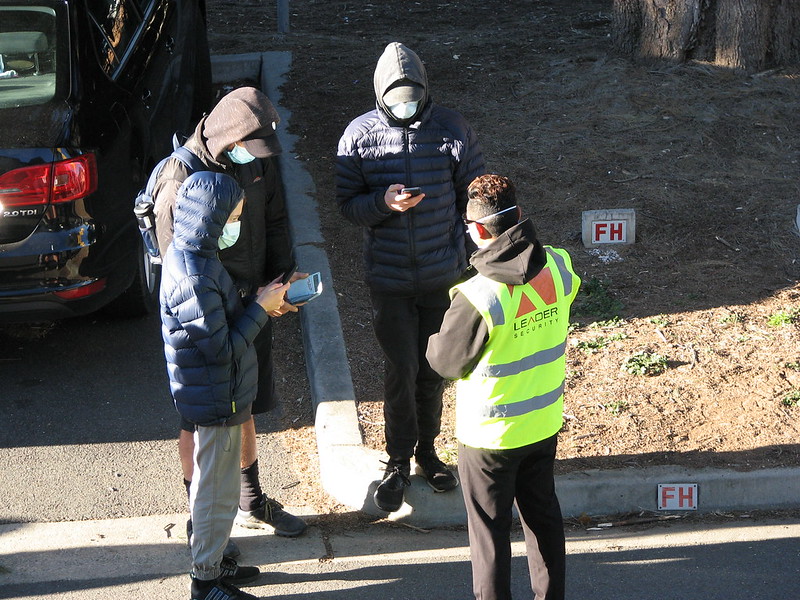
Came back from my bicycle ride yesterday (allowed under Canberra's lock-down rules) to find a line of people standing in the street outside my front door. First I thought it might be a Le Mans start for a car rally: but during a lock-down? Then I thought it might be a socially distanced protest: but against what? Then everyone moved one place to the right and I saw it was a queue snaking around the corner to the pathology lab, for COVID-19 tests. 

COVID-19 Marshall at Testing Queue in Canberra, 
by Tom Worthington CC BY 17 August 2021 
There was a marshal in a yellow vest going along the line checking details. It was very orderly and gone in an hour. The line was back this morning on a very cold winter's day. I was proud to see my fellow citizens responding to an emergency with quiet determination. It was also to see one of the local cafes was offering to deliver food and drink to those in the queue.

Wednesday, February 05, 2020

Innovation in Difficult Times

Greetings from the Canberra Innovation Network, where Andrew Barr, Chief Minister of the ACT,  just opened their new co-working space. He pointed out "we are going to have to be innovative". One challenge was that due to fires the ACT can' t recycle materials: so how to we keep this out of landfill. Also the ACT has to respond to changing climate, and further reduce carbon emissions. While Canberra doesn't have net emissions from electricity, the Chief Minister admitted there was much more to do. Another challenge was the Wuhan coronavirus and its effect on Canberra's education sector.

Wednesday, August 21, 2019

GovHack 2019 Launched

Greetings from the Canberra launch of GovHack 2019. This is the tenth year of the GovHack completion where teams have a few days to build an application using open government data. This is hosted by the Australian National University for 2019. It happens  have just come from the launch of the Square One co-working space at ANU, next door.

Friday, July 19, 2019

ACT Renewables Showcase

I am running a free workshop on "How Green is my Computer?" at the ACT Renewables Showcase in Canberra, 26 July 2019. There is also an electric car exhibition.

Program

9:00-9:20 Registration
9:20-9:30 Welcome/Opening
10:00-17:00 Electric Vehicles Exhibition (in partnership with Tesla Owners Club of Australia and Australian Vehicle Association)
9:30-10:15 Panel: Policy Implications for Renewables with Geoffrey Rutledge (ACT Government), Dr Frank Jotzo (ANU), Dr Andreas Loeschel(University of Munster); moderated by Sylvia Tulloch (BAB Chairman for REIF)
10:30-11:45 Workshop: How Green is my Computer? by Tom Worthington.
11:45-12:45 Panel: Women in Renewables with Shahana McKenzie(Bioenergy Australia), Clara Mazzone (ITP Renewables), Alison Reeve (ACT Government), Michelle McCann (PV Lab), Dr Marnie Shaw (ANU); moderated by Ruth O'Connor (ANU)
13:15-14:10 Seminar: Renewable Energy Innovation and World Trends by Simon Corbell (Energy Estate).
14:25-14:50 Speed Talks: Greening the Future-Bioenergy for Transport and Industrial Application by Dr Clive Stephens (Vtara Energy Group).
14:55-15:20 Speed Talks: How Electric Vehicles Could Shape Our World? by Darryl Bourke (Tesla Owners Club of Australia).
15:25-15:50 Speed Talks: Building Blocks of a Sustainable Energy Future by Vincenzo Marciano and Ryan Wood (Evergen).
16:00-16:55 Seminar: State of affairs: Clean Energy Market Challenges by John Grimes (Smart Energy Council).
17:00-17:30 Closing Ceremony closing remarks by Chief Minister Andrew Barr.
From 17:30, Energy Lab will kick off with their famous annual Hackathon. Join us to explore a variety of opportunities that will accelerate the uptake of clean energy. To register for the Hackathon, click here.
You can find tickets at https://www.eventbrite.com.au/e/act-renewables-showcase-2019-tickets-63848147528

Tuesday, April 30, 2019

Canberra Trams Working but Need Safety Improvements

On Saturday I took my first ride on Canberra's new light rail system. The trams work, are fast, and reasonably comfortable, but some improvements need to be made to the information systems, and the safety of the network.
In late March I suggested to the Minster and Transport Canberra, some improvements for the safety of Canberra's trams. Here is the reply:
"Hi Tom, thanks for contacting us.

 Automatic Train Protection is a range of different signalling technologies that have been adopted to varying degrees across train networks in recent times. Only small parts of the Australian train network currently operate ATP. It is based upon (train) railway signalling systems that are utilised on train networks but not light rail/tram networks. There has been no adoption to date of ATP in light rail/tram networks.

Once the ATP technology is developed for light rail/tram systems it is expected most operators across the world will examine whether it is suitable and required for their networks.

Thanks, TC." Apr 2, 2019, 3:33 PM
In my view it would have feasible to at least install automatic stopping at stop signals for the trams, given far more sophisticated automatized systems are provided by the contracts in Europe.

Neither TC nor the Minister replied to my suggested upgrades to pedestrian crossings. However, one safety improvement I did notice at the  Macarthur Avenue stop, was a large retro-reflective sign "< LOOK>" had been painted on the pedestrian crossing. This is well placed to be seen by people looking down at a mobile phone while walking. However, the yellow sign is not as easy to see as you would expect. These signs are normally applied to a black road surface, and are harder to see against the gray concrete of the tram line. I suggest the signed be given a dark background, to increase the contrast.

The electronic signs at the stop proved to be confusing. These display the last stop on the line in large letters with a number next to it: "GUNGAHLIN PL 6". Another passenger asked me if this was the right platform for Gungahlin, and it too some time to work out what the sign meant. After a few seconds under this in small letters appeared "TO: Gungahlin 23 min". As the trams were supposed to be running every 15 minutes this made no sense. Then the large digit changed to "5" and I worked out this was a countdown to the next tram, and the smaller display was the one after that.

The tram arrived as per the sign, and I got on to what was a moderately crowded service. Even so I was able to get a seat. The trams are very similar to those on the Sydney and Newcastle lines. The ride was much less smooth than the older Newcastle line. The tram swayed from side to side, jerked over bumps, stopped and started with a jerk, and squealed around the corner at Epic. This is surprising for a new installed system. At one location I noticed what appeared to be welding metal left on the track, which may have added to the bumpy ride and indicates poor instantiation and testing of the track. Also at one point in my travels, the tram stopped suddenly, sending standing passengers sprawled onto the floor, fortunately without any apparent injuries.
not as
I alighted at Well Station Drive stop. Unfortunately the pedestrian crossing at this stop only has the "< LOOK >" sign on the road side of the crossing. It would be very easy for someone to step off the tram, and under the path of a tram coming the opposite way. I suggest "< LOOK >" be added to all crossings.

The Green Shed had posted to Facebook, pointing out there was now a stop near their second had store at the Mitchell Resource Management Centre (aka "The Tip Shop"). The information sign at the tram stop directed me to the center. However, I could not find a footpath from the stop to the center. Worse still, the bicycle path which previously ran beside the road was moved to the roadway, and the previous path plowed up. I watch as someone tried to pull their wheeled shopping bag over this broken path. I suggest the path be repaired.

I continued my journey to the stop at the end of the line: Gungahlin Place. As the doors opened, a flustered transport officer told us to alight from the other side of the tram. This was confusing as an announcement had just told us to use either side. The staff were having difficulty coping with the large number of passengers, and had sensibly decided to have them enter one side, and exit the other. But the onboard system needs to be changed to say this. Surprisingly, the pedestrian crossing here at the terminus was also not well marked. My return journey was uneventful.

The next day I took the tram to Civic. One pleasant surprise was a new coffee shop, "The Coffee Store", at the corner of David Street and MacArthur Avenue, a short walk from the tram.

The Civic terminus was not as busy as Gungahlin had been the day before. I noticed temporary barriers at the end of the platform, and at the crossing, to stop people walking into danger. I suggest these should be replaced with permanent barriers, and extended along the approaches to the platform. There was a passenger sitting on a raised concrete plinth next to the platform, with their legs dangling over the track. A transport officer quick, politely, but firmly told them to move. However, I suggest a barrier needs to be placed at this point, to stop passengers, deliberately, or accidentally going on to the track. Also I suggest fencing should be installed at the approaches to all stops, and crossings, to deter waling across the track. This could be progressively extended, until the entire route, from  Civic to Gungahlin is fenced.

The tram works, and will be an asset to Canberra. However, it does not work as well as that in Newcastle.

Saturday, March 30, 2019

Technology to Improve the Safety of Canberra's New Trams


Two recent incidents, a pedestrian was struck by a  tram, and a tram running a red light, highlight the need for safety upgrades to Canberra's light rail network, before it goes into regular service. Better markings and low level lights for pedestrian crossings, plus activation of Automatic Train Protection (ATP), would make the network safer. These have been suggested to Transport Canberra, and Meegan Fitzharris MLA, ACT Minister for Transport. These measures would save money, by avoiding accidents. Otherwise those who decided to not to install safety measures may need to explain their actions in the ACT Coroner's Court, if there is a fatality.

Mark pedestrian crossings

In a recent incident, a pedestrian was struck by a test tram. When using the tram crossing near the station at the intersections of Northbound Avenue and  Macarthur Avenue, I noticed the crossing was difficult to see, as were the indicator lights. The crossing is the same gray concrete as the path leading up to it, with no contrasting color to mark where to stop, or where the crossing is. There are Hazard Tactile Indicators to warn those with low vision, but these are also in a low contrast color, and difficult to distinguish from the concrete. The pedestrian indicator lights are high up on poles. It is therefore very easy to step out into the path of a tram.

On the day I used the crossing there was a laminated paper sign attached to the poles near the indicator lights. This sign warned to look out for trams. However, the sign was flapping in the wind, hard to read, and was distracting from the indicator light, so increasing the risk of an accident.
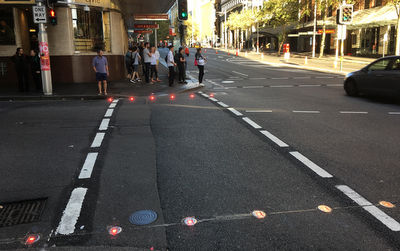
The tram crossings should, I suggest, be marked in a contrasting color, as the adjacent road crossings are, and lower lights added. Low level lights are being trialed in Sydney and Melbourne.

Install Automatic Train Protection


In a recent incident reported in the media, a test tram ran through a red light. This indicates that Canberra's trams are either not equipped with Automatic Train Protection (ATP), or it is not functioning correctly. With ATP the tram would stop automatically at a red light, preventing accidents. ATP should be fitted and functioning before the system is put into service.

Update: 1 April 2019


Canberra is full of otherwise intelligent people, but they do not stop at tram crossings. I suggest fences are needed along the track, and at stops, as well as better marking, and signals, at crossings. 
 
Yesterday I waited fifteen minutes for a bus on
Northborne Avenue (while trams rattled past empty). In that time I saw several people use the crossing adjacent to the MacArthur Avenue tram stop. None of these people even paused as they approached the crossing, they did not look left or right, just walked strait across the tracks. The same people did stop, and look, at the road crossings. Several people also walked across the tracks not at the crossing. It would be easy to say these people deserve their fate, but we need to build infrastructure for people as they are, not as we would wish them to be.

Thursday, March 08, 2018

Climate mitigation and adaptation in the ACT

Greetings from the Canberra Renewables Innovation Hub, where the ACT Government is holding a workshop on the Climate mitigation and adaptation in the ACT: costs, benefits and implications report (22 February 2018). It is going to be a difficult exercise, as this is a sixty eight page technical economic report, presented to a general audience.

ps: It turned out to go well, but this wasn't really a general audience, but a self selected group of experts and enthusiasts.  

My suggestions were:
  1. Public-private pocket parks: These would be modeled on the private part at the center of the City-edge development at O'Connor. This looks like a public park but is owned by the bodies corporate of the surrounding apartments. 
  2. Pop-up Community Groups: ACT Government would provide a website where a group of residents could register a community group. When enough people had joined, this would be a legally constituted group and receive government support to run a community garden and the like.

Sunday, November 26, 2017

Autonomous Electric Bus in Canberra

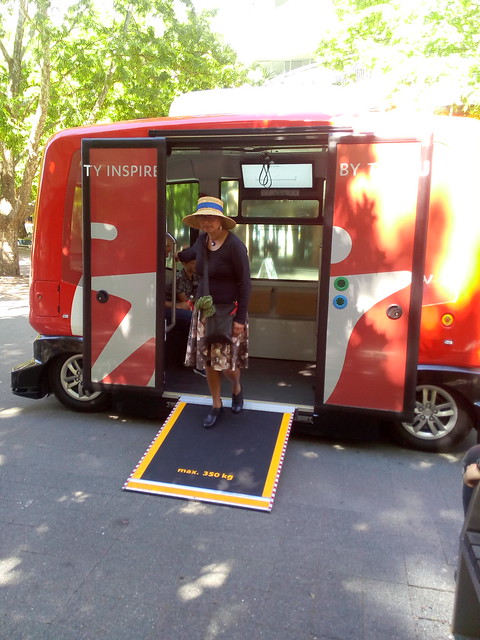
EZ.10 driverless electric shuttle bus from company Easy Mile, on demonstration run in Canberra's city center. Marghanita da Cruz steps out of the bus. The wheelchair ramp has been deployed, as part of a demonstration. This would not normally be used for ambulatory passengers.
Easy Mile EZ.10 Shuttle
Yesterday I went for a short ride on an EZ.10 driver-less electric shuttle bus from company Easy Mile, on demonstration run in Canberra's city center.  The bus traveled a few hundred meters through Canberra' central mall.  While it has a maximum speed of 40 kph, this was done at walking pace, as it weaved in between the street furniture.

The vehicle hold six people sitting in two rows facing each other and with room for another six to stand (or a wheelchair). There are very wide doors making entry easy. The vehicle is higher than it is wide and looks more like a cross between a lift and a golf buggy than a bus.

The ability of the vehicle to find its way between the obstacles in the mall was impressive, with a smaller turning circle than even a mini-van. Also it was able to deal with pedestrians who strayed into its path. When the vehicle's sensors detected a person it would first ring a bell (like that of an old fashioned street car), then slow down and, if the person was not out of the way, stop. No one seemed perturbed or frightened by the vehicle slowing making its way along.

There is also a  wheelchair ramp which can be deployed by the press of a button (the vehicle also kneels to make entry easier).

This would appear a practical form of transport around a university campus (the Australian National Universality could do with a half dozen such vehicles),  or a city center. It would be a useful way to get people to and from light rail and other more conventional forms of public transport.

Tomcar Military Electric Vehicle
While the EZ.10 is imported, this is an industry which Australia could enter. There are already Australian companies making small electric vehicles for farms, factories and the military. Our universities and high-tech companies have the expertise to design the software for the sensors to operate the vehicle.

The EZ.10 shuttle is on an  Australian tour it will be in Canberra today (Sunday) until 12 Noon and 1pm to 3pm, then Cairns from 4 to 8 December and Mooloolaba from 14 to 16 December.

Wednesday, August 02, 2017

Future of Innovation in Canberra

Greetings from the Canberra Innovation Network's  First Wednesday Drinks. I have been here since 2:30pm, for a World Cafe on the future of innovation in Canberra. A room full of people moved from table to table discussing what needs to be done to foster innovation, how that can be done and how to get the message out about doing it. It can be very frustrating at such sessions where there is a lot of ideas floated but you wonder if anything will ever happen. In this case we had the satisfaction of then attending the first Wednesday pitches and heard of real things making a real difference.

I did try to get a bit more creative with ideas, beyond the obvious of teaching innovation, I suggested turning CBRIN into a reality TV show, with the real life drama of turning ideas into products and services.

Sunday, July 30, 2017

Video for GovHack Entry

Greetings from  GovHack 2017. I
I have had some queries in the Canberra Coach Pit about what should be in the Video entry.

As it says in the GovHack Handbook:
"This a video pitch of your entry that tells a story of how you have reused data. The video should demonstrate your hack concept, the benefits or value the concept could achieve and where possible introduce your team. The most common method is to use a screencast, with a voice-over narration". (Emphasis added)
 To that I would add:
  1.  Get it in before the deadline (4pm AEST): It doesn't matter how good your video is, if it is not in on time it will not be considered. Making a video is a very time consuming process. Produce a rough cut well before the deadline and then polish, as it is going to take longer than you thought. Upload well before the deadline, as the handbook says: "must submit actual Video URL not link to another website". The preferred location to link to is YouTube.
  2. Explain what the problem is: The story you tell should say what the problem you are tying to solve is, as that may not be obvious to the viewer.
  3. Make the vision clear:  Don't have tiny text, or too much detail, as that will be hard to see. My tip is to view the video on a smart phone held at arm's length and see if it is watchable.
  4. Make the sound clear: Find a quiet spot to record audio. A headset microphone works well, as it gets the microphone close to your mouth.
  5. Don't worry about live video:  This is about the application, so live video of people is not essential. You can use screen capture software for a "live" demo and also still screen-shots, along with still images of the people and the problem.
  6. Say who you are at the beginning and end: Introduce your project at the start and remind the viewer again at the end.

Saturday, July 29, 2017

Tom's Ten Tips for GovHack

Greetings from the Snow Centre for Education at Canberra Grammar School, where GovHack 2017 is in full swing. I am on duty n the "Coach Pit", at the top of the building, which is a little like being on the bridge of a ship. I am looking down on the old red brick buildings of the school, and a winter landscape of bare trees in the fog. Business is not brisk at present with only a few teams dropping in for advice.

Coaching a GovHack team is a skill none of the coaches is entirely comfortable with and so we had a discussion of the "Coaching Kata". 

But we are here for GovHack, so some tips for teams:
  1. Build a Team: You need people with a range of skills for your team: it is not just about technical computer skills (it is mostly not about technical computer skills).
  2. What is the Problem? You need to be able to clearly and briefly explain what problem you are solving. Practice by explaining it in a few words to people in the coffee queue (the coffee at GovHack is very good).
  3. What is the solution? With the problem identified, the solution is still not easy to explain. One way is by comparison to an existing product or service: "It is *** for ***.
  4. Who is this for?  Consider who will ultimately use the application and who might be interested in providing the service.
  5. Has it been done? A quick web search will help see if what you propose has been done before. If it has, that is not the end of the world, as you can do it differently, or better, or both. 
  6. Get Help:  There are Mentors with deep knowledge of the data provided and Coaches with knowledge of tools and techniques. Drop into the Pits or post a query via the forum, or both.
  7. Do we have a plan?  It helps to know what you are planning to do when, even if it almost never turns out that way. The GovHack has deliverables at fixed times and you need to work towards these.
  8. Do we have a clear presentation? GovHack is as much about explaining your solution s getting it to work. Keep it clear and simple.
  9. Get it in on time:  It doesn't matter how good your solution is, if it is not submitted on time, it does not count.
  10. Learn and enjoy: GovHack is not a job: you can't tell your team to do something, you can only encourage them. Remember to take breaks and have a walk around outside. This will also make you more productive and ideas will pop into your head when wandering around.

Friday, July 28, 2017

GovHack 2017 Opened at Snow Centre for Education

Greetings from the Snow Centre for Education at Canberra Grammar School, where GovHack 2017 just opened. Tonight is mainly for familiarization and team formation. The hacking proper starts tomorrow. I am a Strategy Coach for the event, which involves wandering around asking people how they are going and prompting them to think about it.

The venue is a new purpose built education facility, more advanced than most at Australian universities. The MC for the event is Matthew Purcell, Head of Digital Innovation at Canberra Grammar School. Matthew is a highly skilled IT professional, as well as a teacher. 

For the next two days the teams will think up something innovative to do with government data, try to implement it and, most importantly, explain what it is and why it is useful.

Wednesday, July 26, 2017

GovHack 2017

GovHack 2017 is on this weekend. I will be going along as a Strategy Coach for Canberra GovHack. The idea is to help teams of volunteers to build useful applications using data provided by government agencies. This is also happening at venues across Australia and New Zealand.

Monday, April 10, 2017

Driving Canberra's Innovation Ecosystem

At the First Wednesday Connect hosted by the Canberra Innovation Network (CBRIN), I gave a sixty second pitch about my book "Digital Education". The people who pitched were then asked "What do you think Canberra needs to do to drive its innovation ecosystem?" and this ended up on a short video. Caught on the spot I ended up saying "The danger with any project with government support is it will get forgotten about before it has a chance to succeed". I am last on the video, so ended up with my image on the video thumbnail. CBRIN and how it uses the Cambridge Silicon Fen approach to industry development, features in my book.

Wednesday, September 21, 2016

Bus Rapid Transit System for Canberra

Proposed Bicycle Path in Center of Media Strip of Northborne Avenue Canberra, see: http://blog.tomw.net.au/2012/07/lower-cost-rapid-transit-system-for.html
My Northbourne Avenue Proposal


The ACT Liberal party have proposed a Bus Rapid Transit System for Canberra, as an alternative to the Light Rail system already under construction by the ACT Government. While lower cost than the Light Rail option, the opposition's bus alternative would still be more expensive than the option I proposed and would result in higher carbon emissions.

The opposition plan adds an extra lane for busses to Northbourne Avenue.  Adding a lane would require extensive and expensive work, but not as much as laying tram tracks and adding overhead power. Because the number of lanes for cars would not be reduced, there would not be a reduction in carbon emmissions from cars.

Tuesday, August 23, 2016

ACS Canberra 2016 Conference

Greetings from the ACS Canberra 2016 Conference.


8.30
9.00
Arrival Tea & Coffee (BALLROOM FOYER)
9.00
9.05
Conference opening (BALLROOM) - Conference Chair, Dr Tim Turner
9.05
9.25
Conference Address
Data Fuels Innovation and the Digital Economy; But who owns and controls Data?
Anthony Wong
President, Australian Computer Society
9.25
10.15
Plenary Keynote (BALLROOM)
Drones, Droids and Robots - Which one are you?
Jon Cumming
Chief Digital Officer, ACT Government
10.15
10.35
Tea & Coffee Break and Exhibition (GALLERY FOYER)


Security (Derwent Room)
Leadership (Fitzroy Room)
Education (Murray Room)
The Future of Work (Swan Room)
Data Management (Torrens Room)
10.35
11.15
Session 1
Session 1
Session 1
Session 1
Session 1
5 minutes
Change over
11.20
12.00
Session 2
Session 2
Session 2
Session 2
Session 2
Chris Hamling
12.00
12.40
Lunch
12.40
1.30
Plenary Keynote (BALLROOM)
5 minutes
Change over


Professionalism (Derwent Room)
Leadership (Fitzroy Room)
Education (Murray Room)
Analysis and Design (Swan Room)
Data Management (Torrens Room)
1.35
2.15
Session 3
Session 3
Session 3
Session 3
Session 3
Denver Bunzel George Mouratidis
5 minutes
Change over
2.20
3.00
Session 4
Session 4
Session 4
Session 4
Session 4
Dr Therese Keane
3.00
3.20
Tea & Coffee Break and Exhibition (GALLERY FOYER)
3.20
4.00
Session 5
Session 5
Session 5
Session 5
Session 5
5 minutes
Change over
4.05
4.55
Plenary Locknote (BALLROOM)
Miguel Carrasco
Partner and Managing Director, The Boston Consulting Group
4.55
5.15
Conference Address
Robotics and the Future of Work
Andrew Johnson
CEO, Australian Computer Society
5.15
5.30
Closing Remarks
Dr Tim Turner
Conference Chair
5.30
7.00
Cocktail reception (GALLERY FOYER) - Social networking drinks
7.00
10.00
Gala Dinner (BALLROOM)
Conference Dinner Address
ACT Chief Minister
Conference End

Wednesday, February 17, 2016

ACT Chief Digital Officer Outlines His Vision for the Future of Canberra

Jon Cumming, the new (and first) ACT Chief Digital Officer (CDO) talked at an Australian Computer Society meeting in Canberra last night. He outlined the ACT Digital Strategy he has proposed to government:
  1. Growing the digital economy
  2. Delivering digital services
  3. Foundations for digital services
As Jon explained, the first of these aims is outward looking, the other two about government.

What struck me was there was no mention of education and training. The ACT Government is doing good things in this area and perhaps should highlight them. The best example is the Canberra Innovation Network (CBRIN) promoting business startups. More could be done in ACT schools implementing the national digital curriculum.


One point of confusion was exactly what was the role of a CDO. I had assumed this was just a new term for the CIO and Jon was the new head of IT for the ACT Government. But it appears this more a role like the Australian Government's Digital Transformation Office (DTO), to encourage adoption of IT. This is a difficult role as it involves advocating use of IT to improve services (and particularly the public face of services) without getting bogged down in implementation details. There is a risk that those designing digital initiatives will attempt to implement complex IT systems. There are many IT systems which sound like a really good idea, but which have not been built because either they can't be built reliably, or, on closer inspection really are not a good idea. An important part of the job of an IT professional is to say to their client: "NO: that is not a good idea".

Jon mentioned Estonia's success with digital government. However, what he did not mention was that E-Estonia was subject to cyber-attack in 2007 which has a serious effect on government operations. In response the NATO Cooperative Cyber Defence Centre of Excellence (CCDCOE) was established in Estonia. Canberra is a national capital and so a prime target for cyber-war. While such attacks by nation states, or non-state groups, will be primarily directed against Australian Government agencies in Canberra, the ACT Government will also be a target. The ACT Government needs to plan to keep services operating while under sustained on-line attack for months, or years. Every digital service the ACT Government implements needs to take this risk into account.