Showing posts with label Senator Lundy. Show all posts

Thursday, April 21, 2016

Building Canberra Innovation

Greetings from the Data 61 office in Canberra where Kate Lundy, Canberra Local Industry Advocate for the ACT Government, is speaking at CollabIT meeting to promote IT development in Canberra. She described a pilot system for "fail fast" Small Business Innovation Partnerships Program (SBIP) for new projects. This is a good initiative, but I suggest following the South Australian Government and simply call this the "Industry Advocate", or "Canberra Industry Advocate". The Canberra initiative will be formally launched next week.

Victor Pantano from University of Canberra described the Knowledge Exchange Internships to commence next semester. Students will work for a semester in a company. Next week the ACT Government is sponsoring "Doing Procurement Better", 27 April 2016.

Wednesday, March 25, 2015

Valedictory Speech by Australia's Most IT Literate Senator

Kate Lundy is retiring from the Australian Senate, after almost two decades as the chamber's most IT literate member. I was honored to  received a mention in Senator Lundy's Valedictory Speech, about the time Senator and myself promoted Canberra, by sending live photos to the Internet from a hot air balloon floating over the city. I was also honored to be mentioned alongside "the amazing Pia Waugh", who, as Senator Scott Ludlam later pointed out, has worked with Senator Lundy (and later in various government roles) to make government more accessible on-line.

From the perspective of 2015 it is very hard to remember how the Internet and the idea of citizens having ready access to information on-line, was such an alien concept in the mid 1990s. Some of the thinking of that time is evident in my Interview with Kate Lundy, at Gorman House, 26 September 1995.

Sunday, July 28, 2013

Having Public Servants Work On-line to Advance Digital Economy

Hamish Barwick  reported that Senator Kate Lundy had told a recent IT conference that government agencies will replace paper forms and face-to-face contact with on-line equivalents ("More government services to go online: Kate Lundy", CIO Magazine, 25 July, 2013 15:27). The government issued "Advancing Australia as a Digital Economy: Update to the National Digital Economy Strategy", but this does not appear to have received the attention it deserves. Chapter 11 of the strategy sets the target that:
By 2020, four out of five Australians will choose to engage with the Government through the internet or other types of online service.
However, one barrier to on-line use which does not appear to be addressed is the digital literacy of public servants. For citizens to engage with government on-line, we first need to ensure that public servants are trained in how to engage with each other on-line. Services such as GovDex, the public service's own internal cross-agency on-line platform, are underutilized. Public servants tend to still occupy much of their time with last-century face-to-face committee meetings.

Substituting email for paper minutes and video conference for face to face is a small improvement, but real productivity gains will require staff to be trained in how to collaborate effectively on-line and given incentives. I find it takes about three weeks for my masters students in on-line courses (many of whom are public servants) to adjust to working in on-line forums. It comes as a shock to many how hard it is to make the transition and I suspect many would not do the work needed, if it was not for the prospect of failing the course (where on-line participation is assessed every week).

The Australian Public Service needs to put in place targets and effective training programs, with incentives for staff to participate and penalties for those who do not. We will then have a public service which is competent to communicate with the public on-line.

Thursday, June 06, 2013

Jane Treadwell Goes Naked at GovCamp

Greetings from GovCamp at the Inspire Centre in Canberra. The first speaker is  Jane Treadwell, CEO, DesignGov, who said she was "going naked", meaning speaking without any Powerpoint slides.

DesignGov is the Australian Centre for Excellence in Public Sector Design. It was established in mid 2012 to apply strategic co-design processes in the Australian Public Service.The initiative has parallels in the ANU Unravelling Complexity course, which I help teach.

Coming up before morning tea are: Steve Baty, Meld Studios;  Senator Kate Lundy, Minister Assisting for Industry and Innovation;  Pia Waugh, GovHack MC and Cassandra Bisset, Objective Corporation.

Monday, April 02, 2012

Near Real Time Public Opinion Analysis for the Australian Government

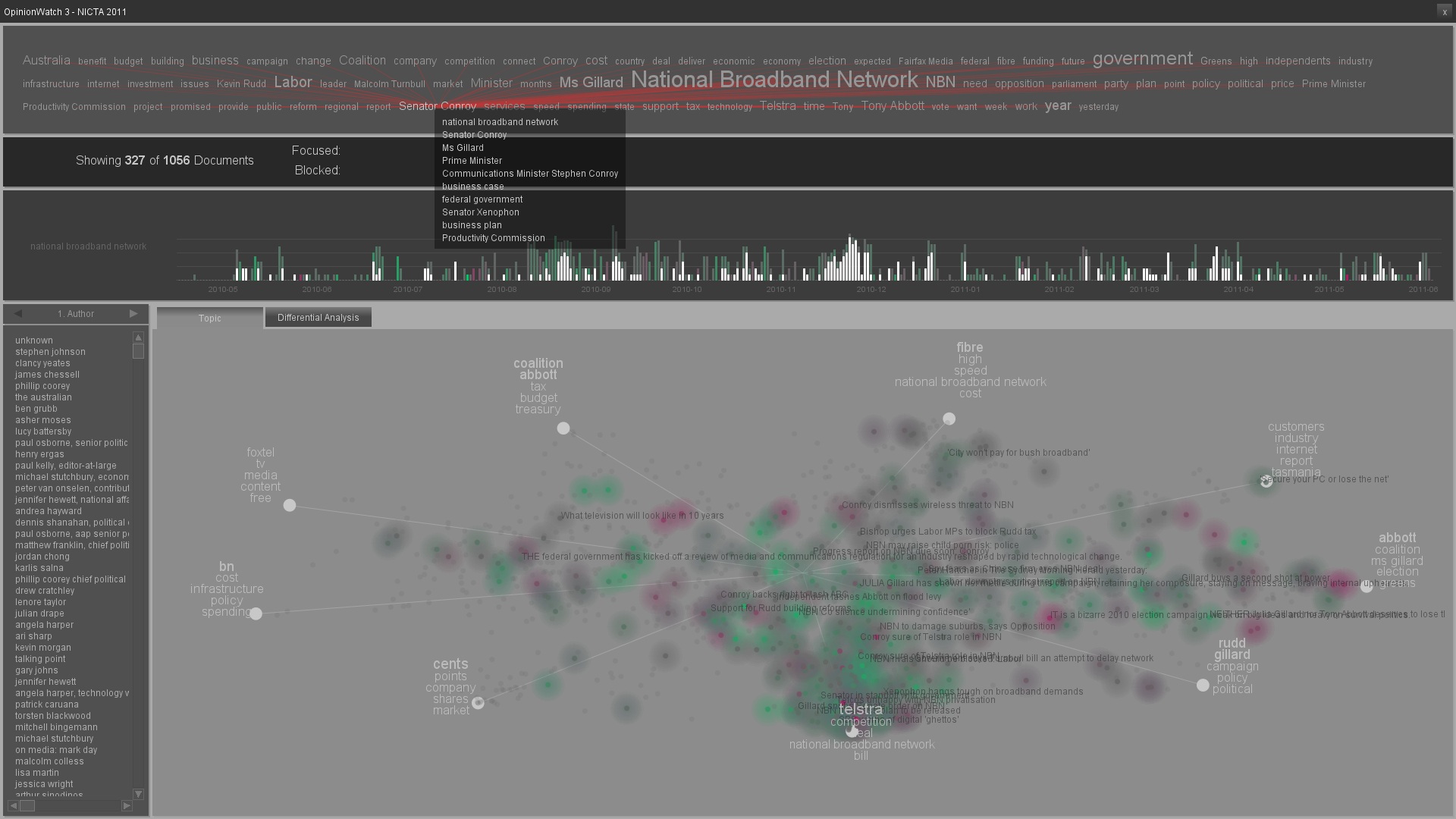
Screen Shot from NICTA OpinionWatchGreetings from "IR and friends" at CSIRO on the Australian National University campus in Canberra, where Paul Rivera and William Han from NICTA are demonstrating "OpinionWatch". This is a system for analysis of public opinion. It was tested with data from Senator Lundy's Public Sphere Process , at Defence Joint Decision Support Centre and recently demonstrated to the Prime Minister. The idea is to be able to get an overall impression of what the community thinks on an issue without having to conduct expensive opinion polls or long consultation processes. The software can sift through thousands of documents and carry out an analysis of the general sentiment of the authors.

One interesting outcome of a demonstration analysis of public statements from the Prime Minister and the Opposition Leader is that Tony Abbot's comments about climate change is very focused on "carbon tax" whereas Julia Gillard is using a much broader range of terms (which perhaps, I suggest, is why the PM is not winning in the opinion polls: the message is too confusing).

From a technical point of view the software is interesting in that it has a HTML5 interface and so should be usable on a tablet computer or smart phones. However, the interface currently presents far too much information to be usable on a mobile device and I have suggested it be redesigned to present less data, bolder. As well as make it usable on a smaller screen than should make it easier to understand when presented to a group on a projection screen.

One application for the software might be the analysis of the submissions to parliamentary inquiries, or even just the analysis of the topic of the inquiry in public blogs. Currently the Parliamentary Library prepares summaries of issues of interest to MPs, but these generally cover the facts of the situation, not the sentiment and take considerable work from expert information analysis to prepare.

ps: The former Parliamentary Librarian will speak at ANU, 4 April 2012, 11am.

Wednesday, October 26, 2011

Democracy with Web 2.0

Greetings from the AGM of Computing Assistance Support & Education Inc (CASE) where Pia Waugh, policy adviser to Senator Kate Lundy, speaking on Engaging in Democracy with Web 2.0. Pia started by pointing out that the Australian Government issued a Declaration of Open Government (DOG). She showed some of the winners from the government sponsored Mashups, including Know Where You Live.

Pia then showed Senator Lundy's website, produced using Wordpress and designed to have a relatively simple layout. She pointed out that Open Australasia's enhanced version of Hansard is used.

Pia then discussed citizen centric services, noting that Australia had been a leader in on-line government. The idea is to put the citizen at the centre of the design of services, rather than a structure based on government agencies. For me, the issue how much of this can be done via software mashups and how much requires the government to be restructured. An examples are an australia.gov.au account, which the citizen to deal with multiple government services with one account.

Pia then discussed participatory government, using the example of the Public Sphere process she developed for Senator Lundy. She emphasized the need for consultation with the public to be conducted sincerely. In the latest example a 106 page Submission on Digital Culture (6MB PDF) was created for the National Cultural Policy.

Pia suggested that using on-line tools two people could conduct a substantial public consultation over three months. This is far less than the staffing needed for a traditional process.

Friday, October 21, 2011

Engaging in Democracy with Web 2.0 Initiatives

Pia WaughPia Waugh, Adviser to Senator Kate Lundy, will speak on "Engaging in Democracy with Web 2.0 Initiatives", at the AGM of Computing Assistance Support & Education Inc, in Canberra, 26 October, 2011

Pia Waugh started work as an Adviser to Senator Kate Lundy in April 2009. Prior to this she was a consultant at Waugh Partners in Sydney, Australia. She also works to develop the Australian FOSS industry and improve Government policies towards Free and Open Source Software.

Wednesday, October 05, 2011

Universities Australia e-Press

For the Digital Culture Public Sphere in Sydney, 6 October 2011I have suggested support to reinvogorate the Australian book publishing industry. Australian government measures in this area have been ineffective so far as they have equated "publishing" with "printing". The e-book is making printing printing increasingly irrelevant to publishing. So in the Digital Culture Wiki being created as part of a submission to the National Cultural Policy, I have proposed:

  • Support for Book Publishing: In the rush to video and digital on-line work the role of the humble book in Australian culture has been forgotten. However, the book is being re-borne as the e-book and Australia can have a viable e-publishing industry. This industry can be supported by Australia's libraries and universities. This will enhance the traditional role of the library as a resource for authors, for allowing them not only to research their work but prepare it for publication, submit it and also offer a not-for-profit service for free open access publishing. This will provide savings, for libraries which currently are required to purchase access to the works written by their clients.
  • Reform of university presses: Currently the Australian government subsidizes non-profitable university publishers. These publishers produce works on paper which are not available to most of the Australian population. Under a revised system, universities would merge their presses into "Universities Australia e-Press" with the mission to produce cultural works on-line for free, for community benefit. ANU ePress would be used as the model for the new organization.

Australian Digital Culture On-line Policy Forum Live On-line from Sydney

The Digital Culture Public Sphere in Sydney, 6 October 2011 will be streamed live online. It is tol consider input on digital arts and industries for the National Cultural Policy discussion paper. I am helping out with the moderating for the event.

Tuesday, September 20, 2011

Senator Lundy Elected Honorary Membership of Australian Computer Society

Senator Kate Lundy was awarded Honorary Member of Australian Computer Society in recognition for her advocacy of the Internet, Gov 2.0, open source and ICT innovation on 15 September 2011. This honor is well deserved, with Senator Lundy working on the application of IT for community benefit and on introducing her fellow parliamentarians to the technology, since election in 1966. Even before this the Senator worked on community and non-profit IT use, as we discussed over lunch, I interviewed the then Senate candidate, over lunch on a sunny spring day in September 1995.

One of the Senator's most important achievements is the "Public Sphere" events have directly lead to the adoption of on-line processes for public consultation by the Australian Government. The first of the "Public Sphere" processes, which blends face to face with on-line processes for consultation on public policy.m The first Public Sphere on High Speed Broadband, was run at the ANU, in conjunction with the School of Computer Science, 7 May 2009.

Public Sphere 2: Government 2.0 lead to the creation of a Government 2.0 Task Force and reforms to Australian Government processes, including the introduction of open access to government information.

Public Sphere 3 is on the topic "Digital Culture", with a Live Event 6 October 2011, in Sydney and on-line.

What is less well know is the Senator's role on Parliamentary committees introducing IT to the committee processes and the members offices.

Senator Lundy also received the International e-Democracy Award 2010.

Wednesday, September 07, 2011

Australian Digital Culture On-line Policy Forum

Senator Kate Lundy is running a Digital Culture Public Sphere on-line and in Sydney, 6 October 2011. This will consider input on digital arts and industries for the National Cultural Policy discussion paper, released by Simon Crean, Australian Minister for the Arts, on 11 August 2011.

There was a Book Industry Strategy Group (BISG) set up by Senator The Hon Kim Carr, Minister for Innovation, Industry, Science and Research, in 15 February 2010. But that seems to be more about propping up the declining paper based printing industry, not mainstream digital publishing.

On the 11th August 2011 Minister Crean released a discussion paper seeking public input on a National Cultural Policy. This consultation will help determine a 10 year strategic vision to ensure our arts, cultural and creative endeavours resonate with a 21st century, globally competitive, internationally celebrated and culturally diverse Australia.

The National Cultural Policy itself covers three major sectors:

  • traditional core arts such as opera, dance, theatre, literature, music, visual arts and craft,
  • creative industries such as games development, film, animation, media content, architecture, fashion, design & publishing,
  • cultural heritage such as the work done by cultural institutions (regional metro & national galleries, libraries, archives & museums) and Australia’s Indigenous culture.

The Office of Senator Kate Lundy in collaboration with the Office of Minister Simon Crean is running a Digital Culture Public Sphere consultation to look specifically at the digital arts and industries as well as opportunities for cultural institutions around digitisation, public engagement and collaboration. This consultation will result in a submission that will be presented directly to the Minister as part of the broader National Cultural Policy consultation.

“The Digital Culture Public Sphere consultation is a breakthrough exercise in bringing together ideas and projects, working them through and providing a rich base of information and pathways for Australia’s digital cultural challenges and opportunities. It will provide a valuable contribution to the National Cultural Policy Consultation which is an important opportunity to examine how the Australian Government should support arts and culture in the 21st century,” said Minister Crean.

“We are laying the foundations for the broad cultural arts and industries in Australia at a time when high speed broadband will provide a platform to use our cultural collections and creative skills for new applications, education and research services. I welcome contributions from the digital arts and industries as well as cultural institutions across Australia”.

Friday, February 11, 2011

Broadening Public Discussion

Today I attended a meeting at the Moot Court at the Australian National University in Canberra from 12:30pm to 4pm. Fourteen people from academia, government and industry were discussing the creation of the "Australia Forum", a project for enabling public policy discussion. I attended for the School of Computer Science at ANU which researches the technology for such forums and also has hosted some. I wrote a blog post summarising my understanding of the background of the project.

The "Moot Court" is a room in the Law Faculty which simulates a court for training lawyers. This was selected as the best space for the meeting as it has furniture which can be arranged into a circle.

After acknowledging the original inhabitants of the land the chair asked us to sum up what our contribution could be in one sentence. I explained I was from ANU Computer Science and teach using online forums, help design physical spaces for this. Also I pointed out CS has hosted such events in room N101 for Senator Lundy and others.

As with a real dialogue, the difficult part is working out who everyone is and where their points of view come from. The task is to work out what we are attempting to achieve and what we have in common.

The Australian Forum is over ten years old (although I only heard of it for the first time last week). The ANU's Australian Centre for Dialogue also has been in existence for several years. There is obvious possible synergies between the two projects.

One of the difficulties is understating exactly what is proposed. It could be a convention centre or a web site, or something in between. Also it is not clear if the philosophy of "dialogue" requires any particular physical or virtual infrastructure.

Unfortunately much of the original promotional material developed for the Australia Forum is based on the idea of a symbolic building in Canberra. This makes the project look like the Canberra building industry asking for a government handout to build an expensive building which will hardly ever be used. The project has evolved to include a more flexible and virtual approach. But this is not yet reflected in the promotional material.

I spent an hour trying to work out what was wrong with a project which apparently worthwhile project and how to fix it. Senator Lundy then arrived and mentioned the NBN and Public Sphere. These were the missing piece of the puzzle. Not everyone agrees that the NBN is the best way to get broadband across the community, but most would agree if you have the broadband it can be of great use for community consultation. Senator Lundy's Public Sphere process provides a methodology for carrying out such processes.

Senator Lundy described the meeting "in the round" she attended recently in Geneva. This was the Universal Periodic Review at the United Nations Human Rights Council. These international forums have a very structured process. The Senator suggested using online tools to help make these processes more flexible. Also the Senator raised the idea of Australia hosting such international forums.

Senator Lundy suggested that any forums need a strong nexus with political issues of the day. This will then supplement the political process, not compete with it. Digital tools can provide a more granular approach to discussion. That discussion can take place from formulation of public policy through to its implementation.

Pia Waugh pointed out that we want human synthesis of the conversation, not just automation. I pointed out that we now use these techniques for teaching at university. There are approaches to this which are well tested and can be applied to broader public discussion.

The Australian Forum is planning to put out its next planning document in the next few months. In the interim, those who want to get a taste for what a well run Internet enhanced face-to-face meetings are like, can attend the free BarCamp Canberra 2011, being held at ANU, 19 March

Sunday, February 06, 2011

Australia Forum

Model of the proposed Austrlaian Centre for Dialogue Building, design by Alicia BaylThe "Australia Forum", is a proposal from the Canberra Business Council for a venue in Canberra for meetings, dialogue, cultural events and occasions of national importance. There is a Scoping Study available for the project. This complements the Austrlaian National University's "Australian Centre for Dialogue Project". There is a Vision and Mission Statement (PDF) and a brief explanatory movie. I was asked to provide some input on how computer mediated communication could be used to encourage discussion. This blog post has my initial thoughts on the project.

The Australian facility would be modelled on the Morris J Wosk Centre for Dialogue at Simon Fraser University. In 2007 an architectural competition was held for the design of a proposed $26M (later $30M) "Centre for Dialogue", to be a building built in Canberra. This would be located in parkland, sited similarly to the House of World Cultures Berlin and the Zappeion Athens. The completion was won by Alicia Bayl. However, it appears that since then the project has been modified to incorporate online dialogue, linking multiple physical locations. This is a useful development.

The forum could take advantage of the expertise, technologies and infrastructure in place for "blended" learning (combining online learning and face-to-face classes). This would allow educational information systems and buildings to be used for the forum. It would also also combine the functions of teaching about the use of such forums into conducting them.

A few initial thoughts:

1. PUBLIC SPHERE

Senator Kate Lundy has run a series of "Public Sphere" events which use live face to events, blended with online forums, for developing public policy.

The first Public Sphere event "High Bandwidth for Australia" was hosted by the ANU Department of Computer Science in the computer equipped room N101 in the Computer Science.

In the past I have used Moodle (the same e-learning software as now used at ANU) for part of the online consultation mechanism. Following on from this I suggest using a "learning commons" as the physical venue for the forum. Having a physical venue helps bring focus to the discussion, which if entirely online can seem a little too "virtual".

2. LEARNING COMMONS

From the Australia Forum project material it appears that the original idea was to have a purpose built building for the forum. That then changed to a virtual forum, due to the cost and complexity of a purpose built facility. I suggest a middle path: use a dual purpose facility, which could also function as a learning commons for an educational institution.

Most of the time the space would be used for teaching (including teaching about the forum) and only occasionally used for the "Australia Forum". The venue could be electronically linked to other such spaces, nationally and internationally, for a distributed discussion.

Using a learning commons as the basis for the forum building would also allow the latest technology and designs to be used. IT support and ideas on how to lay out physical spaces having made rapid advancement in the last few years. Part of this advancement was research sponsored by the Australian
Government on learning commons.

A "learning commons" is the trendy term for a building with a mix of open plan teaching areas and classrooms, equipped with extensive computer facilities. I will be speaking on "The dos and dont's in developing learning commons" at the 2nd Annual Learning Commons Development and Design Forum in Brisbane, 20 March 2011.

In 2008 ANU was considering a conference centre as part of the City West development. In response to a request for input, I suggested a triple purpose conference, training and decision support centre. The idea was that the centre would be used day to day for university teaching. Occasionally it would be reconfigured for commercial and academic conferences. In a national disaster, the centre would become a high-tech command and control facility for emergency operations.

As far as I am aware, it was decided not to proceed with the conference centre at City West. The University of Canberra opened a more modestly scaled Teaching and Learning Commons this month, on the mezzanine above their refurbished refectory. I attended the first event to use the facility.

3. AUSTRALIA FORM AS AN UN-CONFERENCE

The first use of the UoC teaching commons was for "Recent Changes Camp 2011: Canberra", an "un-conference".

An "un-conferecne" is similar to an academic symposium, but with more flexibility as to topic and discussion and with Internet support.

Several such events have been run at ANU. The ethos of these, along some of the support software and organisational techniques were applied to Senator Lundy's Public Sphere series. I suggest this could be explored further for the Australia Forum.

4. SOFTWARE FOR DIALOGUE

Modern educational techniques emphasise the use of discussion between the students. This is supported in Learning
Management Systems. In particular Martin Dougiamas built this into his Moodle software, now used by ANU. The ANU College of Engineering and Computer Science is now a leader in this field with its Engineering 'Hubs and Spokes' Project. I use Moodle with mentored and collaborative techniques for postgraduate courses at ANU.

As we prepare Australians for the dynamic opportunities and challenges ahead new forms of engagement will be needed. Australia’s best future will be shaped through dialogue – and through facilities and technologies that are enabling, democratic and globally connected.

Capital cities around the world are embracing the need in the 21st century need high quality secure venues catering for international dialogue, trade and significant national events. These are important elements of national infrastructure and the positioning of capitals. Centres of this nature are also the learning hubs of the future – pivotal places in terms of economic development and knowledge transfer from research institutions.

Our National Capital, Canberra, is the meeting place of the nation. It is also a rare centre of knowledge and research, with far reaching global relationships. Canberra is a capital with unparalleled assets and opportunities.

Now the need is clear – for a truly national meeting place in the Capital – one that will meet the future needs of Australia and Australians themselves, and realise the rich potential that exists.

That is the vision for the Australia Forum. ...

From: "Australia Forum", Canberra Business Council, 2010


ps: I viewed the explanatory video for the "Centre for Dialogue" with some amusement. The location proposed for the building is the same as one used in the Australian TV comedy "The Hollowmen". In series 2, episode 2, "Edifice Complex" a building is proposed at this location with no purpose other than to boost the ego of a Prime Minister. ;-)

Thursday, September 30, 2010

Online Consultation for Australian National Broadband Network

The new Australian Government is implementing a $42b "National Broadband Network" (NBN) to provide a fibre optic connection to most homes. This is more than a little controversial, with Australia's new minority government dependant on independent parliamentarians who want broadband in regional areas. So the government needs to be seen to be doing a credible job on broadband or they will not be the government.

One of the areas chosen for the new system is "Gungahlin", a satellite town in the north of Canberra. The Gungahlin Community Council is holding a meeting to discuss the NBN. One of the Senators representing the area, Senator Kate Lundy, is a long time supporter of using the Internet for community consultation and there will be live online participation in the event.

Gungahlin was the site of a Telstra broadband trial with the ACT Government. The project started in mid 1993 and was abandoned in late 1996.

Tuesday, May 04, 2010

Adding e-Literacy to the National Curriculum

Senator Lundy has posted a very useful draft submission on ICT skills for students to the Australian National Curriculum Consultation. The Senator proposes three core skills, to which I suggest adding "e-literacy" as a mandatory part of the curriculum. That is: we need to teach students how to read and write in the online environment.

The Draft K-10 Curriculum documents from ACRA make some mention of online literacy:
"... Students learn to interpret, appreciate, evaluate and create literary texts such as narrative, poetry, prose, plays, film and multimodal texts, in spoken, print and digital/online contexts...

Multimodal/ digital focus ... cartoons, websites, picture books, films and television including children’s drama, Aboriginal paintings, cook books, road directories, pamphlets, online search engines, ebooks. ...

Literature ... Students learn to interpret, appreciate, evaluate and create literary texts such as narrative, poetry, prose, plays, film and multimodal texts, in
spoken, print and digital/online contexts. ...

Research skills ... Multimodal/ digital focus advertisements, current affairs programs, newspapers and magazines, literary websites, graphic novels, manga, animation, feature films, television drama series, television documentaries, bio-pics and mockumentaries, blogs, wikis, mash ups, online social networking sites, ebooks ..."

From: English Australian Curriculum, Draft Consultation version 1.0.1, ACRA, April 2010 (emphasis added)

"... Information and communication technologies (ICT) are evident in historical skills associated with locating, processing and communicating historical information. This includes the use of search tools for accessing a growing range of digitised online materials, spreadsheets and databases for analysing evidence and historical trends, and video conferencing for collaboration and debating ideas. ICT tools, such as wikis and blogs, have the potential to enhance students’ analytical thinking capabilities in their study of history. ...

From: History Australian Curriculum, Draft Consultation version 1.0.1, ACRA, April 2010 (emphasis added)
I attempted to complete the Australian Curriculum online survey to comment on some issues, but I was unable to get the web based survey to work. One comment I had was that the ACRA web site fails to meet manditory government web standards. The home page failed HTML validation, Mobile OK, and Linkaccessibility for the disabled tests.
After becoming frustrated by the poor quality of online communications I wrote a book chapter on "How to Read and Write E-mail Messages" (the book has a forward by Senator Lundy). In the decade since then there has been considerable progress in understanding of how communication online differs from writing on paper and speaking face to face. Also the research in this area has shown how many assumptions about traditional communication were incorrect.

While much has been learnt, little of this has been reflected in the way literacy is taught in schools, or universities. That can be changes quickly using the computers, networks and software now being made available to educators and students. However, such an education also requires suitable assessment. It would be unfortunate to teach students how to communicate online and then assess their performance with a closed book pencil and paper test.

In the book "Green Technology Strategies" I outline a course which uses online forms for education, where the students learn by collaborating with each other, with the teacher in the role of mentor. While this course is at the postgraduate level for universities in Australia and North America, essentially the same techniques can be applied in schools.

It cannot be assumed that young people know how to communicate online for scholarly purposes, just because they can use an online forum. They need to learn how to use these tools in a more structured and disciplined way.

As Senator Lundy notes, students also need formal training in the sue of software tools. Existing educational standard may be of use for this, such as the International Computer Driving Licence. But it needs to be kept in mind that such standards tend to emphasise the mechanics of how to use computer software, rather than how to use it to communicate with people.

... core skills into three specific areas:

  1. Productivity skills
    The applied use of ICT to other areas, for instance creating a document, slideshow, video or graph to present information in a useful and comprehensible format. Production skills should be taught conceptually and with a number of software examples to ensure skills are transferable to different applications and different versions of the same application. This will lower training costs and productivity losses in ICT upgrades or migrations for all employers.
  2. Online engagement skills
    How to safely and effectively use the Internet for research, communications, collaboration and content creation, as well as the skills needed for online communications such as manners (netiquette) and how to establish and participate effectively in online communities of interest. These skills will teach students how to participate online and discover new opportunities for employment and education.
  3. Automation skills
    The skills to automate tasks and innovate both personally and in the workplace – regardless of the sector or job description. Skills include basic computer administration, programming, scripting and teaches students to be empowered by technology rather than bound to the current status quo. For example, the ability to write a short script to automate a task rather than having to manually repeat it continually. ...
From:Open Submission to the National Curriculum Consultation, By Pia Waugh for Senator Kate Lundy, 22April 2010

Tuesday, March 02, 2010

Senator Lundy live online from CeBIT Germany

Senator Kate Lundy will be speaking live online from CeBIT Germany at 9:30pm AEDT.
“Connected Worlds” is the main topic at CeBIT 2010, and Senator Lundy will be speaking about how the Australian Government has set the scene through policies such as the National Broadband Network, the Digital Education Revolution and the FoI reforms to put ICT at the heart of social and economic growth.

She will also discuss the Australian Gov 2.0 Taskforce report (launched December last year) which is a practical blueprint for a more open, transparent, participatory and open government. The Senator will discuss the important of open data, citizen-centric services and the collaboration of government with citizens to co-design the government of the future.

She will also discuss important changes to ICT procurement in the Australian government, and some of the opportunities and challenges facing the industry today. ...
ps: Seems a long time since we sat around a cafe table in Canberra, discussing how to put the nation online.

Thursday, February 25, 2010

Senator Lundy on Internet Regulation

Senator Kate Lundy has written extensively, and thoughtfully, on the issue of Internet censorship in Australia. I think she is on the right track. This is an issue where you can't please everyone. I had the task of preparing the ACS position on regulation in 1995. My own position is summed up in a talk gave on ABC Radio: "Filtering Porn on the Internet: Imperfect by Necessity".

By Senator Lundy on Internet filtering:

Wednesday, August 12, 2009

Senator Lundy describes her Public Sphere initiative

A ten minute video "Senator Lundy describes her Public Sphere initiative" is now available. This was made for my students at ANU studying Information Technology in Electronic Commerce COMP3410. For an assignment the students have to work out what metadata is appropriate to support such public discussions and to archive video used in policy making.

Public Sphere uses a mix of blogs, wikis, instant messaging, video and other tools, in different formats on different systems. This is fine for a pilot, but if this approach is to be used routinely for public policy making, then a system which allows easier set-up, use and archiving all of the material (perhaps for hundreds of years) is needed.

Government 2.0 Taskforce - Road Show starts consulting the public on 17 August in Canberra, followed by other locations around Australia, ending in Darwin on 2nd September 2009. The Taskforce has 15 experts chaired by Nicolas Gluin and was announced at Public Sphere 2 (Video & transcript available).

The open source XENA tool ("XML Electronic Normalising of Archives") which National Archives of Australia use can then be modified to convert discussions and video from public policy events into a long term storage formats.

Monday, May 04, 2009

High Bandwidth for Australia Workshop

Senator Kate LundySenator Kate Lundy is running a workshop "Bandwidth for Australia" on the opportunities and issues around getting high bandwidth Internet in Australia at the Australia National University in Canberra, 7 May 2009. Online Participation is available via Twitter using #publicsphere as the tag. Participants both in the room and remotely can post questions to @katelundy.

The event is being held in the famous Room N101 at the Australian National Unviersity, School of Computer Science. Being a green campus, while there is plenty of broadband , parking for private cars is limited, so consider taking the bus.

I will be giving a brief preview of my talk on how to use social networking and broadband to reduce greenhouse gas emissions, for the ACS Victorian Branch 2009 Conference. Working out how to get the the conference without using a private car has proved an interesting exercise in use of the web.

Wednesday, April 29, 2009

Opening Australian Government Online

Senator Kate LundySenator Kate Lundy has a new web site subtitled "Taking Australia forward with openness". The Senator has been a pioneer of Internet use in the Australian Parliament, but has a result has has an assortment of web sites using different technologies. Noted technology evangelist Pia Waugh has now helped the Senator to consolidate all the material into one place. I have suggested adding links to the archived copies of the old sites so they are available as a research resource. No doubt someone at ANU will do a PHD on the evolution of parliamentary web sites (there is a thesis on web censorship lobbying). The Senator is going to run a series of informal technological events starting with one on "The opportunities and issues around getting high bandwidth Internet in Australia", 7 May 2009, at the Australia National University.