 |
This is not quite the broadband for social good which Roger Clarke and I envisioned in 1994.
|
"An analysis of the voting behaviour in the 2007 and the 2010 Federal elections shows a pattern in which the ALP held seats were the key beneficiaries of the early NBN rollout. Moreover, the results suggests that the Coalition held safe seats were the least likely to receive the infrastructure. Diverse sub-patterns across the three states of New South Wales, Queensland, and Victoria have been discussed in details. However, the overall findings remain that the selection process for the early NBN rollout was skewed up for potential political gains.I suggest the lesson from this is: when proposing tech policy, find some aspect which offers short term political gain. Making appeals to the national interest and long term benefit is of little relevance to politicians aiming to win the next election. So how do we make changes we think need to be made to Internet policy appealing to voters in the short term and so therefore appealing to politicians?
The paper then moves to the second question on whether the targeted infrastructure provision worked and swung votes for the ALP in the following 2013 Federal election. The analysis of the voting in the NBN early rollout areas versus the rest of the country shows a clear difference. While the ALP experienced an overall heavy negative swing across the nation and lost the election, the negative shift was highly mitigated in the NBN early release sites."
From Alizadeh and Farid, 2017.
"ANU adjunct lecturer Tom Worthington says the Canberra system has the advantage because there is new cable installed to homes, whereas for the NBN the plan is to re-use old phone cables". From "iiNet offering VDSL2 in Canberra to compete with NBN", by Alexandra Back, Sydney Morning Herald and Canberra Times, December 29, 2015

"In Australia, there are 3.7 million people who have never used the internet. On top of this, many Australians who do have internet access, are not confident enough to do the basics. To become a truly leading, inclusive and global digital nation we need everyone to become confident internet users by 2020."I suggest an aspect of digital literacy which needs to be addressed in Australia is the data use of on-line applications. This particularly impacts remote users of the NBN Interim Satellite Service, with the so called "Data Drought". Users find their small data allocation is soon used up on day to activities, so that their children then can't access on-line education. This will remain a problem even with the new NBN "Sky Muster" satellite.
Tom Worthington, an adjunct senior lecturer at the Australian National University’s school of computer science, also believes the advent of high-speed internet may not prove to be the boon for regional Australian living that many imagine.
He says while better broadband will allow those in regional areas to access services online, this may also result in a loss of face-to-face services.
In other words, while you will be able to consult a doctor, accountant, lawyer or teacher online more easily, you may not be able to see one in person, as they will have moved to the city or to another country.
Quality
Approximately 7.1 million premises (65 per cent) are in areas that have access to peak median download speeds of less than 24 megabits per second over the copper network.
About 0.7 million (6 per cent) premises are unable to get access to a fixed broadband service.
Of premises with access to xDSL broadband services over copper, about 3.7 million are located in areas with an estimated peak median download speed of less than 9 Mbps, and 920,000 in areas with an estimated peak median download speed of less than 4.8 Mbps.
Benefit
|
Amount
|
COMMUNICATIONS > SOCIAL ENGAGEMENT & SOCIAL MEDIA
|
$74
|
E-COMMERCE > TRAVEL SAVINGS, CHOICE
|
$565
|
ONLINE SERVICES > ENTERTAINMENT
|
$269
|
TRAVEL SAVINGS > E-HEALTH, E-EDUCATION, E-GOVT
|
$217
|
EMPLOYMENT > TELEWORK, TRAVEL
|
$634
|
PRODUCTIVITY > LOWER PRICES, BETTER QUALITY
|
$1,930
|
TOTAL
|
~$3,800
|
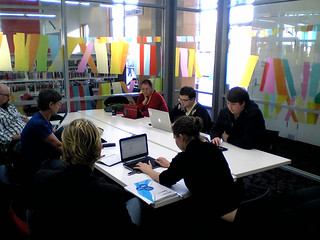 Greetings from the GovCamp and GovHack organizers meeting. We are in one of the community meeting rooms at the Gungahlin Library, just behind the Canberra NBN Hub.

