Showing posts with label start-ups. Show all posts

Wednesday, December 06, 2017

Canberra Start-up Overnight Success Decades in the Making

Ken Kroeger, Executive Chairman of Seeing Machines gave a virtuoso presentation on the origins, accomplishments and future of this Canberra startup at an Australian Computer Society meeting last night. Seeing machines makes head and eye tracking technology to check drivers of vehicles and pilots of aircraft are paying sufficient attention.

Seeing Machines was spun off ANU research in 1999, around the same time I join the Computer Science faculty. I saw vehicles with weird cameras attached around the university and this was part of research into driver aids. Occasionally I have been an experimental subject having my eye gaze tracked. But from then, until now, I did not know the depth and breadth of what Seeing Machines has attempted and accomplished.

Ken demonstrated Seeing Machines technology using a volunteer from the audience. He also described the ways the company attempted to commercialize the technology, with several "pivots" where they changed direction. Curiously, one large market for Seeing Machines is autonomous vehicles. There are now cars being offered which can drive themselves, but only in very limited conditions. The driver has to be paying attention to be able to take over when the automated system can't. The Seeing Machines system helps with this by making sure the driver is looking at the road and the vehicle instruments and is not reading a book, or asleep.

In retrospect a successful hi-tech product can sound very simple: put a couple of cameras in a box with a small computer and bolt it to the dashboard of a vehicle. But Ken took us through some of the complications of sun glinting off the driver's spectacles to mining companies which jump start start trucks with an electric welder and clean the cab with a high pressure hose, thus destroying the electronics.

One of the remarkable things about Seeing Machines is that after a decade they are still in business, another is that they are now an "overnight" success. Perhaps most remarkably, while their industrial partners are in the USA, manufacturing in Asia and financing in the UK, the research and development is still based in Canberra, a short distance from the Australian National University campus.

Tuesday, June 13, 2017

Venture Capital Effect

The Venture Capital Effec by Australian Private Equity and Venture Capital AssociationGreetings from the Mural Hall of Parliament House Canberra, where The Venture Capital Effect is being launched. This report  is from the Australian Private Equity and Venture Capital Association, so is very pro-VC.

This is of interest to me as I help students undertaking start-ups at the Australian National University. Some of these are extra-curricular activities such as the Innovation ACT competition, while others are part of their degree program through ANU Techlauncher.

Unfortunately all the MPs had to go to a division, just they were getting up to speak at the event. Perhaps one new venture could be an electronic voting system for Parliament, so MPs need not be in the chamber. ;-)


Tuesday, February 16, 2016

International Innovation Competition from Shenzhen

At the last Canberra Innovation Network meeting, I was handed a brochure for the First Innovation competition of International Talents. While this is being hosted in  Shenzhen (China), participants can enter for free from anywhere in the world and there is an Australian division to the competition (as well as USA, Japan, Germany, and Israel). Entries close 29 February 2016.

There are three rounds to the competition:
  1.  1 – 15 Mar 2016 online review 
  2. 5 Apr 2016 on-site reviews 
  3. 14 – 18 Apr 2016 Championship final in Shenzhen (finalists get a trip paid for).
The Grand Final First Prize is US$80,000, with smaller prizes for rounds (plus extra prizes for those intending to go into business in Shenzhen).

Exactly what the competitors have to produce is not clear from the website, but I assume it is a typical innovation competition, where competitors produce a pitch and business plan for a product or service.

ps: I whizzed through Shenzhen last year on a fast train.

Saturday, December 26, 2015

Building a Local Entrepreneurial Community

Apparently I asked one of the libraries I am a member of to get the book "Startup Communities: Building an Entrepreneurial Ecosystem in Your City by Brad Feld (2012). I don't recall asking for it, or where I heard about the book. It must have been months ago, when I was writing a course on Innovation for Canberra university students, particularly those participating in the Canberra Innovation Network. The book has just arrived, too late to use in the course, but is none the less useful.

As the name suggests, the book is for those building, a local startup community. As in Canberra, this can involve entrepreneurs (and those wanting to be), governments, universities, investors (be they angels or otherwise), mentors and service providers (in a gold rush those who provide shovels do well).

The book is 224 pages and based on the author's experience in Boulder USA, referred to as the "Boulder Thesis". Unfortunately the book is very USA-centric. As an example it is not explained until the second chapter what "Boulder" is (a city of 100,000 people in the state of Colorado, USA). The author suggests Boulder may have the highest  density of entrepreneurs per head of adult population of any city in the world. However, I suspect that some small university cities may have higher entrepreneurial density. As an example, Cambridge (UK) has a population of about 130,000 and significant start-up activity.

In Chapter two the author takes us through Boulder's pre-Internet start-up era, the Internet bubble and its intimidate aftermath. In Chapter three we learn some theory of what makes for a vibrant startup community and then it is straight into the "Boulder Thesis":
"1. Entrepreneurs must lead the startup community.
2. The leaders must have a long-term commitment.
3. The startup community must be inclusive of anyone who wants to participate in it.
4. The startup community must have continual activities that engage the entire entrepreneurial stack."

From:  Startup Communities: Building an Entrepreneurial Ecosystem in Your City, Brad Feld, 2012, Chapter 3.
This would seem to be a useful guide for any community: it should be lead by people from the community, by people with a long term commitment and be inclusive. However, I suggest it is unrealistic to expect everyone to commit to a twenty year plan. There has to be scope for people who have a year or two, a week or two, or an hour or two. If only those with total, long dedication are included, then most people and particularly those with family and other commitments, will be excluded.

In Chapter four Feld argues that the leaders in a start-up community must be the entrepreneurs, but "The best startup communities are loosely organized and consist of broad, evolving networks of people." He is skeptical of the value of government officials who are officially supposed to help with start-ups, such as economic development directors. He sees government programs as well intentioned but not long term enough to be of real value, with staff who do not understand entrepreneurship.

Feld sees government as not being good at investing in entrepreneurial activity. In general I would agree with this. One exception is the ACT Government's investment in the Canberra Innovation Network (CBRIN). The government provided office space and funding for some training and start-up competitions. CBRIN's office and its activities have the low cost, start-up feel to them, not like a glossy government development department. As well as inculcating people from the private sector and the universities with the entrepreneurial spirit, CBRIN also changed with teaching retiring public servants how to move to the private sector. This has the subtle effect of spreading the entrepreneurial approach throughout the public sector.

Also in Chapter four Feld expresses skepticism over the idea that startups need to be near a major university. However, he does agree that human capital (students and university academics) are useful, particularly students. This would agree with the main thesis of the "Cambridge Phenomenon", that the students and staff were important to the development of start-ups around the University of Cambridge (UK).

Feld is less impressed with the usefulness of research facilities at universities or of the formal transfer of licensed research results for commercialization. When I visited the University of Cambridge om years ago to discuss that issue, I found an interesting form of creative ambiguity: no one seemed to agree as to who owned the IP from research. Rather than be a negative, this seemed to provide flexibility for start-ups.

Feld also seems ambivalent as to the role of venture capital investors, seeing them as essential, but often at cross purposes with the entrepreneurs. He is more positive about mentors, almost idealizing them. It has taken me years to be comfortable is the role of mentor to student start-up projects. I was never sure how firm I should be in what advice I gave the students. When I noticed that my students were winning start-up competitions, I stopped worrying so much and assumed I must be doing something right.

A group which Feld mentions only briefly are the service providers, who provide legal, accounting, marketing and staffing advice to start-ups. In events at CBRIN I have met quite a few people from these companies. They seem ready to provide some free advice, in the hope of getting paid work later.

Surprisingly Feld spends more time on the role of large companies, such as Google and Microsoft in helping start-ups. Google has an R&D office in Sydney and comes to Canberra a couple of times a year to recruit university graduates. Many of these people end up in Sydney. Google hosts IT related meetings in its Sydney office (such as the Sydney Linux User Group, lovingly known as SLUG).

The most fun part of Feld's book and the fun part of start-ups is chapter seven on "Activities and Events". He discusses the Young Entrepreneurs' Organization (now known as the Entrepreneurs' Organization) and the Boulder Denver New Tech MeetupBoulder Open coffee Club, Boulder Startup-weekend, CU New Venture Challenge, Boulder Startup Week, Entrepreneurs Foundation of Colorado (EFCO). The point here seemed to be about getting people together in person.

Curiously what is lacking from Feld's analysis, given that many start-ups are about the Internet, is the use of the Internet for collaboration. While I agree it does help for people to meet in person, at least once, many cannot spend time at face to face events. There seems to be a lack of discussion of on-line tools, as if this would undermine the start-up ethos.

One of the impediments to the entrepreneurial community is the jargon. For example, what is an "accelerators"? For startups, this is a short term program designed to provide the venture with advice, training. In chapter eight Feld gives the example of the Techstars accelerator program. He contrasts these accelerators with "Incubators" being set up to help businesses at any time, whereas an "accelerator" is a fixed term program the start-up is run through. There may be accelerators and incubators associated with each other, for example the KILN Incubator and the GRIFFIN Accelerator  are both run out of the Canberra Innovation Network office. As Feld pints out there can also be accelerators run out of universities, although I have seen one example where the accelerator office were very neat and tidy, not nothing seemed to be happening there.


In chapter 9 Feld addresses the role of universities, starting with something called the "Silicon Flatirons Center" at the University of Colorado Law School. The significance of "Flatiron" was lost on me, but this seems to be a center for technology policy research. The problems with limiting examples to Boulder is most apparent in this chapter of Feld's book. The University of Colorado Boulder no doubt shares problems of engagement with entrepreneurial engagement, limited entrepreneurial programs and siloing of programs with other institutions. But there are universities elsewhere in the world which have overcome these problems. Feld's solution is the students. In Canberra this is shown by the enthusiasm with which they have taken up the Innovation ACT program, where students (and other) can form teams and compete to produce a business plan for a startup and ANU TechLauncher, where students undertake a project course to produce a product or service (with the help of alumni as mentors).

The point at which I started to disagree with Feld was chapter ten "The Difference Between Entrepreneurs and Government". He says "Great entrepreneurs are intensely self-aware... Entrepreneurs fail often and own it; government leaders rationalize why something didn’t go their way." However, this criticism of government could be applied to an established organization, public or private. No one running an organization is going to want to admit they do not know what they are doing or have made a mistake. It is very easy for an Entrepreneur who has no customers to say something went wrong, it is much harder for someone running a service lived depend on.

Feld says "Entrepreneurs work bottom up and government works top down". As he says Government has hierarchy, infrastructure, staff and rules. However, there is innovation in the public sector and it does happen bottom up. This innovation usually happens despite the organization structure and rules, not because of it. As an example in the mid 1990s a group of public servants set out to introduce the Internet to the Australian Government. This was not done as a result of any central mandate, quite the opposite (it was done in contravention of central mandate). Part of the process was to change the minds of the senior management and lastly to allow the political level to take credit, retrospectively.  That might sound subversive, but it is how change happens in government and large private sector organizations. This is not usually acknowledged but is not secret. As an example I gave a talk about it in Canberra in 1995: "Internet in Government" and this was reported in the media as  "The cabal that connected Canberra" (1995) and detailed in Peter Chen's 2000 ANU PHD thesis. An interesting experiment is currently being conducted by the Australian Government, with the creation of the Digital Transformation Office. The DTO aims to create "Simpler, clearer, faster public services". The immense challenge is to do this while keeping government reliable and equitable. DTO might benefit from running internal entrepreneur programs and training, or joining in those provided for  students and the public.

Working in and around bureaucracies is an area which is perhaps neglected in the education of entrepreneurs. Many revolutionary business ideas depend on having laws changed. An example are share applications such as Uber and AirBnB, where individuals provide a service to others. Building an IT system to make this possible is the easy part, the difficulties come in getting around the many of laws covering the existing commercial providers of such services. Entrepreneurs might be able to learn from the way public servants effect change.

In chapter twelve Feld.


Reference


Feld, B. (2012). Startup communities: Building an entrepreneurial ecosystem in your city. John Wiley & Sons.

Monday, October 26, 2015

Sydney Silicon Harbor Proposal


Inside the ATP Innovation Center
ATP Sydney 1998
The NSW Government has proposed that the "White Bay Power Station will be reborn as a hub for knowledge-intensive industries", with a Request For Proposals to be issued this week. This is indented to form part of the "Bays Precinct", to the north west of the Sydney CBD on the Sydney waterfront. It happens that I proposed the reuse of a power station for a hi-tech center to designers studying this site in 2002.

In 2002 design students and staff from the "new" Bauhaus Dessau in Germany, visited Sydney and undertook a planning exercise for the area now known as the bays precinct. They were interested in the role of computers and telecommunications in the city, so I gave them a talk on Canberra's fibre optic broadband system entitled Canberra: Encircled by Light. As a footnote to this I proposed reusing the old Canberra power-station as a hi-tech centre.

The results of the Bauhaus study were published in 2003, as the book "Serve City: Interactive urbanism" by Neil Leach, Wilfried Hackenbroich and Regina Sonnabend, available in the libraries of the University of Sydney and Western Sydney and from Amazon.com.
Sydney hi-tech company Atlassian have suggested that the existing Australian Technology Park (ATP) which is in a repurposed railways workshop in Redfern would be more more viable. It does seem odd that the NSW government would be proposing establishing a new tech park, when they already have one languishing on the other side of the city.

In my closing address to the 1998 Information Industry Outlook Conference, I used the ATP to illustrate how Australia could create a cultured image to market its information industries. Rather than Silicon Valley, I suggested that Australia should model its hi-tech start-up strategy on Cambridge (England) and the so-called "Cambridge phenomenon".

An area which is growing organically into a hi-tech center is around UTS in Ultimo. This has the new UTS Innovation Building and the adjacent Fishburners Co-working Space.

Wednesday, October 07, 2015

Start You High Tech Business in Canberra

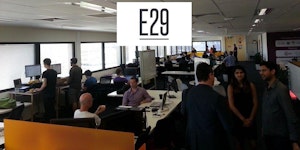
The ACT Government, in partnership with local universities, are training former public servants and universality students in how to set up a new business to commercialize an idea. The Entry29 Co-working space is holding a free Canberra Tech Startup Open Day, at its Canberra city office on the afternoon of Friday, 16 October 2015. If you are curious about all the talk of new high tech Silicon Valley type company start-ups, it is a good opportunity to come along and see where it is now happening. You don't need to be a computer genius to start a new venture, in fact it helps if you are not (I mentor start-ups and judge hacker competitions). You can get a free ticket, if you are just interested, already have an idea or are working on your business venture.

ps: A "co-working space" is a shared office where new business ventures can rent cheap space while setting up.

Tuesday, April 14, 2015

Application to Helping New Employees

Greetings from the Canberra Innovation Network, in the heart of the Canberra Start-up Business Boomerang, where Welcomer Chairperson Kate Lundy is launching the WelcomeAboard product. This is an on-line service to help organizations take on new employees. The idea is to take the tedium of paper form filling out of taking on a new employee, with all the details of their bank account (where they want to be paid), tax details and superannuation. The  service is designed to work with clod based accounting packages, such as Xero.

Saturday, January 31, 2015

Startup Muster Australian New Business Ventures

Startup Muster is preparing a list of Australian new business ventures. I filled in their survey form for my Higher Education Whisperer venture. What was interesting was that after answering a question I was shown the results so far from all participants. It is useful to see how your startup compares with others in Australia.

The previous surveys showed Australian startups had 19% female founders in 2013, 30 to 35 was the most common age, with 84% having been to university, and this being their first startup ventrure for most. NSW leads Australia for stat-ups, with 48% of the total and the Sydney CBD being the most common location. About half of the startups use a co-working space. 28% of startups have one founder, 66% have one or two, 86% have three or less. 

Monday, December 29, 2014

Muru-D Telstra Start-up Accelerator

muru_dThe Telstra Muru-D Start-up Accelerator hosted a Christmas party with the Sydney Educational Technology Meetup group (SydEduTech) on 19 December. This was held at Muru-d's offices in trendy Oxford St, Paddington.

Getting into the building provided difficult, as this is a working Telstra telephone exchange and was was on a heightened security state due to a recent incident in the centre of Sydney (the army base donw the road was at SAFEBASE alert CHARLIE). After having my photo id carefully checked, I was escorted to the muru-D floor, which has been converted from holding racks of telecommunication equipment to be a place for start-up companies.

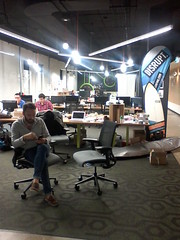
Like many such co-working spaces, muru-D has a warehouse conversion aesthetic, with cable-ways still visible on the ceiling, long rows of desks in an open plan environment . There is space for presentations with bean bags and stackable cardboard stools. Unlike the average co-working space, there is a roof-top deck next to the well equipped gym and kitchen, with panoramic views of Sydney (and glimpses of Sydney harbor and the bridge).

There were a series of typical start-up[ talks from the latest batch of businesses (Telstra selects a small number to be in residence every six months). These were well presented, with the usual enthusiasm (and the usual worry about how viable they were).

As this was a joint event with SydEduTech there was an emphasis on education. Also I noticed a strong connection with Chinese business.

The vent gave me some useful ideas. From January 2015 I am taking over teaching of the Australian Computer Society's "New Technology Alignment" (NTA) on-line postgraduate course.

Tuesday, September 24, 2013

Co-working in Perth

I booked a Tour of the Spacecubed Co-working space in Perth . But what I didn't realize is there are two Spacecubed offices in St George's Terrace, Perth. The older office is at 45 St George's Terrace, in an old bank building (they have a meeting room in the old vault).

The newer is at 131St George's Terrace, about two blocks further West, in another ornate building. Number 45 was buzzing with activity, with people coming for meetings and others hard at work at their workstations.

There is the usual co-working setup, with a lounge area, for informal socializing (and work), rows of desks for work and some meeting rooms. The ideal such setup has a reception desk near the front door, which also have sight of the entire facility, so one person can keep an eye on things, much like the librarian at the front desk of a library.

There can be transparent screens (Space cubed has some glass partitions and other made of perforated sheet), which provide some partial privacy. As well as small private meeting rooms, the common area can be used for large events, with some people still sitting at their desks working.

A couple of features at Space Cubed I have not seen at other such places in Australia (and Sri Lanka)  are a Yammer site for members to congregate on-line and Community Membership for those who don't need office space, but want to be part of the community.

Number 131 is smaller, newer and less busy (there is a meeting this-evening to co-design the space. While I was there an economist turned up looking for space. This surprised me as I thought it was only web entrepreneurs who inhabited these places. But apparently other professionals are looking for low cost flexible space with a pool of services to hand (including web designers).

 Perhaps these co-working spaces will evolve into something like the old lawyers chambers, where individual professionals form a cooperative for office space and then ancillary services group up around this.

Sunday, September 22, 2013

Spacecubed Co-working in Perth

Spacecubed in Perth, is a new Co-working, Collaboration and Innovation Space in the Perth CBD. Like Fishburners in Sydney and Entry 29 in Canberra, Spacecubed offers low cost shared office space to those starting up a new business venture, with the chance to meet like minded people.

One useful feature is reciprocal membership, with Spacecubed in Perh, teaming with Cityhive Geraldton and Sync Labs Leederville (also in Western Australia), as well as Fishburners Sydney, York Butter Factory Melbourne, River City Labs Brisbane, , Typewriter Factory, Hobart, and  Fill in the Blank Hong Kong.

One problem which Spacecubed has, along with other co-working spaces (in my view), is the silly name. It would be a lot easier to understand if it was called "Perth Co-working Centre", "Perth Startup Office" or the like.