Showing posts with label Hybrid. Show all posts

Friday, June 22, 2012

Solar Powered NBN Co Discovery Truck

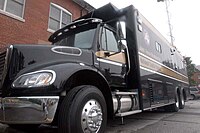
HINO Hybrid TruckThe National Broadband Network Company (NBN Co), have a "NBN Co Discovery Truck" touring Australia to promote broadband use. The schedule says the truck is at Toormina today and then will be at Penrith (NSW) on 26 June. I saw the display in Canberra this week. This is a good display, but I suggest NBN Co need a smaller version of the truck for urban areas.

Co Discovery TruckThe NBN truck is a very large semi-trailer which requires a specially qualified driver, wide roads, a large set-up area and several staff. Also the display needs considerable amounts of electricity from a diesel generator.

I suggest NBN Co commission a smaller truck for inner urban areas. This could be small enough to be operated by one person with an ordinary car licence and use solar, or mains power, when set up for display.

Smallest trucks can have their engines "de-rated" so they can be driven with an ordinary car license. A small display on the back of such a truck could be powered from batteries, charged while driving and supplemented by a small solar cell. An ordinary outdoor power cable could be used to run the display for extended periods and a small generator used intermittently when there is no mains and no sun.

The display could be secured and automated so that one person could set it up and oversee it, but would not need to be present all the time.

Several companies make small hybrid trucks using similar technology to the Prius hybrid car. These small trucks are popular with parcel delivery companies and local councils, as they are most efficient for stop start traffic. One of these would generate enough electrical power to run a display for a day. One is the Hyno Hybrid Truck, from Toyota's truck subsidiary.

It should be noted that the idea of a traveling display of telecommunications technology on a truck around Australia is not a new one. Digital video expert, George Bray, ran the "TechTrek", around Australia, in 2002. George used a converted camper-van, sponsored by the Australian Government and technology companies, to survey the use of the Internet and demonstrate its benefits. This was reported by the BBC. The "TechTrek Final Report" (George Bray, May 2002) is available.

Monday, August 01, 2011

Hybrid Sydney Bus

I photographed a hybrid bus on trial by the NSW State Transit Authority on the 370 route in Annandale, in the Sydney inner west. A media release described this as being a deseil electric hybrid which can run on battery power alone. But another option is a mild hybrid, running on natural gas, with battery power as a supplement.
"The hybrid bus will run on a small diesel generator, which either charges the buses’ electric battery or provides power directly to the electric motor if the battery is full. The motor, not the generator will drive the bus".

From: Hybrid Bus to Commence Trial in Sydney, Media Release, Carmel Tebbutt MP,

Thursday, July 21, 2011

Electrical Saftey in Battery Cars

Greetings from the Australian National University, where Professor Peter Zeller from Upper Austria University of Applied Sciences, is speaking on "Safety Aspects of Renewable Energy and Electrical Cars". The problem is that an electric car has a battery pack producing 100 V to 500 V which can deliver 10 to 20 kWh of energy. Rescue services may need to cut into a vehicle to after an accident, with the risk of electrocution or explosion of the battery. In addition the battery power is DC, not the AC which electrical engineers are used to controlling.

Simulating Short Circuits on Electric Cars

The Upper Austria University of Applied Sciences simulated the effect of a short circuit in an electric car, resulted in electrical arcing. Professor Zeller pointed out that such a high temperature arc will soon burn through the insinuation between the battery pack and the passenger compartment of a car.

There may be a very large fuse in the car, but this will offer limited protection. In theory a switch can be used to disconnect the battery, but the design of such a switch is problematic, due to the very high current involved. It occurred to me that for a safety switch a linear shaped charge might be used (explosives are already used in airbags and pretensioning seat belts).

An interesting point Professor Zeller made was that even the 48 volt systems used in new internal combustion cars are causing problems due to arcing and the problem is much worse with 100 to 300 volts in an electric car.

Photo-voltaic panel safety

There are similar problems with photo-voltaic panels on homes, with many electrical connectors exposed to the elements (as with the recent Queensland floods). Reports indicate that up to 80% of the solar panels installed on homes in Australia have faults.

Smart Batteries and Solar Panels

Professor Zeller's analysis is based on the assumption that the battery or solar panel creating the high voltage and current is "dumb". That is the cells are simply connected together in series to create a large battery (or solar array), which is then switched off as one unit. The other option would be to use an electronic switch on each battery, so that one large switch is not needed. This can be done easily where each voltage source has its own regulator (as for example where each panel converts low voltage DC to high voltage AC with a micro-inverter). If AC is used then the switching problem is much less.

Thursday, June 30, 2011

Monday, October 04, 2010

Longer Life Rechargeable Batteries

Sanyo Eneloop Power Pack Kit with 8 AA and 2 AAA Batteries, plus 4 C and 4 D Size adaptersSanyo announced an improved version of their Sanyo Eneloop Low Self-Discharge Rechargeable Battery, 6 October 2009 . These are now avialable in Australia and I purchased two AA cells from Dick Smith Electronics in Canberra.

These are Nickel Metal Hydride (NiMH) rechargeable batteries, which can be charged in the same sort of charger as other NiMH batteries. The main advantage advantage is that the Eneloop batteries will keep a charge for years, while normal NiMH batteries only keep a charge for months. The new batteries are claimed to retain 85% of their charge after a year, whereas normal batteries would be 50% discharged. Also they can be recharged 1,500 times, 500 times more than conventional NiMH batteries.

This makes NiMH batteries practical for low current applications, such as running a clock, where they previously they would not be of use.

USB Charger with 2 Sanyo Eneloop AA batteriesAmazon.com adversities the Eneloop in AAA Battery 4 Packs
and the AA batteries in 4 Packs and 8 Packs. There is also mains powered charger with 4 AA batteries and a USB Charger with 2 AA batteries.

There is also a very elaborate "Eneloop Power Pack Kit" 8 AA and 2 AAA Batteries, plus 4 C and 4 D Size adapters.

There is a detailed "Review: Testing Sanyo's Eneloop Low Self-Discharge Rechargeable Battery" avialable, along with a comparison of the new Eneloop against other brand of batteries "Review: Pre-Charged (Low Self-Discharge) Rechargeable Battery Comparison".

It will be interesting to see if the technology is also applicable to batteries for hybrid and electric cars. One of the worrying costs with electric cars is replacing the battery pack. If the battery can be made to last 50% longer, that will reduce the cost. Also a car which can keep the charge longer will be more practical.

Saturday, September 18, 2010

Canberra Electric Vehicle Festival

There is a display of electric bicycles, motorbikes, cars and trucks at the Canberra Electric Vehicle Festival today until 4pm, on the laws across from Old Parliament House. What interested me most was not the Tesla electric car, but the Fuso FE Eco-Hybrid 4 x 2 truck. This Mitsubishi vehicle is similar to the Toyota Hino Hybrid truck. However, the Fuso is using lithium batteries, rather than the hydride ones used by Toyota. This size truck is used commonly by councils. It would also be useful for emergency command centre vehicles, with the lithium battery and generator being able to supply power.

Also on display is a 1917 vintage Detroit Electric car. Several Mitsubishi iMIEVs are on display (I have driven the iMiEV and it is very practical). There were numerous electrical bicycles and electric bicycle conversion kits for sale (I wonder when someone will build a true electric bicycle, which replaces the gears with a generator).

The ACT Light Rail group had a display. Also I met Patrick Stein, from SONA promoting Home Sustainability Assessments.

Wednesday, May 05, 2010

Prius Plug-in Plug-out hybrid Car in Canberra

In Canberra today I noticed a Prius plug-in hybrid car. These are not that unusual, being a hybrid car which has been modified with a larger battery pack and a socket to allow them to be recharged from the mains power supply, or a renewable source, such as a solar panel or wind generator. This car was unusual in that it had a second socket marked "plug out". I assume this allows the car to supply electrical energy. The car was marked "Country Energy" with a web address for "Intelligent Network".

Such a plug out car could become a mainstream product in the future, supplying peak power back into the grid from the expensive batteries in the car. In the short term these are more likely to be of use in remote areas where mains supply is not available, in developing nations where a reliable mains supply does not exist and for military and emergency applications where the mains has failed. As an example, the Hawkei Protected Military Light Vehicle (PMV-L) might be equipped with power out to supply electronic warfare equipment.

Sunday, December 06, 2009

Hybrid Trucks for Local Council

Leichhardt Council in Sydney has purchased a Hino Hybrid Truck fromToyota's truck subsidary, which uses similar techology to Toyota's Prius hybrid car. In stop-start traffic, such a truck uses 20 l/100km, which is a considerable saving. Adapting this technology for trucks has taken a long time. The decision to purchase the truck was made in 2004 (Motion C465/04 by PARKER/HAMILTON, MINUTES of ORDINARY MEETING of Leichhardt Municipal Council , 23 November 2004), but it has taken until 2009 for the vehicles to be readily avialable.

In his 3 December Mayoral Column ("New Hybrid Truck Helps Cut CO2 Emissions in Leichhard"on page 12 of the Inner West Courier) , Mayor of Leichhardt, Counsellor Jamie Parker, reported on the purchase of the truck for garden maintenance.Unfortunately the Mayor's message contains a typographical error in that it refers to the truck reducing Carbon Monoxide emissions by 72%. This should read "Carbon Dioxide", as indicated by the chemical symbol in the report (CO2).

Also it is not clear that a hybrid truck is not particularly suited to garden maintenance, as the Mayor suggests. Hybrid vehicles achieve greatest savings when operating at low speed in stop start traffic. A good example of such an application are garbage trucks, which stop every few metres and rarely exceed a few kilometers an hour. Local busses are another example. In contrast a garden maintenace truck spends most of its time stationary with the engine turned off, while the garden work is being done. As a result little saving is made in fuel use.

This is a good initiative, but the council might like to consider other uses for it. These trucks have a useful role by providing electrical power. One use would be for powering the hot water weed killing unit often used for roadside weeds. These are usually powered by a diesel generator mounted on the truck. With a hybrid truck the generator could be eliminated.

The council could also use the truck as an emergency generator for its disaster response. . Usually diesel generators are used for this role which require ot be specially purchased, maintained, fuelled and tested, which is expensive and environmentally unfriendly. Instead the council could have the hybrid truck fitted with a socket to allow its generator and batter to supply electrical power. This could be used for extended and extensive blackouts at council premises. It could also be used to power a mobile emergency facility., such as those provided by Salvation Army Emergency Services (SAES). The truck could also be used for power at council work sites and at community functions in parks where mains power is not avialable. The Petersham Tafe are experienced in the development of alternative power systems and should be able to advice how to do this.

Monday, November 02, 2009

Victorian Hybrid Buses

The Victorian Government is sponsoring a trial of two hybrid buses. As the video from the Victorian Transport Department explains, two types of hybrid bus are being trialled: the serial hybrid is more suited to slow routes with many stops, the parallel to longer routes with higher speed.

The series hybrid vehicle is for Ventura Coaches, with the wheels driven only by electric motors. It is claimed to reduce fuel use by 40%. There are 640 lithium ion batteries charged from a 2-litre diesel Volkswagen car engine. The internal combustion engine is much smaller than that normally used in a bus. As this is a full hybrid, the bus could, in theory act as a plug-in hybrid, or pure electric bus, charged from mains power. However, as Victorian electricity is primarily sourced from highly polluting brown coal, this would not have environmental benefits.

The Grendas Bus Service vehicle is a parallel hybrid (similar to a most hybrid cars), built from an Australian made Iveco bus chassis, Volgren Low Floor Route bus body and Cummins diesel Allison hybrid gearbox. This is used as a "Smart Bus" on the Springvale Road 888/889 route.

One aspect of the hybrid buses which is not clear is their fuel source. If the hybrid buses run on diesel they may have little environmental or cost advantages over conventional natural gas powered vehicles.

Thursday, October 01, 2009

Mitsubishi new electric small van

Mitsubishi  i-MiEV CARGO electric vanMitsubishi Motors is showing its i-MiEV CARGO electric van at the 41st Tokyo Motor Show. This is derived from the i-MiEV electric car, which I test drove in Canberra. It will be on sale in Japan from April 2010.

The CARGO looks a very useful vehicle for small deliveries on short runs in inner city areas. It looks far more useful than the passenger i-MiEV, which offered little envrionmental benifit over the much cheaper petrol powered petrol engine Mitsubishi i small car it was based on.

i-MiEV CARGO specifications
Overall length 3395 mm
Overall width 1475 mm
Overall height 1860 mm
Wheelbase 2550 mm
Track F/R 1310 mm / 1270 mm
Occupants 2
Motor Permanent magnet synchronous
Max. output 47 kW
Max. torque 180 Nm
Max. cruising range 160 km
Drive train Rear wheel drive
Tire size Front: 145/65R15; Rear: 175/55R15
Mitsubishi Concept PX-MiEV Also on show will be the PX-MiEV hybrid petrol/electric "crossover" concept car. This appears to be Mitsubishi's answer to the Toyota Kluger Hybrid. Such a vehicle makes no practical sense and hopefully this one will not go into production.

Friday, June 05, 2009

Hybrid Police Car

Australian Federal Police Prius CarWhile at the Belconnen Mall in Canberra yesterday, I noticed a Toyota Prius hybrid car in Australian Federal Police markings. I assume this is not used for pursuit, but it was equipped with lights.

Saturday, April 04, 2009

Chevy Volt Not Commercially Viable

GM put a restructuring plan to the US Government. In its response, the US Treasury expressed the view that the Chevrolet Volt plug-in hybrid car is too expensive to be commercially viable:
"GM is at least one generation behind Toyota on advanced, “green” powertrain development. In an attempt to leapfrog Toyota, GM has devoted significant resources to the Chevy Volt. While the Volt holds promise, it is currently projected to be much more expensive than its gasoline-fueled peers and will likely need substantial reductions in manufacturing cost in order to become commercially viable ..."
From: Determination of Viability, General Motors Corporation, Summary, March 30, 2009
One of the problems is that the Volt tries to combine the functions of a hybrid car and an electric car. The Volt is designed with an electric motor and battery pack large enough to travel a reasonable distance (64.4 km) and speed (more than 100 k/hr) as an electric car, plus it also has a petrol engine. In contrast the Toyota Prius can only travel a couple of kilometres on battery power alone and only at up to 40 km. Many other hybrids cannot be driven at all without their petrol engine running. As a result these hybrids can have a smaller, lower cost electric engine and battery.

As designed, the Volt will need a battery about 30 times the capacity of the one in the Prius and so costing about 30 times as much. The difference in size of the electric motor: 111 kW versus 57 kW, is less significant in terms of cost. One solution for GM would therefore be to sell a lower cost model of the Volt with fewer batteries. GM could then advertise the Volt as having an electric range much longer that the Prius, but starting at a comparable price.

A smaller battery pack would also be much quicker to charge and could be done from an ordinary power point. Smaller lower cost charges could double the range of the electric Volt if there is a charger at each end of a regular trip. As an example, if there is a charger at the office car park a commuter could travel to work on battery power and then plug the car in to recharge for the trip home.

Of course a hybrid plug-in electric car might be trying to do too much. If you want an electric car for short runs at 40 km/h, then India already makes the REVA Electric Car. If you want a hybrid which can go longer at higher speeds, then Toyota already make these, along with Honda (Civic Hybrid) and Ford (Escape Hybrid using technology from Toyota).

Friday, October 03, 2008

Battery electric hybrid tram

The Japan New Energy and Industrial Technology Development Organisation (NEDO) has developed a battery/electric "hi-tram". This is described as a contact wire/battery hybrid Light Rapid Transit (LRT) vehicle in Railway Technology Avalanche (19 September 2008). There is no internal combustion engine (as in a hybrid car); instead the battery is recharged from the overhead wires. The tram can then lower the pantograph and run on battery power for a few km. This allows trams to be used in places where overhead wires cannot be installed for cost, safety or aesthetic reasons. There is a video of the tram in operation.

The vehicle is also referred to as a "Contactwire-less Tramcar" and uses Lithium Ion batteries. Obviously it would be feasable to create a hybrid trolleybus, using similar batteries and motors to the tram. This would be able to drive on unmodified roads on battery power and then recharge when on main routes equipped with overhead wires.

Tuesday, April 15, 2008

Problems of Uncertainty in Power Networks with Renewables

Professor Ian Hiskens from University of Wisconsin-Madison will talk on the problems renewable energy systems and plug-in electric cars will cause for the electricity grid at the Australian National Unviersity in Canberra, 14 April 2008:

INFOENG SEMINAR SERIES

Problems of Uncertainty in Power Networks with Renewables

Prof. Ian Hiskens (University of Wisconsin-Madison)

DATE: 2008-04-21
TIME: 11:00:00 - 12:00:00
LOCATION: RSISE Seminar Room, ground floor, building 115, cnr. North and Daley Roads, ANU

ABSTRACT:
Renewable generation and plug-in hybrid electric vehicles are set to play an important role in future power networks. This will present a significant change from current systems that are dominated by centralized generation. Accordingly, existing analysis tools are not well suited to assessing the dynamic performance of power networks that incorporate highly distributed generation and storage technologies. Aggregated models of the distributed resources will be necessary, though such models will be highly uncertain. The seminar will present computationally feasible approaches to assessing the influence of uncertainty on the dynamic behaviour of nonlinear systems, with a focus on power networks. A process of ranking parametric influences will be considered. It will be shown that trajectory sensitivities can be used to obtain accurate first-order approximations of trajectories that arise from perturbed parameter sets. These approximate trajectories provide an efficient means of generating an uncertainty envelope around the nominal trajectory.

BIO:
Ian A Hiskens received the BEng (Elec) and BAppSc (Math) degrees from the Capricornia Institute of Advanced Education, Rockhampton, Australia in 1980 and 1983 respectively. He received the PhD degree in Electrical Engineering from the University of Newcastle, Australia in 1991. He is a Professor in the Department of Electrical and Computer Engineering at the University of Wisconsin - Madison. From 1980 to 1992, he was with the Queensland Electricity Supply Industry, where he held the positions of EMS Security Applications Engineer and Planning Engineer Transmission Systems. From 1992 to 1999, he was a Senior Lecturer at the University of Newcastle, Australia, and from 1999 to 2002 a Visiting Professor in the Department of Electrical and Computer Engineering at the University of Illinois at Urbana-Champaign. His major research interests lie in the analysis of nonlinear (hybrid) systems, in particular system dynamics and control, and numerical techniques. Power systems form his primary applications focus. He is involved in numerous IEEE task forces and committees, is past Chair of the Technical Committee on Control of Energy Processing and Power Systems within the IEEE Control Systems Society, and past Chair of the Power Systems and Power Electronic Circuits Technical Committee of the IEEE Circuits and Systems Society. He was an Associate Editor of the IEEE Transactions on Circuits and Systems-I: Regular Papers from 2002 to 2005, and is currently an Associate Editor of the IEEE Transactions on Control Systems Technology. He is the Treasurer of the IEEE Systems Council. Professor Hiskens is a Fellow of the IEEE, a Fellow of Engineers Australia, and a Chartered Professional Engineer in Australia.

Tuesday, March 04, 2008

Toyota Prius Hybrid Sydney Taxi

Prius Sydney Taxi
In the streets of Sydney's inner west, I noticed a Toyota Prius hybrid car being used as a taxi. This makes sense as taxis spend a lot of their time traveling at low speed and in stop-start traffic, making best use of the electric motor of the hybrid system.

The NSW Taxi Council and Legion Cabs ran a 12-month pilot program using early models of the Prius in 2006/2007. The Prius was then approved for use as a taxi and hire car in November 2007.

However, a Prius has some disadvantages as a taxi, being smaller than the cars usually used and a hatchback, not a sedan. Also the Prius' lack of boot space, and only a compact spare tire, would make it difficult to convert to LPG (autogas). Because of government incentives, LPG is cheaper than petrol and so a petrol Prius may not be more economical than an LPG car. At least one test car has been converted.

The Toyota Camry Hybrid might make a better taxi. The
New York City Taxi and Limousine Commission (TLC) offers advice on how to install the meter. The Australian Government is seeing if the hybrid Camry be built in Australia. Toyota has has some LPG compatible vehicles. So a hybrid LPG Camry made in Australia is possible.

See also:
  1. Books about the Prius
  2. Prius accessories

Wednesday, November 07, 2007

Hybrid automatic transmission for Australian cars

German company ZF have announced a modular eight speed hybrid automatic transmission. The significance of this is that a hybrid petrol or diesel electric car can be produced by adding the transmission in place of a regular transmission. A mild hybrid can be produced by using a crankshaft starter generator (essentially a beefed up starter motor), which will provide an electric boost for the engine. Or a larger electric motor can be used to produce a true parallel hybrid (with bother or either electric and internal combustion engines powering the vehicle). ZF transmissions are used in some upmarket models of Australian made cars, so these could be upgraded to hybrid.

The new 8-speed automatic transmission has a modular design that will allow it to be used in tandem with various drivelines without having to adapt the basic transmission concept. It is particularly versatile when it comes to hybrids: a mild hybrid drive can be adapted with the addition of a crankshaft starter generator or a full hybrid system can be integrated as a parallel hybrid drive – both options regardless of the available space. Alternatively, the 8-speed automatic transmission can be combined with a hydrodynamic cooled clutch or an integrated starting clutch. In terms of power take-off, it can be used with all standard ZF all-wheel systems. ...

From: Hybrid transmissions, ZF, 14.09.2007

Friday, August 24, 2007

Hybrid Truck for Mobile Command Center

Hino Hybrid TruckHino, Toyota's truck subsidiary, are now selling a Hybrid medium size truck. These are large enough to carry a containerized shelter for a Mobile Command Center, as used by the police, fire and other emergency services. Use of a hybrid vehicle has been noted saving having to install a separate generator in the truck to power lights, computers and air conditioning.

The Hino Hybrid truck has a 23kW generator and 273 volt 6.5Ah battery. This would be enough for a small containerized shelter the size of a 20 foot ISO shipping container. These can be expandable.

Metropolitan Ambulance Service mobile command and                      communications vehicleAn example of an Australian mobile command center on a truck the size of the Hino Hybrid is the Victorian Metropolitan Ambulance Service mobile command and communications vehicle. The Fire & Emergency Services Authority of Western Australia Incident Control Vehicle is based on a smaller bus chassis.

Mobile Command Center of the US Joint Force Headquarters National Capital RegionA large range of commercial vehicles are used for mobile command centers, from ones based on SUVs, up to articulated semitrailers. As an example the Mobile Command Center (MCC), of the US Joint Force Headquarters National Capital Region (JFHQ-NCR) is on a 41 foot semi-trailer.

The same technology is used for mobile classrooms, PR displays and outside broadcast units.

Sunday, June 24, 2007

Hybrid Battery Electric High Speed Train Tested

A British HST (High Speed Train) has been modified with a hybrid fuel saving diesel electric system. A video of the train is available. This is significant for Australia as NSW's XPT trains are based on the HST.

"ON MAY 3 Hitachi Europe unveiled 'Hayabusa', which it says is Europe's first battery-assisted diesel-electric power car. The hybrid drive has been installed in a British HST power car to allow realistic trials of the prototype technology, which Hitachi and its development partners Brush Traction, Network Rail and Porterbrook Leasing anticipate could reduce fuel consumption by 20%."

From Railway Gazette International, 4 May 2007


Wednesday, November 29, 2006

Macquarie Bank Sydney Airport Train?

In November I proposed a "Hybrid High Speed Train to Sydney Airport":
... high speed battery-electric/diesel trains could be routed from Canberra to Sydney via the exiting line to Sydney Airport. ...
Perhaps we will see Macquarie Bank investing in a high speed Sydney-Canberra train, similar to the one they run in Sweden. This would be a relatively inexpensive way to free up landing slots at Macquarie's Sydney airport and allow Macquarie's Qantas aircraft to be used for more profitable routes.

Macquarie Bank have made a takeover approach to Qantas Airlines:
"Nov. 22 (Bloomberg) -- Qantas Airways Ltd., Australia's biggest airline, received a takeover approach from Macquarie Bank Ltd. and Texas Pacific Group ... lifted the airline's market value to A$10 billion ($7.7 billion)."
From: "Qantas Approached by Macquarie Bank, Texas Pacific (Update4)", Bloomberg, 21 Nov 2006
Macquarie Bank has already invested in Sydney Airport:
"Sydney Airport - Australia's busiest and most important aviation hub for both passengers and freight - was opened in 1920 and is one of the oldest continuously operating airports in the world. Sydney Airport covers 907 hectares on the shoreline of Botany Bay, eight kilometres south of Sydney's central business district. The airport is a dynamic economic centre, requiring the services of some 500 businesses and organisations to meet the needs of airport users. Sydney Airport is owned under a 50 year lease, which started 1 July 1998, with an additional 49 year zero cost option.
From: "Sydney Airport - Macquarie Airports", Macquarie Bank Limited, 2006
Macquarie Bank's European Infrastructure Fund owns the Arlanda Express high speed train to Stockholm airport. I travelled on this train in 2001.

Replacing Qantas flights from Sydney to Canberra with a train would free up 40 landing and takeoff slots per day for use by more profitable long distance flights. It would also make better use of the underutilized Sydney airport rail line.

The UK High Speed Trains which the Australian XPTs are based on are being refurbished and fitted with new diesel engines. It would be much cheaper for Macquarie/Qantas to buy or refurbish some trains than buy additional aircraft for Qantas.

The term "high speed" would largely be for marketing purposes with a Sydney-Canberra train, as without extensive trackwork the train could not travel at high speed for more than a fraction of the journey. However, the hybrid technology being tested with UK HSTs might provide high torque for more rapid climbing of the NSW highlands, in a variation of the "ballistic travel" used by TGVs. Improvements being made to the line into Sydney to speed freight might also help reduce delays for a Canberra train, making the trip just over three hours and competitive with an airline flight with ground delays of just over two hours.

A parliamentary report noted time savings could be made from reducing delays:
"During 1995, the NSW State Rail Authority trialed a Swedish X2000 tilting train on the Canberra corridor, claiming notable travel time savings. However, most of the savings came from the deletion of normal station stops and special operational arrangements in the Sydney network to avoid conflicts with suburban trains. The X2000 actually achieved standard trip times of three hours and twenty minutes at best. ..."
From: High Speed Trains between Canberra and Sydney, Current Issues Brief 17 1996-97, Matthew James, Denis James, Parliamentary Library
But my trip on the X2000 from Sydney to Canberra was much slower. ;-)

Monday, November 20, 2006

Hybrid High Speed Train to Sydney Airport?

Hitachi Hybrid Traction System
Back in March I suggested that high speed battery-electric/diesel trains could be routed from Canberra to Sydney via the exiting line to Sydney Airport. This seemed a little far fetched, but in October 2006 Hitachi announced they are modifying a UK High Speed Train (HST) with their diesel electric system developed in Japan. The XPT trains used in NSW are based on the UK HST, so it should be possible to use the Japanese hybrid technology in Australia.

Hitachi Europe Ltd. today announced the launch of technology that will create Europe's first hybrid high speed train. The technology has been proven under test in Japan to cut fuel bills by up to 20% and harmful emissions by up to 50%. The test train includes a new hybrid traction system (consisting of a battery-assisted diesel electric traction drive) which will be installed into an existing High Speed Train (HST), with the equipment fitted into the front Power Car and a modified Trailer Car. The technology has been developed and tested in Japan since 2003 and is currently in production for a Japanese customer.

Hitachi and its partners Porterbrook Leasing, Network Rail and Brush Traction are aiming to commence trial running of the modified train in April 2007 and on completion of testing the modified train will run in service on the New Measurement Train for a period of six months to prove the benefits of the technology.

Alistair Dormer, General Manager Hitachi Rail Group, commented:

"Long term sustainability is a key requirement for future transportation systems and Hitachi is delighted to be playing a part in developing this new hybrid traction system, which will in time demonstrate significant benefits in reducing the environmental impact of train travel and reducing fuel bills". ...

From: Hitachi Announces Launch Of First Energy-saving Hybrid High Speed Train In Europe, Hitatchi Europe Ltd, 12 October 2006