I have suggested the tour organizers offer virtual tours of the the Taman Pintar science park, the shopping center and a ride in a local bus as to the visitor these are also fascinating.
Showing posts with label virtual reality. Show all posts
Friday, March 26, 2021
Virtual Tour of Borobudur
Travelxism, who ran the tour of Borobudur Temple I went on in 2019, at TALE 2019, are now offering virtual group tours, with a local guide using Zoom. They offer tours also to other Yogyakarta sites. This can be for a group of friends, a workplace, club or conference. Of course. it is not quite the same as the real thing, but you do get to ask questions.
I have suggested the tour organizers offer virtual tours of the the Taman Pintar science park, the shopping center and a ride in a local bus as to the visitor these are also fascinating.
Thursday, February 09, 2017
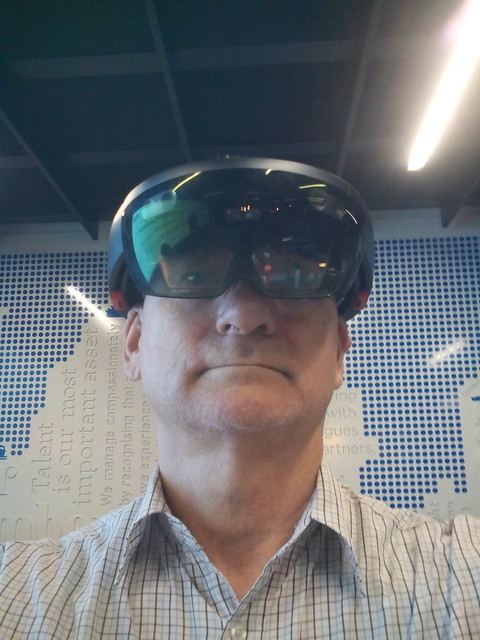
Tried Microsoft HoloLens at LinkedIn Sydney
At the Instructional Design & eLearning Meetup last night at LinkedIn Sydney, I had the opportunity to briefly try Microsoft HoloLens. This was the most comfortable of the virtual reality headsets I have tried. The key feature is that the display is semi-transparent, superimposing images on what you can see around you. Also there is less of a catastrophic feeling. In addition the unit feels more balanced than other headsets which impose weight on the face. I was able with a little practice to use hand gestures to manipulate the image in front of me. But more significantly, I was still able to see and talk to people around me.
The Microsoft HoloLens is still a large and cumbersome device to have on your head. We are a couple of equipment generations, and several years, from a unit which is suitable for everyday use. These will need to be reduced to the size of the MicroOptical_MyVu, from 2002, which clipped onto the side of a pair of spectacles (but lacked the sensors in the VR units). As it is you would need a good reason to use the Microsoft HoloLens, for gaming, education or work.
The case for gaming with VR is clear, however, applications in education and work are less clear. There are not many situations where the immersion augmented/VR experience counteracts the impediment of the equipment. There would be limited roles in education, where the student needs their hands free. In the workplace the roles would be even more limited. Such units have been proposed for those repairing complex equipment to provide detailed instructions. However, those repairing, for example jet engines, or heart valves, do not do so untrained: they already have to have a high level of skill and knowledge.
One obvious use is in defence and security applications. The technology in consumer VR headsets could make the units affordable for more than just fighter pilots (and the VR headsets for the F-35 are not working too well anyway).
The Microsoft HoloLens is still a large and cumbersome device to have on your head. We are a couple of equipment generations, and several years, from a unit which is suitable for everyday use. These will need to be reduced to the size of the MicroOptical_MyVu, from 2002, which clipped onto the side of a pair of spectacles (but lacked the sensors in the VR units). As it is you would need a good reason to use the Microsoft HoloLens, for gaming, education or work.
The case for gaming with VR is clear, however, applications in education and work are less clear. There are not many situations where the immersion augmented/VR experience counteracts the impediment of the equipment. There would be limited roles in education, where the student needs their hands free. In the workplace the roles would be even more limited. Such units have been proposed for those repairing complex equipment to provide detailed instructions. However, those repairing, for example jet engines, or heart valves, do not do so untrained: they already have to have a high level of skill and knowledge.
One obvious use is in defence and security applications. The technology in consumer VR headsets could make the units affordable for more than just fighter pilots (and the VR headsets for the F-35 are not working too well anyway).
Thursday, April 15, 2010
Operating robots with virtual reality
Bagus Manuaba is researching at the ANU how to remote control a machine using virtual reality. Devices such as bomb disposal robots are normally operated by remote control, with an operator looking at a live video display and pushing buttons and operating a joystick. The operator is only a few hundred metres from the robot and so there is little delay transmitting video from the robot to the operator and the operators instructions back. However, as the distance in increases the, delay does also.
Where the operator is on one side of the world and the robot the other, the delay prevents fine control and the robot has to be semi-autonomous. In addition, looking at a flat 2d image makes it hard to control a robot.
Some systems use stereoscopic video, such as the Airbus Military Aerial Refuelling Boom System (ARBS) fr the Airbus A330 Multi Role Tanker Transport (MRTT) aircraft being acquired by the Royal Australian Air Force. With this system the operator sits in the aircraft cockpit and fly the boom while looking at a stereoscopic image. Previous systems, such as the KC-135, require the operator to be in the tail of the aircraft. It might be interesting to enhance the Airbus system with virtual reality.
Where the operator is on one side of the world and the robot the other, the delay prevents fine control and the robot has to be semi-autonomous. In addition, looking at a flat 2d image makes it hard to control a robot.
Some systems use stereoscopic video, such as the Airbus Military Aerial Refuelling Boom System (ARBS) fr the Airbus A330 Multi Role Tanker Transport (MRTT) aircraft being acquired by the Royal Australian Air Force. With this system the operator sits in the aircraft cockpit and fly the boom while looking at a stereoscopic image. Previous systems, such as the KC-135, require the operator to be in the tail of the aircraft. It might be interesting to enhance the Airbus system with virtual reality.
Teleoperation System with Supervisory Control in a Mixed Reality Environment
Bagus Manuaba (SoCS CECS)
CS HDR MONITORINGInfo & Human Centred Computing Research Group
DATE: 2010-04-15
TIME: 11:30:00 - 12:00:00
LOCATION: Ian Ross Seminar Room
CONTACT: Michelle.Moravec@anu.edu.au
ABSTRACT:
Mixed reality is a new innovation of virtual reality. By combine this innovation with supervisory control in teleoperation system is expected can solve any limitations that occur in teleoperation system today. In this presentation I will give a brief description about teleoperation, supervisory control and mixed reality, and also bring several examples of research that related in this area. In addition, it is also showing the focus and the expected outcomes from my current research.
Tuesday, February 24, 2009
Virtual Reality for Commanding the Australian Defence Force
The Australian Department of Defence has issued a Request for Tender for a "Headquarters Joint Operations Command (HQJOC) Telepresence System" providing virtual reality meeting rooms. There is a 94 page document available, but only a couple of pages addresses the requirement in very general terms. This seems a good opportunity for those with advanced systems to offer products beyond ordinary video conferencing. One limitation will be compatibility with systems such as those I observed personnel using on the USS Blue Ridge.
The Department of Defence (Defence) requires solutions for a virtual reality meeting capability between two Defence locations in and near Canberra, ACT, Australia.
Defence is seeking a Respondent's proposed solution that will:
a. provide Defence with visibility of Respondents products, indicative costs and options for a virtual reality meeting solution;
b. meet Defence's current and future defence capability requirements;
c. provide Defence with a value-for-money solution;
d. provide significant and sustainable benefits to Defence, defence industry and the Respondent who is ultimately successful in the process; and
e. provide long-term cost benefits and risk reduction to other forms of personnel communications over short, medium and long distances. ...
From: "Headquarters Joint Operations Command (HQJOC) Telepresence System, AZ4477, Defence Support Group of the, Department of Defence, 23-Feb-2009
Subscribe to:
Comments (Atom)

