Showing posts with label Tsunami. Show all posts

Thursday, June 21, 2018

False Alarm from Indian Tsunami Early Warning Centre

Thursday morning I noticed a worrying message from the Indian Tsunami Early Warning Centre:
Date: Thu, 21 Jun 2018 03:29:03 +0530 ...
"IOTWMS-TSP INDIA has detected an earthquake with the following preliminary information:
Magnitude  : 8.5  M
Depth      : 10  km                      
Date       : 20 JUN 2018
Origin Time: 2154UTC
... this earthquake may be capable of generating a tsunami affecting the Indian Ocean region."
This was alarming because an 8.5 magnitude earthquake is extremely large. But then I noticed the location was given as "TEST_TEST_CENTRAL CHILE".

As confirmed later, this was a test message which escaped from the internal system, out to the public:
"CANCELLATION MESSAGE ...
Date: Thu, 21 Jun 2018 05:33:31 +0530

IOTWMS TSUNAMI SERVICE PROVIDER INDIA (ITEWC)
This is not a real event. This event was issued due to an operator error during an internal test. ..."
It took two hours to issue the correction, which is an unacceptably long time.


Wednesday, January 24, 2018

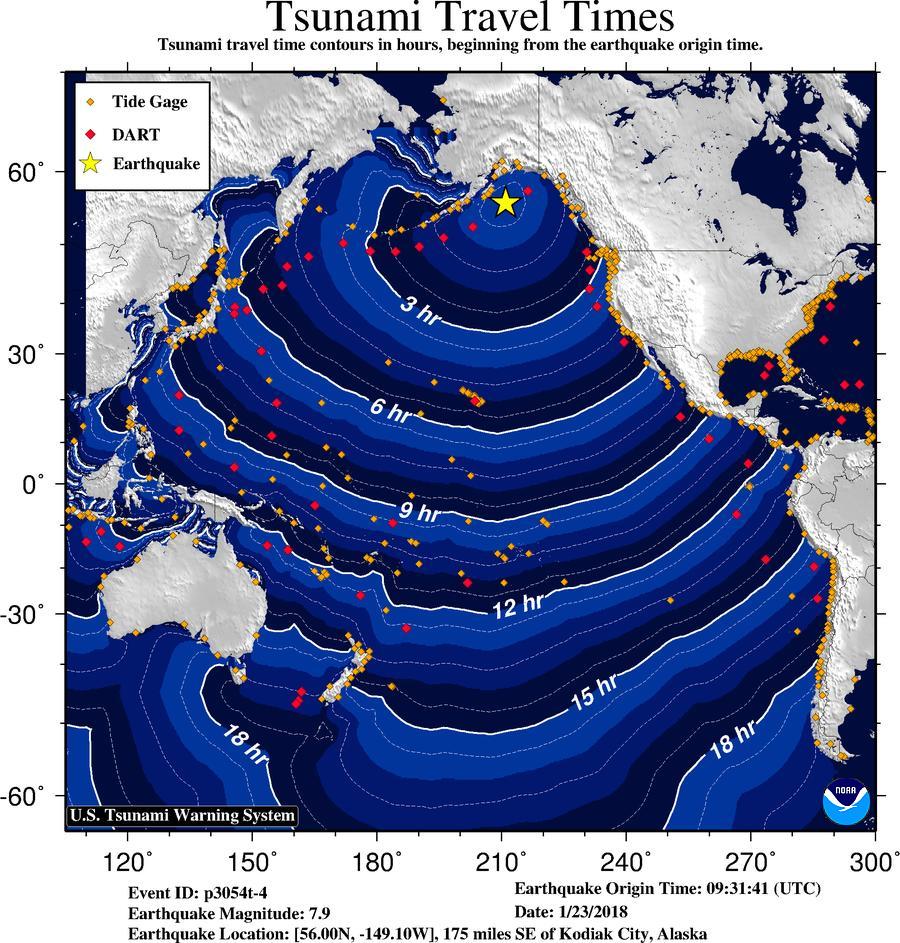
U.S. Tsunami Warning System Problem

Tsunami Warning after an earthquake
near Alaska at 01-23-2018 09:35:57 UTC
The U.S. Tsunami Warning System issued a warning after an earthquake near Alaska at 01-23-2018 09:35:57 UTC.

However, when I checked the home page at 11:15 UTC the map did not show the earthquake location and instead said "Earthquake Layer failed to load" and "Alerts/Threats Layer failed to load". This would appear to be because the system was overloaded. I then canceled the page request, not wishing to make the situation worse.

The NWS Tsunami Alerts Twitter feed was working at the time. However, the twitter alerts contained a link to the same non-functioning web page:
    NWS Tsunami Alerts
‏    Verified account @NWS_NTWC
    2m2 minutes ago

    TSUNAMI WARNING 4: See http://tsunami.gov  for alert areas.
    M7.9 175mi SE Kodiak City, Alaska 0032AKST Jan 23:
There were some maps provided direct in the twitter feed, which did display:

Tsunami Travel Time Map, from
U.S. Tsunami Warning System
     Media

    NWS Tsunami Alerts
    ‏Verified account @NWS_NTWC
    1m1 minute ago

    Tue Jan 23 11:18:49 UTC 2018  event picture

    https://pbs.twimg.com/media/DUOMO-xWsAAOEMk.jpg
However, these maps are difficult to interpret, as they showed a series of predicted arrival times as colored lines, with no scale as to the size of the wave. The waves were shown reaching Australia in 11 hours, although no warning had been issued by the Joint Australian Tsunami Warning Centre. 

Colored dots on the map indicated the location of tidal gauges and "DART". Not explained on the map, DART is a system of "Deep-ocean Assessment and Reporting of Tsunamis" detectors. 

Fortunately in this case the tsunami was only 6 inches high (as reported at Old Harbor Alaska 0256  PST Jan 23). However, I suggest revising the design to use simple static map images on the web site, using a few colors, so the file is small. Also the use of extensive JavaScript should be avoided to allow the page to load quickly. At present the HTML file is only 61 kBytes, but the other files are 3.4 Mbytes, including a 1.2 Mbyte JavaScript file.

The tidal gauge and DART locations are not of use to someone who wants to know when, when and how large a tsunami to expect. These should be omitted from the map, unless they show a reading. The predicted arrival time should be limited to a few hours, until the existence of a significantly sized tsunami is confirmed.

Thursday, October 24, 2013

Ten Years of Post-Tsunami Recovery in Sri Lanka

A call for papers has been issued for the 2nd Asian Conference on Information Systems for Crisis Response and Management on the topic "10 Years of Post-Tsunami Recovery: the role of ICTs in building disaster resilience". The conference ISCRAM-Asia 2014, will be Colombo,  to be held in Sri Lanka, 20-21 June 2014.

2nd Asian Conference on Information Systems for Crisis Response and Management

Call for Papers

CONFERENCE THEME: 10 years of post-tsunami recovery: the role of ICTs in building disaster resilience 
ISCRAM-ASIA 2014: 2nd Asia-Continental Conference on Information Systems for Crisis Response and Management 
CONFERENCE DATES: Friday 20th & Saturday 21st June 2014 LOCATION: Colombo, Sri Lanka.

 THEMES

1. RESPONSE
1.1    Coordination, Search and rescue / First Aid
1.2    Humanitarian and Disaster relief supply chain management
1.3    Emergency management information systems (Information Systems supporting Situational Awareness, disaster relief supply chain management)
2. REHABILITATION AND RECONSTRUCTION
2.1    Humanitarian challenges
2.2    Reconstruction, long term recovery and ecosystem reconstruction
2.3    Resettlement (land use planning/reasoning)
2.4    Monitoring long-term progress in disaster risk reduction
3. CROSS CUTTING ISSUES
3.1    ICTs for Disaster Risk Management
3.2    Decision support systems
3.3    Risk communication, dissemination and comprehension
3.4    Development and operationalization of response control systems
3.5    Intelligent systems
3.6    Use of ICTs in public health and emergency medical management
3.7    Role of social media in risk perception, awareness, knowledge management, and crisis response
3.8    Mobile technology for real-time emergency response
4. PREPAREDNESS
4.1    The role of cultural and gender dimensions in disaster vulnerability, response, and recovery
4.2    Innovative Multi-stakeholder Community-focused Partnerships in DRR and EWS
4.3    Functional Early Warning Systems
4.4    Disaster Risk Assessment
4.5    Emergency drills and simulations
5. PREVENTION AND MITIGATION
5.1    Risk communication, dissemination and comprehension
5.2    Disaster risk insurance, management and planning
5.3    Development and operationalization of response control systems
5.4    Disaster awareness education training (or disaster education and learning)
5.5    Progress in developing early warning systems
5.6    Climate Change Adaptation

CONTRIBUTIONS

ISCRAM-ASIA 2014 invites two categories of papers. All paper submissions must be relevant to ISCRAM, make a new and significant contribution to the body of knowledge on information systems for emergency management, support their contribution with valid arguments, and be clearly structured and well written.
  • Research papers presenting valid, original, relevant cutting edge research that will be reviewed to the highest academic standards. Reviewing will pay additional attention to the application of the related scientific literature and theory, to the use of an appropriate research methodology, and to technical, mathematical and statistical correctness. This will be complemented by a review from a member of the Scientific Committee (SC).
  • Insights from the Practice of Emergency Management papers presenting new developments in emergency management and policy making, discussing approaches, methods, tools, (best) practices and standards. These papers should focus on practical issues and concerns and raise challenges for future research, and will be reviewed to the highest practice-oriented standards.According to the completeness of work, authors can choose to submit their work as
  • Full papers presenting completed work. Such papers should be no more than 10pages including figures & tables (~5000 words).
  • Short papers presenting work in progress and novel approaches that are beingdeveloped. Such papers should be no more than 4 pages with figures & tables (~2000 words).
Posters
  • Posters presenting work in progress, novel approaches being developed or completed work must first outline the content of the poster through a 1 page abstract (~250 words), then followed by an image of the actual poster.
  • Panel discussions presenting work in progress, novel approaches being developed or completed work must first outline the title, theme, context, and panelists credentials in a short-paper no more than 4 pages with figures & tables (~2000 words)For each type of paper, submissions are welcome from academics, researchers, practitioners, technical or other experts, policy makers, or other professionals in the emergency management domain. The proceedings will identify the type of submission and reviewing process chosen.Other forms of contributions: Separate calls are or will be made for workshops, panels, posters, demonstrations, and the doctoral consortium. All calls will be published on iscram2014.org.

TO SUBMIT A PAPER:

  1. Authors must submit papers electronically through the conference system. The link to the submission system will be available on the website in November.)
  2. All papers must use the ISCRAM paper template and follow the ISCRAM house style. The template will be available through the conference system and on the conference submissions page

Important Dates

Announce call for full-paper abstracts
20 October 2013
Deadline for submission of full-paper abstracts
24 November 2013
Review abstract and invite submission of full-papers
15 December 2013
Deadline for submission of full papers
09 March 2014
Deadline for panel proposals
09 March 2014
Deadline for short-paper submissions (work-in- progress & concept papers, poster proposals)
09 March 2014
Complete review of full-papers, short-papers, and
13 April 2014
panel proposals

FINAL submission of camera-ready full-papers, short- papers, and panel proposals
18 May 2014
FINAL decision made by the Program and Scientific Committee
01 June 2014
...

Thursday, April 04, 2013

Python for Tsunami Warnings

Greetings from the Canberra Python Users Group (CPUG) meeting in the famous Room N101 in the Australian National University's Computer Science and Information Technology Building, in Canberra. I gave a short talk on "MOOCS with Books". This was followed by Fei Zhangon on "Python at Geoscience Australia", who use Python for the Australian Tsunami Warning System (ATWS).

Thursday, March 21, 2013

Caribbean Tsunami Warning Exercise

The Intergovernmental Oceanographic Commission is currently conducting a Caribbean tsunami warning system test. The Participant Handbook for "EXERCISE CARIBE WAVE/LANTEX 13: A Caribbean Tsunami Warning" is available. Here is the start message I received for the exercise:


Subject: [Tsunami Message - IOC] Local Tsunami Watch Message
Date: Wed, 20 Mar 2013 13:03:18 +0000
From: tsunami-information-ioc@lists.unesco.org
Reply-To: tsunami-information-ioc@lists.unesco.org
To: IOC_Public_Lists@ptwc.noaa.gov

TEST...TSUNAMI EXERCISE MESSAGE NUMBER 1...TEST
NWS PACIFIC TSUNAMI WARNING CENTER/NOAA/NWS
ISSUED AT 1302Z 20 MAR 2013

...THIS MESSAGE IS FOR TEST PURPOSES ONLY...
...CARIBE WAVE 13/LANTEX 13 TSUNAMI EXERCISE MESSAGE. REFER TO PTWC
MESSAGE 1 IN THE EXERCISE HANDBOOK. THIS IS AN EXERCISE ONLY...

THIS MESSAGE IS BEING USED TO START THE CARIBE WAVE 13/LANTEX 13
CARIBBEAN TSUNAMI EXERCISE. THIS WILL BE THE ONLY EXERCISE MESSAGE
BROADCAST FROM THE PACIFIC TSUNAMI WARNING CENTER EXCLUDING SPECIAL
EMAIL MESSAGES DISCUSSED IN THE HANDBOOK. THE HANDBOOK IS AVAILABLE
AT THE WEB SITE WCATWC.ARH.NOAA.GOV. THE EXERCISE PURPOSE IS TO
PROVIDE EMERGENCY MANAGEMENT A REALISTIC SCENARIO TO TEST TSUNAMI
RESPONSE PLANS.

THIS IS ONLY AN EXERCISE.

Wednesday, October 24, 2012

Indonesian Tsunami Early Warning System Issuing False Alarms

The Indonesia METEOROLOGICAL CLIMATOLOGICAL AND GEOPHYSICAL AGENCY (BMKG) has started issuing warnings online from the Indonesian Tsunami Early Warning System (InaTEWS). Unfortunately, InaTEWS is relaying bulletins issued from other regional warning systems. These bulletins are already relayed by UNESCO, so that multiple copies of irrelevant Tsunami warnings are received. As an example InaTEWS issued a bulletin about an earthquake near Nicaragua on 24 Oct 2012 at 0045 UTC. It would be a very long time, if ever, before this effected Indonesia, on the other side of the Pacific Ocean.

Wednesday, April 11, 2012

Indian Ocean Wide Tsunami Watch

Map of Magnitude 8.7 earthquake off the western coast of Northern Sumatra (Indonesia) at 08:39 UTC 11 April 2012The Pacific Tsunami Warning Center in Hawaii issued a Indian Ocean Wide Tsunami Watch at 08:45 UTC on 11 April 2012. This followed a Magnitude 8.7 earthquake off the western coast of Northern Sumatra (Indonesia) at 08:39 UTC. The latest bulletin, number 4 at 10:54 UTC, reported a tsunami wave of 1.06 m at Meulaboh, capital of West Aceh, Indonesia. A magnitude 8.3 aftershock was also reported. The Joint Australian Tsunami Warning Centre has not issued any warning for Australia.

Sunday, February 05, 2012

Tsunami Test Message Failure

The Pacific Tsunami Warning Centre in Hawaii issued an unscheduled test message for the Caribbean Sea and Adjacent Regions Tsunami Warning System (CARIBE-EWS) at 16:40:36 UTC 4 February 2012. It appears to have taken just under four minutes to get to me by email at 11:44:20 UTC. This indicates a failure of the system as the message took more than a few minutes to arrive. Most of the delay in the initial step from the PTWC to UNESCO.

A potential problem remains with the formatting of the tsunami warnings, in that they may be mistaken for Spam. Here is the spam report for this message:
X-Barracuda-Spam-Report: Code version 3.2, rules version 3.2.2.73406


ptsrule namedescription
0.00NO REAL NAMEFrom: does not include a real name
3.38FH DATE PAST 20XXThe date is grossly in the future.
0.01UPPERCASE 75 100message body is 75-100% uppercase
1.93UPPERCASE 75 100 2message body is 75-100% uppercase

The "FH_DATE_PAST_20XX" rule does not appears to be incorrectly applied. A combination of the way the messages are formatted and problems with spam filters may block some emergency messages.

The message is also set via fax, as well as the:
  1. Global Telecommunications System (GTS)
  2. Aeronautical Fixed Telecommunication Network (AFTN)
These systems originally used fixed, dedicated point to point links, to ensure fast and reliable delivery of warnings. However, they are increasingly using IP networks and Internet technology.
Subject: [Tsunami Message - IOC] Unscheduled Communications Test
Date: Sat, 04 Feb 2012 16:40:36 +0000
From: tsunami-information-ioc@lists.unesco.org
Reply-To: tsunami-information-ioc@lists.unesco.org
To: IOC_Public_Lists@ptwc.noaa.gov

TEST... TSUNAMI DUMMY - COMMUNICATIONS TEST ...TEST
NWS PACIFIC TSUNAMI WARNING CENTER EWA BEACH HI
1640 UTC SAT FEB 04 2012

THIS IS A TEST MESSAGE. THIS MESSAGE APPLIES TO COUNTRIES WITHIN
AND BORDERING THE CARIBBEAN SEA...EXCEPT FOR PUERTO RICO AND THE
VIRGIN ISLANDS.

...THIS MESSAGE IS FOR TEST PURPOSES ONLY...
...TEST PTWC UNSCHEDULED CARIBE-EWS COMMUNICATIONS TEST...

THIS IS A TEST MESSAGE. THIS IS AN UNSCHEDULED TEST OF THE
COMMUNICATION METHODS USED TO DISSEMINATE TSUNAMI INFORMATION
FROM THE PACIFIC TSUNAMI WARNING CENTER TO THE CARIBE-EWS
TSUNAMI WARNING FOCAL POINTS.

THIS TEST IS CONDUCTED APPROXIMATELY TWO TIMES PER YEAR AT AN
UNSCHEDULED TIME. THE MESSAGE IS SENT BY SEVERAL COMMUNICATION
METHODS INCLUDING THE GLOBAL TELECOMMUNICATIONS SYSTEM OR GTS...
THE AERONAUTICAL FIXED TELECOMMUNICATIONS NETWORK OR AFTN... BY
EMAIL... AND BY TELEFAX.

THIS MESSAGE SHOULD ARRIVE BY ALL DESIGNATED METHODS WITHIN A
FEW MINUTES OF ITS BEING DISSEMINATED. TSUNAMI WARNING FOCAL
POINTS SHOULD CHECK THAT IT WAS RECEIVED BY ALL METHODS IN A
TIMELY FASHION.

PLEASE RESPOND TO THIS TEST MESSAGE.
------------------------------------
FOR THIS TEST IT IS NECESSARY TO RESPOND. PLEASE NOTIFY THE
PACIFIC TSUNAMI WARNING CENTER BY EMAIL INDICATING BY WHICH
METHODS THE TEST WAS RECEIVED AND THE TIME OF RECEIPT FOR EACH
METHOD.

ALSO INDICATE IF ANY OF THE EXPECTED METHODS FAILED OR WERE
DELAYED BY MORE THAN A FEW MINUTES. PLEASE PROVIDE AN EMAIL
ADDRESS FOR A PERSON OR PERSONS TO CORRESPOND WITH REGARDING
ANY PROBLEMS.

IN ACCORDANCE WITH THE AGREEMENT OF THE ICG CARIBE-EWS...THE
RESPONSE SHOULD BE MADE WITHIN ONE HOUR OF THE TEST. YOUR
COOPERATION IS APPRECIATED.

PACIFIC TSUNAMI WARNING CENTER EMAIL ADDRESS
--------------------------------------------
COMMS@PTWC.NOAA.GOV

THE PACIFIC TSUNAMI WARNING CENTER WILL WORK TO RESOLVE ANY
COMMUNICATIONS PROBLEMS THAT ARE IDENTIFIED.

----------------------------------------------------------------
PLEASE NOTE THAT THE FEBRUARY 2 ROUTINE MONTHLY TEST AT 1530 UTC
WAS CANCELLED BUT WILL RESUME AGAIN IN MARCH.
----------------------------------------------------------------

THIS IS A TEST MESSAGE. THANK YOU FOR YOUR PARTICIPATION IN THIS
TEST.

$$

Thursday, March 24, 2011

CARIBE WAVE 11/ LANTEX 11 tsunami exercise

Tsunami exercise CARIBE WAVE 11/ LANTEX 11 is being conducted. A exercise Caribbean-Wide Tsunami Watch Message was issued at 1302Z 23 MAR 2011. This was relayed by the West Coast/Alaska and NWS Pacific Warning Centres. The messages received have spam warnings due to there being no sender's name and all upper case in the body of the message. This is not sufficient to prevent reception of the messages, but is a potential problem which needs to be addressed.
The CARIBE WAVE 11/ LANTEX 11 tsunami exercise is being conducted to assist tsunami preparedness efforts throughout the Caribbean region. Recent events, such as the 2004 Indian Ocean, 2009 Samoa, and 2010 Haiti and Chile earthquakes and tsunamis, attest to the importance of proper planning for tsunami response. The purpose of the exercise is to improve Tsunami Warning System effectiveness along the Caribbean coasts. The exercise provides an opportunity for emergency management organizations throughout the Caribbean to exercise their operational lines of communications, review their tsunami response procedures, and promote tsunami preparedness. Regular exercising of response plans is critical to maintain readiness for an emergency. This is particularly true for tsunamis, which are infrequent but high impact events. Every Caribbean emergency management organization (EMO) is encouraged to participate.

Friday, March 11, 2011

Japanese Earthquake and Tsunami

The Pacific Tsunami Warning Centre issued Bulletin number 1 for a Tsunami Watch at 0555 UTC 11 March 2011 for Japan much of the western and mid pacific are nearby areas. This was due to an earthquake at 0546Z 11 MAR 2011 near the east coast of the Japanese island of Honshu, Japan, then assessed at magnitude 7.9. This was expanded with bulletin 2 at 0643Z, with the magnitude of the earthquake reassessed as 8.8. At 0730Z bulletin 3 upgraded this to a widespread warning with gauge reports of up to 2.79m at HOKKAIDO. Up to now the latest bulletin is number 7, warning of possible damage along coastlines of all islands of Hawaii.

The Indian Ocean Tsunami Warning System relayed the initial bulletin at 05:56:02 GMT. The PTWC web site is responding to web page requests with no significant delays. For an overview of how these systems work, see my talk to the East Mediterranean Tsunami Warning Centre in Istanbul.


Time (UTC) Region Type To: Details
111 Mar 2011 11:33Near East Coast of Honshu, JapanWarning Supplement StatementHawhtml, text
111 Mar 2011 11:32Near East Coast of Honshu, Japan a Widespread Warning is in EffectPachtml, text
111 Mar 2011 10:31Near East Coast of Honshu, JapanWarning Supplement StatementHawhtml, text
111 Mar 2011 10:30Near East Coast of Honshu, Japan a Widespread Warning is in EffectPachtml, text
111 Mar 2011 09:30Near East Coast of Honshu, JapanWarning Supplement StatementHawhtml, text
111 Mar 2011 09:30Near East Coast of Honshu, Japan a Widespread Warning is in EffectPachtml, text
211 Mar 2011 09:01On the South Flank of Kilauea VolcanoLocal Information StatementHawhtml, text
311 Mar 2011 08:30Near East Coast of Honshu, JapanWarning Supplement StatementHawhtml, text
311 Mar 2011 08:30Near East Coast of Honshu, Japan a Widespread Warning is in EffectPachtml, text
311 Mar 2011 07:31Near East Coast of Honshu, JapanWarning StatementHawhtml, text
311 Mar 2011 07:30Near East Coast of Honshu, Japan a Widespread Warning is in EffectPachtml, text
311 Mar 2011 06:44Near East Coast of Honshu, JapanWatch Supplement StatementHawhtml, text
311 Mar 2011 06:43Near East Coast of Honshu, JapanExpanding Regional Warning SupplementPachtml, text
411 Mar 2011 05:56Near East Coast of Honshu, JapanWatch StatementHawhtml, text
411 Mar 2011 05:55Near East Coast of Honshu, JapanExpanding Regional WarningPachtml, text

Tuesday, May 11, 2010

Policy lessons to reduce disaster risks

Greetings from the new Crawford Building, at the Australian National University in Canberra, where Peter McCawley is speaking on "Preparing for megadisasters: Lessons from the Asian tsunami". Peter is a Visiting Fellow in the Arndt-Corden Division of Economics at the ANU working on policy for reducing disaster risks faced by the poor in developing countries. He is finishing a book on disaster preparedness.

Teach disaster reduction techniques

Below I have made some quick notes on Peters talk. The most significant point for me was "How do we make agencies learn?". That is, there are many detailed analysis's of what happened in previous disasters and lists of recommendations for change. But the national and international agencies involved do not appear to learn these lessons. The answer to this seems obvious to me: to make the organisation learn you teach the individual staff.

Last Saturday, the Australian Prime Minister announced that ANU would be providing training for the Australian Public Service. The ANU could therefore formally and officially teach disaster prevention to the Australian Public Service. Most of this training will be done online and therefore this training could also be made available to staff of national and international agencies. This training could incorporate open source software which would then be available for coordination of international operations.

I asked Peter about this and he commented that the problem was sustaining the effort: many of the post tsunami web sites are now moribund. I commented that the Sahana Foundation was set up to provide long term support for disaster software and proved itself in several situations (winning humanitarian awards). Perhaps this could be expanded to cover education as well. This could use the integrated education techniques I discussed with Last week Cameron Shorter a few weeks ago.

One of the audience recommended UNOGunog Humanitarian Reform and another (from AusAid) recommended the Global Disaster Alert and Coordination System: Virtual OSOCC.

Notes from the talk

Peter cited "A ripple in development? Long term perspectives on the response to the Indian Ocean tsunami 2004" from the Swedish International Development Cooperation Agency (Sida), 29 May 2009. He used this to help argue that the international aid response to the Indian Ocean Tsunami was large aid project, but not significant in the long term.

Peter criticised the Australian Government for not placing an emphasis on human security in the region. Instead the emphasis as on military security for nation states, not people.

He showed a reproduction of the "Great Wave off Kanagawa" and pointed out it is not a Tsunami.

Peter commented that the Asian tsunami had high levels of aid provided, compared to the Burma cyclone, due to political limitations.

Peter showed a graph of the economic stages of a disaster. There is sudden economic loss due to the disaster. Initial relief is local, followed by international relief. Rehabilitation follows, then high levels of economic activity during reconstruction, the a drop off in activity afterwards.

Livelihood programs are needed, but Peter comments that donor agencies have difficulty with these on a small scale and quickly. Rebuilding infrastructure is important, but can take years to organise, as it involves rebuilding roads, bridges, airports. Donors like to build large infrastructure projects but these do not provide rapid aid to the local economy.

Social capital may be lost if new housing is not design to suit local social structures. As an example emergency housing designed for a small nuclear family will not work for an extended family.

Peter commented that coordination is a major challenge following a disaster. Indonesia did well setting up a strong agency with a cabinet level minister in charge. The flow of finance can also be complex.

It occurs to me that these could be a role for the Sahana foundation, to produce software to help with coordination. This would only be in part about producing software, what would be more important would be to produce some de-facto standardisation of the paperwork required by different agencies.

One problem is looking after assets provided by aid. The local administrators now have the problem to manage these Peter commented that Indonesia has now a large stock of physical assets. There is no inventory of what has been provided, and funds for maintenance have not been given.

Peter argued that disaster risk reduction and preparedness needed to be carried out in advance of a disaster, rather than responding afterwards. He listed 8 lessons:
  1. Objectives: Delivery of aid is only one objective of those involved.
  2. Local responses: The fastest relief for the tsunami was provided by the local community, with little recognition/
  3. Coordination: International coordination is needed.
  4. Stages: Different: agencies respond at different phases
  5. Supply oriented donors: Donors tend to supply, not ask what is actually needed
  6. Finance: Problematic (I did not understand this point)
  7. Cost increases: Aid response may cause local cost increases
  8. Methods of spending: Cash or kind.

Tuesday, May 04, 2010

Preparing for megadisasters: Lessons from the Asian tsunami

Peter McCawley will speak on "Preparing for megadisasters: Lessons from the Asian tsunami", 11 May 2010 at the Australian National University. Peter is a Visiting Fellow in the Arndt-Corden Division of Economics at the ANU.

Preparing for megadisasters: Lessons from the Asian tsunami

Peter McCawley

Tuesday 11 May 2010, 12.30pm - 1.30pm

Acton Theatre, Level 1, new Crawford Building, Lennox Crossing, Australian National University

Light lunch will be provided.

Enquiries contact Henry Keenan: Ph: 6125 5559, henry.keenan@anu.edu.au


Poor people in developing countries live risky lives. Amongst the risks they face are the risks of disasters. In recent years – and especially following the 2004 Asian tsunami – the international community has been paying increasing attention to the impact of disasters in developing countries. This new approach, in turn, is part of a heightened awareness of the need to strengthen human security for the poor in developing countries. This seminar will consider both the international and regional response following the 2004 Asian tsunami. Some policy lessons to be learnt in aiming to reduce disaster risks faced by the poor in developing countries will be outlined.

Peter McCawley is a Visiting Fellow at the ANU in Canberra . Between 1980-85 he was Head of the Indonesia Project. Most recently, he was Dean of the Asian Development Bank Institute based in Tokyo in 2003-2007. One of his main areas of current research is the provision of aid following the 2004 tsunami in Asia . In cooperation with Professor Sisira Jayasuriya from LaTrobe University he has recently completed a book on the Asian tsunami to be published later this year.

Thursday, March 25, 2010

Atlantic and Pacific Tsunami exercises under way

Tsunami exercise "LANTEX 10" commenced at midnight GMT today, with the first message sent by the West Coast/Alaska Tsunami Warning Centre. This is a scripted exercise to test tsunami response plans. LANTEX 10, simulates a magnitude 7.5 earthquake off the New England coast. Detail of the exercise, including the timeline of what is scheduled to happen when is available in the LANTEX10 Handbook Version 3.0.

There is also the corresponding Pacific exercise PACIFEX 10, simulating a magnitude 9.0 earthquake south of the Alaska Peninsula. Details are in the PACIFEX10 Handbook Version 3.0. In addition Alaska and California are conducting tests of their Emergency Alert Systems, including on TV and radio the same day.

It should be noted for those used to more free flowing exercises, as used by the UK and Australia, the US exercises tend to be more tightly scripted.

ps: Also note, as it says in all messages issued: THIS IS ONLY AN EXERCISE.

Sunday, March 07, 2010

Australian Tsunami Awareness Review

Yesterday, the Attorney-General, Robert McClelland, announced a Tsunami Awareness Project, and a review of the public response to tsunami warnings. These are of limited value due to a lack of detail about the review and restrictions placed on distribution of the awareness campaign materials by the Attorney.

"Tsunami Education and Awareness" is a CD-ROM and web site distributed by Surf Life Saving Australia. The Attorney says he has written to Emergency Services Ministers and Surf Life Saving Organisations requesting a review of the public response to tsunami warnings. It is not clear who is conducting the review, what resources have been made available for it or when it is to be completed. The Attorney did not release the proposed terms of reference for the review.

While Australia has a well designed and run Joint Australian Tsunami Warning Centre (JATWC) provided by the Bureau of Meteorology and Geoscience Australia, there is no national system for the warnings to be distributed through government agencies, nor a response coordinated. Warnings are sent to an ad-hoc arrangement of state organisations and then to an assortment of local bodies. It is not surprising that the public may take little notice of the resulting confusing and contradictory messages they get as a result.

An example of the lack of effort for Tsunami warning is show by the Queensland Government's "Queensland Tsunami Notification Protocol" (Version 1 , 9 December 2009). This has been distributed as a 9 page 3.7Mbyte PDF document, scanned from a paper original. As a result the text of the protocol cannot be found with a search or copied for use. The protocol contains such outdated procedures as the JTWC contacting Queensland by telephone before issuing a Tsunami warning. This is not an acceptable procedure as it would delay the issue of a warning and risk public safety. The protocol assumes a 90 minute warning for a Tsunami. However, situations can arise much more quickly, which would place emergency personnel in the ethical dilemma of either following procedures or ignoring them to issue a timely warning. The Protocol does not specify how agencies within Queensland are notified. Based on previously experience of a Tsunami warning in Queensland, it is not clear the Queensland Government has a system for coordinating a response.
The review will be conducted with State and Territory Emergency Services Agencies, Local Governments, surf life saving organisations and other stakeholders and will focus on:
  • ways to better educate and prepare the public for, and improve its response to, future tsunami warnings, and
  • mechanisms for the effective distribution of tsunami warnings to the public. ...
From: Tsunami Awareness Project, Media Release, Attorney-General, Robert McClelland, 6 March 2010
Tsunami Education and Awareness Material

The distribution of the awareness material distributed by Surf Life Saving Australia will be greatly hampered be the Attorney's decision to ban making copies. The Attorney has imposed copyright restrictions on the material banning the making of any copies without written permission of the federal government. The Attorney could have instead used a Creative Commons licence, freely allowing not-for-profit distribution.

Tests on the main menu page of the awareness kit show:
  1. No HTML Validation Errors.
  2. Score of only 35/100 with the W3C mobileOK Checker. It would be very useful for such a awareness program to be compatible with mobile phones used by young people.
  3. On an automated accessibility test (TAW 3.0 for WACG 1.0) the page had zero Priority 1, sixteen Priority 2 and 4 Priority 3 problems. It would be useful if the page at least met current Australian guidelines for accessibility of web sites by the disabled.
Table of Contents of the Awareness Campaign

Sunday, February 28, 2010

Australian Tsunami Warning Issued after Chile Earthquake

Australian Tsunami Warning MapThe Joint Australian Tsunami Warning Centre (JATWS) issued a National Warning Summary and Marine Tsunami Warnings for Norfolk Island, Lord Howe Island, Tasmania, Victoria, New South Wales and Queensland at 5:37AM after an earthquake in Chile. The marine warning was for dangerous waves, strong ocean currents and some localised flooding from around 8am (times vary by location).

The text of the warnings issued by the JATWS are confusing, as they say "TOP PRIORITY FOR IMMEDIATE AND FREQUENT BROADCAST", but do not order use of the Standard Emergency Warning Signal (SEWS).

The Pacific Tsunami Warning Centre issued an Expanding Regional Warning for areas near the earthquake at0646Z 27 FEB 2010. It issued a Pacific Ocean-wide Warning at 1045Z 27 FEB 2010, with supplements every few minutes.

WCATWC Traffic Light Tsunami IndicatorThe West Coast and Alaska Tsunami Warning Centre (WCATWC) turned their traffic light symbol to orange to indicate an advisory.

WCATWC Schematic Map of Earthquake LocationWCATWCV showed a simplified map displaying South America, with the earthquake indicated by a red cross.

National Warning Summary issued 5:37AM EDT Sunday 28 February 2010

IDY68020

Australian Government Bureau of Meteorology

MEDIA:

NO USE OF STANDARD EMERGENCY WARNING SIGNAL (SEWS)

REFER TO INDIVIDUAL STATE AND TERRITORY TSUNAMI WARNINGS AND WATCHES FOR MORE

DETAILED INFORMATION.

********************************************************************************

NATIONAL TSUNAMI WARNING SUMMARY FOR AUSTRALIA NUMBER 10

Issued by the Joint Australian Tsunami Warning Centre (JATWC) at

5:37 AM EDT on Sunday 28 February 2010

********************************************************************************

TSUNAMI SOURCE:

An undersea earthquake of magnitude 8.8 occurred at 5:34 PM EDT on Saturday 27

February 2010 near THE COAST OF CENTRAL CHILE (latitude 35.320S longitude

72.930W ).

********************************************************************************

NATIONAL TSUNAMI WARNING STATUS SUMMARY:

Norfolk Island Marine Warning issued 6:01AM local time Sunday 28 February 2010

Lord Howe Island Marine Warning issued 5:31AM EDT Sunday 28 February 2010

Tasmania Marine Warning issued 5:31AM EDT Sunday 28 February 2010

Victoria Marine Warning issued 5:30AM EDT Sunday 28 February 2010

New South Wales Marine Warning issued 5:30AM EDT Sunday 28 February 2010

Queensland Marine Warning issued 4:30AM EST Sunday 28 February 2010

********************************************************************************

TSUNAMI DETAILS

The following sea level gauges have observed a tsunami:

Heights refer to wave amplitudes (half the peak to trough value).

GAUGE LOCATION LAT LON TIME AMPL

------------------- ----- ------ ----- ---------------

RIKITEA FRENCH POLYNS 23.1S 134.9W 1559Z 0.15M

DART MARQUESAS 51406 8.5S 125.0W 1531Z 0.18M

CALDERA CHILE 27.1S 70.8W 0843Z 0.45M

TALCAHUANO CHILE 36.7S 73.4W 0653Z 2.34M

COQUIMBO CHILE 30.0S 71.3W 0852Z 1.32M

CORRAL CHILE 39.9S 73.4W 0739Z 0.90M

VALPARAISO CHILE 33.0S 71.6W 0708Z 1.29M

IQUIQUE CHILE 20.2S 70.1W 0907Z 0.28M

ANTOFAGASTA CHILE 23.2S 70.4W 0941Z 0.49M

ARICA CHILE 18.5S 70.3W 1007Z 0.94M

DART 32412 18.0S 86.4W 0941Z 0.24M

SAN FELIX CHILE 26.3S 80.1W 0815Z 0.53M

VALPARAISO CHILE 33.0S 71.6W 0708Z 1.29M

EASTER ISLAND 27.2S 109.5W 1205Z 0.35M

BALTRA GALAPAGS IS 0.4S 90.3W 1452Z 0.35M

********************************************************************************

FOR LATEST AND FURTHER INFORMATION:

Refer to individual State and Territory tsunami warnings and watches issued by

the JATWC for more detailed information.

Listen for any further advice from your local emergency service through the

media.

Maps showing the affected areas are on the Bureau web site www.bom.gov.au.

For emergency assistance, call your local emergency service on 132 500. Call

the Tasmania Police on 131 444.

********************************************************************************

NEXT UPDATE:

The next national warning summary will be issued at 7:07 AM EDT on Sunday 28

February 2010

********************************************************************************

EDT = Eastern Daylight Time

EST = Eastern Standard Time = EDT - 1 hour

CST = Central Standard Time = EDT - 1.5 hours

CDT = Central Daylight Time = EDT - 30 minutes

WST = Western Standard Time = EDT - 3 hours

The JATWC is operated by the Australian Bureau of Meteorology and Geoscience

Australia

********************************************************************************


TSUNAMI BULLETIN NUMBER 014
PACIFIC TSUNAMI WARNING CENTER/NOAA/NWS
ISSUED AT 1934Z 27 FEB 2010

THIS BULLETIN APPLIES TO AREAS WITHIN AND BORDERING THE PACIFIC
OCEAN AND ADJACENT SEAS...EXCEPT ALASKA...BRITISH COLUMBIA...
WASHINGTON...OREGON AND CALIFORNIA.

... A WIDESPREAD TSUNAMI WARNING IS IN EFFECT ...

A TSUNAMI WARNING IS IN EFFECT FOR

CHILE / PERU / ECUADOR / COLOMBIA / ANTARCTICA / PANAMA /
COSTA RICA / NICARAGUA / PITCAIRN / HONDURAS / EL SALVADOR /
GUATEMALA / FR. POLYNESIA / MEXICO / COOK ISLANDS / KIRIBATI /
KERMADEC IS / NIUE / NEW ZEALAND / TONGA / AMERICAN SAMOA /
SAMOA / JARVIS IS. / WALLIS-FUTUNA / TOKELAU / FIJI /
AUSTRALIA / HAWAII / PALMYRA IS. / TUVALU / VANUATU /
HOWLAND-BAKER / NEW CALEDONIA / JOHNSTON IS. / SOLOMON IS. /
NAURU / MARSHALL IS. / MIDWAY IS. / KOSRAE / PAPUA NEW GUINEA /
POHNPEI / WAKE IS. / CHUUK / RUSSIA / MARCUS IS. / INDONESIA /
N. MARIANAS / GUAM / YAP / BELAU / JAPAN / PHILIPPINES /
CHINESE TAIPEI

THIS BULLETIN IS ISSUED AS ADVICE TO GOVERNMENT AGENCIES. ONLY
NATIONAL AND LOCAL GOVERNMENT AGENCIES HAVE THE AUTHORITY TO MAKE
DECISIONS REGARDING THE OFFICIAL STATE OF ALERT IN THEIR AREA AND
ANY ACTIONS TO BE TAKEN IN RESPONSE.

AN EARTHQUAKE HAS OCCURRED WITH THESE PRELIMINARY PARAMETERS

ORIGIN TIME - 0634Z 27 FEB 2010
COORDINATES - 36.1 SOUTH 72.6 WEST
DEPTH - 55 KM
LOCATION - NEAR COAST OF CENTRAL CHILE
MAGNITUDE - 8.8

MEASUREMENTS OR REPORTS OF TSUNAMI WAVE ACTIVITY

GAUGE LOCATION LAT LON TIME AMPL PER
------------------- ----- ------ ----- --------------- -----
CABO SAN LUCAS MX 22.9N 109.9W 1833Z 0.36M / 1.2FT 12MIN
DART TONGA 51426 23.0S 168.1W 1844Z 0.04M / 0.1FT 30MIN
HIVA OA MARQUESAS 9.8S 139.0W 1741Z 1.79M / 5.9FT 12MIN
PAPEETE TAHITI 17.5S 149.6W 1810Z 0.16M / 0.5FT 10MIN
NUKU HIVA MARQUESAS 8.9S 140.1W 1745Z 0.95M / 3.1FT 04MIN
MANZANILLO MX 19.1N 104.3W 1705Z 0.32M / 1.0FT 24MIN
DART MANZANILLO 434 16.0N 107.0W 1611Z 0.07M / 0.2FT 24MIN
ACAPULCO MX 16.8N 99.9W 1549Z 0.16M / 0.5FT 24MIN
RIKITEA PF 23.1S 134.9W 1559Z 0.15M / 0.5FT 22MIN
DART MARQUESAS 5140 8.5S 125.0W 1531Z 0.18M / 0.6FT 18MIN
BALTRA GALAPAGS EC 0.4S 90.3W 1452Z 0.35M / 1.2FT 14MIN
EASTER CL 27.2S 109.5W 1205Z 0.35M / 1.1FT 52MIN
ANCUD CL 41.9S 73.8W 0838Z 0.62M / 2.0FT 84MIN
CALLAO LA-PUNTA PE 12.1S 77.2W 1029Z 0.36M / 1.2FT 30MIN
ARICA CL 18.5S 70.3W 1008Z 0.94M / 3.1FT 42MIN
IQUIQUE CL 20.2S 70.1W 0907Z 0.28M / 0.9FT 68MIN
ANTOFAGASTA CL 23.2S 70.4W 0941Z 0.49M / 1.6FT 52MIN
DART LIMA 32412 18.0S 86.4W 0941Z 0.24M / 0.8FT 36MIN
CALDERA CL 27.1S 70.8W 0843Z 0.45M / 1.5FT 20MIN
TALCAHUANO CL 36.7S 73.4W 0653Z 2.34M / 7.7FT 88MIN
COQUIMBO CL 30.0S 71.3W 0852Z 1.32M / 4.3FT 30MIN
CORRAL CL 39.9S 73.4W 0739Z 0.90M / 2.9FT 16MIN
SAN FELIX CL 26.3S 80.1W 0815Z 0.53M / 1.7FT 08MIN
VALPARAISO CL 33.0S 71.6W 0708Z 1.29M / 4.2FT 20MIN

LAT - LATITUDE (N-NORTH, S-SOUTH)
LON - LONGITUDE (E-EAST, W-WEST)
TIME - TIME OF THE MEASUREMENT (Z IS UTC IS GREENWICH TIME)
AMPL - TSUNAMI AMPLITUDE MEASURED RELATIVE TO NORMAL SEA LEVEL.
IT IS ...NOT... CREST-TO-TROUGH WAVE HEIGHT.
VALUES ARE GIVEN IN BOTH METERS(M) AND FEET(FT).
PER - PERIOD OF TIME IN MINUTES(MIN) FROM ONE WAVE TO THE NEXT.

EVALUATION

SEA LEVEL READINGS CONFIRM THAT A TSUNAMI HAS BEEN GENERATED
WHICH COULD CAUSE WIDESPREAD DAMAGE. AUTHORITIES SHOULD TAKE
APPROPRIATE ACTION IN RESPONSE TO THIS THREAT. THIS CENTER WILL
CONTINUE TO MONITOR SEA LEVEL DATA TO DETERMINE THE EXTENT AND
SEVERITY OF THE THREAT.

A TSUNAMI IS A SERIES OF WAVES AND THE FIRST WAVE MAY NOT BE THE
LARGEST. TSUNAMI WAVE HEIGHTS CANNOT BE PREDICTED AND CAN VARY
SIGNIFICANTLY ALONG A COAST DUE TO LOCAL EFFECTS. THE TIME FROM
ONE TSUNAMI WAVE TO THE NEXT CAN BE FIVE MINUTES TO AN HOUR, AND
THE THREAT CAN CONTINUE FOR MANY HOURS AS MULTIPLE WAVES ARRIVE.

FOR ALL AREAS - WHEN NO MAJOR WAVES ARE OBSERVED FOR TWO HOURS
AFTER THE ESTIMATED TIME OF ARRIVAL OR DAMAGING WAVES HAVE NOT
OCCURRED FOR AT LEAST TWO HOURS THEN LOCAL AUTHORITIES CAN ASSUME
THE THREAT IS PASSED. DANGER TO BOATS AND COASTAL STRUCTURES CAN
CONTINUE FOR SEVERAL HOURS DUE TO RAPID CURRENTS. AS LOCAL
CONDITIONS CAN CAUSE A WIDE VARIATION IN TSUNAMI WAVE ACTION THE
ALL CLEAR DETERMINATION MUST BE MADE BY LOCAL AUTHORITIES.

BULLETINS WILL BE ISSUED HOURLY OR SOONER IF CONDITIONS WARRANT.
THE TSUNAMI WARNING WILL REMAIN IN EFFECT UNTIL FURTHER NOTICE.

THE WEST COAST/ALASKA TSUNAMI WARNING CENTER WILL ISSUE PRODUCTS
FOR ALASKA...BRITISH COLUMBIA...WASHINGTON...OREGON...CALIFORNIA.

Sunday, November 15, 2009

Tsunami Recovery in Sri Lanka

Cover of People's Verdict on Tsunami Recovery in Sri Lanka by Muttukrishna SarvananthanThe People's Verdict on Tsunami Recovery in Sri Lanka by Muttukrishna Sarvananthan (International Centre for Ethnic Studies, Colombo, 2007, ISBN: 978-955-580-114-0) provides an useful analysis of the recovery operations after the 2004 Indian Ocean Tsunami. The emotive title of "people's verdict" is unfortunate, as it may make the reader think this is some sort of left wing political propaganda, rather than the careful empirical research it is. The book is based on an extensive survey of tsunami survivors and provides useful lessons for future disaster recovery operations,. Unfortunately even so long after the events of 2004 it also notes where the recovery operation is still lacking, particularly with housing and schooling. Some surprising findings were that there was little corruption or discrimination in the distribution of aid. The provision of employment and schooling were identified as important issues. I acme across this book by accident in the new arrivals at the Australian National University Library. The International Centre for Ethnic Studies might wish to consider distributing excepts from this book online for free, so as to make the information more widely available.

Thursday, October 01, 2009

Tsunami warning and response for Samoa

The Pacific Tsunami Warning Centre detected a magnitude 7.9 earthquake in the Samoa Islands region at 1748Z 29 September 2009. In response a Tsunami Warning and Watch was issued 16 minutes later at 1804Z (Bulletin 1). In all 11 messages were issued, the last being 0501Z 30 September 2009. The centre issued messages for both Hawaii and the Pacific.

Due to the closeness of the earthquake to Samoa and limitations in the technology available, the warning message was issued 5 minutes after the predicted arrival time of the Tsunami (1759Z) at the first population centre, Pago Pago in American Samoa.

The centre issues warnings to national authorities and there is then a delay while local authorities decide if, and how, to warn the public.
At best only 11 minutes warning could have been provided (assuming instantaneous detection, analysis and alert). Telecommunications systems can provide a warning within one minute.

The warning was also forwarded by email by UNESCO to the Interim Indian Ocean warning system mailing list. This message was dated Tue, 29 Sep 2009 18:04:43 GMT. It was received from UNESCO approximately three minutes later by the Fastmail.fm mail system and a summary by SMS via Vodafone Australia within one minute.

Samoa uses a system of sirens and church bells to the warn the population of Tsunami. The USA has a system of "NOAA Weather Radio" which issues automated warnings. There is a NOAA transmitter in American Samoa, located in Pago Pago.

During a visit to Samoa in 2005 to teach web design for UNESCO, I noticed that while a national digital telephone network had not yet been installed, there was a limited private GSM service (a similar service existed in Tonga). There were proposals for a GSM network in Samoa in 2007, but it is not clear how this has progressed. The significance of these networks is that they provide the SMS and SMS cell broadcast networks, which could be used to issue emergency warnings.

SequenceTimeType
129/09/09 18:03Expanding Regional Warning
229/09/09 18:05Watch Statement
329/09/09 18:54Expanding Regional Warning Supplement
429/09/09 18:57Watch Supplement Statement
529/09/09 20:21Expanding Regional Warning Supplement
629/09/09 20:23Watch Cancellation Statement
729/09/09 21:34Expanding Regional Warning Cancellation
830/09/09 01:58Advisory Statement
930/09/09 03:03Advisory Supplement Statement
1030/09/09 03:57Advisory Supplement Statement
1130/09/09 05:01Final Advisory Statement

Tuesday, August 11, 2009

Indian Ocean Tsunami Warning Cancelled

The Pacific Tsunami Warning Center (PTWC) issued a warning for the Indian Ocean at 2005 UTC (bulletin number 1). This followed a 7.7 earthquake near the Andaman Islands. A tsunami was predicted to arrive in towns in the islands within 15 minutes, and on the Indian mainland including KAKINADA within an hour, and later: MYANMAR, INDONESIA, THAILAND, BANGLADESH. The JAPAN METEOROLOGICAL AGENCY (JMA) issued a similar bulletin at 2025. The PTWC issued a second bulletin at 2105Z saying a tsunami was generated, but a third bulletin at 2124Z corrected this saying no tsunami had been observed. At 2211Z PTWC cancelled the Tsunami watch. A problem with this process is the difference in times and details between the Japanese and US warnings. The JMA seems to issue fewer, later and less detailed bulletins.

Thursday, July 16, 2009

Australian Tsunami Warning Issued

The Joint Australian Tsunami Warning Centre issued a Land Warning for Lord Howe Island at 10:45 PM EST on 15 July 2009 and a Marine Warning for much of south east Australia. This followed an earthquake off the south of New Zealand at 0923Z 15 JUL 2009. The media were requested to use the Standard Emergency Warning Signal (SEWS) for Lord Howe Island, but not mainland Australia.

At 12:14 AM EST on Thursday 16 July 2009 threat for Lord Howe Island was downgraded to a Marine Warning and use of the SEWS cancelled. One anomaly with this was that the message for Lord Howe Island (IDY68035) used different text to those for the mainland (IDY68028). The mainland messages said "Marine Warning", whereas the Lord Howe Island message did not contain that phrase. This may seem a minor point, but a lack of use of standard wording can cause dangerous misunderstandings.

Unlike the Pacific Tsunami Warning Center, the Australian Centre does not appear to provide a public archive of issued messages, so I have included two in this posting for research purposes.

For a discussion of warning systems see my "National Bushfire Warning System", Seminar, College of Engineering and Computer Science, ANU, Canberra, 16 April 2009.

** Land and Marine Threat Tsunami Warning is current for Lord Howe Island. **

THERE IS A LAND AND MARINE TSUNAMI WARNING CURRENT FOR LORD HOWE ISLAND.

IDY68034
Australian Government Bureau of Meteorology

MEDIA:
PLEASE USE STANDARD EMERGENCY WARNING SIGNAL (SEWS)
TOP PRIORITY FOR IMMEDIATE AND FREQUENT BROADCAST
********************************************************************************

TSUNAMI WARNING NUMBER 3 FOR LORD HOWE ISLAND
Issued by the Joint Australian Tsunami Warning Centre (JATWC) at
10:45 PM EST on Wednesday 15 July 2009

********************************************************************************

TSUNAMI THREAT TO LOW-LYING COASTAL AREAS AND THE MARINE ENVIRONMENT

********************************************************************************
SUMMARY:

Tsunami warning for LORD HOWE ISLAND.

An undersea earthquake of magnitude 7.9 (Latitude 45.960S Longitude 166.470E )
has occurred at 07:22 PM EST on Wednesday 15 July 2009 near OFF W. COAST OF
S. ISLAND, N.Z..

For low-lying coastal areas there is a threat of MAJOR LAND INUNDATION,
FLOODING, DANGEROUS WAVES AND STRONG OCEAN CURRENTS for several hours from
09:30 pm (EST) Wednesday.

People in affected areas are strongly advised by the NSW STATE EMERGENCY
SERVICE to go to higher ground or at least one kilometre inland.

For all threatened areas, people are advised to get out of the water and move
away from the immediate water’s edge.

Next update will be issued by 11:45 PM EST on Wednesday 15 July 2009

For latest and further information call 1300 TSUNAMI (1300 878 6264) or visit
www.bom.gov.au

********************************************************************************
DETAILS:

TSUNAMI THREAT TO LOW-LYING COASTAL AREAS
A threat of MAJOR LAND INUNDATION, FLOODING, DANGEROUS WAVES AND STRONG OCEAN
CURRENTS exists for several hours from 09:30 pm (EST) Wednesday.

COMMUNITY RESPONSE ADVICE FROM THE NSW STATE EMERGENCY SERVICE:

- The NSW STATE EMERGENCY SERVICE has ordered the evacuation of low-lying parts
of coastal towns and villages.

- People are strongly advised to go to higher ground, at least ten metres
above sea level, or if possible move at least one kilometre away from all
beaches and the water's edge of harbours and coastal estuaries.

- Take only essential items that you can carry including important papers,
family photographs and medical needs.

- It may be in your own interests to walk to safety if possible to avoid
traffic jams.

- If you cannot leave the area take shelter in the upper storey of a sturdy
brick or concrete multi-storey building.

- Boats in harbours, estuaries or shallow coastal water should return to
shore. Secure your boat and move away from the waterfront.

- Vessels already at sea should stay offshore in deep water until further
advised.

- Do not go to the coast to watch the tsunami, as there is the possibility of
dangerous, localised land inundation of the immediate foreshore.

- Check that your neighbours have received this advice.

CAUTION:
Tsunami waves are more powerful than the same size beach waves, with the first
wave not necessarily being the largest.

Low-level effects may be observed in neighbouring coastal areas. People are
advised to take care.

TSUNAMI SOURCE:
An undersea earthquake of magnitude 7.9 (Latitude 45.960S Longitude 166.470E )
has occurred at 07:22 PM EST on Wednesday 15 July 2009 off W. COAST OF S.
ISLAND, N.Z.

Sea level observations have confirmed a tsunami has been generated.

Tsunami has been observed at Spring Bay in TAS at 10:05pm and at Port Kembla in
NSW at 10:06pm.

The NEXT UPDATE will be issued by 11:45 PM EST on Wednesday 15 July 2009

FOR LATEST AND FURTHER INFORMATION:
Call 1300 TSUNAMI (1300 878 6264) or visit www.bom.gov.au

FOR EMERGENCY ASSISTANCE:
Call the NSW STATE EMERGENCY SERVICE on 132 500

********************************************************************************

EST = Eastern Standard Time
CST = Central Standard Time = EST - 30 minutes
WST = Western Standard Time = EST - 2 hours

The JATWC is operated by the Australian Bureau of Meteorology and Geoscience
Australia
********************************************************************************

** Marine Threat Tsunami Warning is current for Norfolk Island. **

THERE IS A MARINE TSUNAMI WARNING CURRENT FOR NORFOLK ISLAND.

IDY68035
Australian Government Bureau of Meteorology

MEDIA:
NO USE OF STANDARD EMERGENCY WARNING SIGNAL (SEWS)
TOP PRIORITY FOR IMMEDIATE AND FREQUENT BROADCAST
********************************************************************************

TSUNAMI WARNING NUMBER 3 FOR NORFOLK ISLAND
Issued by the Joint Australian Tsunami Warning Centre (JATWC) at
01:47 AM NFT on Thursday 16 July 2009

********************************************************************************

TSUNAMI THREAT TO THE MARINE ENVIRONMENT

********************************************************************************
SUMMARY:

Tsunami warning for the marine environment of NORFOLK ISLAND.

An undersea earthquake of magnitude 7.9 (Latitude 45.960S Longitude 166.470E )
has occurred at 07:22 PM EST on Wednesday 15 July 2009 off W. COAST OF S.
ISLAND, N.Z.

Possibility of DANGEROUS WAVES, STRONG OCEAN CURRENTS AND SOME LOCALISED
OVERFLOW ONTO THE IMMEDIATE FORESHORE from now until 2:30am local time
Thursday.

Although major evacuations are not required, people are advised to get out of
the water and move away from the immediate water's edge.

Next update will be issued by 02:47 AM NFT on Thursday 16 July 2009

For latest and further information call 1300 TSUNAMI (1300 878 6264) or visit
www.bom.gov.au

********************************************************************************
DETAILS:

A threat of DANGEROUS WAVES, STRONG OCEAN CURRENTS AND THE POSSIBILITY OF SOME
LOCALISED OVERFLOW ONTO THE IMMEDIATE FORESHORE exists from now until 2:30am
local time Thursday.

COMMUNITY RESPONSE ADVICE FROM THE NORFOLK ISLAND POLICE :

- While major evacuations are not required, people are advised to get out of
the water and move away from the immediate water's edge of harbours, coastal
estuaries, rock platforms and beaches.

- Boats in harbours, estuaries or shallow coastal water should return to
shore. Secure your boat and move away from the waterfront.

- Vessels already at sea should stay offshore in deep water until further
advised.

- Do not go to the coast to watch the tsunami, as there is the possibility of
dangerous, localised flooding of the immediate foreshore.

- Check that your neighbours have received this advice.

CAUTION:
Tsunami waves are more powerful than the same size beach waves, with the first
wave not necessarily being the largest.

Low-level effects may be observed in neighbouring coastal areas. People are
advised to take care.

TSUNAMI SOURCE:
An undersea earthquake of magnitude 7.9 (Latitude 45.960S Longitude 166.470E )
has occurred at 07:22 PM EST on Wednesday 15 July 2009 near OFF W. COAST OF
S. ISLAND, N.Z..

Sea level observations have confirmed a tsunami has been generated.

Tsunami has been observed at Spring Bay in TAS at 10:05pm and at Port Kembla
in NSW at 10:06pm.

Tsunami threat levels are expected to gradually decrease from 2:30am local time
Thursday.

The NEXT UPDATE will be issued by 02:47 AM NFT on Thursday 16 July 2009

FOR LATEST AND FURTHER INFORMATION:
Call 1300 TSUNAMI (1300 878 6264) or visit www.bom.gov.au

FOR EMERGENCY ASSISTANCE:
Call the NORFOLK ISLAND POLICE on 977

********************************************************************************

EST = Eastern Standard Time
CST = Central Standard Time = EST - 30 minutes
WST = Western Standard Time = EST - 2 hours

The JATWC is operated by the Australian Bureau of Meteorology and Geoscience
Australia
********************************************************************************
Friday, March 20, 2009

Fault in Pacific Tsunami Warning System

The Pacific Tsunami Warning Center (PTWC) issued a warning 19 March 2009 after a magnitude 7.7 earthquake near Tonga. A small tsunami of 0.04 m was later reported and in all six messages were issued, before the warning was cancelled. While the text based warning messages worked as planned (I received trimmed versions by mobile phone SMS as well), there appear to be continuing problems with the HTML versions on the NOAA web site. The PTWC needs to review its web design to ensure poor formatting is not impeding this important service.

When I attempted to access the PTWC web site at 8:10am this morning the system reported:"Information Alert - Status : 504 Gateway Time-Out -
Description : Lost connection to origin server". The site worked on a second attempt. While the text versions of the warning messages were readable, the HTML versions were blank, with the PTWC page header and side menu, but no warning message. On examining the HTML source code I found a large amount of formatting information and text about last year's tsunami exercise and awareness month commented out, but no current tsunami warning. It is not clear if this excessive formatting and redundant information caused the problem with displaying the message, but it would place an additional and unnecessary load on the system. This problem was previously identified 9 January 2009.

I will be discussing this issue at a seminar on a "National Bushfire Warning System" at The Australian National University in Canberra on 16 April 2009.