Showing posts with label Citizen Journalism. Show all posts

Thursday, July 05, 2018

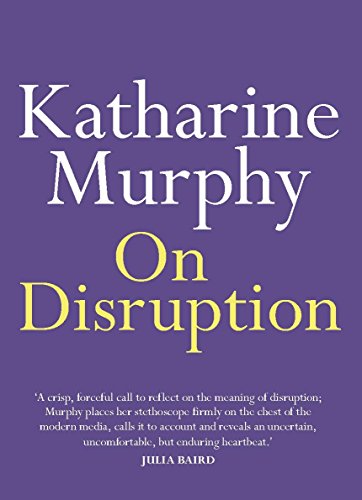
Katharine Murphy On Disruption

Greetings from the Australian National University, where Michelle Grattan is asking Katharine Murphy about her new book "On Disruption".

This is a short 121 page, A6 size pocket book, which is very readable. This is a bit Zen and the Art of Motorcycle Maintenance, being in part a personal reflection on becoming a journalist and part on the nature of political discourse in the age of the Internet. It starts "It was the fag end of summer and I was decked out in a new linen threepiece suit from Sportscraft."

Michelle Grattan asked about the story of the week with Senator Leyonhjelm's comments about Sarah Hanson-Young. Katharine Murphy commented that women have decided not to accept such comments any more.

One question from the audience is where does the money come from. Katharine Murphy replied that The Guardian has a membership scheme, rather than a pay-wall. This is curious as in effect, the for-profit company takes donations like the pay-what you can Lentil as Anything
restaurant in Sydney.

The thesis of the book is that the Internet has "disrupted" journalism, in the same way Uber disrupted taxis. The problem is not knowing where all the information "washing around" the Internet came from "... perhaps someone in a basement in Moldavia".

What I find surprising is that journalists did not realize the Internet was going to disrupt  their business until it happened. Hopefully the academics in the audience are listening, as the Internet is coming to disrupt them.

Last month the "Father of the Internet", Vint Cerf, talked at the Australian National University in Canberra. Australia has had Internet access for thirty years, about ten years after the US development.

Wednesday, April 30, 2014

Future of Journalism

Last night I attended "Has journalism a future" with presentations by
Caroline Fisher (University of Canberra), Stephen Matchett, (Campus Morning Mail), Matthew Ricketson (University of Canberra) and Lenore Taylor (Guardian Australia). This was at the new
Centre for China in the World, at the Australian National University in Canberra. The entertaining evening was chaired by Colin Steel, ANU Emeritus Fellow.
 
The new Centre for China in the World is so new, that the WiFi has not yet been installed, which is why I am posting this the next day. It also has a "new car" smell. ;-)

The first speaker said the good news was that the cost of production for news had reduced. However, there is a tendency for the new media to concentrate on that most ancient and popular form of news: gossip. The market for news is shrinking and the print media made the mistake of giving away their content free online while trying to survive on advertising. A few premium paid news services may survive, but most will not.

Many policy journalists now write for free for "The Conversation", with journalism becoming philanthropy, part funded by the state. But without real journalists chasing hard facts there will be less oversight of government.

The second speaker took exception with the fist speaker having a problem with taxpayers funded journalism, pointing to the work of the ABC.

It occurs to me that all the journalists speaking seemed to have the idea that journalism was a noble search for the truth, whereas in a business sense it is the job of the journalist just to fill up the spaces between the paid advertisements (which are the important parts of the publication). Perhaps James Marcus' book "Amazonia: Five Years at the Epicenter of the Dot.Com Juggernaut" should be required reading at journalism school. In this one of Amazon.com's early employees relates how they were hired to Amazon to write and edit book reviews. They saw their job as writing Amazon to write and edit independent and interesting book reviews, whereas Amazon saw them as helping sell books. Amazon worked out that a crowd-sourcing system which passed on recommendations from customers to other customers was more popular and more effective at selling books than professional reviews, at which point the journalist was out of a job. The same is likely to happen to almost all journalism jobs.


The result may well be a reduction in serious investigative journalism, if that turns out to be something readers do not value. As an example of this future, yesterday I was contacted by a TV news service asking about hacking of WiFi baby monitors over the Internet. When I checked I found recent stories about this, but also almost identical stories a year ago. I explained to the journalist that I did not think this was a real story, it was recycled from a year ago. The journalist explained their boss wanted a story and so there would be a story: they did not seem to be concerned as to if it was true or not. I declined to take part in a story which was pandering to parent's fears, with little  basis in fact.

Wednesday, September 29, 2010

Context and Critical Thinking in Course Design

At the 2010 ACT MoodlePosium in Canberra next week, I am chairing the Friday morning "Andragogy" session featuring Margaret Robson (CIT) on "Engaging learners by incorporating critical thinking and reflection" and Srinivas Chemboli (ANU) on "Contextualising learning outcomes and course design in Moodle". I need to introduce the speakers, and while these are people I know, I did not want to make the mistake of assuming I knew of all the accomplishments, so here is what I found with a search:

Margaret RobsonMargaret Robson, Education Designer, Flex:Ed, Canberra Institute of Technology (CIT), Canberra

Margaret Robson has worked with flexible and online learning at CIT since 1997, firstly whilst teaching in the Department of Software Development and more recently in Teacher Education where she used Web 2.0 social networking tools to re-engineer programs to provide multiple learning pathways.

She has published IT workbooks to support flexible learning programs.

Margaret co-facilitated the Flexible Learning Leaders online network throughout 2000 and 2001 and holds a Graduate Diploma of Computing, a Master of Education and a Graduate Certificate of Facilitating and Managing Elearning.

Expertise: education design, resource development to meet learning goals, professional development facilitation.

From: Who are Flex:Ed?, CIT, 2010


XHTML, HTML & DREAMWEAVER
This book supports ICAITU019C and ICPMM65dA in Certificate III and IV in Information
Technology (Software Applications) ICA30199.

Copyright Margaret Robson, October 2002. Revised January 2006.
Author : Margaret Robson
ISBN : 1-74123-151-5

Srinivas Chemboli, Postgraduate Student / Educational Technologist, OESG,College of Engineering and Computer Science, The Australian National University, Canberra

Srinivas Chemboli is a PhD student in the ANU School of Computer Science, researching effective capture and reuse of intellectual effort in scientific workflows. He is also an Educational Technologist in the Online Environment Support Group (OESG) in the Division of Information at the ANU.

From: Presentation for Wattle Wednesday, 2010

Research
Omnispective Analysis and Reasoning: An epistemic approach to scientific workflows ...

Teaching

From: Srinivas Chemboli, College of Engineering and Computer Science, ANU , 2010

Wednesday, August 29, 2007

Online journalism with Crikey.com founder

Crikey.com founder, Stephen Mayne, gave a talk on Online journalism and its impact on traditional media, 29 August 2007 at the National Library of Australia in Canberra. He discussed how online journalism is changing traditional media and politics and if user-generated Web 2.0 content is journalism. An audio recording is available from the NLA web site (30 Mbytes).

Michele Huston, Director Web Publishing at NLA introduced the talk pointing out that early editions of Crikey.com are preserved in the NLA's Pandora archive.

Stephen talked about journalism as a noble profession on one hand and in the power of political office on the other. After being a journalist for a time Stephen said his job as a political spin doctor was to intimidate the journalists and distort the news. In response to this he set up crikey.com to get out as much information as possible. The Internet provides a deluge of information, raw, good and bad.

Stephen said that Crikey.com previously had Google AdSense advertisements which paid $1,000 a month and now sells its own web ads receiving $100,000 a month. Crikey.com advertises its issues on Google AdWords, spending $2,000 a month (their ads regularly appear on my web pages). Crikey now has 24 regular contributors, about 10 of whom are professionals journalists, with about half the content written by academic commentators and the like.

Stephen said Crikey provides a service in "join the dots" journalism, by pointing the reader to disparate sources to provide context and add value. Even so he argues that mainstream media in Australia is healthy and has a future. Radio is healthy. Free to Air TV is suffering and the quality of TV journalism is suffering. Newspapers are loosing advertising revenue to the web. Fairfax is diversifying to electronic and online media, with journalists filing online and then in print. The typical story is twice as long on the web version as the print edition of The Age. Online newpapers have more readers, but less revenue.

Stephen argues that the advertising model of quality investigative journalism is in decline and that in Australia the ABC's public funded model works well.

Stephen argues that Web 2.0 user generated content is not new. Letters to the editor and talkback radio are old forms of user generated journalism. Unfiltered anonymous online forums quickly generate into a mess. Bloggers don't break many major public stories. Due to compulsory voting, independent bloggers are unlikely to influence elections. The bloggers need a partnership with the conventional media to reach a mass market. Bloggs can also continue a public debate, in the place of declining public forums.

Stephen is skeptical of Google deciding what is good and what is not. He claimed that Crikey.com now pay for a higher ranking on Google. This is something Google are likely to deny, but I do wonder if my own web site's high Google ranking is due to my using so many Google services. He also said that many people do not understand that "sponsored links" are advertisements.

ABC came in for praise for their podcasts. Wikipedia came in for some criticism for the edit it yourself approach. Stephen said he was half contemplating running against the Treasurer at the next election.

I asked Stephen if the Internet had changed the political process, in the way that it is changing the way the administration of government is done (as illustrated by AGIMO's work wil web standards). He replied that the web was being used extensively for fundrasing in the USA and for recruiting people for campaigns. However, this answer missed the point of my question, which was about doing politics differently. What I had in mind was that the web could be used for formulating political positions, rather than just to help raise money to elect someone to go and sit in a room and talk about political positions.
Tuesday, August 07, 2007

Online journalism with Crikey.com, Canberra

Recommended:
National Library of Australia Digital Culture talk

The internet revolution has been the greatest structural shock to hit the mainstream media since the introduction of television. Crikey.com founder Stephen Mayne will assess how online journalism is fundamentally changing traditional media and whether any of the so-called 'user-generated content' of Web 2.0 should even be called journalism. Whilst some media companies are now embracing the internet as an opportunity and dominating the space, many are feeling seriously threatened. And with such an extraordinary fragmentation and proliferation of information in cyberspace, what is the role of libraries in recording journalism's traditional 'first draft of history approach' to the news as it unfolds?

Date: 29 August 2007
Time: 12.30 to 13.30
Venue:
National Library of Australia Theatre
Entry: Free

The speaker, Stephen Mayne, will be introduced by Michele Huston, Director Web Publishing, National Library of Australia.

Bobby Graham
Web Content Manager
Web Publishing Branch, IT Division
National Library of Australia
Tel: +61 2 6262 1542


Monday, April 09, 2007

Citizen Journalism Research Job

The Queensland University of Technology is advertising a research job with Citizen Journalism. This is to work with projects such as Online Opinion, (which I am on the editorial advisory board of).

Queensland is working hard at being a power in the new "Creative Industries", with their
Creative Industries Precinct hosting the 2007 China Media Centre Conference in July (where I am speaking on my work on the web design for the Beijing 2008 Olympics).
Research Associate in Digital Media and Citizen Journalism - Creative Industries Faculty, QUT

A Research Associate is required to work collaboratively with a team of researchers on an ARC Linkage Project on digital media and citizen journalism. The Research Associate will be part of a collaborative research project based in the Creative Industries Faculty.

This position is required to work collaboratively with a team of QUT and externally-based researchers in Brisbane and Sydney. Partners on this project include the Special Broadcasting Service (SBS), National Forum (publishers of On Line Opinion) and The Brisbane Institute. The position is for two years, and the starting salary is $63 285 to $72 781 pa.

This position will involve working with an academic and industry team on the development of new forms of digital media that facilitate citizen journalism, and an investigation of their impact. It involves project management, management of stakeholder participation, development of research methodologies and performance metrics, and documentation of project outcomes.

The person will work with the project team, under the direction of the Chief Investigators, on managing relations with external stakeholders, developing appropriate methodologies and performance metrics for embedding and evaluating online participation in cross-platform media environments, with a focus upon news and current affairs and factual programming.

The successful applicant will have an understanding of social networking media, and a capacity to work collaborative across a range of user communities, as well as project participants in government, industry and media, and skills in the areas of applied social research, and project management.

The Research Associate will report to the Chief Investigator at QUT on the project for regular supervision, and will be required to liaise with the Management team. This will require an ability to commit to interstate travel, particularly for meetings with the Sydney and Brisbane-based project members.

The person should have an understanding of the broader context in which debates surrounding citizen journalism have gained increasing significance in the digital media environment. Information technology skills, particularly as they relate to the establishment and maintenance of collaborative media environments (e.g. blogs, wikis, social networking media) are desirable, but not essential.

Further information on the position can be found at http://www.hrd.qut.edu.au/recruitment/forapplicant/careersatqut/27173.jsp

The closing date for applications is Friday 27 April, 2007. ...