Showing posts with label 4G. Show all posts

Monday, May 22, 2017

World's Smallest 4G Smartphone?

Jelly 4G Smartphone
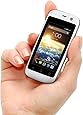
My smartphone will stop working at the end of September, when Vodafone decommissions its 2G network in Australia. So I have signed up with the Kickstarter campaign for the "Jelly Smartphone", claimed to be the smallest 4G smartphone.

Posh Micro X Smartphone
The Jelly appears similar in size to the Posh Micro X, claimed as the "Smallest Smartphone in the World". This has been on sale for some time and gets reasonable reviews on Amazon.com, typically commenting it is adequate given the size. The Jelly appears to offer upgraded electronics and software compared to the Posh and better compatibility with global phone networks.

The Jelly will have a 2.4 inch screen, about the size of my old pre-smart "feature phone". What I really wanted was a flip-phone, but I could not find a reasonably priced one which would work on Australian networks. Perhaps someone will make an after-market Star Trek flip cover for the Jelly, like the cover on the
Motorola A760. This protects the screen when closed (but with the display visible through a transparent window). You could then answer a call by opening the flip and end it by closing. The cover has channels to take the sound from the speaker in the body of the phone up to your ear, making it more comfortable to hold.

Sunday, March 03, 2013

Multi-carrier Internet for ABC Classic FM Live Concerts

ABC Classic FM was unable to broadcast the "A Hundred Golden Autumns" concert from Canberra today, due to failure of an ISDN link between Canberra and Sydney. However, the concert was in Llewellyn Hall, which is on the campus of the Australian National University, which has a very high speed fibre optic link. The ABC could plug their router into the university network, so that could be used if the ISDN link failed. They could also have a wireless Internet connection via one of the mobile carriers, in case both wired links were lost. No special programming or configuration is needed for this, as the Internet is designed to route around failed links. The ABC just needs about $200 of extra equipment.

Tuesday, February 15, 2011

Telstra 4G mobile broadband by 2012

Telstra has announced it will implement a 4G mobile broadband wireless network by the end of 2011. It is claimed this will provide similar data rates to ADSL wired links, with typical speeds being 20 to 30 megabits per second. This is using Long Term Evolution (LTE) technology, which is a low risk upgrade from the current system. The federal opposition's Malcolm Turnbull has claimed this undermines the case for the fibre optic NBN. However, I see wireless complementary to fibre optic networks, not really a competitor. Fibre will provide more capacity, wheres wireless provides convenience. However, I think the NBN's mix of fibre and wireless could be adjusted to use more wireless, to make the overall cost lower.

Thursday, November 25, 2010

Femtocells for Wireless Broadband

Professor Mark Reed, Principal Researcher, NICTA, talked on "Next Generation Wireless: How can we solve the data crunch?" at the Australian National University in Canberra, this morning. This was timely as I was at a workshop with people from the Bangladesh government discussing "e-Government for Developing Nations". One key point is that wireless allows skipping generations of telecommunications technology.

Mark argued that Femtocells can provided greatly expanded broadband wireless and outlined research areas. However, it seemed to me the major issue was how this technology could be integrated into the business models of telecommunications companies (as illustrated by the lack of a business case holding up progress with the National Broadband Network). In other words the research question is: "How do we make money out of this?". As an example, one way would be for the customer who buys a femtocell to share in the revenue from others using the cell (this happens with some public WiFi systems).

Previously I suggested wireless be built into the NBN modems installed in homes. This would provide public femtocells and a very profitable supplement to the wired service.

One technical area for research is how to carry video efficiently. As Mark pointed out video is the major driver for wireless use. But video has very different characteristics to voice transmission and web access. It should be feasible to make video hundreds of times more efficient with a few simple protocol tweaks. Changes to the network topology would make it hundreds of millions times more efficient. Some changes are relatively simple, such as changing packet sizes and priorities, some will require hardware changes, such as putting caching in the cells. While there are many millions of videos which people might watch, there will be a relatively small number which most people will be watching at one time. Also the system can anticipate what people will want to watch and download it when there is spare network capacity.

Another issue is the use of mesh networks. With this arrangement, the consumer's handsets and base stations can communicate with each other, supplementing the fixed infrastructure. This could be used with intelligent and predictive caching.

Friday, November 19, 2010

Next Generation Wireless

Professor Mark Reed, Principal Researcher, NICTA , will talk on "Next Generation Wireless: How can we solve the data crunch?" at the Australian National University in Canberra, 11am, 25 November 2010. Wireless in one of the options for completing the National Broadband Network (NBN). This is a free talk, no need to book, just turn up:
Next Generation Wireless: How can we solve the data crunch?

Assoc. Prof. Mark Reed (NICTA)

APPLIED SIGNAL PROCESSING SERIES

DATE: 2010-11-25
TIME: 11:00:00 - 12:00:00
LOCATION: RSISE Seminar Room, ground floor, building 115, cnr. North and Daley Roads, ANU
CONTACT: charlotte.hucher@cecs.anu.edu.au

ABSTRACT:
With the forecast exponential growth of mobile broadband over the next few years and the availability of 3G mobile systems that are spectrally efficient, there remains a question of whether 4G systems will solve the key problems of coverage, throughput, and cost. This talk will discuss next generation wireless systems taking insight and input from commercial drivers and needs. It will explore the "data crunch" issue driven by smartphones and social networking and highlight that spectrum allocation and the deployment of 4G/LTE will not alone solve the problem. Interestingly, this initiates a lot of new and interesting research problems that havn't been explored in any depth by the research community, including small cell (femtocell) technology and self organising network (SON) technology.


BIO:
Mark Reed is a leading researcher in the area of WCDMA receiver and network design with more than 18 years of experience with positions in the USA, Switzerland, and Australia. He received his B. Eng. (Honours) from RMIT in 1990 and Ph.D. in Engineering from University of South Australia in 2000. He is an Adjunct Assoc. Prof. at the Australian National University and a Principal Researcher and Project leader at NICTA where he has been since 2003 and leads a team on a research-inspired commercial project. Mark pioneered the area of iterative detection techniques for WCDMA base station receivers and has more than 60 publications and eight patent applications. He has a mix of real-world industrial experience as well as research experience where he continues to put his techniques into practice. Mark has previously performed research and developed real-time world- first Satellite-UMTS and mobile WiMAX demonstration systems. Recently Mark has lead a team to realize a real-time WCDMA Femtocell modem working at RF and tested against independent equipment. This realization contains world-first advanced receiver techniques that significantly improve the uplink throughput and range. Mark is a senior member of the IEEE and from 2005-2007 he was an Associate Editor for the IEEE TRANSACTIONS ON VEHICULAR TECHNOLOGY..