Showing posts with label programming languages. Show all posts

Tuesday, August 20, 2019

Memoir from Programmer of the Apollo 11 Lunar Module

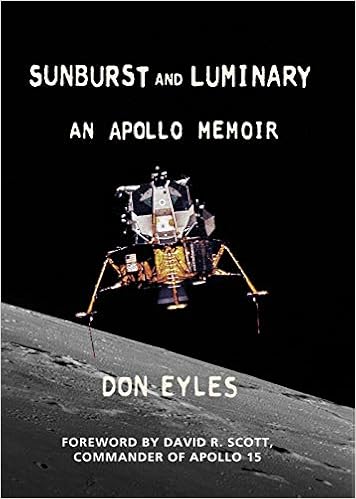
The book "Sunburst and Luminary: An Apollo Memoir" by
Don Eyles relates his experience programming the computer on the Apollo Lunar Module. This is a relatively modest first person recounting of someone who fell into computer programming, and ended up on the Apollo program as their first assignment. It would be useful for students who have ambitions of a career in computing to read.
"In 1966 the author, newly graduated from college, went to work for the MIT laboratory where the Apollo guidance system was designed. His assignment was to program the complex lunar landing phase in the Lunar Module's onboard computer. As Apollo 11 approaches, the author flies lunar landings in simulators and meets the astronauts who will fly the LM for real. He explains the computer alarms that almost prevented Neil Armstrong from landing and describes a narrow escape from another dangerous problem. On Apollo 14 he devises a workaround when a faulty pushbutton threatens Alan Shepard's mission, earning a NASA award, a story in Rolling Stone, and a few lines in the history books.  This memoir is a new kind of book about Apollo. It tells a story never told before by an insider the development of the onboard software for the Apollo spacecraft. It makes a vertical connection between technical details and historic events, but by broadening the story using his own experiences as he grows into adulthood in the 1960s the author draws a parallel between that era of successful space exploration, and the exploration, inner and outer, that was taking place in the culture."

ps: I read the copy in Libraries ACT.

Tuesday, May 05, 2015

History and Future of Programing Languages

Greetings from the Canberra branch of the Australian Computer Society where Dr Jan Newmarch, from Box Hill Institute, is speaking on "The history and future of programing languages". He sees there will be a division into complex (Java, Scala)and simple (Go, Rust) languages in the future.

Dr Newmarch prefers the simple languages, provided they easily support libraries from other languages. He pointed out the usefulness of reflection, where a program can examine and modify itself.

Dr Newmarch described object-orientated imperative languages as mainstream, with some functional techniques being introduced. He also described the explosion of specialist languages, such as R and frameworks which are almost languages, such as Hadoop.

At question time Dr Newmarch  as asked about Australian developed programming languages. I suggested "Blue", which he explained was a teaching language from University of Sydney. 

While in Canberra, Dr Newmarch has been introducing the Australian Government to the Raspberry Pi. The Raspberry PI is a recent product of the "Cambridge Phenomenon".

ps:  Dr Richard P. Gabriel and Dr Guy Steele reprised their presentation "50 in 50: 50 Programming Languages in 50 Years" in Canberra in 2010.