Showing posts with label Gov 2.0 Taskforce. Show all posts

Saturday, November 16, 2019

Gov 2.0 Taskforce: Annual "unparliament" at Old Parliament House?

Asia Pacific Hall at the SFU Morris J. Wosk Centre for Dialogue
SFU Asia Pacific Hall
At Gov 2.0 Taskforce: Ten Years On,  we are back from work-shopping actions to progress. Mine was to propose an annual "unparliament" be held at Old Parliament House.

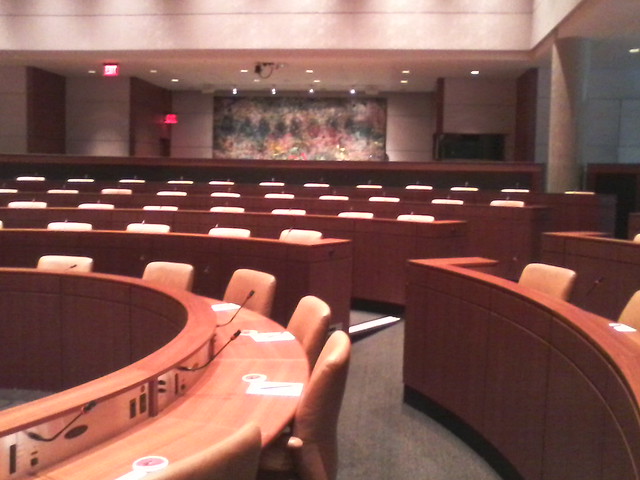
The Simon Fraser University  Centre for Dialogue has a purpose designed circular room, the Asia Pacific Hall, for fostering constructive discussion.

OPH Senate Chamber
In contrast, Australia's Old Parliament House has two chambers with rows of seats facing each other, designed for an adversarial approach where there is a government, and opposition (with a small amount of room for others on the "cross bench). However, the old building hardware could be updated, with some mobile devices and applicaions, to allow for techniques such as deliberative democracy. In effect we would be upgrading democracy with some teach.

Gov 2.0 Taskforce: Open is Expensive, Not Just Free

At Gov 2.0 Taskforce: Ten Years On, one of the un-conference presentations was on "Open is Expensive, Not Just Free". The essence of this seemed to be pointing out that open access initiatives are usually supported by unpaid volunteers. The implication is that these initiatives can't be maintain, because we can't expect people to keep working for free. I suggest the start-up community has an answer to this. There are models by which people can work on free open products, but still make money from them. One example is "social enterprises". Also start-up centers, such as the Canberra Innovation Network (CBRIN), train people how to build a business case, which includes who is going to pay, and also trains people to ask for money. Also there is The Mill House, which specializes in social enterprises.


There is a live stream and online questions are accepted. From the

Gov 2.0 Taskforce: Recommendations

Minister's Office, Old Parliament House
At Gov 2.0 Taskforce: Ten Years On, we broke into groups to look at the "Engage: getting on with Government 2.0" report recommendations.  There is a live stream and online questions are accepted. From the two groups I talked to Recommendation 4: Encourage public servants to engage online , has had mixed results. There are now many ways for government to collect citizens views online. However, public servants are, if anything, more constrained in doing anything with the results of the consultation. The digital public facing system is not well interfaced to the old analogue public service hierarchy. There is then a widening air-gap between the public service and the political level of government. 

To me this problem of getting anything done in government sounded an old problem. As a public servant,I had to occasionally work around the official processes to get anything done. This was usually with official approval. For these purposes links to academia and the professions are useful. Unfortunately in the Internet age it is very much more difficult to have an off the record, or "other hat" discussion. To that end I have added "Teaching Gov 2.0 to Government" to the list of topics for discussion.

A recent example is that ANU will run the Cyber Bootcamp Project for the Department of Foreign Affairs and Trade. Such courses provide a way for government employees from across governments to have a relatively free discussion. Students can explore ideas as students, then work out how the outcomes can be put to their organizations as initiatives. This also happens in professional bodies, and standards committees.

ps: My old posts from ten years ago are at gov2taskforce 

Gov 2.0 Taskforce: Ten Years Done

Pia Andrews
At Gov 2.0 Taskforce: Ten Years On, Pia Andrews gave an upbeat summary of achievements.Pia  pointed out that, for example, the Australian Federal Government adopted an open access creative commons license for its documents, and state agencies adopted more online engagement. However, she suggested more recently this engagement has changed to consultation, rather than encouraging more active citizens participation. I have noticed this, being invited to what are characterized as "co-design" workshops with government, but which are really old fashioned, customer focus groups, dressed up with some hashtags. There is a live stream and online questions are accepted. 
ps: My old posts from ten years ago are at gov2taskforce 

Gov 2.0 Taskforce: Ten Years Off

Nicholas Gruen,
CEO, Lateral Economics
At Gov 2.0 Taskforce: Ten Years On, Nicholas Gruen is reflecting on the original intent of the Taskforce and what happened. There is a live stream and online questions are accepted. He showed some "historical artifacts" slides, which showed the excitement and potential of Gov 2.0 ten years ago. One aspect was how outsiders, not from government, could have input. The widespread interest in the report "Engage: getting on with Government 2.0", was its translation into Korean. However DR. Gruen's summary was "We got our recommendations accepted, but then they were not implemented".

Gov 2.0 Taskforce: Ten Years On

Greetings from Old Parliament House in Canberra, where the Director is opening Gov 2.0 Taskforce: Ten Years On. I will be blogging on it throughout the day. There is a live stream and online questions are accepted. My old posts from ten years ago are at gov2taskforce. Here is the official announcement of the event:
"It has been 10 years since the Gov 2.0 Taskforce handed down it's report. Those were optimistic days, so let's review & plan next steps. ...

About this Event

A few folk who were involved or contributors to the Gov 2.0 Taskforce (2009) thought it might be useful to reflect on the 10 years since the Report was delivered. Those were optimistic days and a strong community formed around the activities and engagement from the Taskforce. The Report recommendations were accepted almost entirely by the Government Response, so 10 years on, how well was the intent and vision of the Report realised, and what do we need to do next?
Our sincere thanks to the Museum for Australian Democracy (and Democracy 2025) for being the venue sponsor and supporter for the event. The event will be hosted at Old Parliament House, the perfect setting!
Thanks also to Cordelta for coming on board as a corporate sponsor and The Mandarin as media sponsor.
The goal of this event is threefold and would involve a diverse crowd that broadly reflects the communities and sectors of Australia:
  1. To reflect on 10 years since the Gov 2.0 Taskforce Report, progress made or not.
  2. To identify and articulate the barriers to progress, and consider the old, new and emerging opportunities and threats.
  3. To (re}energise and activate a diverse community around the goal of better public sectors for a better society, both through reconnecting in this event, and through creating and committing to actions over the coming year.
The event will be in Canberra, where the Taskforce was launched, but people are welcome to create satellite events to connect local communities using the live stream and online tools to contribute to the day.
Please note this event is being run by volunteers, and any feedback, volunteering or support is welcome.
We hope this event helps contribute some momentum to a range of community and cross sector activities. We believe this needs to happen if we are to get the public sector we need. One that is collaborative, resilient, trustworthy, fair and which provides a stable foundation upon which all people can thrive.
Please also book a place in the kids creche if you need it, noting that teenagers are welcome in the event on a normal ticket.
We also have an anonymous survey running to get pre-event feedback to help inform the day, so if you can spare about 10-15 mins, please get a cuppa and participate in the Gov 2.0 Taskforce Recommendations Report Card survey.
The rough agenda is:
Introductions
  • 09.30 - Welcome to Country
  • 09:40 - Introductions and outline for the day
  • 09:45 - Nicholas Gruen reflects on the original intent and hopes/fears of the Taskforce and observations from the last decade.
  • 10:00 - What was implemented at the time?
  • 10:05 - Government 2.0 as an enabler of citizen led initiatives
  • 10:15 - Gov 2.0 Taskforce Report Card - survey result overview 
  • 10:30 - Report card group session: To reflect on the survey results of progress made on Report recommendations, where we went backwards and what we wouldn’t do. Fully participatory session for attendees to discuss, review and identify what success might look like today..
  •  11:00 - Break - BarCamp signups
  • 11.20 - Primer talks for barcamp session (10 mins each):
  • Gov innovation trends: Alex Roberts reflects on global trends in public sector innovation and his observations of progress in Australia since the Gov 2.0 Taskforce (including with Design Gov).
  • Emerging tech and government - what technology trends have or could have the greatest impact for public sectors from the last 10 years?
  • 11:40 - BarCamp session: short self-nominated sessions for participants to present ideas about the barriers to progress, new threats and opportunities facing us, and to draw out the hopes and fears for the future.
  • 13:00 - Lunch
  • 14:00 - Action stations: After participants vote for the topics/themes they want to action, they each go to the “action station” of greatest interest around topics or themes to identify and commit to practical actions and experimentation over the coming year to improve public sectors, to further realise the original intent from the Gov 2.0 Taskforce, and to bring about a better future for all. Teams report their actions into the online tool.
  • 15:30 - Reflections from the day and report from action stations.
  • 16:00 - Close"