 |
| Windrose electric prime mover, Photo by Tom Worthington, CC-BY 20 October 2025 |
Showing posts with label Transport. Show all posts
Showing posts with label Transport. Show all posts
Wednesday, October 22, 2025
Charging for Electric Trucks

Saturday, April 19, 2025
More help points for Sydney Central Station?

Apart from being unable to find any way to summon station staff, I had difficulty describing where I was, being underground away from streets. So I have now installed the Emergency+ app from the emergency services. This includes what3words, which uses 3 words to identify every 3 square meters of the planet.
Tuesday, April 20, 2021
Gigworker's Shelters to Reduce Energy USe
 |
| Cabmen's shelter, by Andy Scott, 2019, CC BY-SA 4.0 |

Tuesday, February 25, 2020
Super-charabanc Peoplemover

 |
| Artist''s impression of Brisbane Metro Vehicle. From Brisbane City Council |

 |
| Bishop Austrans Pod |
Dressing up a public service in an unnecessary streamlined shell may seem a waste of engineering talent. However, engineering is of no value if the public doesn't want the products produced. One way I suggest this can be does is by providing entrepreneurial training.
Monday, October 15, 2018
Battery Electric Tuk Tuk in Colombo
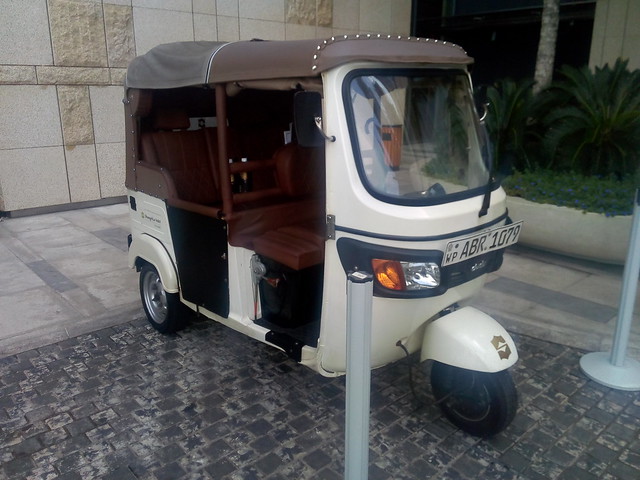
Saturday, October 13, 2018
New Port City Colombo
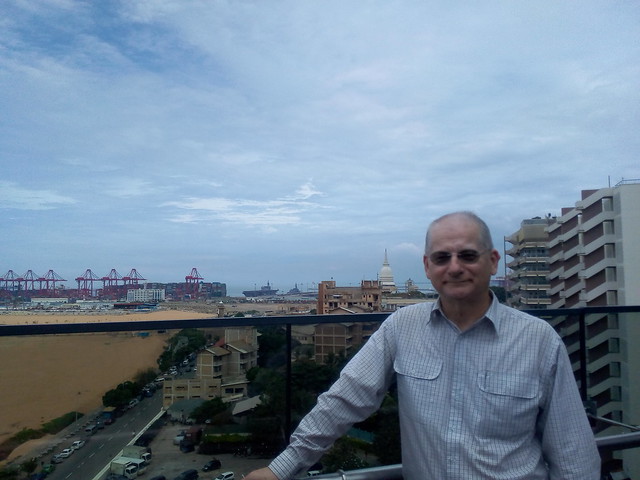 |
| Tom Worthington in Colombo |
The new city is intended to be in the style of Singapore. It will be interesting to see how this goes.
 |
| JS Kaga at Colombo |
Monday, September 01, 2014
NSW Opal Card Not Compatible With Airport Train
Getting off a 14 hour flight from Vancouver, I was disappointed to find my Opal card did not work at Sydney international airport station. The Opal card has a $10 minimum balance, but a train ride from the airport to city costs more than $10 (the link from the "fare calculator" page to say how much airport access costs is not working). As my card had a balance more than the $10 minimum it had not been automatically topped up to the minimum $40, but was less than the cost of the train fare and so was rejected. I suggest NSW introduce the system as at Vancouver airport, where those with pre-paid tickets do not pay the airport surcharge.
ps: Even when the card has been accepted at a railway station, I noticed that after the gate opens a red "Card Rejected" is displayed.
ps: Even when the card has been accepted at a railway station, I noticed that after the gate opens a red "Card Rejected" is displayed.
Wednesday, August 27, 2014
Vancouver from the 17th Floor
UBC Malls
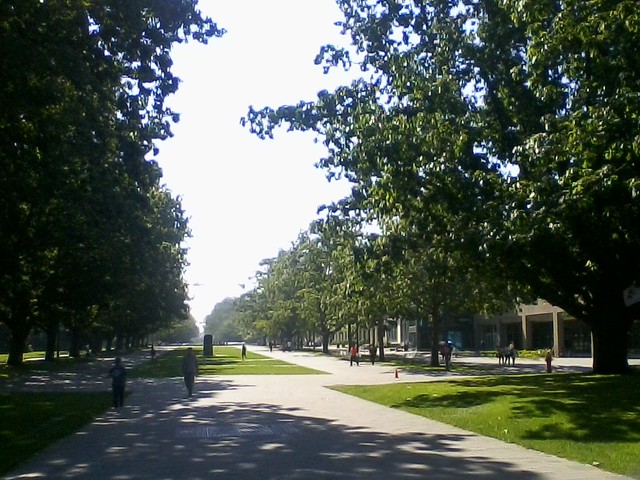 The UBC campus is very large with tree lined pedestrian "Malls". The buildings on the malls have mostly been kept to four to six floors, to match the height of the trees. So while these buildings are large close up, they do not dominate when looking down a Mall.
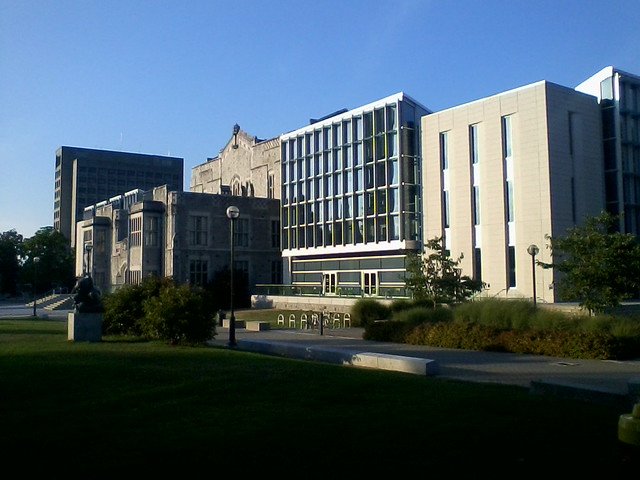 There is an attempt to blend the new glass walled buildings into the old granite ones, by using granite bases and muted sandstone and grey colouring on the new ones. A good example is the Irving K Barber Learning Centre, which has been wrapped around the sides and back of an old granite one..
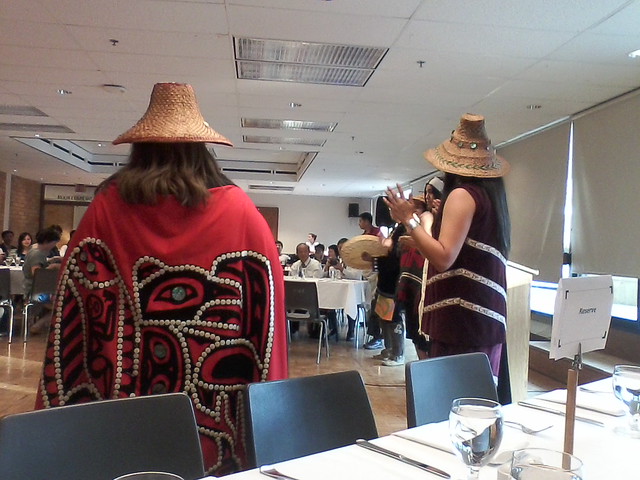 The ICCSE 2014 conference dinner featured a welcome from local indigenous performers. This had a fun bit of audience participation, with the delegates loosening up a little after getting up to dance as animal spirits (last year we had Sri Lanka Drummers).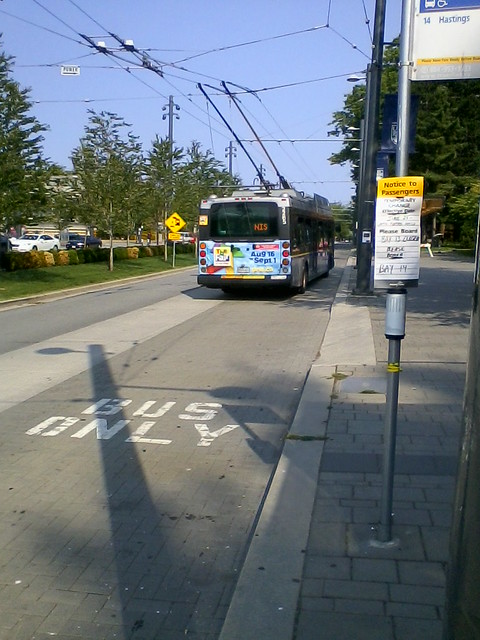
UBC has two bus stations, one of which is serviced by electric trolley buses.This is something the city of Canberra might consider, in preference to trams. It is about a 30 minute ride to down-town Vancouver. I took a ride from UBC to the SFU Vancouver campus. The BC FareSaver Tickets allow you to get on and off buses and trains for 90 minutes. So I stopped off along the way to the city to shop at the Salivation Army Thrift Store (2714 West Broadway) and picked a pair of near new Italian shoes for $20.
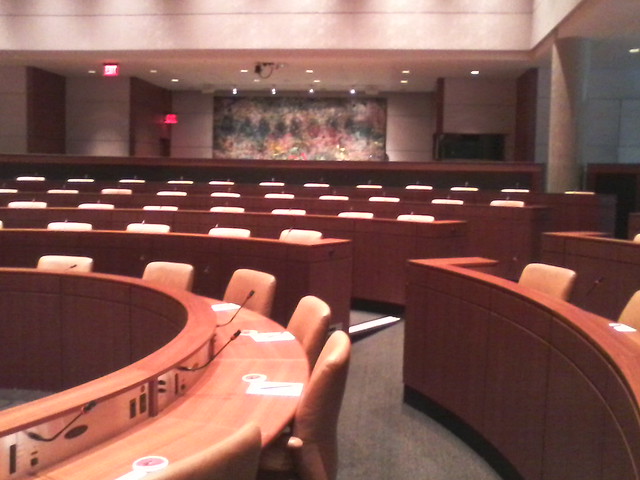 The bus stopped outside SFU's Vancouver campus, near the waterfront. Across the road is the SFU Morris J. Wosk Centre for Dialogue. The guard was kind enough to open up the Asia Pacific Hall for me to have a look at this impressive room. This is a circular parliamentary style chamber, with stepped seating. It is intended to facilitate discussion, rather than adversarial debate.
Sunday, August 10, 2014
Sydney Smart Ticket on a Bus to Nowhere

ps: I had hoped to try Vancouver's Compass card later in the month, to get from the airport (and avoid a $5 surcharge which international passengers are slugged with). But the smart cards are not generally available yet.
Sunday, March 23, 2014
Making a Smaller Seven Family Car
Recently I was asked for advice on a family vehicle to carry two parents, two children and, occasionally, two grandparents. I suggested a 2013 Kia Rondo Diesel or a 2012 Prius V. These have seven seats, are about the same size and fuel efficiency. The
Kia was upgraded significantly in 2013. The Prius V has not changed much
since it was introduced in 2012 and they age well, so there is little
point getting a new one.
These are more car-like than the larger people movers and SUVs. The catch is, with all three rows of seats occupied, there is not much room for luggage. But most of the time you are likely to be using only two rows of seats and so have a very large boot. For Griswold holidays, you can add a roof-box ($1,000 with mounting bars).
 For something larger there is the 2013 Ssangyong Stavic. These are low priced, mainly due to the ugly front end of the previous model. The 2013 model looks bland, rather than ugly. But it still looks odd at the back, and too large for its tiny wheels. This might be improved with a Range-Rover-like colours scheme, with the lower edge of the vehicle painted black, along with the pillars, up to the roof rails.
These are more car-like than the larger people movers and SUVs. The catch is, with all three rows of seats occupied, there is not much room for luggage. But most of the time you are likely to be using only two rows of seats and so have a very large boot. For Griswold holidays, you can add a roof-box ($1,000 with mounting bars).
Monday, December 23, 2013
Sydney Double-Decker Express Commuter Bus

As described in the brochure, the buses have 92 seats and look huge from the outside but a little cramped on the inside. The stairway on the right behind the driver takes up a lot of room, making it hard to get past. But the stairs are wide (for a bus) and well lighted (with luminous treads). Upstairs is a little roomier but with a low ceiling (one passenger hit their had on the LCD display screen at the front, which fortunately was padded.
There are two double bench seats upstairs at the front with a very large window in front. The view is excellent, but leg room cramped in the front row. Also it can be a little unnerving watching trees, bridges and traffic lights rushing towards you (some trees in George Street did seem to be scraping on the bus roof). Those without a head for heights, or long legs, might choose the second row of seats.
The bus has a much more compliant ride that the regular single deck Hills buses. The double deck buses seem to float over bumps, rather than crashing. However, high up this can induce a slight feeling of seasickness (some magnetorheological dampers might help).
Next to the bus stop at Castle Hill is the information office for the North West Rail Link. Work on the Castle Hill station is under-way across the road, but given the stop-start nature of previous Sydney metro projects, it is difficult to believe this will be built. In contrast the Metro-buses and transit lanes along the main roads are cost effective and tangible parts of a a transport system.
While at Castle Hill, I visited the excellent Castle Hill Library, which has a cafe where you can browse the magazines and newspapers. The easiest way to get to the library from the bus stop is to walk along Castle Street and under the enormous Castle Towers Shopping Centre (there seems to be no pedestrian exit to the centre on the library side).
M61 Double-Decker Times
The bus operator CDC advised that the Double-Decker buses usually run on these services:WEEKDAYS: The weekday timetables are run during peak hours only as follows:
CASTLE HILL: AM 06.50, 07.00, 07.50, 08.00, PM 16.01, 16.11, 16.51, 17.01, 17.11
RAILWAY SQUARE: AM 08.18, 08.28, 09.02, 09.17, 09.32 PM 17.15, 17.25, 8.05, 18.15, 18.25
WEEKENDS: The weekend timetable is a little more frequent as follows:
CASTLE HILL: AM 07.30, 07.50, 08.10, 08.30, 08.50, 09.50, 10.10, 10.30, 10.50, 11.10, PM 12.50, 13.01, 13.30, 13.50, 14.30, 16.30
RAILWAY SQUARE: AM 08.40, 09.00, 09.20, 09.40, 10.00, 11.40, PM 12.00, 12.20, 13.20, 14.20, 15.00, 17.40
Wednesday, December 11, 2013
Hawkei Australian Protected Vehicle for Prime Minister

Friday, May 10, 2013
High Speed Train for Canberra Regional Development
Stephen Byron, from Capital Airport Group, will speak on “Planes, Trains and Regional Development”, at University of Canberra, 5.30pm-7.00pm, 27 May 2013. Capital Airport Group has upgraded Canberra airport for international flights and proposed it be a station for a Sydney to Melbourne fast train.
Centenary Seminar Series 2013
“Planes, Trains and Regional Development”
Stephen Byron, Capital Airport Group
5.30pm-7.00pm, Monday, 27 May 2013
Ann Harding Conference Centre, Building 24, University Drive South, University of Canberra
Capital Airport Group’s Stephen Byron will discuss how better infrastructure will have an impact on Canberra and the region.
The Canberra Airport has positioned itself in
2013/14 for international services following the completion of the new $480m terminal. Canberra and the communities in the region are set to benefit from this major upgrade.
Stephen studied Commerce and Law at the
Australian National University and was development manager for Capital Property Trust and Capital Property Corporation.
For more information, and to register for this event, contact:
Hamish Sinclair
Canberra Urban and Regional Futures
Email: hamish.sinclair@canberra.edu.au
http://curf.com.au/
Campus map: http://www.canberra.edu.au/maps/printing
Saturday, March 30, 2013
Google Shopping Express
Google are trialling "Google Shopping Express" in the USA's San Francisco Bay Area. This is one of many services which will deliver goods you order on-line. It is not clear if Google is offering to deliver perishable goods, such as fresh food. One service Google might consider, to differentiate it from others, is a Google PostBus. A postbus is a combined passenger and mail delivery service.
Sunday, February 03, 2013
ANU Bus Road

Friday, January 18, 2013
Offshore Combatant Vessel

The MRV 80 resembles the US Independence class littoral combat vessel from the same designers. But the MRV 80 is smaller and leaves out the high tech weaponry and complex systems of the LCS. The LCS has a stern door for launching boats and sensors at sea, with a side ramp for loading equipment in port. In contrast the MRV 80 has boats stored in open areas on each side and a stern ramp for loading equipment. The stern ramp is based on a proven design used on car ferries and might be used to launch sensors at sea and transfer cargo while underway, as well as in port.
Wednesday, December 05, 2012
State of Australian Cities 2012
The "State of Australian Cities 2012" report was released by the Minister for Infrastructure and Transport, Anthony Albanese, on 4 December 2012. The report found a housing shortage, with a reduction in new housing lots and block size and price per square metre increases. There is a rise in the premium for living near the CBD and rapid growth in industry in the CBD. The average number of people living per dwelling is falling. The distance traveled in capital cities is declining. There is a National Summary and for each city. Unfortunately the report is provided in PDF format, making it difficult to read, so here is the text of the national summary and Canberra:
State of Australian Cities 2012: National Summary
Key findings
The gap between population increase and housing supply in Australian cities is now the largest and most sustained in a century.- A decline in the number of housing lots produced per capita is occurring across the capital cities but is particularly severe in Sydney. Block size has fallen and the price per square metre has risen sharply.
- There has also been a marked rise in the premium for living near the CBD of cities. In Sydney and Melbourne, a dwelling close to the CBD has increased more than five-fold in real terms since 1986, while one 50 kilometres from the city centre has only doubled in value.
- Housing occupancy rates (the average number of people living in a dwelling) plateaued in the mid- 2000s, after having fallen steadily for nearly a century.
- Most of the industry sectors that are experiencing rapid growth economically are located in CBDs and other dense centres. These industry sectors rely on increasing job densities to drive their productivity.
- Cities may be beginning to economically shrink in on themselves, reversing the dispersing forces, especially associated with manufacturing, that have been dominant since the end of World War II.
- The number of kilometers traveled per person in Australian capital cities has declined markedly since peaking in 2005.
- The per capita freight task in cities is increasing substantially and is likely to become the major driver of urban transport systems.
- Fare recovery in Australian urban mass transit systems continues to decline, raising questions about the sustainability of current financial structures associated with public transport capital investment and operations.
- Age distribution in our major cities shows that under 25s have declined proportionally, while there has been a small increase in working age population and a large increase in over 65s.
- The average labour force participation rate across major cities is 64.8 per cent; however there are significant differences between cities.
- Major cities have experienced increases in female participation in the paid workforce since 2000, some by more than five per cent.
- A growing proportion of older people are working past the traditional retirement age in major cities.
Population and Settlement
There are now 280 cities with over one million people in the greater Asian region. By 2025, it is expected that there will be at least 750 cities of over half a million people in size in the region.- Australia's resident population in June 2011 was 22,323,933 people, an increase of 2.9 million people or 15 per cent over the last ten years. More than 75 per cent of the population lived in our 18 major cities - cities with more than 100,000 people.
- The proportion of the population living in the capital cities of most states and territories has steadily increased over the past 40 years. Sydney and Melbourne have absorbed nearly 40 per cent of the population growth since 2001.
- In 1996, 60 per cent of major city home owners owned their dwelling outright, compared to 46 per cent in 2011.
- New houses in Australia are possibly the largest in the world, eclipsing the United States. However, there has been little or no growth in their size for a decade and the size of units has fallen.
- While there has been net growth in government-provided dwelling stock since 2006, it has fallen as a proportion of total stock across all major cities, apart from Cairns and Toowoomba.
- Real rental income per dwelling has increased virtually without interruption since rental controls were lifted in 1949.
- Rental vacancy rates remain very low across all capitals but are particularly severe in Perth, Darwin and Canberra.
- In the year to March 2012, Australians spent 279 million nights away, of which 50 per cent were spent in the major cities. Australians made 7.8 million short-term trips overseas, up from 7.1 million in 2008 and more than doubling since 2001.
- Australia hosted 5.5 million international tourists in the year to March 2012, up one per cent from 2011 and five per cent from 2008. Of the 197 million nights these visitors spent in Australia, 82 per cent were spent in our major cities.
Productivity
The morning travel peak in cities has significantly increased in the last 30 years, greatly increasing the pressure on transport networks. This appears to be driven in part by an increase in discretionary travel in the morning peak period.- The sea ports of coastal major cities, particularly Sydney and Melbourne, are experiencing a significant increase in container (TEU) volumes. More than 80 per cent of containers are discharged and loaded within the urban boundary.
- In 2011, Australia's major city airports had 97,033,481 domestic passengers and 28,872,843 international passengers.
Sustainability
Most Australian cities, except for those located in the far north, have experienced declines in annual rainfall over the last 60 years.- Since 1952, Australia's major cities experienced increases in average maximum temperatures of up to 2°C.
- The number of very high and extreme fire weather days is estimated to increase by between 15 and 60 per cent by 2020 and double to quadruple by 2050. This may increase the risks of property loss from bushfire in our capital cities, given the close proximity of up to 750,000 houses to substantial bushland.
- Fresh food production on the fringes of our cities is under threat from the outward expansion and economic pressures of our cities.
- Our cities continue to place pressure on urban waterways and estuarine environments, many of which contain sites of international heritage significance.
- Total open space in and around our cities can amount to 60 per cent of the urban area.
- Local, state and territory governments are moving to better manage natural and urban systems and are addressing challenges such as the urban heat island effect, cleaning waterways and more sustainable buildings.
Liveability
Melbourne has been ranked first on the global 2012 Economist Intelligence Unit Global Cities Liveability Index and Adelaide has retained its top ranking in the Australian My City Survey.- The proportion of families with children living in higher density residential dwellings has increased in major cities.
- The proportion of the population that is Aboriginal or Torres Strait Islander is largest in Darwin (9.2 per cent) and smallest in Melbourne (0.5 per cent). However, Sydney's Aboriginal or Torres Strait Islander population (54,747 people) is the largest in the country.
- The cost of living for the residents of Australia's capital cities has been relatively stable for over two decades.
- Of the capital cities, Hobart has the highest proportion of people who walk to work whilst Perth has the lowest. Darwin has the highest proportion of people who cycle to work whilst Sydney has the lowest.
Governance
The Council of Australian Governments (COAG) Reform Council Review of Capital City Strategic Planning Systems was released in April 2012. It highlighted the need for ongoing intergovernmental co-operation on cities issues to help all levels of government implement effective strategic planning systems.- An Infrastructure Finance and Funding Reform report, prepared by the Infrastructure and Finance Working Group, was released in June 2012. It stressed the importance of improved planning, a deeper pipeline of projects and funding reform.
- In June 2012 the Productivity Commission released the first national study of the regulatory role of local government. Its key message is that implementing and enforcing state laws, rather than local laws, is dominating local governments' regulatory workload.
- The 2012-13 Federal Budget included a framework for the second phase of the Nation Building Program (NB2) which will run from 2014-19 and help deliver on the goals and objectives of the National Urban Policy.
State of Australian Cities 2012: Canberra Summary
Population and Settlement
The Canberra - Queanbeyan metropolitan area population increased from 360,537 in 2001 to 418,292 in 2011, a growth rate of 1.5 per cent, which is exactly the national average.- Canberra-Queanbeyan is Australia's eighth largest city and is home to 1.87 per cent of Australians.
- Over the five years 2006-11, Canberra-Queanbeyan's stock of private dwellings increased by 14,062.
- With a population increase of 37,210 over the same period, there were 2.65 additional people for each new dwelling constructed. Canberra-Queanbeyan's 2011 household occupancy rate was 2.76 people per dwelling, aligning with the 2011 average major city rate of 2.73.
- Of Canberra-Queanbeyan's total stock of 158,706 private dwellings in 2011, 7.38 per cent were unoccupied, well below the major city average of 9.16 per cent.
- In the year to March 2012, Canberra hosted 5.3 million domestic visitor nights, down from 5.6 million in 2012, and 4.1 million international visitor nights, up significantly from 2.7 million in 2008.
Productivity
- In 2011, Canberra Airport had 3,158,957 domestic passengers.
- Canberra's labour force participation rate has been relatively stable since 2000, and remains Australia's highest at 72.4 per cent, well above the national average of 65.1 per cent.
- The labour force participation rate for males in Canberra is 76.4 per cent and has dropped 2.3 per cent since 2000.
- The labour force participation rate for females in Canberra is the highest rate of the surveyed major cities at 68.8 per cent and has increased slightly since 2000. Canberra's labour force participation is higher than the national average of 65.1.
- Canberra has one of the highest rates of labour force participation for males aged 65 years and over, being 18.8 per cent, having more than doubled since 2000. Participation of females in this age group is 6.3 per cent, up from 3.7 per cent in 2000.
Sustainability
Consistent with other inland major cities (Albury-Wodonga and Toowoomba), Canberra experienced a trend of larger increases in average annual temperatures and decreases in average annual rainfall than major cities in other parts of Australia. 1
Liveability
In 2011 Canberra was included in the Mercer Quality of Living Index for the first time, debuting in 26th position - above Adelaide (30th) and Brisbane (37th), but below Sydney, Melbourne and Perth.- According to the Australian City Liveability Index survey of residents in ten Australian cities:
- Canberra has the highest proportion of residents who feel that their city is a 'place for people and their property' (69%) and, with Melbourne, equal highest proportion of residents who consider Canberra has 'good educational facilities and healthcare services' (71%).
- Compared to other capital cities, Canberra also has a high proportion of residents who agree that the city has 'good transport infrastructure and services' (53%).
- Only 42 per cent of Canberra residents feel that the city provides 'quality affordable housing'.
- According to the 2012 AMP NATSEM Income and Wealth Report's analysis of typical household goods and services Canberra is the second most expensive of the capital cities after Sydney. Rental costs, other utilities, and household contents and services are most expensive in Canberra.
- In Canberra, 23 per cent of people living in flats, units or apartments were in households with children.
- Canberra remains the volunteering capital of Australia, with 21.2 per cent of the population aged 15 years or over volunteering with a group or organisation in 2011. However, this represents a slight decline on 2006 levels, when 22.3 per cent of the population were involved in volunteering.
- In Canberra 81 per cent of people travel to work by car and just 7.6 per cent by public transport.
- Canberra has the highest rates of active travel (walking and cycling) of the eastern capital cities, with 2.7 per cent of people cycling to work, and 4.7 per cent travelling to work on foot. Only Darwin records higher rates of walking and cycling. Governance
- The Canberra-Queanbeyan urban area straddles the Australian Capital Territory-New South Wales border and is subject to strategic planning by both jurisdictions.
- The ACT Government released the new ACT Planning Strategy in August 2012.
- The key planning strategy for Queanbeyan is the NSW Government's Sydney-Canberra Corridor Regional Strategy, scheduled for review every five years. A systematic review is currently underway.
- Following completion of the NSW Government's Long Term Transport Master Plan, a Regional Transport Plan will be developed and linked to the existing regional strategy.
- In May 2012, the ACT became a member of the South East Regional Organisation of Councils (SEROC), in recognition of the significant dependencies between the ACT and the surrounding NSW region.
Wednesday, November 28, 2012
Australian Transport Future at AusRAIL 2012 in Canberra
Greetings from the National Convention Centre in Canberra where the Australian Railway conference "AusRAIL 2012" is on today. The conference exhibition has spilled out of the exhibition hall into the foyer and upper levels. Heavy engineering companies from around the world are alongside Australian logistics and ICT. The exhibition is free and open to industry, academia and government until 3pm today. The next conference is November 2013 in Sydney.


Dion Castle from PivoTel was showing pocket size satellite terminals. The inReach is a 2 way satellite communicator is a solid looking almost cubic device which can be worn on a belt. It has no display and just a few buttons. On its own it can be used to send out a regular message to allow the wearer to be tracks and has an SOS button. But the device also has a Bluetooth interface allowing text messages to be received and sent from a smart phone.
At a time when the emphasis is on higher and higher speed broadband communications, it is important to keep in mind that much can be done with very low bandwidth high latency communications. This is important when you are outside the coverage of urban communications networks, or when those networks fail, especially in an emergency.
At a time when the emphasis is on higher and higher speed broadband communications, it is important to keep in mind that much can be done with very low bandwidth high latency communications. This is important when you are outside the coverage of urban communications networks, or when those networks fail, especially in an emergency.
Saturday, November 24, 2012
Hydrogen and Fuel Cells for Transport

BiographyDistinguished Lecturer Prof Kevin Kendall FRS
Prof Kendall received his surface physics PhD in the Cavendish Laboratory, Cambridge in 1970. After post-docs in Monash and Akron he joined ICI in Runcorn to study polymers and fine particles. 20 years later, he returned to Academe, first in Keele, then in Birmingham in 2000 as Professor of Formulation Engineering. He was elected FRS in 1993.
Abstract
HYDROGEN & FUEL CELLS FOR TRANSPORT-energy storage problem
Using hydrogen and fuel cells (HFCs) for transport should double the efficiency and reduce emissions to zero, except for water vapour exhaust. The most famous application is the NASA moon missions where auxiliary power and drinking water were provided by a 10kW alkali stack. Now that aircraft are going more electric, fuel cells are being investigated but compressed hydrogen is shown to be poor in terms of weight and volume. For large planes, liquid hydrogen is good, but for small unmanned air vehicles (UAVs) propane is difficult to beat.
Ground transport includes forklifts, bikes, buses and cars. Here the polymer electrolyte membrane fuel cell (PEMFC) is being tested and progress is being made in performance, lifetime and cost. Lithium ion batteries and supercapacitors are beneficial in hybrids. Compressed hydrogen at 350 and 700 bar is the standard fuel at present. At Birmingham, 5 HFC cars have been tested on campus since the first UK hydrogen filling station was installed there by Prof Kendall in 2008. The results show that the prototypes beat all combustion cars in fuel economy, largely because of lightweight construction. Surprisingly, the results fitted a Coulomb friction law line. Further improvement of the drive train showed that these cars were ultimately better than all other HFC cars. The race to market in 2015 is now taking place between the major manufacturers
Tour Details:
Canberra on Friday 7th December 2012
Location: ANU
Leonard Huxley Lecture Theatre - Bld56, End of Mills Road, Acton
Time: 11.00am
Thursday, July 19, 2012
Cool Night on a Slow Moving Train
Greetings from the overnight train from Melbourne to Sydney. This is a NSW CountryLink XPT , which left Melbourne's Southern Cross Railway Station on time at 7:55pm and is due at Sydney Central Station at 8:20pm. We are one hour late due to track-works, but that is hardly noticeable in the first class sleeper compartment, with breakfast served on time.
The compartment has three seats during the day and converts to two single bunk beds. There is a shower/toilet shared by each two compartments. Showering on a moving train is a challenging experience, but it is refreshing.
The compartment has a power-point, handy for laptops and mobile charging (although mobile data and cell coverage becomes intermittent outside the city, due in part to the metallic anti-reflective coting on the windows blocking radio signals).
Outside the city there is not much variation in the countryside: trees, fields and the odd cow and horse. This does not quite compare with the Rock Mountains, the Swiss Alps, or Thessaloniki to Istanbul. But particularly for rail enthusiasts, this is one to tick off on the list. You should book soon, as the NSW Government has announced a restructure of railways and the service is likely to be canceled (see: "RailCorp split divides opinion", Ben Neutze, The Current, 16 May 2012).
ps:Warm Nights on a Slow Moving Train was a 1988 film by Bob Ellis with Wendy Hughes and Colin Friels, set on a NSW overnight train. This trip did not have quite that excitement.
The compartment has three seats during the day and converts to two single bunk beds. There is a shower/toilet shared by each two compartments. Showering on a moving train is a challenging experience, but it is refreshing.
The compartment has a power-point, handy for laptops and mobile charging (although mobile data and cell coverage becomes intermittent outside the city, due in part to the metallic anti-reflective coting on the windows blocking radio signals).
Outside the city there is not much variation in the countryside: trees, fields and the odd cow and horse. This does not quite compare with the Rock Mountains, the Swiss Alps, or Thessaloniki to Istanbul. But particularly for rail enthusiasts, this is one to tick off on the list. You should book soon, as the NSW Government has announced a restructure of railways and the service is likely to be canceled (see: "RailCorp split divides opinion", Ben Neutze, The Current, 16 May 2012).
ps:Warm Nights on a Slow Moving Train was a 1988 film by Bob Ellis with Wendy Hughes and Colin Friels, set on a NSW overnight train. This trip did not have quite that excitement.
Subscribe to:
Posts (Atom)