Showing posts with label Japan. Show all posts

Saturday, October 13, 2018

New Port City Colombo

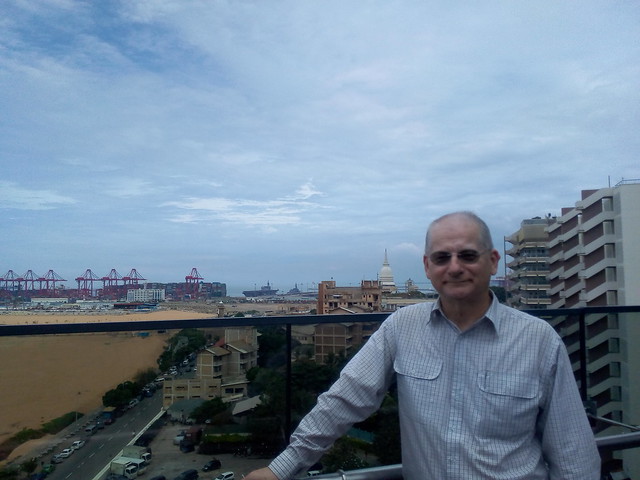
Photo from hotel roof cafe overlooking the old and new waterfront at Colombo. The grey warship at the port in the background is Japan’s Kaga, a helicopter carrier.
Tom Worthington in Colombo
In early October I was in Colombo, Sri Lanka to speak at the Computer Society of Sri Lanka (CSSL) National IT Conference (NITC 2018).What was the waterfront when I visited in 2013 is now a kilometer inland, with reclamation for a new Port City Colombo.

The new city is intended to be in the style of Singapore. It will be interesting to see how this goes.

JS Kaga at Colombo
The grey warship at the port in the photo background is the Japanese warship, JS Kaga. Like Australia's HMAS Canberra, this was intended to carry helicopters, but may be adapted to operate F-35B stealth fighters.

Friday, February 19, 2016

Japan, Australia and regional security architecture

Greetings from the Australian National University in Canberra where I am attending a panel discussion on "Japan, Australia and regional security architecture". Dr Amy King (ANU), with Professor Mie Oba (Tokyo University of Science), Associate Professor Ryo Sahashi (Kanagawa University), and Professor Nick Bisley (La Trobe University) are discussing Japan and Australia's role in regional security institutions, including  ASEAN Regional Forum, ASEAN Defence Ministers Meeting Plus, and East Asia Summit. But it quickly become evident that the real topic was what Japan and Australia could do about China claims to islands in the region. The claim was made by one of the panelists that Australia is not directly involved in the dispute. However, I suggest it is, in that RAAF aircraft are flying over some of the islands, in a direct military challenge to China's claim of sovereignty. I am not a foreign policy expert, but it seems to me that one effective initiative for Japan and Australia is to build more submarines. Forums, Meetings and Summits have no effect, unless they can be backed by a credible military force.

Wednesday, January 06, 2016

Computer Education Conference on Way to Koyoto?

I was planning to attend the 11th International Conference on Computer Science and Education (ICCSE2016), 23-25 August 2016 at Nagoya University, Japan (Satellite site, 23 August 2016, University of Fukui, Koyoto City). If anyone knows of any start-up, higher education or IT conferences in Japan or nearby I could attend at the same time (or anyone who would like a seminar or workshop), that would be good. Last year I attended ICOFE 2015 in Hong Kong on the way to ICCSE 2015, but this year ICOFE 2016 is earlier and ICCSE later. Flights from Sydney to Osaka (ITM), Kansai (KIX) and Central Japan (NGO) go via Tokyo, Seoul, Taipei, Cairns, Hong Kong, Manila, Singapore, Brisbane, Nouméa and Shanghai.

It is very frustrating to go though the many lists of conferences looking for suitable dates and locations. as an example,  the  International Conference on E-Learning and E-Technologies in Education (ICEEE), in Kuala Lumpur, September 6-8, 2016 looks interesting, but what are the flights like from Japan?

Tuesday, September 01, 2015

Japanese Politics and China

Greetings from the Australian National University, where Dr Sheila A. Smith is speaking on "Japanese Domestic Politics and a Rising China". Dr Smith is the author of "Intimate Rivals: Japanese Domestic Politics and a Rising China". She argues that the Japanese PM is not the most significant player in determining Japanese foreign policy and inherited the current Senkaku/Diaoyu Islands dispute. Dr Smith argued that the islands dispute is separate from the East China Sea dispute. She also pointed out that China and Japan were able to cooperate on investigation of tainted Chinese dumplings in Japan. Dr. Smith' conclusion was that while there were individual points of dispute between Japan and China, but this did not reflect a general rise in anti-Chinese nationalism in Japan.

This is of relevance to Australia, due to its increasing military ties to Japan and economic ties to China. However, there is only one mention of Australia in Dr. Smith's book and only to do with China's exporting of food (page 163).

Dr. Smith pointed out that until recently the USA and Japan had no plans for managing military conflict with China. I assume this is a reference to diplomatic plans, as it seems unlikely that the USA would not have detailed military plans in place and their Japanese counterparts would not be familiar with these, even if this could not be publicly acknowledged.

Dr Smith asserted that US representatives have made clear they will not provide direct military force to defend the Senkaku Islands, but they are helping Japan train its soldiers as marines (something Australia is also developing an amphibious capability and might usefully work with Japan)

Sunday, April 19, 2015

Japan’s Ocean Surveillance of Chinese Submarines

All 162 pages of the book "The Tools of Owatatsumi: Japan’s Ocean Surveillance and Coastal Defence Capabilities" (Desmond Ball and Richard Tanter, ANU Press, 2015), are available free on-line. The book details the undersea and electronic intelligence systems run by Japan and the USA to detect Chinese military activities, particularly submarines. The authors suggest that wile effective this network is vulnerable to attack, leading to possible military escalation and use of nuclear weapons.

However, what the authors do not discuss is ways in which surveillance networks can be made less vulnerable with technological developments. Japan's manned coastal surveillance stations are, by their nature, prominently located along the coast and so vulnerable to attack. However, electronic surveillance can now be undertaken by miniaturized equipment operated by remote control, making it far less visible and vulnerable.
Table of Contents for The Tools of Owatatsumi:
  1. Introduction
  2. Post-Cold War Intrusions into Japanese Waters
  3. The JMSDF’s Ocean Surveillance Architecture
  4. The Japanese Ground Self-Defense Force (JGSDF)
  5. The Organisation of the JMSDF: The High Command, Fleet Bases and Regional Districts
  6. Japanese Undersea Surveillance Systems, 1920–45
  7. Technical Developments since 1945
  8. US SOSUS Stations
  9. JMSDF ELINT/Undersea Surveillance Stations
  10. Airborne Ocean Surveillance
  11. JMSDF SIGINT Collection and Ocean Surveillance Ships
  12. The US Ocean Surveillance Information System (OSIS)
  13. The Maritime Safety Agency (MSA)/ Japan Coast Guard (JCG)
  14. Assessment of Japan’s Ocean Surveillance Capabilities
From: Ball, Desmond & Tanter, Richard, (author.) (2015). The tools of Owatatsumi : Japan's ocean surveillance and coastal defence capabilities. Canberra ACT ANU Press. Retrieved from http://press.anu.edu.au/titles/the-tools-of-owatatsumi/

Tuesday, November 11, 2014

Possible Use of Nuclear Weapons in Sino-Japanese War

Greetings from the Australian National University in Canberra, where Robert Ayson and Desmond Ball are speaking on the alarming topic of "Escalation in the East China Sea: A Political and Military Possibility". Their thesis is that a dispute between China and Japan in the East China Sea could result in a way which draws in the USA. A lack of crisis management and China’s command and control system's vulnerability could result in their use of nuclear weapons. Professor Ball stated that the USA had plans for "limited" use of nuclear weapons against China, including in a conventional war between China and Japan. Attacks on US undersea surveillance systems around China, some of which are collocated with Japanese facilities may also provoke a nuclear response on Chinese mainland bases. Knowing this China would then be tempted to make a preemptive nuclear strike. One area for concern is that the PLAN (Cihinese Navy) may become overconfident in its abilities.

Executive Summary:
  • Political competition and a lack of crisis management mechanisms could make it very hard for China and Japan to resist escalatory pressures in the very plausible event of a minor armed clash in the East China Sea.
  • Japan’s reluctance to use force may be less extensive than some assume and its connections to US strategy and C4SIR systems increase the prospect of early American participation.
  • Command and control vulnerabilities could mean serious pre-emption pressures if Beijing thought a larger conflict was possible. American attacks on the PLA’s conventional war-fighting systems could create perverse incentives for China to use its nuclear weapons early while it was still confident in its physical ability to do so.
This would suggest some obvious actions:
  • Crisis management mechanisms including a secure political hot-line and military to military communication channels which are regularly tested. Military personnel should visit each other, observe exercises and attend training courses.
  • The USA could ensure it has a Command, Control, Communications, Computers, Intelligence, Surveillance and Reconnaissance System (C4SIR) which can operate separately from that of Japan. Japan could harden its system.
  • China could make clear it has a robust C4SIR. China's deployment of military forces world wide recently may be in part to send such a message to potential enemies. This could include conducting exercises which the media and other nations military leaders are invited to attend. China could improve its C4SIR using its considerable commercial ICT industry capability and workforce.
Ayson and Ball recommend:
  1. Australian planners should assume that China and Japan may not be able to continue avoiding minor hostilities over their conflicting East China Sea claims.
  2. Australian planners should also assume that initial hostilities between Japan and China could easily escalate into a much more serious conflict, potentially involving the United States and possibly crossing the nuclear threshold.
  3. Australian policymakers and decision-makers should encourage their Chinese and Japanese counterparts to treat the Sino-Japanese relationship as an adverse partnership involving common as well as competing interests.
All of this is worrying for Australia as a close partner of the USA and Japan. I suggest Australian could go further and help directly with some of the risk reduction measures, especially where China and Japan could not be seen to be doing this directly. Australia could provide some channels for communication in a crisis. If Australian politicians and military commanders know their Chinese and Japanese counterparts and have secure and robust technical communications with them, they could help defuse a crisis.

Thursday, October 30, 2014

Use of Nuclear Weapons Possible in Sino-Japanese War

Robert Ayson and Desmond Ball will speak on "Escalation in the East China Sea: A Political and Military Possibility" at the Australian National University in Canberra, 5:30pm, 11 November 2014.

Event Details

Presented by the Strategic & Defence Studies Centre
Even if the leaders of China and Japan can lessen the significant political tensions between North Asia’s two biggest powers, the East China Sea dispute could still spark a bilateral war which might also bring in the United States. A recent spate of near misses shows that a minor armed clash is eminently possible. Nationalist sentiment and the lack of crisis management mechanisms could make restraint difficult once this occurs. Japan’s reluctance to use force may be less extensive than some assume and its connections to US strategy and C4SIR systems increase the prospects of early American participation. China’s command and control vulnerabilities could create serious pre-emption pressures if Beijing thought a larger conflict was possible. Moreover American attacks on China’s C4SIR systems and its conventional maritime and missile forces might create perverse incentives for China to use its nuclear weapons early while it was still confident in its physical ability to do so.

Australian defence planners should not assume that China and Japan are going to be able to keep their tense relationship in the East China Sea below the threshold of armed violence. Neither should they assume that China, Japan, and the United States will find it easy to avoid a very serious escalation once minor hostilities have occurred. This seminar presentation marks the launch of a new SDSC Centre of Gravity paper by Robert Ayson and Desmond Ball entitled "Escalation in North Asia: A Strategic Challenge for Australia", based on their forthcoming Survival article "Can a Sino-Japanese War Be Controlled?".

Sunday, January 29, 2012

Australian High Speed Ship Used by Japanese Military

LinkMedia reports indicate that the Natchan World, a high speed ferry designed and built by Incat Australia, was used to transport tanks and other military vehicles, for a Japanese Self-Defense Force exercise in November 2011. The Natchan World, operated by the Tsugarukaikyo Ferry Company, is very similar in design to the HSV-2 Swift operated by the US Navy. The Natchan World, loaded Type 90 tanks and Type 89 infantry combat vehicles, via the stern ramp (the ramp on the Incat ships can swivel around to load from either side).

Another Australian company, Austal, is making the Spearhead class Joint High Speed Vessel (JHSV), for the US Department of Defence. Unlike many military projects, these ships have been very successful, as they use already proven civilian technology, with minor changes for military use.LinkLink

Sunday, January 09, 2011

Public Information Symbols in Japan

The book "Symbol Signs" (AIGA, 1993) documents the development of the standard symbols for use in airports by the American Institute of Graphic Arts for the U.S. Department of Transportation. A similar process was undertaken in Japan by the "The Study Committee of Public Information Symbols" from April 1999. As with the US effort this was a joint private government partnership with the Ministry of Land Infrastructure and Transport and the Nippon Foundation. The Study recommended 125 Public Information Symbols in 2001.

The symbols are in eight categories:
  1. Public Facilities
  2. Transport Facilities
  3. Commercial Facilities
  4. Tourism,Culture,Sport Facilities
  5. Safety
  6. Prohibition
  7. Warning
  8. Mandatory
There are three grades (A, B and C), with "Grade A" having the most commonly used symbols. There is also a fourth category of "Existing", which is presumably of symbols in common use which the committee did not particularly like, but felt obliged to include.

The Symbols follow the style of the US AIGA DOT symbols and mostly use the AIGA recommendations, but have more detail. As an example, as well as an "Information" sign (small case "i"), there is a "question and answer" sign ("?").

The sample syvbmols are prtovided as 70 x 70 pixel PNG files. The sybmols are mostly monochrome in black on a white background. The safety signs are in green or red, prohibition signs in red and black on a white background and warning signs in black on a yellow background. PDF, EPS and GIF archioes are proveded of each set of symbols at higher resolutioons. However, the symbols are not provided as individual files at higher resolutions, making the m much harder to use.

Public Facilities

Grade A

  • Question & answer
    Question & answer
  • Information
    Information
  • Hospital
    Hospital
  • First aid
    First aid
  • Police
    Police
  • Toilets
    Toilets
  • Men
    Men
  • Women
    Women
  • Accessible facility
    Accessible facility(*1)
  • Accessible slope
    Slope(*1)
  • Drinking water
    Drinking water
  • Smoking area
    Smoking area
  • Smoking area
    Smoking area(*2)
  • *2 Use the symbol below wherever so required by the fire prevention ordinance.

Grade B

  • Check-in / ReceptionCheck-in / Reception
  • Lost and found
    Lost and found
  • Hotel / Accommodation
    Hotel / Accommodation
  • Tickets / Fare adjustment
    Tickets / Fare adjustment
  • Baggage storage
    Baggage storage
  • Coin lockers
    Coin lockers
  • Lounge / Waiting room
    Lounge / Waiting room
  • Meeting point
    Meeting point
  • Bank, money exchange
    Bank, money exchange
  • Cash service
    Cash service
  • Post
    Post
  • Telephone
    Telephone
  • Fax
    Fax
  • Cart
    Cart
  • Elevator
    Elevator
  • Escalator
    Escalator
  • Stairs
    Stairs
  • Nursery
    Nursery
  • Cloakroom
    Cloakroom
  • Dressing room
    Dressing room
  • Dressing room(women)
    Dressing room(women)
  • Shower
    Shower
  • Bath
    Bath
  • Water fountain
    Water fountain
  • Trash box
    Trash box
  • Collection facilitiy for the recycling products
    Collection facility for the recycling products

Transport Facilities

Grade B

  • Aircraft / Airport
    Aircraft / Airport
  • Railway / Railway station
    Railway / Railway station
  • Ship / Ferry / Port
    Ship / Ferry / Port
  • Helicopter / Heliport
    Helicopter / Heliport
  • Bus / Bus stop
    Bus / Bus stop
  • Taxi / Taxi stand
    Taxi / Taxi stand
  • Rent a car
    Rent a car
  • Bicycle
    Bicycle
  • Cable car
    Cable car
  • Cable railway
    Cable railway
  • Parking
    Parking
  • Departures
    Departures
  • Arrivals
    Arrivals
  • Conecting flights
    Conecting flights
  • Baggage claim
    Baggage claim
  • Customs / Baggage check
    Customs / Baggage check
  • Immigration / Quarantine / Inspection
    Immigration / Quarantine / Inspection

Commercial Facilities

Grade B

  • Restaurant
    Restaurant
  • Coffee shop
    Coffee shop
  • Bar
    Bar
  • Gasoline station
    Gasoline station
  • Cashier
    Cashier

GradeC

  • Shop
    Shop
  • Newspapers,magazines
    Newspapers,magazines
  • Pharmacy
    Pharmacy
  • Barbar / Beauty salon
    Barbar / Beauty salon
  • Baggage delivery service
    Baggage delivery service

Tourism,Culture,Sport Facilities

Grade B

  • View point
    View point
  • Athletic stadium
    Athletic stadium
  • Football stadium
    Football stadium
  • Baseball stadium
    Baseball stadium
  • Tennis court
    Tennis court
  • Swimming place
    Swimming place
  • Ski ground
    Ski ground
  • Camp site
    Camp site
  • Hot spring
    Hot spring

Grade C

  • Park
    Park
  • Museum
    Museum
  • Historical monument
    Historical monument
  • variant 1
    variant 1
  • variant 2
    variant 2

Existing

  • Nature reserve
    Nature reserve
  • Sporting activities
    Sporting activities
  • Squash court
    Squash court
  • T bar lift
    T bar lift
  • Chairlift
    Chairlift

Safety

Grade A

  • Fire extinguisher
    Fire extinguisher
  • Emergency telephone
    Emergency telephone
  • Emergency call button
    Emergency call button
  • Emergency exit
    Emergency exit
  • Safety evacuation area
    Safety evacuation area

Prohibition

GradeA

  • General prohibition
    General prohibition
  • No smoking
    No smoking
  • No smoking
    No smoking(*1)
  • No open flame
    No open flame
  • No entry
    No entry
  • No parking
    No parking
  • No bicycles
    No bicycles
  • No admittance
    No admittance
  • Do not rush
    Do not rush
  • Do not touch
    Do not touch
  • Do not throw rubbish
    Do not throw rubbish
  • Not drinking water
    Not drinking water
  • Do not use mobile phones
    Do not use mobile phones
  • Do not use electronic devices
    Do not use electronic devices
  • Do not take photographs
    Do not take photographs
  • Do not take flash photographs
    Do not take flash photographs
  • *1 Use the symbol below wherever so required by the fire prevention ordinance.

Grade B

  • Do not use prams
    Do not use prams(*2)
  • No swimming
    No swimming
  • No camping
    No camping
  • *2 Require supporting text

Grade C

  • Do not eat or drink here
    Do not eat or drink here
  • No uncaged animals
    No uncaged animals

Warning

Grade A

  • General caution
    General caution
  • Caution, obstacles
    Caution, obstacles
  • Caution, uneven access / up
    Caution, uneven access / up
  • Caution, uneven access / down
    Caution, uneven access / down
  • Caution, slippery surface
    Caution, slippery surface
  • Caution, drop
    Caution, drop(*1)
  • Caution, overhead
    Caution, overhead
  • Caution, electricity
    Caution, electricity
  • *1 Require supporting text

Mandatory

Grade A

  • General mandatory
    General mandatory
  • Quiet please
    Quiet please
  • Please stand on the left
    Please stand on the left(*1)
  • variant / Please stand on the right
    variant / Please stand on the right(*1)
  • *1 Require supporting text

Grade B

  • Line up in twos
    Line up in twos(*2)
  • variant 1 / Line up single file
    variant 1 / Line up single file(*2)
  • variant 2 / Line up in threes
    variant 2 / Line up in threes(*2)
  • variant 3 / Line up in fours
    variant 3 / Line up in fours(*2)
  • Directional arrow
    Directional arrow
  • variants
    variants
  • *2 Require supporting text

Existing

  • Close safety bar
    Close safety bar
  • Open safety bar
    Open safety bar
  • Get off
    Get off
  • Raise ski tips
    Raise ski tips
  • Skiers have to get off
    Skiers have to get off