Showing posts with label Conference. Show all posts

Friday, March 26, 2021

Virtual Tour of Borobudur

Travelxism, who ran the tour of Borobudur Temple I went on in 2019, at TALE 2019, are now offering virtual group tours, with a local guide using Zoom. They offer tours also to other Yogyakarta sites. This can be for a group of friends, a workplace, club or conference. Of course. it is not quite the same as the real thing, but you do get to ask questions.

I have suggested the tour organizers offer virtual tours of the the Taman Pintar science park, the shopping center and a ride in a local bus as to the visitor these are also fascinating.

Friday, December 20, 2019

Mount Merapi

Mount Merapi is an active volcano near the Indonesian city of Yogyakarta. This photo was taken from the balcony of a hotel downtown, during the TALE 2019 conference. In 2006 I arranged for the Australian Computer Society to fund Indonesia students to work on adapting the Sahana open source disaster management software if needed for an expected eruption of Merapi. Fortunately this did not happen.

Monday, December 16, 2019

Flight over the Australian Desert

On the long flight back from Jakarta to Australia after TALE 2019, I noticed an aircraft below, dwarfed by the vast desert.

Saturday, December 14, 2019

On the Yogyakarta to Jakarta Train

In the dining car
Locomotive
Greetings from the Yogyakarta to Jakarta Train. I was in Yogyakarta for the IEEE TALE 2019 engineering education conference. The train, as recommended by Seat 61 is  very comfortable.
Small Hut Over Water on the Jararta Line
We left on time, and the coffee and rice lunch was okay.There power to  each seat and the mobile data service works.

Monday, December 09, 2019

Bright lights of Yogyakarta

Bright lights of Yogyakarta
I took this photo from a pedestrian overpass in Yogyakarta, last night. It was late and so the street was now as busy as during the day. I am here for the IEEE TALE 2019 engineering education conference. I arrived during a downpour, and foolishly decided to catch the local bus from the airport, rather than take a taxi, or wait for the rain to stop. Just finished drying out. 

On the bus from Yogyakarta Airport

Monday, October 22, 2018

Colombo to Galle by Train Down the Coastal Line of Sri Lanka

A few weeks ago I traveled from Colombo to Galle along the Coastal Line of Sri Lanka. The line follows the coast for about 100 km, sometimes so close to the beach that you can feel the spray on your face.

To plan the trip I used Seat 61 and booked through Visit Sri Lanka Tours. The tickets were at the Colombo Fort ticket office, as promised. However, the office took some finding, as it is not in the main hall of the station (where the local ticket booths are), but through a door to the left (when facing the building) on the outside. There was no one at the Colombo-Galle-Matara window, so after a few minutes I tried the one next to that and got my ticket (it might have been better to pay extra and have the ticket delivered to my hotel). The next challenge was to find the right platform and car, in the early morning commuter rush.

After asking a few people I ended up in the right place. I had booked the 1st class observation car, which was "air-conditioned". The car was far from new and the air conditioning was an electric fan on the roof. But it was only one quarter full, and had a clean toilet, which is luxury on any form of Sri Lanaka transport. There was a large window on the end of the car (with one pane cracked), providing an excellent view of where we had been, plus opening widows on each side.
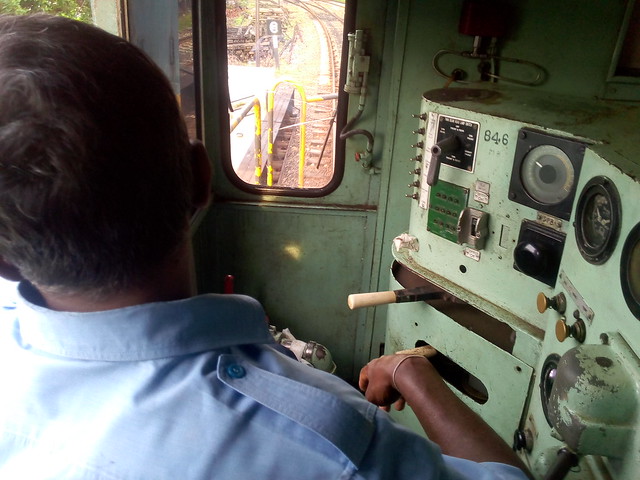
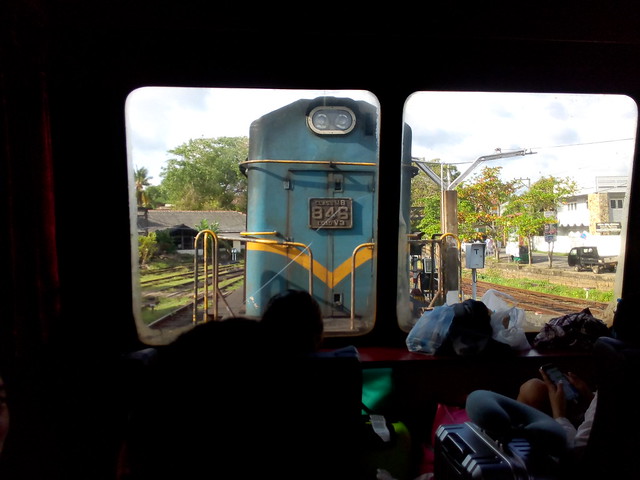
Sri Lankan train driver at the controls on the Coastal Line. One problem is the large number of people bothering you. I had someone at my seat asking for a donation to an orphanage (chased off by the conductor). Someone in a blue shirt then asked if I would like to see in the locomotive. I thought this was yet another tout, but it turned out to be the driver. So I got to see the driving cab of the locomotive. I was worried this might distract the driver from preparations, but there was a second crew member in the cab.
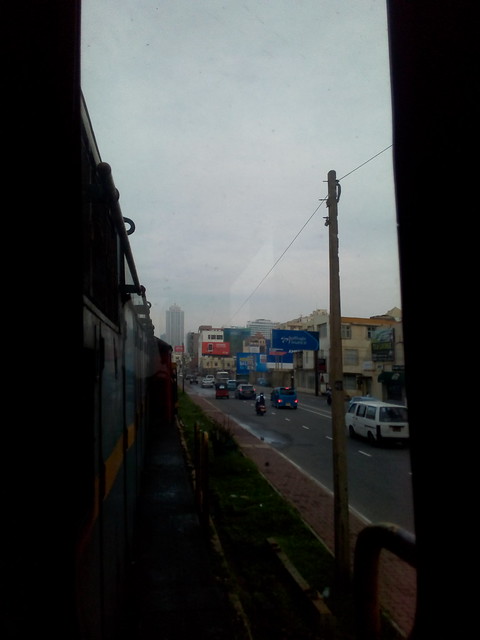
A Colombo street, as seen from a train on the Coastal Line of Sri Lanka.
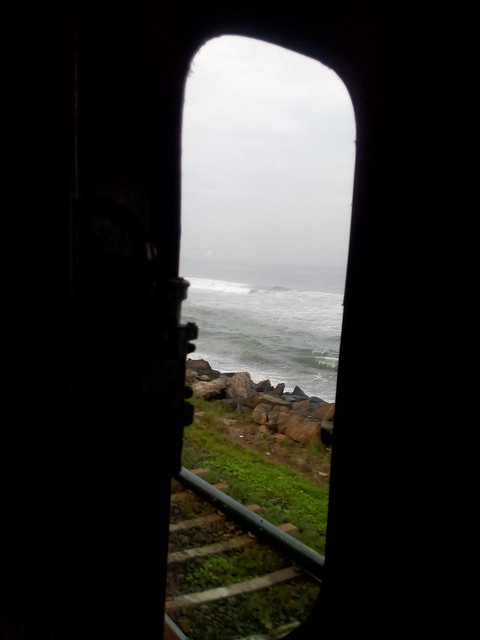
The ocean, as seen from a train in Colombo, Sri Lanka.The track goes though the city in a cutting, then out to the beach, just past Galle Face Green. On one side is the coastal road and on the other the beach. There were  people causally strolling across the track, as well as Tuk tuks. However, it is clear they know ever inch of the track, every bump (there are many) and where to expect problems.

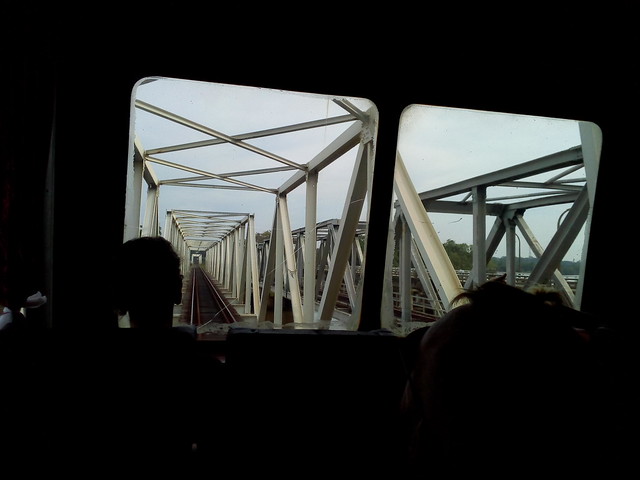
Bridges on the Galle to Colombo Coastal Line of Sri Lanka. Photo is from the observation car at the back of the train.
While the coast with villages and fishing boats is impressive, I was more interested in the rapid development evident on the landward side.

The passengers are mostly foreign tourists. There are the a few seasoned backpackers. One provided a running commentary which was a little disconcerting at times, pointing out this is the line with the worst rail disaster in world history, when the 2004 tsunami derailed a train.
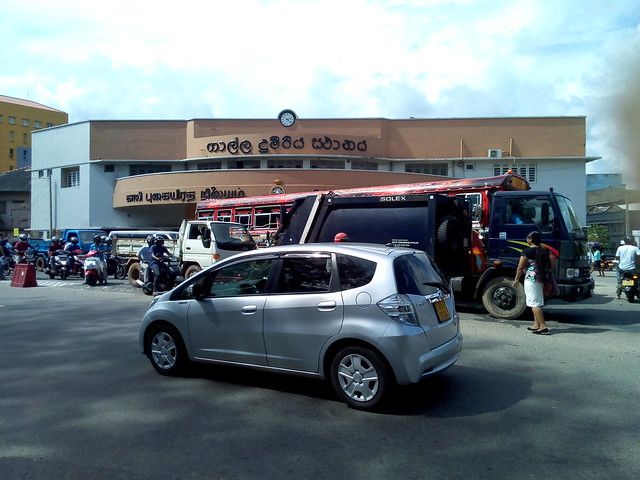
Galle Station on the Coastal Line of Sri Lanka.
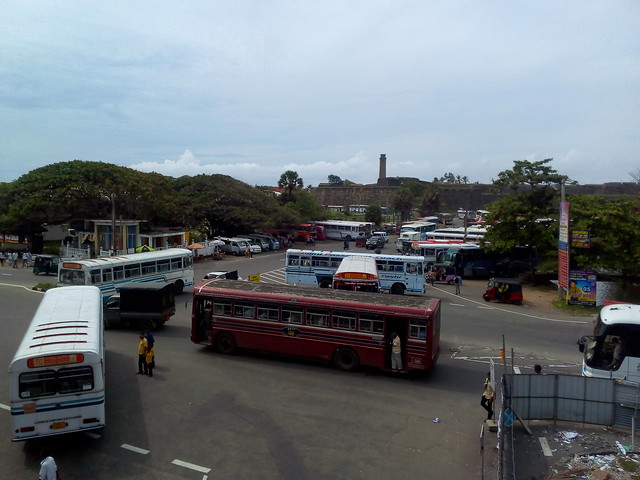
Buses at Galle station in Sri Lanka. Galle Fort is in the background.After a comfortable journey, the train arrived on time at Galle Station, an impressive slightly Art Deco looking building. Getting from the station across the busy road to  Galle Fort proved difficult. I tried the foot-bridge over a creek to the bus terminus, but then could not find how to get across the road. Back across the footbridge and on the other side of the station I found a crossing. This lead to Darmapala Park, which has a bridge to the Fort, but I decided to take a shortcut along the road (dodging past the many parked buses).

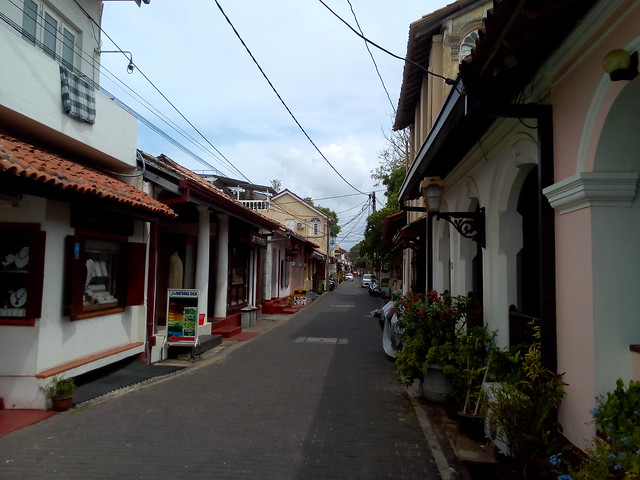
Typical street in the Galle Fort, Sri Lanka.
Galle Fort wall in Sri Lanka.Galle Fort is an impressive structure and large enough to spend a day wandering around. The Galle National Maritime Museum (also devastated by the 2004 Tsunami), provided a break from the heat. The building is almost as interesting as the exhibits, being part of the fort wall. I walked around getting blisters, while turning down numerous offers of Tuk Tuk rides.

After wandering around I had a quick drink in the hip little Old Railway Cafe, overlooking the station. It was then a short walk back to the station, where I bumped into the driver, who pointed out that his locomotive was changing ends and the observation car would be at the front.

Galle to Colombo Train on the Coastal Line of Sri Lanka. The locomotive is approaching the observation car for the return journey to Colombo Fort.
The observation car's end window was now partly blocked by the locomotive. But there was still a good view to ether side. As we rattled along, there were twilight views of people fishing, boats on the beach, and fish for sale at town markets (so close I could smell them). Sitting next to me was a local, who introduced themselves as a guard on the Viceroy Special steam train tours, asking if I knew Scott McGregor.

Despite the twilight, and my entertaining companion, th the trip back was an uncomfortable two hours. The locomotive was belching diesel smoke. It might be a good idea making the trip one way, from Colombo to Galle by train, and come back another way.

As the train pulled into Colombo Fort there was a tropical downpour, and I got back to my hotel sopping wet. Outside my balcony there was a train going past. That makes for a complete day of train tourism in the tropics. ;-)

Monday, October 15, 2018

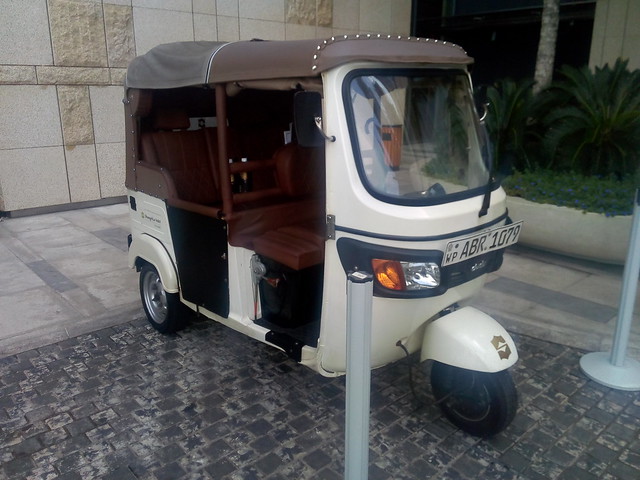
Battery Electric Tuk Tuk in Colombo

In early October I was in Sri Lanka to speak at the Computer Society of Sri Lanka (CSSL) National IT Conference (NITC 2018). The event was at the Shangri-La Hotel in Colombo, who provided guests with a ride in a battery-electric Tuk Tuk. This provides the excitement of a ride in one of these three wheel taxis, with more comfort and safety.

Saturday, October 13, 2018

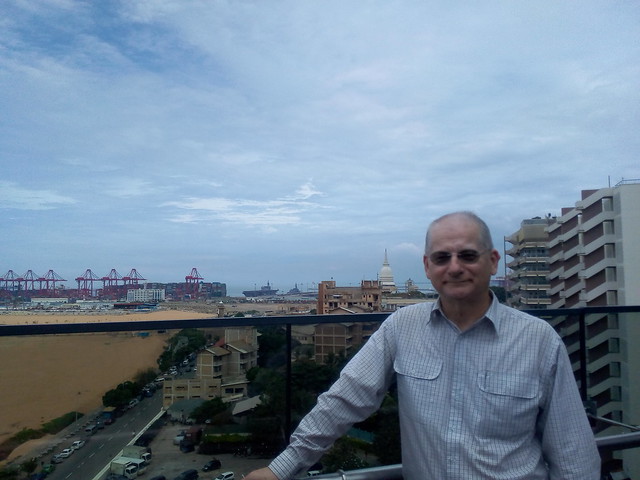
New Port City Colombo

Photo from hotel roof cafe overlooking the old and new waterfront at Colombo. The grey warship at the port in the background is Japan’s Kaga, a helicopter carrier.
Tom Worthington in Colombo
In early October I was in Colombo, Sri Lanka to speak at the Computer Society of Sri Lanka (CSSL) National IT Conference (NITC 2018).What was the waterfront when I visited in 2013 is now a kilometer inland, with reclamation for a new Port City Colombo.

The new city is intended to be in the style of Singapore. It will be interesting to see how this goes.

JS Kaga at Colombo
The grey warship at the port in the photo background is the Japanese warship, JS Kaga. Like Australia's HMAS Canberra, this was intended to carry helicopters, but may be adapted to operate F-35B stealth fighters.

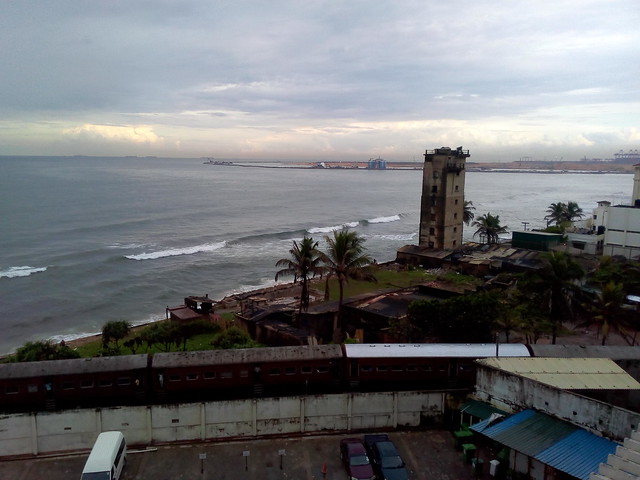
Train past Galle Face in Colombo

Train past Galle Face in Colombo
View from Hotel Samudra Balcony
In early October I was in Colombo, Sri Lanka to speak at the Computer Society of Sri Lanka (CSSL) National IT Conference (NITC 2018). The conference put speakers up at Hotel Samudra. This is a training hotel of the Sri Lanka Tourist Board, with students training in running of a hotel. There are only ten rooms in the hotel.

The students line up outside each morning at 8am, in their perfect white uniforms for the raising of the national flag and anthem. This is not something you see in the average hotel. The rooms are large, with balconies overlooking the beach, but could do with some maintenance. The students are very keen to provide service, but are students. This was a very different atmosphere to an impersonal hotel.

The train from Colombo to Galle runs between the hotel and the ocean. This would be a delight for train spotters. Also the new Colombo port is visible in the distance, past Galle Face. On Friday night there were fireworks at the Galle Face, which I could almost reach out and touch.

Wednesday, July 29, 2015

Longest Guided Busway

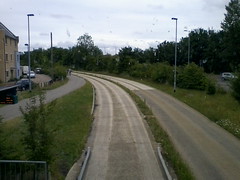
Cambridgeshire Guided BuswayThe Cambridgeshire Guided Busway has overtaken Adelaide's O-Bahn Busway as the world's longest. On Sunday I had a trip from Cambridge, to Huntingdon via St Ives. Most people in Cambridge may not even notice the bus-way, as in the city the specially adapted buses travel on ordinary roads and use ordinary stops.
If you look closely you will see small guide wheels (about the size of a small dinner plate) next to the front wheels of the buses. These contact the edges of the bus-way to steer the buses.

You board and pay for a ride like an ordinary bus (I took a double decker bus, with an excellent view from the front seats upstairs). One complication is that there are two separate companies provideing ser sercves and their tickets are not interchangeable: if you buy a return ticket from one company you cannot travel back on the other. You can use a smart card between both services, but these have to be ordered by mail and cannot be purchased on-lboard.

The bus-way starts just outside Cambridge, where the bus leaves the normal road, goes over a car trap (a pit in the center of the roadway to stop ordinary cars driving onto the bus-way)and onto the concrete tracks. The bus-way is mostly built like a concrete railway, with two wide concrete rails (one for each side of the bus) and a raised edge for the guide wheel. There is grass growing between the rails and between the two sets of tracks. The ride is quite bumpy as the bus goes over the joins in the track and also the bus sways from side to side (more so than I remember from the Adelaide bus-way). The swaying is likely more pronounced on the top deck of a double deck bus (Adelaide has had problems with swaying of the rear of articulated buses).

The bus-way follows a disused railway track and at times goes close behind houses, with a high sound barrier on each side (which you can see over from the top deck). Out in the countryside there are wetlands on either side, with people bird watching and fishing. At one point near St Ives there is a marina at the river.

There are several stops along the way with park and ride facilities and I noted one disused railway station. Between St Ives and Huntingdon the bus travels on ordinary roads. To get the guided bus-way experience you might as well just go Cambridge to  St Ives and back.

In 2009 I traveled the 12 kilometers, of Adelaide's O-Bahn Busway which was then the world's longest. The experience in Cambridge is similar. This is not a glamorous mode of travel (like a monorail), but a pratical solution to a particualr problem: where space in confined or ground too soft or undevne for a normal roadway to be built.

The o-bhan bus guidance technology is a simple and proven mechanical system. However, technology has advanced to the point where it should be possible to achieve the same result using electronics. Using automatic lane and cruse control developed for cars and trucks, it should be possible to have buses self steer in bus lanes and keep a safe distance from each other. This should make it possible for buses with no mechanical modifications to travel on an o-bhan bus-way, as well as one on an ordinary roadway. Also it should be possible to use positioning technology and communications technology to safely share one lane for two way traffic.  This would allow, for example, just one lane to be built and passing lanes at the bus-stops. Buses would take turns to use the lane, waiting at the stops (just as trains do on many lines now). This would greatly reduce the cost of the construction of bus-ways. At peak times buses could travel in convoys, with each automatically separated by a safe distance.

Monday, July 27, 2015

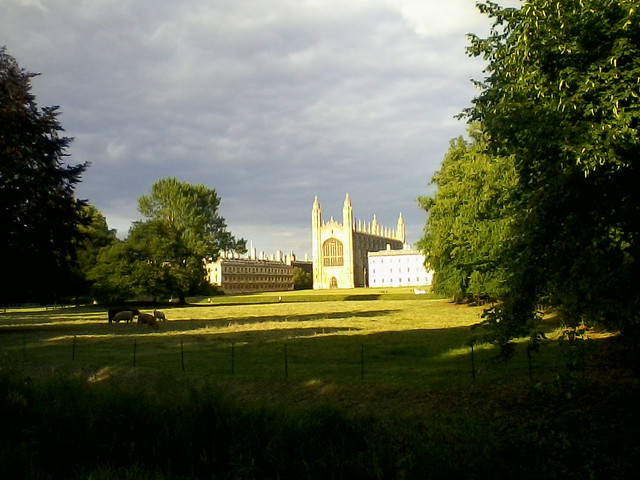
From the Backs at Cambridge

Chapel of King's College CambridgeI don't think it is possible to take a bad photo of the Chapel of King's College Cambridge. Here is one I took yesterday, almost at random (I took a photo from almost the same spot about 20 years ago).

Sunday, July 26, 2015

Romeo and Juliet in St John’s College Gardens Cambridge University

The Cambridge Shakespeare Festival, runs until 29 August. Yesterday I attended the afternoon performance of  from Romeo and Juliet in St John’s College Gardens. The best part of this was the setting in the gardens, at the "backs" of Cambridge University. This is the open area across the river Cam from the city. We arrived to the performers doing warm up exercise and a wandering ministerial. As well as seating there was the option of a picnic on the lawn.

The performers had the challenge of projecting their voices in the open air, without the benefit of a stage and competing with aircraft and traffic noise. Some were not up to the challenge. Juliet was a little old for the part, but made up with girlish enthusiasm.

Saturday, July 25, 2015

From a Cambridge College Room

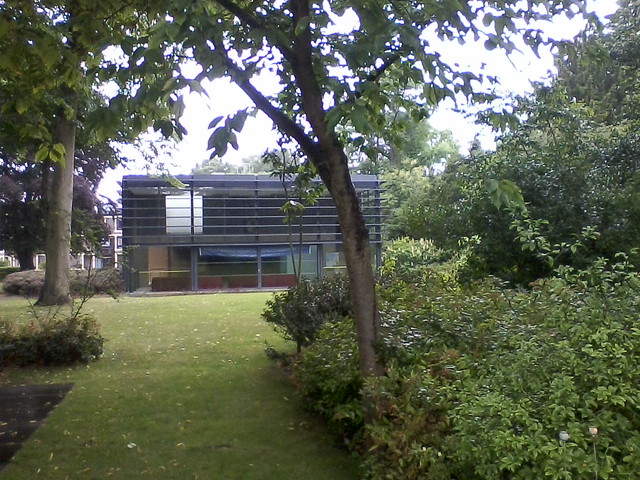
Fitzwilliam College Cambridge AuditoriumGreetings from Fitzwilliam College, Cambridge University (UK), where I have been attending the 10th International Conference on Computer Science and  Education (ICCSE 2015). Most of the other delegates left yesterday and the quad is quiet. Fitzwilliam ("Ftiz") has modern buildings (with plumbing), but retains a modest scale and has quiet quad.
The auditorium used for the conference is only the hight of a two story building, but extends another two stories underground. Like the conference room at Hong Kong Open University (where I attended ICOFE2015), the auditorium also doubles as a basketball court.

Apart from the gardens, the best part of Fitz was the helpful Porter and the barman. The service is understated. Unlike a hotel, when I arrived I did not need to show my passport, provide a credit card deposit and fill in a form. I gave my name, signed in and d was handed a key. Unfortunately, the food was not so good (the baked beans of an English breakfast can be hard to face in the morning). However, the WiFi was excellent (apparently University of Cambridge had suffered a major network outage the day before, but it worked flawlessly during my stay).

You do not have to be alumni or attending a conference to get the university college experience. The service I booked through, Universityrooms.com, has rooms around the world. But keep in mind that during semester times there may be few rooms available, and during the breaks conferences make block bookings.


ps: There is a performance of Romeo and Juliette to attend at St. Johns. 

Wednesday, August 27, 2014

Vancouver from the 17th Floor

It is my last day in Vancouver, after a week conferring on computer education. My trip was to attend the 2014 IEEE International Conference on Computer Science and Education (ICCSE 2014). The conference was at the University of British Colombia (UBC) on a peninsular, next to Vancouver city. From my room on the 17th floor of the Walter Gage Student Residence, there is a magnificent view of forests below, ships on the water, the city skyscrapers and mountains in the distance. Most important for a university is good coffee and I found the Great Dane Coffee just around behind the Walter Gage.

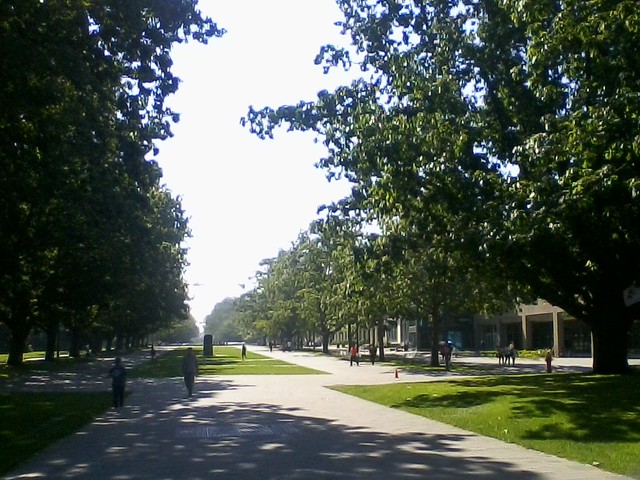
UBC Malls


The UBC campus is very large with tree lined pedestrian  "Malls". The buildings on the malls have mostly been kept to four to six floors, to match the height of the trees. So while these buildings are large close up, they do not dominate when looking down a Mall.
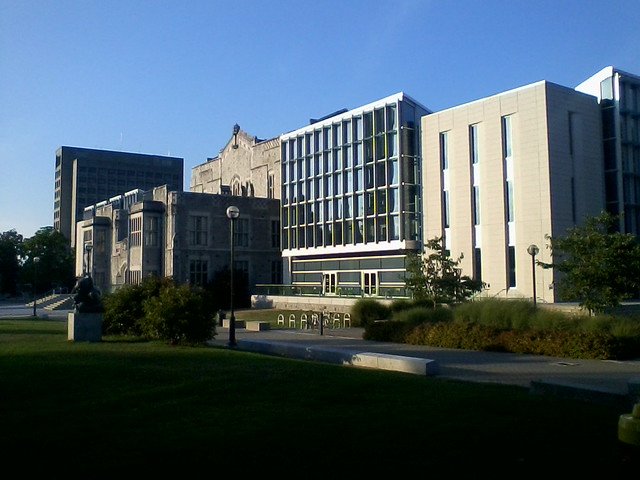
There is an attempt to blend the new glass walled buildings into the old granite ones, by using granite bases and muted sandstone and grey colouring on the new ones. A good example is the Irving K Barber Learning Centre, which has been wrapped around the sides and back of an old granite one..
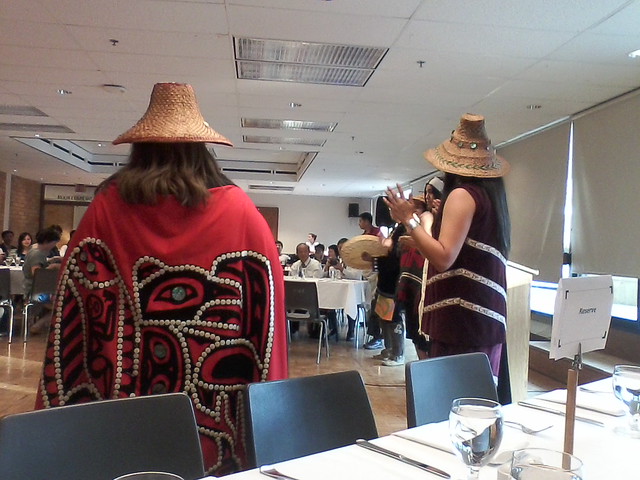
Indigenous Welcome at ICCSE 2014The ICCSE 2014 conference dinner featured a welcome from local indigenous performers. This had a fun bit of audience participation, with the delegates loosening up a little after getting up to dance as animal spirits (last year we had Sri Lanka Drummers).
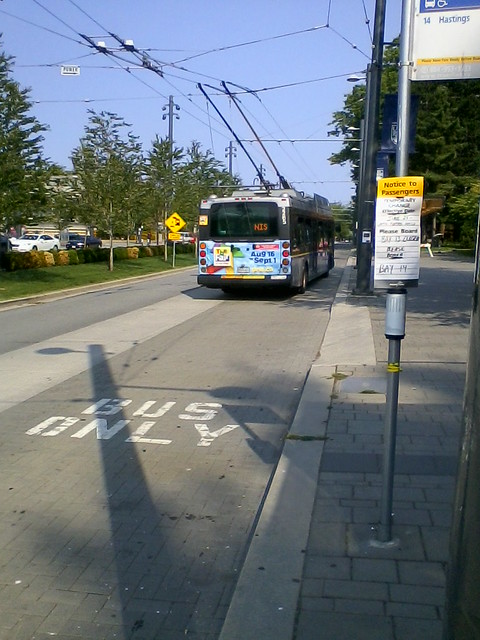

UBC has two bus stations, one of which is serviced by electric trolley buses.This is something the city of Canberra might consider, in preference to trams. It is about a 30 minute ride to down-town Vancouver. I took a ride from UBC to the SFU Vancouver campus. The BC FareSaver Tickets allow you to get on and off buses and trains for 90 minutes. So I stopped off along the way to the city to shop at the Salivation Army Thrift Store (2714 West Broadway) and picked a pair of near new Italian shoes for $20.

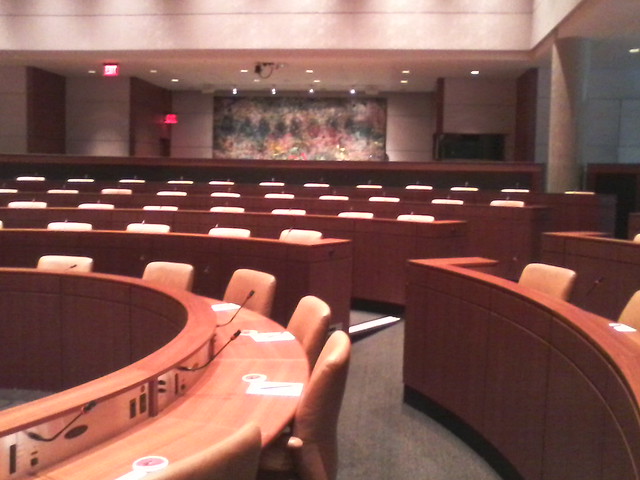
Asia Pacific Hall at the SFU Morris J. Wosk Centre for DialogueThe bus stopped outside SFU's Vancouver campus, near the waterfront. Across the road is the SFU Morris J. Wosk Centre for Dialogue. The guard was kind enough to open up the Asia Pacific Hall for me to have a look at this impressive room. This is a circular parliamentary style chamber, with stepped seating. It is intended to facilitate discussion, rather than adversarial debate.

Saturday, May 11, 2013

Anuradhapura to Colombo train

Having been on one long distance Sri Lankan train (Colombo to Kandy), the next journey was a little easier. Anuradhapura's railway station looks larger than the capital city's but there are just covered platforms behind. This makes it much easier to navigate as it is bright and airy. The Anuradhapura to Colombo serivcde has no observation car, but the normal first class carriage was comfortable enough, and had the advantage of seats facing forward.

The first class was just next to the buffet car and the staff came through offering food and drink, as well as the independent vendors at some stations. For those wanting even more catering, there are stores at the major stations. The seasoned travelers would saunter over, order food and drink and then casually savior their food, as the guard's wistle indicated the train was about to leave. They would sip the last of their beverage from the saucer (to cool it) and then casually walk over and board the now moving train.

What you mostly see from this train are rice paddy fields, worked by mechanical two-wheel tractors (with the operator walking behind). There is the occasional water buffalo team still in use. The hand hoes used today look very much like those in the Sigiriya Museum from a thousand years ago (I don't know if there are any in the Anuradhapura Museum as it is closed for renovation). Everywhere there are irrigation channels, carefully laid out to direct the water to the paddies, and as importantly, to carry it away.

Saturday, April 27, 2013

Information Technology Education in Sri Lanka

Sri Lankan drummers at the opening of ICCSE 2013.
Sri Lankan drummers
at the opening of ICCSE 2013.
Greetings from Colombo, Sri Lanka, where I am attending the opening of the 8th International Conference on Computer Science and Education (ICCSE 2013).
We started with a display of traditional Sri Lankan dancing and drums, followed by the national anthem and the lighting of an oil lamp. In his opening speech, the Sri Lanka Minister of Technology Research and Atomic Energy, Patali Champika Ranawaka, emphasized the economic, environmental and social benefits of national investment in education.  The conference is organized by the China Research Council of Computer Education in Colleges & Universities, Foreign Affair Committee (CRC-CE), co-sponsored by IEEE's Sri Lankan chapter and hosted by the Sri Lanka Institute of Information Technology (SLIIT). I will chairing the e-learning session on Sunday and presenting on "Synchronizing Asynchronous Learning: MOOCs with Books".

Boats on Canal in Colombo
Yesterday, before the formal conference, we had a tour of the main campus of SLIIT. This private institution is affiliated with numerous Australian universities, some UK ones and accredited to deliver programs in Sri Lanaka. SLIIT focuses on ICT and business courses. The main campus looks like that of an Australian vocational institution in the tropics.

The introductory briefing was conducted in a small lecture room for about 72 students. Interestingly they had very narrow tables (about 300 mm, which was just enough to accommodate my laptop) each seating four students in a row. There is a raised stage at the front. Video projection is direct to a white wall, with a freestanding white-board alongside.

I noticed a sign about mid semester one hour  examinations. SLIIT use Moodle for e-learning, but the primary teaching mode appears to be face-to-face in conventional classrooms. There is also a library seating about 140. The library appears to primarily provide multiple copies of textbooks for the students.We also looked at several computer labs with desktop PCs with LCD screens.

I noticed one course offered was Introduction to Renewable Energy from Curtin University. There may be scope for offering my ICT Sustainability course to the engineering, ICT and business students.

SLIIT has a startup incubator "Conceptnursery.Com", where students can lease a small office to work on their own start-up company. This is more lavishly equipped than Australian equivalents such as Fishburners and Entry 29. SLIIT provide a lockable office big enough for four staff, whereas the Australian equivalents offer just a time-shared desk in an open office for the base level. SLIIT might consider this option, as it would allow for many more startups.

An interesting issue is what effect will e-learning have on institutions like SLIIT.  Currently SLIIT acts as a satellite campus and feeder to for overseas institutions. Students can complete lower level qualifications at SLIIT and also travel to the overseas institution for advanced studies. However, if students can undertake much or all of their studies on-line, there may be less need for these partnerships. However, I think it is more likely that the services offered at campuses will change, as they are in Australia, with fewer lecture theaters and more informal spaces for small groups of students.

Thursday, April 25, 2013

From a Film Set in Colombo

Greetings from the foyer of the Galadari Hotel by the beach in Colombo, Sri Lanka. I just arrived for ICCSE 2013, which starts tomorrow.It is a little surreal: there appears to be a wedding party having dinner in the restaurant on one side of me, while a young man with a very spiky hairstyle in an orange suit is being filmed on the other. I thought they might be making an advertisement for the hotel, as I stepped past a waiter standing in the middle of the foyer with a tray of drinks, looked around and found myself on camera.

Correction: it is not a wedding, the pianist (who was doing very sugary renditions of love songs, just broke into "Happy Birthday").

Just to add to the mix tomorrow several hundred computer scientists (mostly from China) are turning up. Should be entertaining.