Showing posts with label Sri Lanka. Show all posts

Monday, October 22, 2018

Colombo to Galle by Train Down the Coastal Line of Sri Lanka

A few weeks ago I traveled from Colombo to Galle along the Coastal Line of Sri Lanka. The line follows the coast for about 100 km, sometimes so close to the beach that you can feel the spray on your face.

To plan the trip I used Seat 61 and booked through Visit Sri Lanka Tours. The tickets were at the Colombo Fort ticket office, as promised. However, the office took some finding, as it is not in the main hall of the station (where the local ticket booths are), but through a door to the left (when facing the building) on the outside. There was no one at the Colombo-Galle-Matara window, so after a few minutes I tried the one next to that and got my ticket (it might have been better to pay extra and have the ticket delivered to my hotel). The next challenge was to find the right platform and car, in the early morning commuter rush.

After asking a few people I ended up in the right place. I had booked the 1st class observation car, which was "air-conditioned". The car was far from new and the air conditioning was an electric fan on the roof. But it was only one quarter full, and had a clean toilet, which is luxury on any form of Sri Lanaka transport. There was a large window on the end of the car (with one pane cracked), providing an excellent view of where we had been, plus opening widows on each side.
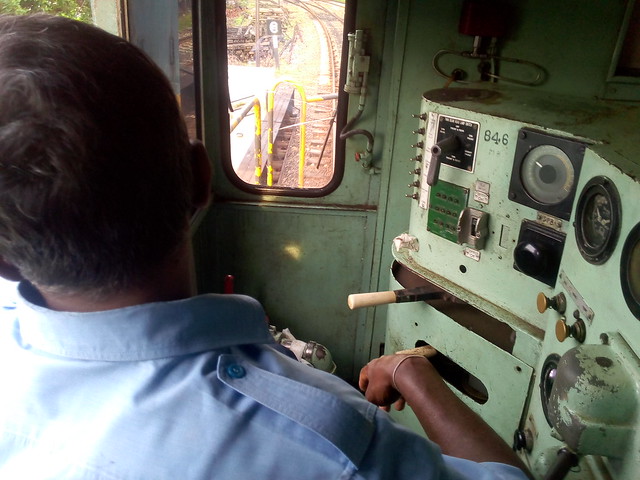
Sri Lankan train driver at the controls on the Coastal Line. One problem is the large number of people bothering you. I had someone at my seat asking for a donation to an orphanage (chased off by the conductor). Someone in a blue shirt then asked if I would like to see in the locomotive. I thought this was yet another tout, but it turned out to be the driver. So I got to see the driving cab of the locomotive. I was worried this might distract the driver from preparations, but there was a second crew member in the cab.
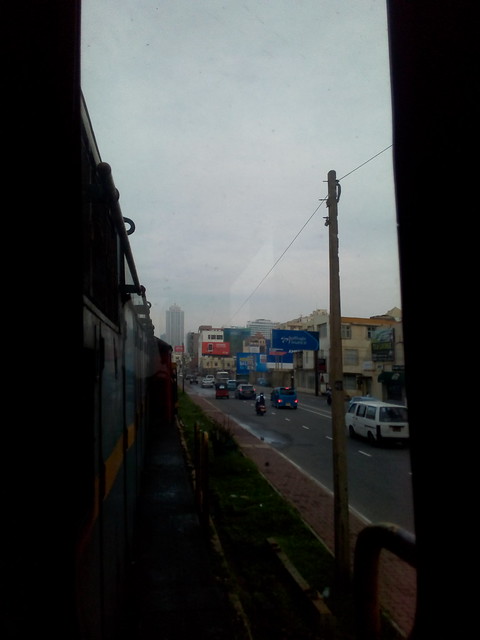
A Colombo street, as seen from a train on the Coastal Line of Sri Lanka.
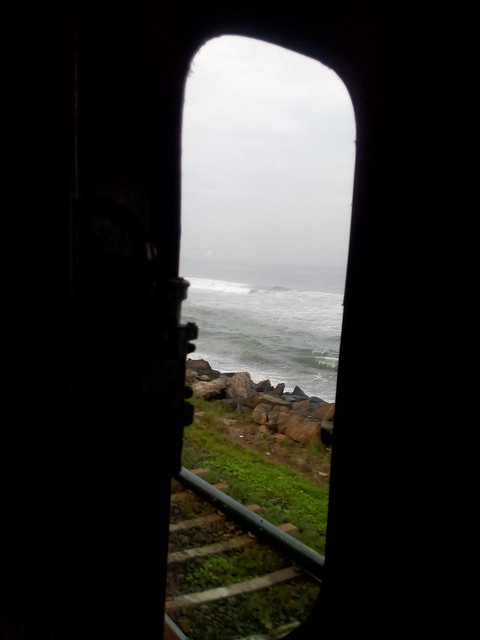
The ocean, as seen from a train in Colombo, Sri Lanka.The track goes though the city in a cutting, then out to the beach, just past Galle Face Green. On one side is the coastal road and on the other the beach. There were  people causally strolling across the track, as well as Tuk tuks. However, it is clear they know ever inch of the track, every bump (there are many) and where to expect problems.
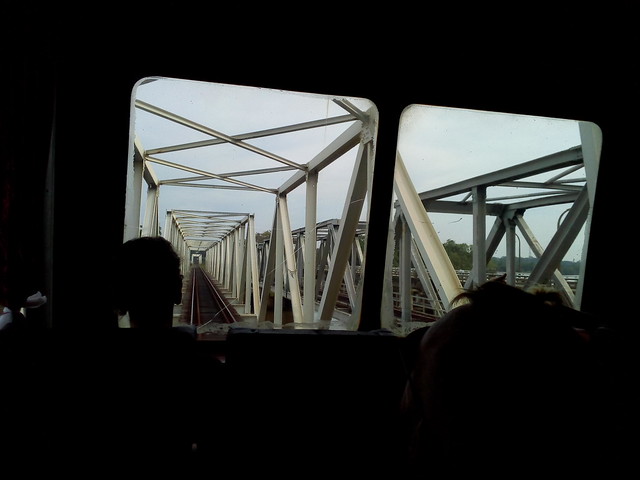
Bridges on the Galle to Colombo Coastal Line of Sri Lanka. Photo is from the observation car at the back of the train.
While the coast with villages and fishing boats is impressive, I was more interested in the rapid development evident on the landward side.

The passengers are mostly foreign tourists. There are the a few seasoned backpackers. One provided a running commentary which was a little disconcerting at times, pointing out this is the line with the worst rail disaster in world history, when the 2004 tsunami derailed a train.
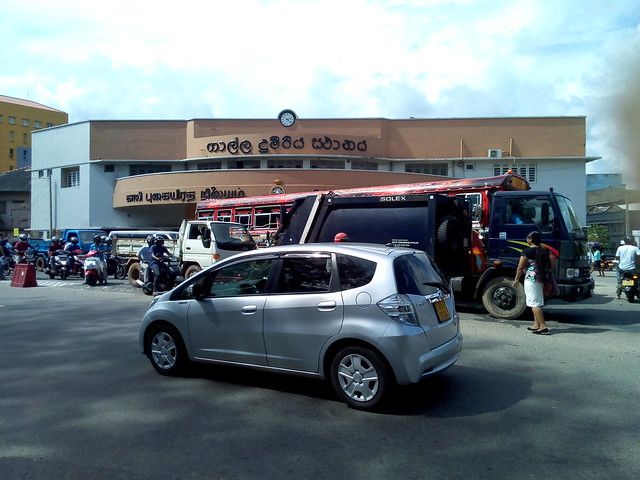
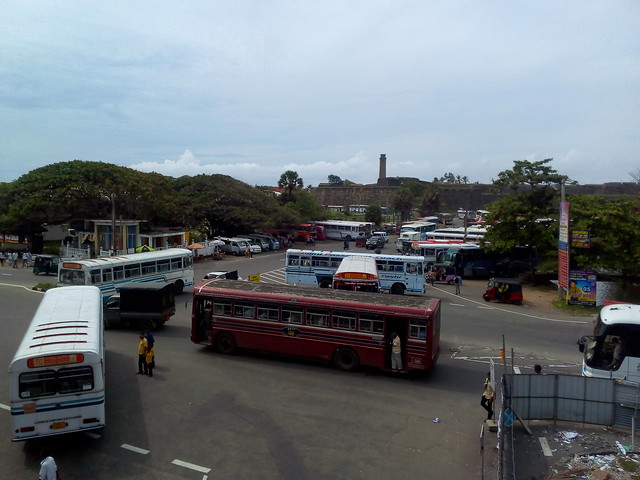
Galle Station on the Coastal Line of Sri Lanka.
Buses at Galle station in Sri Lanka. Galle Fort is in the background.After a comfortable journey, the train arrived on time at Galle Station, an impressive slightly Art Deco looking building. Getting from the station across the busy road to  Galle Fort proved difficult. I tried the foot-bridge over a creek to the bus terminus, but then could not find how to get across the road. Back across the footbridge and on the other side of the station I found a crossing. This lead to Darmapala Park, which has a bridge to the Fort, but I decided to take a shortcut along the road (dodging past the many parked buses).
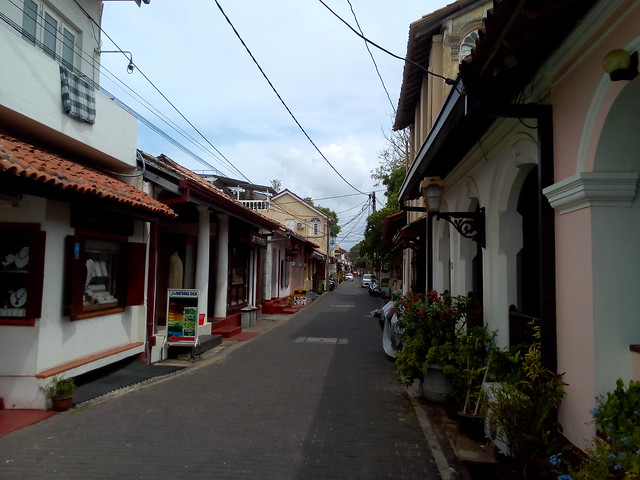
Typical street in the Galle Fort, Sri Lanka.
Galle Fort wall in Sri Lanka.Galle Fort is an impressive structure and large enough to spend a day wandering around. The Galle National Maritime Museum (also devastated by the 2004 Tsunami), provided a break from the heat. The building is almost as interesting as the exhibits, being part of the fort wall. I walked around getting blisters, while turning down numerous offers of Tuk Tuk rides.

After wandering around I had a quick drink in the hip little Old Railway Cafe, overlooking the station. It was then a short walk back to the station, where I bumped into the driver, who pointed out that his locomotive was changing ends and the observation car would be at the front.
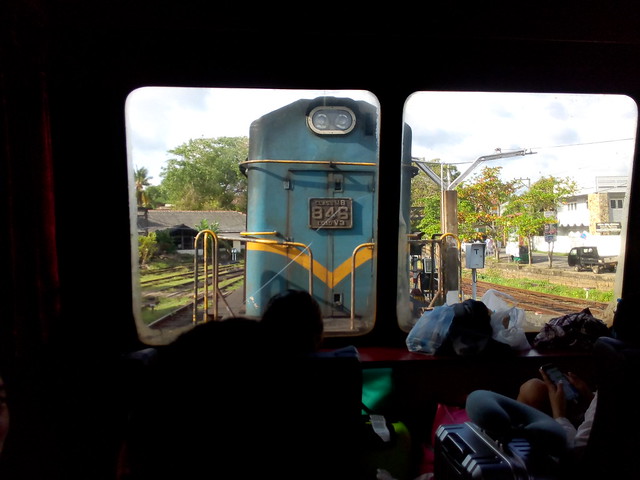
Galle to Colombo Train on the Coastal Line of Sri Lanka. The locomotive is approaching the observation car for the return journey to Colombo Fort.
The observation car's end window was now partly blocked by the locomotive. But there was still a good view to ether side. As we rattled along, there were twilight views of people fishing, boats on the beach, and fish for sale at town markets (so close I could smell them). Sitting next to me was a local, who introduced themselves as a guard on the Viceroy Special steam train tours, asking if I knew Scott McGregor.

Despite the twilight, and my entertaining companion, th the trip back was an uncomfortable two hours. The locomotive was belching diesel smoke. It might be a good idea making the trip one way, from Colombo to Galle by train, and come back another way.

As the train pulled into Colombo Fort there was a tropical downpour, and I got back to my hotel sopping wet. Outside my balcony there was a train going past. That makes for a complete day of train tourism in the tropics. ;-)

Monday, October 15, 2018

Battery Electric Tuk Tuk in Colombo

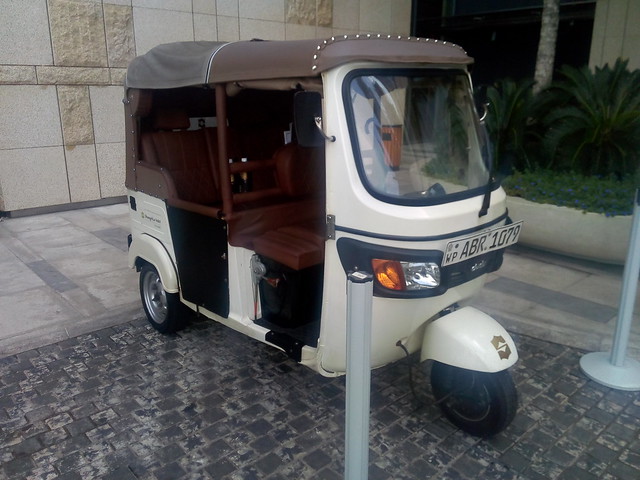
In early October I was in Sri Lanka to speak at the Computer Society of Sri Lanka (CSSL) National IT Conference (NITC 2018). The event was at the Shangri-La Hotel in Colombo, who provided guests with a ride in a battery-electric Tuk Tuk. This provides the excitement of a ride in one of these three wheel taxis, with more comfort and safety.

Saturday, October 13, 2018

New Port City Colombo

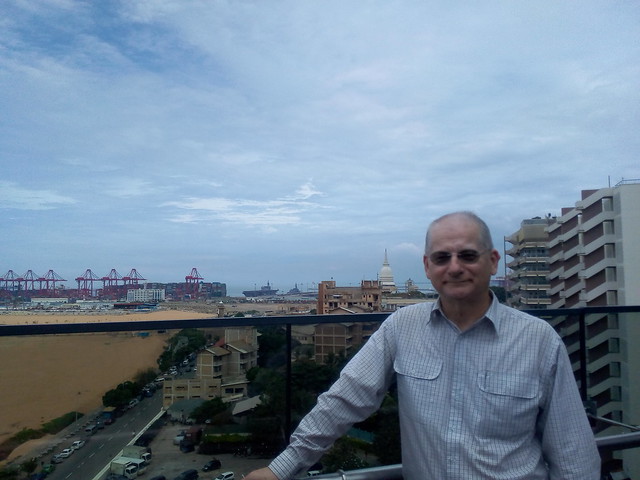
Photo from hotel roof cafe overlooking the old and new waterfront at Colombo. The grey warship at the port in the background is Japan’s Kaga, a helicopter carrier.
Tom Worthington in Colombo
In early October I was in Colombo, Sri Lanka to speak at the Computer Society of Sri Lanka (CSSL) National IT Conference (NITC 2018).What was the waterfront when I visited in 2013 is now a kilometer inland, with reclamation for a new Port City Colombo.

The new city is intended to be in the style of Singapore. It will be interesting to see how this goes.

JS Kaga at Colombo
The grey warship at the port in the photo background is the Japanese warship, JS Kaga. Like Australia's HMAS Canberra, this was intended to carry helicopters, but may be adapted to operate F-35B stealth fighters.

Train past Galle Face in Colombo

Train past Galle Face in Colombo
View from Hotel Samudra Balcony
In early October I was in Colombo, Sri Lanka to speak at the Computer Society of Sri Lanka (CSSL) National IT Conference (NITC 2018). The conference put speakers up at Hotel Samudra. This is a training hotel of the Sri Lanka Tourist Board, with students training in running of a hotel. There are only ten rooms in the hotel.

The students line up outside each morning at 8am, in their perfect white uniforms for the raising of the national flag and anthem. This is not something you see in the average hotel. The rooms are large, with balconies overlooking the beach, but could do with some maintenance. The students are very keen to provide service, but are students. This was a very different atmosphere to an impersonal hotel.

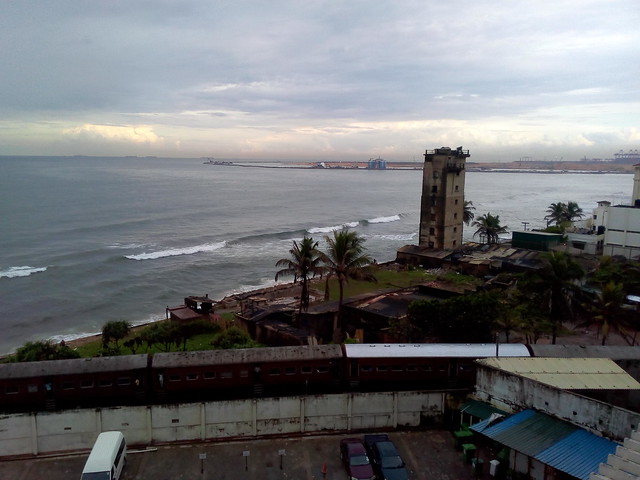
The train from Colombo to Galle runs between the hotel and the ocean. This would be a delight for train spotters. Also the new Colombo port is visible in the distance, past Galle Face. On Friday night there were fireworks at the Galle Face, which I could almost reach out and touch.

Sunday, July 01, 2018

IT Changes Everything in Sri Lanka

I am scheduled to speak at the National IT Conference in Sri Lanka (NITC 2018), 2 to 4 October 2018, organized by the Computer Society of Sri Lanka (CSSL). The theme of the conference is: IT Changes Everything
 
To help me prepare a presentation, the conference organizers have provided some references as background, from which I have extracted some quotes:

Development of Sri Lanka’s digital economy strategy

"Work on the country’s digital economy strategy has begun with input from world-renowned consultancy firm McKinsey, the Prime Minister’s Policy Development Office said yesterday.  ..."
From:  "Work begins on Sri Lanka’s digital economy strategy with McKinsey input", Daily FT, 8 January 2018
 Sri Lanka’s Digital Economy Strategy

"... This initiative will strategize the promotion of the Digital Economy through the lens of three economic development thrust sectors, namely, agriculture sector, tourism sector and the manufacturing sector. It is expected that each of the sectors identified above will could develop at least one flagship programs to support this initial stage of Sri Lanka’s Digital Economy Strategy. ..."

From "Sri Lanka’s Digital Economy Strategy", Department of Government Information, Sri Lanka, 7 January 2018
 Sri Lanka Vision 2025
"The country needs to develop strategies that encourage the use of digital and other emergent technologies to become globally competitive and to drive the nation towards a digitally empowered economy. Enhanced digital ecosystems, through reduced transactions costs, will stimulate inclusive growth and job creation, especially by empowering the self-employed and SMEs.

...  Sri Lanka’s IT literacy rate was a meagre 27.5% in 2016, with only 15.1% of households with internet access. The technology service sector has long been dominated by ICT, and there is little focus on promoting disruptive innovation technologies such as artificial intelligence (AI), data mining and other high-quality technological services. The economy needs a shift towards innovative, knowledge based business ventures.
  1. We will put in place a plan of action to encourage the transfer of appropriate foreign technologies into Sri Lanka. ...
  2. We will actively promote private sector investment in digital technology. Incentives to support emerging industries in robotics, cybernetics, and electronics will be provided. We will support development in advanced technology by encouraging education institutions to link up with the private sector. To improve market access for startups, we will facilitate the convergence of multiple technologies and integration with global startup networks. We will encourage the private sector to plan early for future workplaces, commerce, and manufacturing in the digital era. ...
  3. We will incentivise private sector investment in the ICT industry. ...
  4. We will integrate ICT literacy into school curricula. ...
  5. We will increase free Wi-Fi provision and increase incentives provided to widen internet access. ...
  6. We will continue the national digital identity initiative. ...
  7. We will increase digitalisation of Government operations. ...
  8. We will strengthen ICT based marketing interfaces. ...
  9. We will encourage innovations in mobile payment systems and peer-to-peer lending
    platforms with necessary oversight. ...
  10. We will strengthen Sri Lanka’s National Intellectual Property Office to manage
    registration exploitation, regulation and resolution more effectively. ...
  11. We will strengthen the legal framework for electronic transactions. ..."
From Chapter 9, Technology and Digitalization, "Vision 2025: A Country Enriched", Ministry of National Policies and Economic Affairs, Sri Lanka, 31 August 2017 (numbering of proposals added).

Questions

I was then asked to:
"1. Outline your topic and it's relevancy in-line of the overall theme of "IT changes everything"
2. How do we drive a digital economy? What should be the key measurements? Timelines?
3. What changes are needed at different levels of the society? E.g. how do you propose we change the current education system?
4. What are you looking forward to during you planned visit to Sri Lanka during early October for NITC?
5. Any other info you think which is important."

Discussion

Framing the digital strategy for a nation is too much for one conference presentation. As an educator, I will naturally focus on education. The area I have been looking at in Australia and for the Asian region in my graduate studies has been vocational education. How do we bridge upper schooling, vocational colleges and university?

What are you looking forward to?
 
The easiest question to answer is "What are you looking forward to during you planned visit to Sri Lanka...". On my previous visit I enjoyed meeting people from the local IT industry and educational institutions. Highlights were a visit to a higher education institution which has connections to Australia and a IT company campus (where I gave a talk on emergency management using the Internet).

Tuesday, July 29, 2014

Sri Lanka Announces 1,000 Telecentres

The Sri Lankan Ministry of Telecommunications and Information Technology plans to open 1000 E-nenasala Centres in 2014. These are similar in aim to Australia's telecerntres, providing local access to the Internet and help with its use, for e-literacy, culture, education and economic development (Roger Clarke and I helped this by wiritng "Vision for a Networked Nation"). The Sri Lanka program seems a little over-ambitious. Apart from the installation of equipment, such a programs requires staff to be trained (and ongoing funding to be provided). In Australia the most successful location for Internet access and help has been local libraries. Perhaps for Sri Lanka the best location for this would be the local school.

ps: I was unable to get the  E-nenasala website to respond, but the archived version is available.

Monday, November 11, 2013

Sri Lanka’s post-war troubles

Greetings from the Australian National University in Canberra, where Kishali Pinto-Jayawardena is speaking on "Braving the seas: Sri Lanka’s post-war troubles". Pinto-Jayawardena argues that a climate of impunity existed in Sri Lanka for decades and remains after the end of the Sri Lankan Civil War, with the concept of justice loosing meaning. They argue that poor rural members of the Sinhalese, majority suffer along with other groups from government endorsed military oppression, the example of land takeover ("Is Sri Lanka a military state that devours land?", Kishali Pinto-Jayawarden, November 3, 2013, Colombo, Sri Lanka Guardian). Pinto-Jayawarden questioned if the Australian government's support for Sri Lanka's CHOGM meeting was in return for cooperation on the return of boat people. While Pinto-Jayawarden presneted no evidence, it should be noted that Australian Senator Lee Rhiannon was recently detained on a visit to Sri Lanka. In April I presented a paper at the 2013 International Conference on Computer Science and Education (ICCSE 2013) in Colombo, Sri Lanka. I visited universities and IT companies in Sri Lanka with links to Australia, the USA and the USA. So I asked Pinto-Jayawardena if such links were beneficial to the situation Sri Lanka, they suggested it was (which was a great relief to me).

Thursday, October 24, 2013

Ten Years of Post-Tsunami Recovery in Sri Lanka

A call for papers has been issued for the 2nd Asian Conference on Information Systems for Crisis Response and Management on the topic "10 Years of Post-Tsunami Recovery: the role of ICTs in building disaster resilience". The conference ISCRAM-Asia 2014, will be Colombo,  to be held in Sri Lanka, 20-21 June 2014.

2nd Asian Conference on Information Systems for Crisis Response and Management

Call for Papers

CONFERENCE THEME: 10 years of post-tsunami recovery: the role of ICTs in building disaster resilience 
ISCRAM-ASIA 2014: 2nd Asia-Continental Conference on Information Systems for Crisis Response and Management 
CONFERENCE DATES: Friday 20th & Saturday 21st June 2014 LOCATION: Colombo, Sri Lanka.

 THEMES

1. RESPONSE
1.1    Coordination, Search and rescue / First Aid
1.2    Humanitarian and Disaster relief supply chain management
1.3    Emergency management information systems (Information Systems supporting Situational Awareness, disaster relief supply chain management)
2. REHABILITATION AND RECONSTRUCTION
2.1    Humanitarian challenges
2.2    Reconstruction, long term recovery and ecosystem reconstruction
2.3    Resettlement (land use planning/reasoning)
2.4    Monitoring long-term progress in disaster risk reduction
3. CROSS CUTTING ISSUES
3.1    ICTs for Disaster Risk Management
3.2    Decision support systems
3.3    Risk communication, dissemination and comprehension
3.4    Development and operationalization of response control systems
3.5    Intelligent systems
3.6    Use of ICTs in public health and emergency medical management
3.7    Role of social media in risk perception, awareness, knowledge management, and crisis response
3.8    Mobile technology for real-time emergency response
4. PREPAREDNESS
4.1    The role of cultural and gender dimensions in disaster vulnerability, response, and recovery
4.2    Innovative Multi-stakeholder Community-focused Partnerships in DRR and EWS
4.3    Functional Early Warning Systems
4.4    Disaster Risk Assessment
4.5    Emergency drills and simulations
5. PREVENTION AND MITIGATION
5.1    Risk communication, dissemination and comprehension
5.2    Disaster risk insurance, management and planning
5.3    Development and operationalization of response control systems
5.4    Disaster awareness education training (or disaster education and learning)
5.5    Progress in developing early warning systems
5.6    Climate Change Adaptation

CONTRIBUTIONS

ISCRAM-ASIA 2014 invites two categories of papers. All paper submissions must be relevant to ISCRAM, make a new and significant contribution to the body of knowledge on information systems for emergency management, support their contribution with valid arguments, and be clearly structured and well written.
  • Research papers presenting valid, original, relevant cutting edge research that will be reviewed to the highest academic standards. Reviewing will pay additional attention to the application of the related scientific literature and theory, to the use of an appropriate research methodology, and to technical, mathematical and statistical correctness. This will be complemented by a review from a member of the Scientific Committee (SC).
  • Insights from the Practice of Emergency Management papers presenting new developments in emergency management and policy making, discussing approaches, methods, tools, (best) practices and standards. These papers should focus on practical issues and concerns and raise challenges for future research, and will be reviewed to the highest practice-oriented standards.According to the completeness of work, authors can choose to submit their work as
  • Full papers presenting completed work. Such papers should be no more than 10pages including figures & tables (~5000 words).
  • Short papers presenting work in progress and novel approaches that are beingdeveloped. Such papers should be no more than 4 pages with figures & tables (~2000 words).
Posters
  • Posters presenting work in progress, novel approaches being developed or completed work must first outline the content of the poster through a 1 page abstract (~250 words), then followed by an image of the actual poster.
  • Panel discussions presenting work in progress, novel approaches being developed or completed work must first outline the title, theme, context, and panelists credentials in a short-paper no more than 4 pages with figures & tables (~2000 words)For each type of paper, submissions are welcome from academics, researchers, practitioners, technical or other experts, policy makers, or other professionals in the emergency management domain. The proceedings will identify the type of submission and reviewing process chosen.Other forms of contributions: Separate calls are or will be made for workshops, panels, posters, demonstrations, and the doctoral consortium. All calls will be published on iscram2014.org.

TO SUBMIT A PAPER:

  1. Authors must submit papers electronically through the conference system. The link to the submission system will be available on the website in November.)
  2. All papers must use the ISCRAM paper template and follow the ISCRAM house style. The template will be available through the conference system and on the conference submissions page

Important Dates

Announce call for full-paper abstracts
20 October 2013
Deadline for submission of full-paper abstracts
24 November 2013
Review abstract and invite submission of full-papers
15 December 2013
Deadline for submission of full papers
09 March 2014
Deadline for panel proposals
09 March 2014
Deadline for short-paper submissions (work-in- progress & concept papers, poster proposals)
09 March 2014
Complete review of full-papers, short-papers, and
13 April 2014
panel proposals

FINAL submission of camera-ready full-papers, short- papers, and panel proposals
18 May 2014
FINAL decision made by the Program and Scientific Committee
01 June 2014
...

Wednesday, May 29, 2013

CeBIT Computer Exhibition in Sydney

The CeBIT Computer Exhibition is on a Darling Harbor in Sydney, until 30 May. I went along Tuesday afternoon to see what was new in computer hardware, software, education and management. The exhibition takes up three of the large halls at Darling Harbor and one smaller hall. The layout is themed and as I entered I went through "Security World" with anti-hacking products, then broadband infrastructure (with an NBN Pantechnicon, parked prominently).

At the back of Hall 3 is Skills and eLeanring, with both traditional universities and some new e-learning commercial startups showing their offerings. An unusual entry is the Federal Attorney-General's Department, with their Protective Security Training College (PSTC). The PSTC is a registered training organization offering vocational qualifications for government employees and staff from the private sector who need to know how to protect government information and investigate breeches.

Several Australian federal agencies and state Governments had large booths. The most interesting was NSW, with mini-booths for commercial start-ups, including Open Learning (which offers an on-line platform for free and fee based courses) and Fishburners  Co-working Space (low cost office space for startups).

The one trend from the show was the rise of Asia in IT. There were very large displays from Chinese regions and India.  One surprise was a very strong showing by Sri Lanka, with several companies offering IT outsourcing services.

CeBIT Sydney is worth a visit, provided you have a free ticket. I am not sure it is worth the full $99 entry price.

Monday, May 20, 2013

Combating Coronavirus with Free Software

In "Coronavirus – the next pandemic?" (Online Opinion, 15 May 2013) Peter Curson points out that national boundaries offer no defense from new diseases:.

One answer is better tracking of the disease near the source. A few weeks ago I was in Colombo and was asked by local ICT professionals to talk about how computers could be used to combat a pandemic.

Doctors researching infection came along and we work-shopped what could be done. One idea was to use mobile phones to allow doctors to quickly report cases, which could then be mapped in near real time. Currently, in most countries, cases of reportable diseases are communicated on paper, which could days, or weeks, to get from an outlying clinic to the national department of health, by which time the disease could have spread widely.

Members of the Sahana Software Foundation, who work on free open source humanitarian software, are now looking at how to produce such a tool.

Saturday, May 11, 2013

Humanitarian assistance and disaster relief in Colombo

I booked into the Galadari Hotel in Colombo because that is where my conference was. It is much easier to pop upstairs if I forgot something for a  presentation. The downside is that such hotels are to a uniform international luxury style: you might as well not have left your home town. But because of its location in the midst of Colombo's government, the Galadari has something different: at breakfast the first day I noticed a lot of senior military in uniform and not just Sri Lankan. There were also some Americans in suits and short haircuts, who might as well have been in uniform. I sat down next to one who, examining my own short haircut and dark suit, explained that they were in town for "consultations". Later I found it was a Multinational Communication Interoperability Programme workshop (MCIP) with US Pacific Command (USPACOM). Personnel from 25 countries were meeting in the hotel to discuss disaster relief operations in Asia. I talked on emergency management using Sahana a few days later in Colombo. Sahana also has been used as part of the US Naval Postgraduate School Field Experimentation Program. So perhaps there is scope for the Sahana software to inter-operate with the MCIP.

The hotel is near government offices and military headquarters. This is hard to forget, as the rooms each have a sticker warning you not to use binoculars, or cameras at the window, lest you draw the attention of the armed sentries on the other side of the street. This is a shame as the rooms on the south side look out on the coastline and the Galle Face Green. At twilight, the citizens of the city promenade on the foreshore, buy food and drink from the vendors and fly kites. From the hotel window this is an unforgettable spectacle. Even better is to go down and join in. While non-locals get a few curious stares from the children, everyone is welcome.

When not at a conference I try to avoid luxury hotels. This is partly due to the annoying level of service. At the Galadari this reached new heights: after falling asleep from a long journey I was awakened by a knock at the door and the staff delivered the complementary orchard arrangement. In preference to flowers, I would have liked uninterrupted sleep.

Hanging the "do not disturb" sign on the door does not necessarily prevent disturbances. At a luxury hotel in Adelaide (for a conference) I had a call from the manager to check I was okay when the sign was out for more than a day (the staff though I might be dead).

One difference between an Australian and Sri Lankain hotel is smoking. It had not occurred to me to ask for a non-smoking room. As a result the corridor and room reeked of cigarette smoke (and the carpet appeared to be stained). Later in a non-smoking room the air was much better (the corridor still smelt of smoke and the carpet still looked stained).

My advice is that if you are in Colombo for a conference at the Galadari, then stay one night (perhaps the night of the dinner) and otherwise stay elsewhere.

Temple of the Sacred Tooth in Kandy

The Temple of the Sacred Tooth in Kandy, Sri Lanka, is something like the Vatican combined with the Tower of London. It is not only a center of religions worship, but control of the relic it houses is traditionally central to political power in the country. The temple has been attacked by truck bombs in the past and there are now several layers of security. But unlike in the capital Colombo, the guards appeared to be unarmed and while observing security protocols were friendly.

As with most temples in Sri Lanka, visitors are required to remove the shoes. This can be very uncomfortable for those not used to walking barefoot on hot stone (I am still recovering from burnt feet).

The Relic of the tooth of the Buddha is not seen by the visitors, just the golden casket it is held in and only for a few seconds by each visitor. What I found of more interest was the library with its palm leaf books. The leaves are long rectangles, held together with a string through two holes and with wooden covers. A stylus is used to inscribe the leaves.

Also of interest near the back entrance to the complex was the gardener's depot. Alongside a pile of clippings and a modern tractor, there was an
elephant. A thousand years ago I expect the only difference would have been an extra elephant in place of the tractor.

The complex is adjacent to Kandy Lake, an artificial reservoir, with the Biso ulpen ge (Queens bath) bathing pavillion. Unlike the Temple of the Sacred Tooth, this was deserted and was open to wander around. One section appeared to be occupied by a miniature navy, with a gray military looking power boat.; But this turned out to be the gardeners who zipped across to a small island, did some pruning and zipped back.

Anuradhapura to Colombo train

Having been on one long distance Sri Lankan train (Colombo to Kandy), the next journey was a little easier. Anuradhapura's railway station looks larger than the capital city's but there are just covered platforms behind. This makes it much easier to navigate as it is bright and airy. The Anuradhapura to Colombo serivcde has no observation car, but the normal first class carriage was comfortable enough, and had the advantage of seats facing forward.

The first class was just next to the buffet car and the staff came through offering food and drink, as well as the independent vendors at some stations. For those wanting even more catering, there are stores at the major stations. The seasoned travelers would saunter over, order food and drink and then casually savior their food, as the guard's wistle indicated the train was about to leave. They would sip the last of their beverage from the saucer (to cool it) and then casually walk over and board the now moving train.

What you mostly see from this train are rice paddy fields, worked by mechanical two-wheel tractors (with the operator walking behind). There is the occasional water buffalo team still in use. The hand hoes used today look very much like those in the Sigiriya Museum from a thousand years ago (I don't know if there are any in the Anuradhapura Museum as it is closed for renovation). Everywhere there are irrigation channels, carefully laid out to direct the water to the paddies, and as importantly, to carry it away.

Colombo to Kandy by Train

Ferdinando Prasanna at the Rail Tours office, Colombo Fort Station.
The journey from Colombo to Kandy, starts at Colombo Fort Station, the main station of the country and a large steel structure from the early 20th century. You enter from the bustle of the road outside with taxis, buses and the market opposite. The hardest part of a railway journey in Colombo is buying a ticket. The simplest for the tourist is to buy a package from Ferdinando Prasanna at the tour office in the front of Colombo Fort Station.  The next hardest part (as many places) is finding your platform and carriage.

View out the back of a fist class observation car on the rears of the Colombo to Kandy train.
The bustling crowd seems to know where they are going, leaving the visitor lost. In this case it was not too hard to identify the observation car, as it is at the end of the long distance train and has rounded panoramic windows. What made this confusing was there was a locomotive attached to the car, but this turned out to be a shunter and was detached.

Under the platform canopy with no lights (until the locomotive was attached) the carriage was very dark. It helps to have a small flashlight to see you seat number.

Cow alongside Sri Lankan railway: Colombo to Kandy.While the observation car is first class and the best seats on the train, there is no air conditioning. A switch on the wall activites a gimbal fan on the celinging, but this might produce more noise than air. The windows can be lowered, which is better than air conditioning, when the train is underway, but watch you don't catch your fingers when lowering the heavy panel.

View from Colombo Kandy train in Sri Lanka.Settled in your seat you can watch the city roll by. Traveling by train you see a side of a city no visible by road. While the front of the building may be rendered and painted, often the back will be raw brick, with a lean-too of galvanized steel and, in rural areas, wattle and daub.

After a time the train leaves the city and there are fields and small towns. There is the occasional cow munching alongside the track.


Friday, May 10, 2013

Sigiriya Craft Village

Sigiriya Craft Village Hall
The Sigiriya Craft Village, on Sigiriya Road, Sri Lanka has a good collection of reasonably priced handicrafts. Unfortunately the Sri Lankan Traditional Industries and Small Enterprise Development Ministry Website incorrectly gives its addresses as at Sigiriya Rock (Lion Rock, à·ƒීà¶œිà¶»ිය). However the craft village is about 3km east of the rock. There are small workshops for weaving, metal and woodwork.You can see something being made, talk to the artisans and then buy it. Unfortunately, perhaps because of the low costs, tour guides seem to be reluctant to take tourists to the village.

The community hall is one of the most impressive building I saw in Sri Lanka, it is not highly decorated, not large, but has a non-nonsense presence. The building is octagonal and of brick with a terracotta roof. The wooden beams holding up the roof can be seen from inside and daylight between the tiles. There is also a clerestory for extra light and air. The windows are unglazed with unpainted wooden bars. The floor is polished concrete.


Buying a Replacement Laptop Power Adapter in Sri Lanka

After chairing the Education Reform and Innovation session and speaking on "Synchronizing Asynchronous Learning" at ICCSE 2013 in Colombo, I left my HP DM1 laptop power supply in the conference venue. By the time I realized this everything from the conference had been packed away by the very efficient people from SLIIT. In the local paper there was a double page advertisement from a national chain of computer stores, including mention of replacement Hp Power Adaptors. As I was in Kandy the next day on a sightseeing tour, I asked the driver to take me to the computer store. He commented that computer gadgets were cheaper in Colombo. We found the store after a few phone calls.


Arriving at the store turned into something like a royal visit, with the driver phoning ahead to reserve parking (always a premium in any Asian city). The store security guard directed the car to a spot and then the store staff arrived with an umbrella. Explaining my need, by pointing to the power socket on the computer, I was directed from the glossy computer showroom, up to the less palatial service department on the top floor, where a computer support person, who had that world weary attitude of support staff worldwide, explained they did not have a HP power supply in stock.

I had noticed a smaller computer store packed with goods, next door. So I went in there. Again pointing to the socket on the computer, their technician offered me either a genuine HP power supply or a "universal" third party unit.

The universal unit was about half the price of the HP model, but has the worry of having the interchangeable plug fall off. So I bought the HP adapter. There was then the problem of a power cable. The store only stocked UK mains power cables, as used in newer Sri Lankan premises, so I had to also buy an adapter (about $US2) for the other Sri Lankan power sockets common in older buildings.

Now back in Australia I need to buy a clover-leaf  IEC 60320 C6 cable with an Australian mains plug, to replace the UK one.

Telecommunications for Traveling in Singaport and Sri Lanka

On a recent visit to Singapore and Sri Lanka I had the problem of how to get Internet and phone access. Gone are the days of having to pay a large deposit to have a local SIM card couriered for mobile access, or taking the hotel phone apart to connect a modem. It is possible to buy special travel SIMs. But as I make and receive few phone calls it was simpler to use the international roaming on Vodafone. Receiving or making a call while roaming can be expensive, but use of SMS is reasonable. There is the problem that each time you move more than a few km you can be on a different network which will send a "welcome to ..." message.

In Sri Lanka, I noticed Dialog was very common. As well as a mobile service (affiliated with Vodafone), Dialog also provide a CDMA service used for wireless home phones (common in guest houses) and solar powered public phones. For someone used to a wired infrastructure, it can be disconcerting picking up the phone in a hotel room and finding it is not plugged into anything.

On arriving in Sri Lanka, Dialog sent me a user id and password for their public WiFi hotspots with free credit. This service is common in guest houses and cafes. After using up all my credit I discovered that I just had to ask the guest house for their user id and password for free unlimited Internet access.

In contrast to the free Wifi in Sri Lankan guest houses,The Hotel Galadari in the Capital Colombo, charged $US7 a day for Internet access. This was available via Ethernet in rooms and WiFi in the public areas. But both the cable and wireless versions very slow (typically 40kbps).

While guest houses have free WiFi, getting it to work can be a problem. The service was not working in one location and when I asked about it the staff handed me the USB modem and router, suggesting I take it to my room and see if I could get it to work (I couldn't and suspect they had not paid the bill).

Singapore has very good free WiFi  in the airport. Previously this required registration, but is now available without. Similarly many cafes have free wifi.

Power for Traveling in Singaport and Sri Lanka

On a recent visit to Singapore and Sri Lanka I had the problem of how to recharge my laptop and phone. Both Singapore and Sri Lanka, being former British colonies, use UK power plugs, with large square pins. But Sri Lanka also uses a round pin plug. So I purchased Australian to UK and Australian to European power adapters.

The UK (BS 1363 Type G) adapter worked fine until I left it behind in a hotel. The problem was that the adapter, like most, was the same off-white color as a power point, thus easy to forget. I suggest buying a black one, so it looks like part of your computer power cable.

The next problem was the two different power plugs in Sri Lanka. The capital city, Colombo, seemed to use the UK plug, whereas the rest of the country had a three pin round unit. This looks a little like the European power plug but is not quite compatible. The three pin round sockets are not European ones, but a derivative of an old UK standard (BS 546 or Indian IS 1293).

I found I had to buy a local power adapter for Sri Lanka. There are adapters readily available for about $US2, but these are of questionable safety. The adapters are designed to take UK, European, US and Australian plugs. They have so many and so large holes in them that the plugs are not held firmly and large sparks can be seen when contact is lost.

In Singapore I purchased a Lifetrons 10.5W Travel Adaptor FG-2102PD. This is almost a cube with a US/UK,European and Australian socket on one side  and plugs for the same folding or retracting into the other sides. It is bulky and cumbersome looking but works okay. The unit is black and when plugged into my laptop cable it looks neat. It also has one high power USB socket and so can be used to charge a phone at the same time.

Sunday, April 28, 2013

Attitude Analysis and Development Tool from Sri Lanka

Greetings from the 8th International Conference on Computer Science and Education (ICCSE 2013) in Colombo, Sri Lanka, where V.Mohanadarshan is speaking on "Symphony: Attitude Analysis and Development Tool". The idea is to use games with a wholesome content to teach students good behavior and assess it. This may seem a little like brainwashing, but otherwise the child might only be exposed to games which do not include socially beneficial values.
The presence of good behavioural and positive attitudes in human beings is extremely important to lead a life of respect. This paper gives a detailed description about using an IT based solution for attitude development in children. The main goal of this tool is to encourage healthy attitude development in a child and to motivate good attitude based knowledge improvement through interactive learning environments. The tool developed is based on the affective domain of Bloom’s Taxonomy. It will deliver attitude development to children effectively, efficiently and interactively.
From: Symphony: Attitude Analysis and Development Tool, pp. 603-608. V.Mohanadarshan Sri Lanka Inst. of Info. Tech. S.I.Praveen Sri Lanka Inst. of Info. Tech. M.M.Shareek Ahamed Sri Lanka Inst. of Info. Tech. M.S.M.Zayan Sri Lanka Inst. of Info. Tech. Prasanna S.Haddela Sri Lanka Inst. of Info. Tech. P.Fernando Sri Lanka Inst. of Info. Tech.

Saturday, April 27, 2013

Automated Water Management System for Irrigation Department, Sri Lanka

Greetings from the 8th International Conference on Computer Science and Education (ICCSE 2013) in Colombo, Sri Lanka, where S.Lucksman is speaking on "Ralapanawa RND - Automated Water Management System for Irrigation Department, Sri Lanka". They are building a system to provide water supply information to farmers who use the water and government officials who manage it, using smart phones. An interesting question for me is if farmers can understand the same sort of tables and graphs which the government administrators are used to reading, or will new formats be needed.
Ralapanawa RND is a flood disaster management system with an automated water management componentfor water reservoirs. The system was implemented specifically aiming the requirements of Irrigation Department of Sri Lanka. In the rainy seasons of the year most areas of the country were affected by continuous floods and overnight rain. Many families were victimized by these chaotic disasters. Still there is no proper disaster warning or management system in Sri Lanka. This solution introduced in this paper is a fully automated water management system which will pre-warn far away before these kinds of disasters arise. The system also involves in automating manual driven functions currently undertaken by Irrigation Department management process. The system consist with a Electronic Embedded System (getting water levels from Tank) interconnected to a PC, Android and Windows Mobile Application for Mobility purpose, Telco Based SMS Application for famers, Centralized Web Service plus a Enterprise Web Site. Graphical Illustrations (Graphs and Charts), CCTV live Stream of Tanks, GPS positioning of Irrigators and many functionalities consist in this System.

From: Ralapanawa RND - Automated Water Management System for Irrigation Department, Sri Lanka., by  S.Lucksman Sri Lanka Inst. of Info. Tech. P.Subramaniyam,  H.Suntharalingam, S.G.S.Fernando, C.D.Manawadu Sri Lanka Inst. of Info. Tech. ICCSE2013 pp. 213-217.