Showing posts with label bus. Show all posts

Sunday, November 26, 2017

Autonomous Electric Bus in Canberra

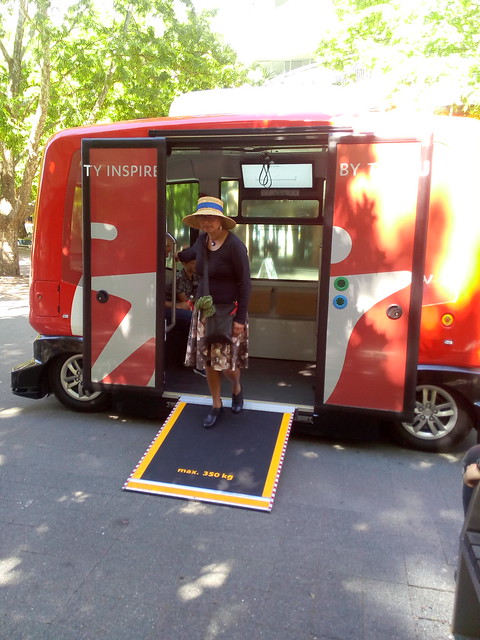
EZ.10 driverless electric shuttle bus from company Easy Mile, on demonstration run in Canberra's city center. Marghanita da Cruz steps out of the bus. The wheelchair ramp has been deployed, as part of a demonstration. This would not normally be used for ambulatory passengers.
Easy Mile EZ.10 Shuttle
Yesterday I went for a short ride on an EZ.10 driver-less electric shuttle bus from company Easy Mile, on demonstration run in Canberra's city center.  The bus traveled a few hundred meters through Canberra' central mall.  While it has a maximum speed of 40 kph, this was done at walking pace, as it weaved in between the street furniture.

The vehicle hold six people sitting in two rows facing each other and with room for another six to stand (or a wheelchair). There are very wide doors making entry easy. The vehicle is higher than it is wide and looks more like a cross between a lift and a golf buggy than a bus.

The ability of the vehicle to find its way between the obstacles in the mall was impressive, with a smaller turning circle than even a mini-van. Also it was able to deal with pedestrians who strayed into its path. When the vehicle's sensors detected a person it would first ring a bell (like that of an old fashioned street car), then slow down and, if the person was not out of the way, stop. No one seemed perturbed or frightened by the vehicle slowing making its way along.

There is also a  wheelchair ramp which can be deployed by the press of a button (the vehicle also kneels to make entry easier).

This would appear a practical form of transport around a university campus (the Australian National Universality could do with a half dozen such vehicles),  or a city center. It would be a useful way to get people to and from light rail and other more conventional forms of public transport.

Tomcar Military Electric Vehicle
While the EZ.10 is imported, this is an industry which Australia could enter. There are already Australian companies making small electric vehicles for farms, factories and the military. Our universities and high-tech companies have the expertise to design the software for the sensors to operate the vehicle.

The EZ.10 shuttle is on an  Australian tour it will be in Canberra today (Sunday) until 12 Noon and 1pm to 3pm, then Cairns from 4 to 8 December and Mooloolaba from 14 to 16 December.

Wednesday, August 27, 2014

Vancouver from the 17th Floor

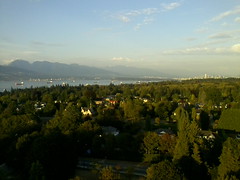
It is my last day in Vancouver, after a week conferring on computer education. My trip was to attend the 2014 IEEE International Conference on Computer Science and Education (ICCSE 2014). The conference was at the University of British Colombia (UBC) on a peninsular, next to Vancouver city. From my room on the 17th floor of the Walter Gage Student Residence, there is a magnificent view of forests below, ships on the water, the city skyscrapers and mountains in the distance. Most important for a university is good coffee and I found the Great Dane Coffee just around behind the Walter Gage.

UBC Malls


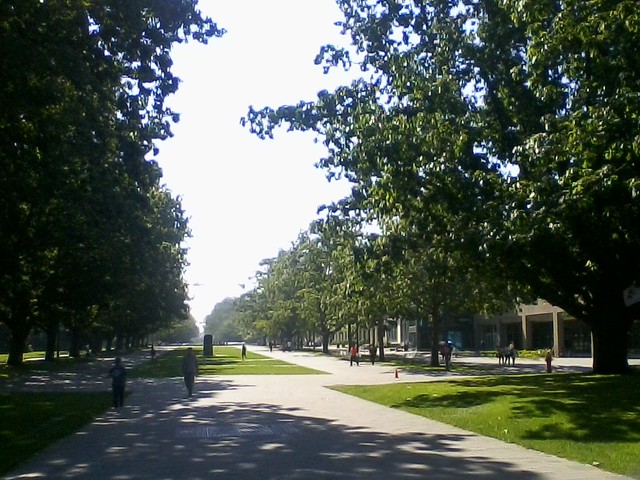
The UBC campus is very large with tree lined pedestrian  "Malls". The buildings on the malls have mostly been kept to four to six floors, to match the height of the trees. So while these buildings are large close up, they do not dominate when looking down a Mall.

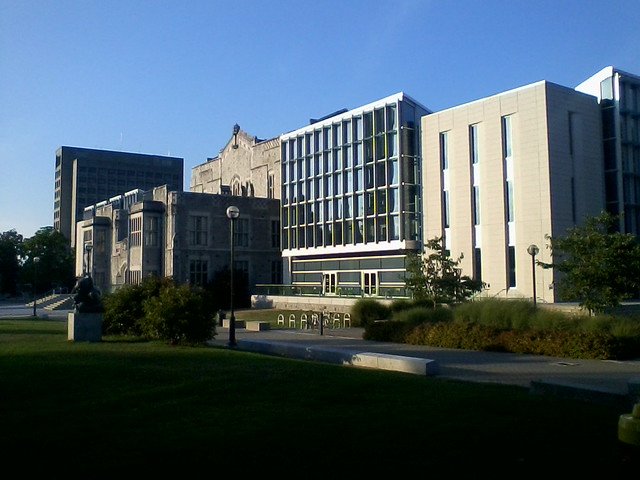
There is an attempt to blend the new glass walled buildings into the old granite ones, by using granite bases and muted sandstone and grey colouring on the new ones. A good example is the Irving K Barber Learning Centre, which has been wrapped around the sides and back of an old granite one..

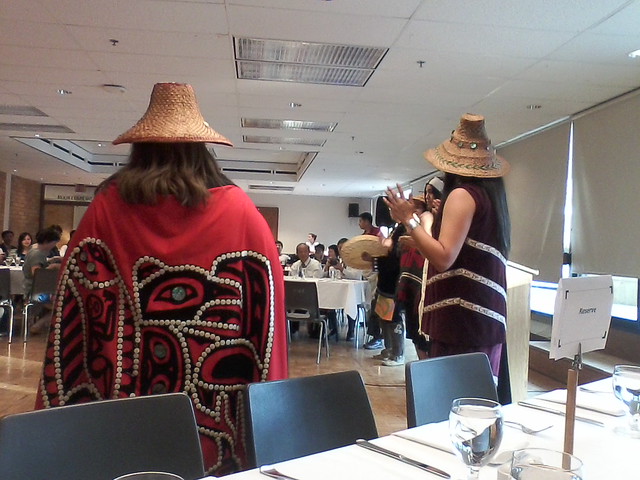
Indigenous Welcome at ICCSE 2014The ICCSE 2014 conference dinner featured a welcome from local indigenous performers. This had a fun bit of audience participation, with the delegates loosening up a little after getting up to dance as animal spirits (last year we had Sri Lanka Drummers).


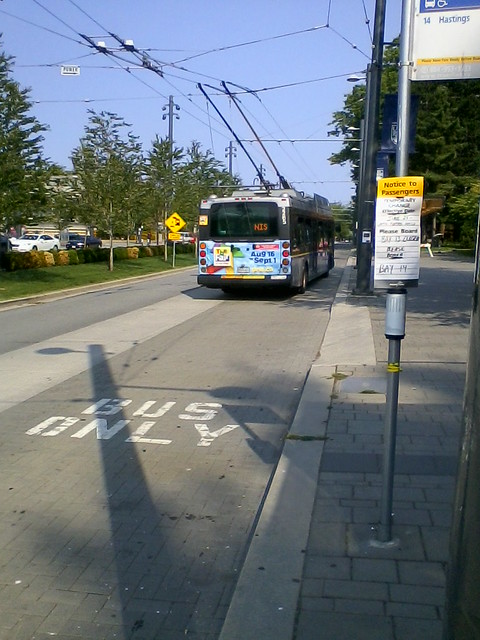
UBC has two bus stations, one of which is serviced by electric trolley buses.This is something the city of Canberra might consider, in preference to trams. It is about a 30 minute ride to down-town Vancouver. I took a ride from UBC to the SFU Vancouver campus. The BC FareSaver Tickets allow you to get on and off buses and trains for 90 minutes. So I stopped off along the way to the city to shop at the Salivation Army Thrift Store (2714 West Broadway) and picked a pair of near new Italian shoes for $20.

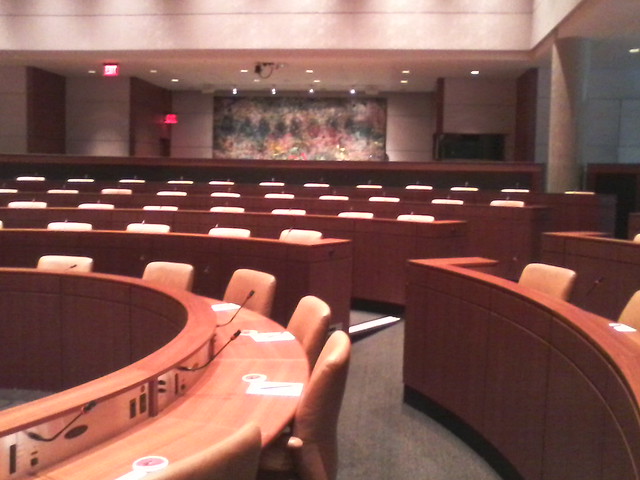
Asia Pacific Hall at the SFU Morris J. Wosk Centre for DialogueThe bus stopped outside SFU's Vancouver campus, near the waterfront. Across the road is the SFU Morris J. Wosk Centre for Dialogue. The guard was kind enough to open up the Asia Pacific Hall for me to have a look at this impressive room. This is a circular parliamentary style chamber, with stepped seating. It is intended to facilitate discussion, rather than adversarial debate.

Monday, December 23, 2013

Sydney Double-Decker Express Commuter Bus

In June, Sydney's private Hillsbus company introduced five Double-Decker buses for the M61 "Metro-bus" express route from the city to Castle Hill, in the North West. The M61 service operates every 10 minutes in peak time, 15 minutes off-peak and 20 minutes on weekends (there is an M61 Castle Hill to City Timetable, but it is 70 pages long). The double deck buses are only used for the morning and afternoon peak services (see times appended). These services take the "MyBus" tickets accepted on Sydney's government buses, as well as cash fares.

As described in the brochure, the buses have 92 seats and look huge from the outside but a little cramped on the inside. The stairway on the right behind the driver takes up a lot of room, making it hard to get past. But the stairs are wide (for a bus) and well lighted (with luminous treads). Upstairs is a little roomier but with a low ceiling (one passenger hit their had on the LCD display screen at the front, which fortunately was padded.

There are two double bench seats upstairs at the front with a very large window in front. The view is excellent, but leg room cramped in the front row. Also it can be a little unnerving watching trees, bridges and traffic lights rushing towards you (some trees in George Street did seem to be scraping on the bus roof). Those without a head for heights, or long legs, might choose the second row of seats.

The bus has a much more compliant ride that the regular single deck Hills buses. The double deck buses seem to float over bumps, rather than crashing. However, high up this can induce a slight feeling of seasickness (some magnetorheological dampers might help).

Next to the bus stop at Castle Hill is the information office for the North West Rail Link. Work on the Castle Hill station is under-way across the road, but given the stop-start nature of previous Sydney metro projects, it is difficult to believe this will be built. In contrast the Metro-buses and transit lanes along the main roads are cost effective and tangible parts of a a transport system.

While at Castle Hill, I visited the excellent Castle Hill Library, which has a cafe where you can browse the magazines and newspapers. The easiest way to get to the library from the bus stop is to walk along Castle Street and under the enormous Castle Towers Shopping Centre (there seems to be no pedestrian exit to the centre on the library side).

M61 Double-Decker Times

The bus operator CDC advised that the Double-Decker buses usually run on these services:
WEEKDAYS: The weekday timetables are run during peak hours only as follows:
CASTLE HILL: AM 06.50, 07.00, 07.50, 08.00, PM 16.01, 16.11, 16.51, 17.01, 17.11
RAILWAY SQUARE: AM 08.18, 08.28, 09.02, 09.17, 09.32 PM 17.15, 17.25, 8.05, 18.15, 18.25
WEEKENDS: The weekend timetable is a little more frequent as follows:
CASTLE HILL: AM 07.30, 07.50, 08.10, 08.30, 08.50, 09.50, 10.10, 10.30, 10.50, 11.10, PM 12.50, 13.01, 13.30, 13.50, 14.30, 16.30
RAILWAY SQUARE: AM 08.40, 09.00, 09.20, 09.40, 10.00, 11.40, PM 12.00, 12.20, 13.20, 14.20, 15.00, 17.40

Sunday, February 03, 2013

ANU Bus Road

new bus road beside ANU-Lena Karmel Lodge (UniLodge) at the City-West/ANU Exchange development next to the Australian National University campus in Canberra
The new bus road "Rimmer Street", beside ANU Lena Karmel Lodge (UniLodge) at the City-West/ANU Exchange development next to the Australian National University campus in Canberra is complete. However, the traffic lights on Barry Drive to allow buses access have not yet been installed, leaving this new road deserted. The road has the ANU Commons Function Centre,the cafe for the student lodge and a row of shops and should be a lively place, as soon as the road opens and buss-loads of students arrive.

Monday, June 11, 2012

Journey Through Sydney Culture on the 370 Bus

The Sydney 370 bus provides a slice of Sydney life. From Sydney's little Italy in Leichhardt, through the student culture of Glebe and Newtown, the University of Sydney and University of NSW, to Coogee Beach. Some stops along the way:
  1. Hunter Baillie Church, for the annual spring festival of music
  2. Fish & Co, fish restaurant, 41 Booth Street, Annandale.
  3. Glebebooks two bookstores in Glebe Point Road are worth a visit: Glebe Books second hand store at 191 Glebe Point Road and Glebe Books new book talks at 49 Glebe Point Road.
  4. University of Sydney
  5. New Theatre, 542 King Street Newtown
  6. Sydney Park, Southern End of King Street
  7. University of NSW
For other Sydney trips, try the Sydney MetroBus and to get somewhere in particular, use the NSW Trip Planner.

Sunday, January 01, 2012

Fireworks Over Sydney Harbor New Years Eve 2011

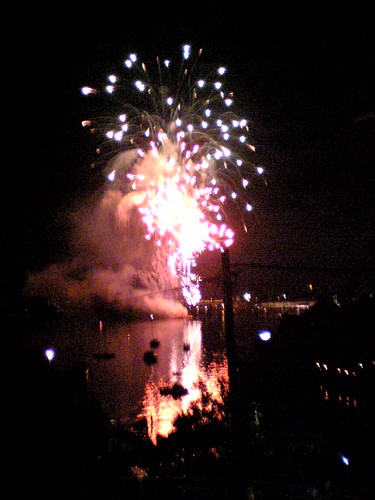
You can't beat Sydney for a New Year's Eve experience. But getting to the harbor on the busiest night of the year can be difficult. I bought a MyMulti Day Pass, good until noon the next day on buses, trains, ferries and light rail. This is useful, as while getting on and off transport on new year's eve is not too bad in Sydney, queuing up to but a ticket can take a very long time. The pass works in the automatic turnstiles of the trains and ferries and on the bus ticket machines. On the light rail (tram) you show the conductor, who hands you a paper ticket (the private operator's system has not been linked to the state transport system yet). At really busy times, you can walk through the train and ticket barriers waving the ticket to the ticket collector.

On this trip I started in Sydney's Inner Weest and started with a STA 470 bus to the Lilyfield tram ( Sydney Light Rail) station. The station is under the highway on an abandoned goods line, complete with rusty sheds and disused tunnels. Joined a happy crowd carrying picnic rugs on the tram. Alighting at the Pyrmont Bay station, I was stopped from crossing the Pyrmont Bridge, at Darling Harbor, as I was carrying a bottle of Veuve Clicquot Champagne. Explaining to the security guards that I did not want to drink it on the bridge, I was escorted ten meters into the secure area so I could get to the Sydney Monorail Station, where I found that my ticket could not be used, turned around and was escorted back out of the security zone. To get to the city it was a matter of getting back on the Sydney Light Rail.

Exiting the tram at Capitol Square it would normally be a simple matter to catch any of the buses up George Street. But George Street was barracaded by police near Town Hall, so I joined a crowd of thousands walking up the road, watched over by mounted police on horseback. Sydney Town Hall Station had most entries blocked off (presumably to prevent revelers from falling down the subway stairs later in the evening. A friendly policeman showed me to open entry (outside Woolworths). AT this point I realized it would have been simpler to stay on the tram and get off at Sydney Central Station.

The first train to come along was full to capacity, but the next tree minutes later had some seats. The view of Sydney harbour from the train as it crosses the Sydney Harbour Bridge is worth the fare. On NYE the harbor is crowded with ships and all the foreshore is covered with people.

Wollstonecraft railway station turned out to have a view of the 9pm fireworks (as well as Sydney Harbor and the bridge, there are fireworks on many of the inlets, so fireworks could be seen over about 180 degrees. A path leads north from the southern platform of the station into Smoothey Park. over a very high footbridge over the ravine to St Giles Avenue. From here it is a 2 km walk to Greenwitch Point. Normally this would be a simple ferry ride from Sydney Circular Quay ferry wharf, but the ferries stop running in the early evening on NYE to allow for fireworks in the harbor. The ferry started again at 1:30pm making for a comfortable ridge back to the city. One thing to keep in mind that you do not necessarily catch the ferry in the direction you wish to go. In this case the ferry was traveling from the city and did not pick up passengers on the return leg. So it was necessary to get on the outward leg, to get back.

LinkLinkSydney was still alive in the early hours of the morning. The sensible people had windproof jackets and flat comfortable shoes. It was a long walk from the ferry terminal to the temporary bus stops around the CBD (necessary as the main roads were still closed in the center for party revelers).

Next time I might try to get a room at the YHA Rocks, which has a rooftop terrace, next to the Sydney Harbor Bridge, overlooking the Opera House..
Link Link

Monday, November 21, 2011

MyBus2.0 App for Canberra public transport

The MyBus2.0 App for Canberra public transport timetables is available now. It was created by Australian National University student, Zakaria Bouguettaya, and won the ‘Unleash Your App’ competition.
This is an application for the ACTION bus service in Canberra, that provides a schedule, and allows people to find a closest bus stop to their current location, or to a chosen point, and tells them what time the next bus comes.

The data now contains 100% of all the bus routes listed on the ACTION website! View all the timetables from the comfort of your phone without a need for an internet connection or computer!

Thanks to your support and efforts the government has released the GPS data for bus stops! We hope to be able to use this data in news ways in a near future update. ...

Thursday, August 04, 2011

Real Time Passenger Information System for Canberra Buses

The ACT Government has invited comment on a Real Time Passenger Information System (RTPIS) for Canberra's ACTION buses. The commuter survey closes 26 August 2011. Unfortunately the link to the survey form is missing from the Community Engagement page about the project.

The survey
canvasses options of web, mobile and SMS bus information, as well as screens at stations, major bus stops and shopping centers.

My preference would be for ACTION to make their web site compatible with mobile devices, rather than build a new mobile "app". They also need to ensure this meets accessibility standards for the disabled, as required by Australian law.

In addition screen should be placed at major stops, showing when busies depart. Obviously the same information should be provided free open access nonlinear via a standard interface to Google and anyone else who wants to use it.

Monday, August 01, 2011

Hybrid Sydney Bus

I photographed a hybrid bus on trial by the NSW State Transit Authority on the 370 route in Annandale, in the Sydney inner west. A media release described this as being a deseil electric hybrid which can run on battery power alone. But another option is a mild hybrid, running on natural gas, with battery power as a supplement.
"The hybrid bus will run on a small diesel generator, which either charges the buses’ electric battery or provides power directly to the electric motor if the battery is full. The motor, not the generator will drive the bus".

From: Hybrid Bus to Commence Trial in Sydney, Media Release, Carmel Tebbutt MP,

Monday, December 20, 2010

Sydney Metrobus Christmas Decorations

Sydney m10 Metrobus Sydney with Christmas decorationsTravelling from Sydney Town hall this afternoon I noticed that the M10 Metrobus had been decorated for Christmas. Front of the bus had tinsel and imitation ivy, looking like a bus in India. The sides had more tinsel. But this did not really prepare me for the inside with with most of the ceiling covered in ivy, tinsel along each window and bows on the hanging straps. The windows had stained glass-like stickers and wall pots planted with ivy and mistletoe. The window sill opposite the back door had a row of candles in silver holders. The concertina of the articulated bus was decorated with more tinsel (which simmered as the bus moved). Top top this all off the air conditioning outlet in the ceiling was covered with a grid of shiny spinning propellers.

A sign on the bus said this was the work of the Leichardt depot staff. They perhaps let there enthusiasm get away from themselves. he decorations are well done, carefully secured and worked around emergency signs and surveillance cameras. But the weight of decoration made the bus cave like and closed in, even on a bright sunny day. Something simple might be good. The STA could institutionalise this with some stick on sheets of decorations, using the same technology as bus advertising signs.

The m10 buses are also providing free WiFi during a six month trial from 15 December 2010. Sessions can last for 45 minutes or 30MB of data use.

Tuesday, November 16, 2010

Bus rapid transit for Australian cities

After a tour of the New Belconnen Bus Stations in Canberra I was reading the Wikipedia entry on "Bus rapid transit". The idea is simple: use buses for a rapid transit system, by providing stations, and dedicated roadways where possible. This is cheaper and easier than putting in rail lines and is almost as efficient.

One limitation is running buses in tunnels. Unless complex and expensive hybrid or electric buses are used, the there will be emissions from the bus engine, requiring ventilation. But it occurred to me that newer buses will have less emissions and so will require less ventilation in tunnels (I edited the Wikipedia entry to point this out).

Another point is that road tunnels are designed mostly for cars, which will emit much more pollution than buses, per person carried. Also engineers designing the tunnels have to assume that the cars are old and not well serviced and so will be emitting more pollution than the latest regulations allow. In contrast a tunnel just for buses can be designed specifically for the latest emission standard and the bus fleet monitored to check they meet the standard. So less ventilation will be required, and for short tunnels, not mechanical ventilation at all.

Sunday, November 14, 2010

New Belconnen Bus Stations in Canberra

Platform 4 of the Belconnen Community Bus Station, looking west. The white lattice steel pedistrian bridge which repalced a previous concrete one, when the Belconnen Bus Interchange was demolished, is visible.The Westfield Bus Station and Belconnen Community Bus Station come into operation at the Belconnen Town Centre in Canberra on Monday 15 November 2011. During the Belconnen Community Festival, yesterday, an Action bus was providing free tours of the new stops, so I took the tour.

The Westfield Bus Station is built on the western side of the newly expanded Westfield Belconnen building (aka "Belconnen Mall"), with a convenient door to the shops. The station will have an ACTION information office and cafe (both yet to be fitted out). The bus stops appear to be at ground level, but are built up over what was previously a cutting (presumably there are shops and/or car parking beneath). The shops in the new section of the mall have not yet opened, with access provided to the old section. Even so this should be a convenient way to access the western end of the mall.

The Belconnen Community Bus Station is built on the site of the demolished (and not missed) Belconnen Bus Interchange. The previous interchange was built like a railway station, with one long island platform down the middle and bus bays on either side. There were pedestrian bridges for access from either end. While in theory this made the interchange safe and convenient for passengers, it meant a long walk if you wanted to get to the community centre right next to the interchange (you had to walk to the end of the platform, over the bridge and then back up the hill). The new interchange has the buses in the middle and platforms on either side. This requires some passengers to cross the road (traffic lights are provided) but the platforms are at ground level and accessible from several points on either side. One issue will be that with many buses using the station, it may be inconvenient for pedestrians to cross the road. A fence has been built to discourage those wishing to cross at other then at the lights, but the fence would not appear to meet pool fence standard AS1926.1 2007 and the average teenager is likely to be able to vault over it.

Canberra ACTION Bus MyWay contact-less smart card ticket readerCanberra ACTION Bus MyWay contact-less smart card ticket machineThe MyWay contact-less smart card ticketing system was installed on the bus used for the tour ( but the tour was free). The new ticket system is being fitted to all busses, with the old magnetic stripe reader ticket machines relocated to make room (the old units look a little battered compared to the new equipment).

When the new MyWay system will be in use is unclear. In July the ACT Chief Minister, Jon Stanhope, announced this was due to commence in the second half of 2010, but ACTION are now advising "early 2011". Such smart card systems have had problems in Melbourne, Sydney and Brisbane. But Canberra is using the more successful system used in Perth ("SmartRider"). The hardware used appears to be the Parkeon Wayfarer 200 Electronic Ticket Machine and Parkeon Astreo Contactless Smart Card Validator. The Canberra system should be easier to implement, as there are no trams, ferries or trains to use the system, just buses.

Sunday, May 16, 2010

Canberra Bus Smart Card Ticket System

Contact-less card readers have stared to be installed on Canberra buses, for the "MyWay" smart card system, to be commenced this year. The system was announced by the ACT Chief Minister, Jon Stanhope, last year ("Smart start to new ACTION ticketing system"). The Canberra "ACTION" bus fleet is small and a flat fare structure is being retained, making this a relatively simple installation. So it is likely the problems which have plagued the Sydney and Melbourne smart ticket systems can be avoided.

One potential problem is that passengers will be required to "tag-off" the buses: that is swipe the card at the end of the journey as well as at the begining. As the fare is not distance or time based, there is no need for the passenger to swipe when they get off to calculate the fare. Presumably this is for the convenience of the bus operator to measure patronage. It will be interesting to see how may people actually do this and what problems it causes. The Victorian Government has had to abandon "tag-off" for short tram journeys due to the congestion problems it caused.

Chief Minister and Minister for Territory and Municipal Services, Jon Stanhope, today announced Downer EDI Engineering Power Pty Ltd would install ACTION's new $8 million smartcard ticketing system.

Mr Stanhope said the contract was awarded after an exhaustive tender and evaluation process which confirmed Downer EDI represented the best value system for Canberra' s bus service.

The new ticketing system, due to commence in the second half of 2010, is modelled on Perth's successful SmartRider system, which was also implemented by Downer EDI.

"Canberrans can look forward to a new ticketing system that is fast, easy and flexible," Mr Stanhope said. "It will offer bus users a reusable and rechargeable card for travel on all ACTION buses.

"Bus users will be able to recharge their smartcard over the internet, phone or at other card facilities across the ACT. A one-use ticket will also be available for casual users and tourists.

"Bus users will be required to tag-on and tag-off buses, which will significantly improve ACTION's capacity to monitor passenger trends and make adjustments to meet changes in demand.

"The new smart card system is an important part of the ACT Government's investment in developing a more efficient and user-friendly bus network.

"I look forward to working with Downer Engineering as we roll-out the smartcard ticketing system across the ACTION network," Mr Stanhope said.

The smartcard uses a microchip that is picked up by a reader without taking it out of a wallet or purse.

The new ticketing system will retain the current flat fares structure. ...

From: Smart start to new ACTION ticketing system, ACT Gvernment, 08/07/2009

Monday, May 10, 2010

Canberra Buses to Get Real-time Information

The ACT Budget includes $12.5M for a real-time passenger information system, using GPS to provide bus arrival information. This is long overdue and will greatly improve the service by allowing the public to plan to arrive at the bus stop when the bus is actually due.

Currently Canberra's ACTION bus service does not know where its buses are most of the time. I was shocked to discover this a few months ago. The bus I was waiting for did not arrive, so I called the enquiry number on the bus stop. I was told that the bus had not reported a problem by radio so ACTION did not know where it was. I was also told that ACTION did not contact delayed buses by radio for safety reasons. I had assumed the busses would be tracked in real time, or at least drivers would routinely call in if they were delayed.

What was most worrying was that the person at ACTION I was talking to did not seem at all perturbed that one of the buses was missing. If an aircraft holding dozens of people went missing for more than a few minutes there would be an emergency declared. However, a bus on a route which goes with a few metres of Parliament House and the Prime Minister's residence can be missing for an hour without any alarm raised.

Monday, November 02, 2009

Victorian Hybrid Buses

The Victorian Government is sponsoring a trial of two hybrid buses. As the video from the Victorian Transport Department explains, two types of hybrid bus are being trialled: the serial hybrid is more suited to slow routes with many stops, the parallel to longer routes with higher speed.

The series hybrid vehicle is for Ventura Coaches, with the wheels driven only by electric motors. It is claimed to reduce fuel use by 40%. There are 640 lithium ion batteries charged from a 2-litre diesel Volkswagen car engine. The internal combustion engine is much smaller than that normally used in a bus. As this is a full hybrid, the bus could, in theory act as a plug-in hybrid, or pure electric bus, charged from mains power. However, as Victorian electricity is primarily sourced from highly polluting brown coal, this would not have environmental benefits.

The Grendas Bus Service vehicle is a parallel hybrid (similar to a most hybrid cars), built from an Australian made Iveco bus chassis, Volgren Low Floor Route bus body and Cummins diesel Allison hybrid gearbox. This is used as a "Smart Bus" on the Springvale Road 888/889 route.

One aspect of the hybrid buses which is not clear is their fuel source. If the hybrid buses run on diesel they may have little environmental or cost advantages over conventional natural gas powered vehicles.

Saturday, October 03, 2009

Paddington Reservoir Gardens

Paddington Reservoir GardensThe Paddington Reservoir Gardens were opened in Sydney 29 March 2009. This is a sunken garden in what was an 1880's underground water reservoir, across the road from the Paddington Town Hal. I thought I would plan a day out in Sydney to visit the gardens (and compare it with Istanbul). As it is Saturday there are the Paddington Markets from 10am. Also the City of Sydney Library at Customs House there is "Remodelling Architecture: Architectural Places - Digital Spaces" with digital design work by young architects. Then a visit to Sydney's Paddy's Markets for some fresh produce would be good.

To get around to all those, I have planned the journey using the excellent, but badly named Transport Info 131500. This provides public transport information for Greater Sydney (with Newcastle, Central Coast, Wollongong and the Illawarra). With this you put in the landmark or locations you want to from and to and the service plots a route by bus, train and freey, taking into account how long it takes to walk between stops.

In this case I am starting from the Annandale Post Office and going to Custom House Square Sydney after 10:30am. The system recommends:

Option 1 : 37 minutes

Mode Details
Map this walk Walk to bus stop Annandale, Booth St Nr Johnston St - 96 metres
Map this bus trip Take the 470 bus*1 (Sydney Buses)
Dep: 10:36am Annandale, Booth St Nr Johnston St
Arr: 11:03am Sydney, Bridge St Nr Loftus St

Map this walk Walk to Custom House Square Sydney - 224 metres

Notes

1 Wheelchair Accessible
Not all landmarks are in the system. As an example "Paddington Reservoir Gardens" is not. But "Paddington Town Hall" is:

From: Custom House Square Sydney

To: Paddington Town Hall

When: Saturday, 3 October 2009

Leave after: 12:00pm...

Option 1 : 31 minutes

Mode Details
Map this walk Walk to bus stop Sydney, Phillip St Nr Bridge St - 312 metres
Map this bus trip Take the 333 bus*1 (Sydney Buses)
Dep: 12:14pm Sydney, Phillip St Nr Bridge St
Arr: 12:32pm Paddington, Oxford St Nr Ormond St

Map this walk Walk to Paddington Town Hall - 128 metres

Notes

1 Wheelchair Accessible ...

You can slow the walking speed, if set to "high" the system tends to suggest trips with 900 m or more of walking between stops. There is also an option to minimise the walking and for wheelchair accessible services.

The maps are lacking in detail compared to those from systems such as Google Maps, but do show the essentials. The service could benifit from having a simplived version for mobile devices.

Thursday, June 19, 2008

Long Distance Turkish Bus

The International Istanbul Bus Station (Uluslararsi Istanbul Otogan) is a wonder of the modern world. This is a three story circular structure which can cater for thousands of passengers and hundreds of buses at once. The buses are serviced on the lower levels, with workshops and stores selling bus spare parts and accessories. The higher level has stores, barbers and cafes servicing the drivers and passengers. The top level has shops the bus company offices, waiting rooms and bays for buses.

I went looking for a cyber cafe while waiting for a bus and descended one level down, into something resembling a scene from the movie Blade Runner. The dimly lit concrete corridors had all sorts of shops, bus parts and people sitting around drinking and eating. There was the risk of turning a corner and being in the path of an oncoming bus, or tripping over a pile of spare parts in the dark.

The cybercafe turned out to be on the open top level, directly opposite where I started. For two Turkish lire, I was able to check my mail in comfort and quickly download a week's worth of MP3.

The Turkish long distance buses are large, comfortable and smoke free. As well as the driver, there is an attendant who checks tickets and serves free drinks and snacks. There was no toilet on the Metro bus I traveled on, but it stopped every few hours at a bus station, equipped with toilets and cafes. The first time the bus stopped I was worried that it would leave without me. But I worked out that at major stops the bus was washed, in a ritual similar to the washing of an elephant, and I had until this was finished.

One surprise was at some point in the night the bus stopped at the water's edge; a car ferry arrived and the bus was transported across a large body of water. I still have no idea of what or where this was.