 |
| Amanda Cattermole, CEO of the Australian Digital Health Agency |
Showing posts with label COVID19. Show all posts
Showing posts with label COVID19. Show all posts
Tuesday, October 25, 2022
Where are my digital health records?

Saturday, March 19, 2022
Virtual Hospital Provides Real Help With COVID-19
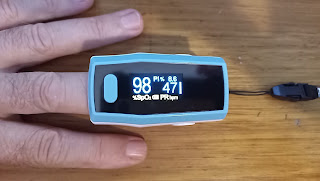 |
| Oximeter on my finger. |
In response to the form, I got a text message telling me to self isolate for 7 days, or longer if not well. It also said "To help you get the care you need, please complete this questionnaire". However, by then I felt fine, did not think I needed care, and so did not fill the form in.
Some time later I got a call from "RPA Virtual Hospital". At fist I thought this was a scam, as most unsolicited calls are. But the caller said I had been referred to them by NSW Health. They seemed a little confused as to why they did not have me on file (no reason why they should). They asked about if I was vaccinated, which seemed odd, as they should have access to my vaccination, and medical records online. They also seemed surprised I felt so well. They asked if I needed groceries or medicines. I didn't, as I had been keeping two weeks supply on hand since the start of the pandemic for just such a situation+. They asked about existing health conditions and decided to send me a Oxiometer. Most usefully they explained that I did not need a COVID-19 test to leave isolation after a week (if well).
The Oxiometer was delivered the next day and is a clever little gadget*. This indicated my oxygen level was fine, and it was a relief to leave isolation.
The PRA Virtual is an excellent service. It could be improved by having an easier to find web page. This would help reassure patients it is not a scam. Some sort of app where you enter your pulse & Oxygen reading regularly might be useful, not so much for the readings, but to reassure the hospital the patient is coping. NSW Health might want to amend their instructions to say the questionnaire should be filled in even if you are feeling well.
Also it might be good if the government system, or the hospital, was to contact the patient at the end of the isolation period, to confirm it was now okay to leave isolation.
Monday, March 07, 2022
Hough COVID-19 Home Test With Flat Battery
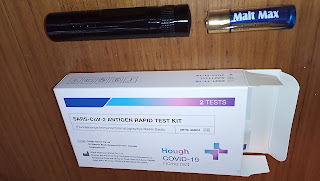
The battery supplied is branded "Malt Max" and has the date 11-2026 printed on it. While AA batteries are readily available, it could cause difficulties in remote areas, and in disaster recovery areas. I suggest it would be prudent to provide a spare AA battery and battery test instructions with the kits. The kit has a manufacturing date of 2021-11-15, Lot SA211111 Use by date 2022-11-12 and bar-code 8 60006 49853 5.
I have reported the problem to the Australian Therapeutic Goods Administration, as well as letting Hough Pharma, and the supermarket know.
Friday, October 15, 2021
Digital COVID-19 Vaccination Certificate Online Proved Impossible

The recorded message at the start was curious, warning that threats would not be tolerated. That seemed an odd way to treat customers, with a greeting threatening them. But after one hour on hold, I can see how a caller could be irate by the time they get to an operator. As it was, after an hour I gave up.
I would be happy to deal with this matter some other way, but no other option is offered: it is by phone, or nothing. I suggest the system needs to be fixed to overcome this obvious fault.
Saturday, August 28, 2021
Australia Needs Self-serve Quarantine Centers
Purpose built Quarantine Centers are being constructed in Australia. I suggest that these be, in the main, low tech, self serve facilities. This will increase the speed with which they can be built, lower the cost of construction and operation, provide lower risk of disease transmission, and be better for the welfare of the guests.
The Building 4.0 Cooperative Research Centre, has submitted an unsolicited high tech "Q_Smart" design for the Victorian quarantine center. This has some good ideas, but is more high tech than needed, The designers have shown a multi-story design, suited to limited land next to airports, as well as single story ones, where space allows. The designers criticize the current "conventional bricks and mortar, or mining camp, approach". However, I suggest this is misplaced. Rapid construction is a priority, and the prefabricated techniques used for mining camps are appropriate. Also mining camp accommodation must be robust, as it is intensively used, by a rapid turnover of guests, which also applies in a quarantine center.
The use of high technology solutions is not a good approach for a quarantine center which is to be constructed rapidly and have only a limited lifetime. As an example, the airlocks, and UV light sterilization suggested for Q_Smart are not be needed, if there is sufficient space and natural ventilation. Touch-less entry to buildings will also not be needed, if guests each have their own door to their accommodation. The guest will be the only one to touch their door during their stay, and it will be cleaned by staff when vacated.
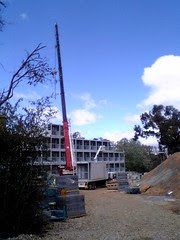 |
Laurus Wing of ANU Ursula Hall under construction. Photo by Tom Worthington CC BY 2009 |
The Q_Smart designers suggest stack-able building modules, built in a factory. This approach is already in use for buildings made in shipping container modules, such as ANU Ursula Hall (2009). However, this approach requires more expensive construction techniques, than if buildings are single story, and where a flatpack approach can be taken. I a multistory building is needed, then pre-cut structural panels, as applied at ANU Fenner Hall, can be used.
Also while stairs can be quickly built, lifts require complex installation and maintenance by specialists. If a multi-story building is required, it can be built with an external open air stairway, and no lifts, but with ground floor accommodation reserved for those with limited mobility, as is the case for City Edge Canberra.
The designers suggest delivery of good direct to rooms, via dumb waiters. However, simple manual and electric dumb waiters, essentially smalls goods elevators, can only travel vertically. There would need to be one such waiter for each building. With a shaft connecting every apartment, this would pose a major cross-contamination risk. A far safer, simpler approach would be to provide guests with enough supplies of sheets, towels, personal hygiene products, and non-perishable food, for the duration of their stay, so there would be no need for regular deliveries. For occasional deliveries a simple, safe, low tech approach would be to place the delivery outside the guest's door, and then invite them to open the door a few minutes later, after any aerosols have dispersed in the open air.
While Q_Smart suggests the use of the Internet of Things, with smart devices deployed around the center for monitoring of systems and the guests, I suggest relying on the guests own smart phones. Just as QR codes have proved a success for checking people into venues, these can be used, with the gusts own phones, for monitoring movement in the center. This requires only low cost QR code signs, not a computerized network requiring installation and maintenance.
Tuesday, August 17, 2021
Canberrans Queuing Around the Block for a COVID-19 Test
 |
| COVID-19 Testing Queue in Canberra, by Tom Worthington CC BY 17 August 2021 |
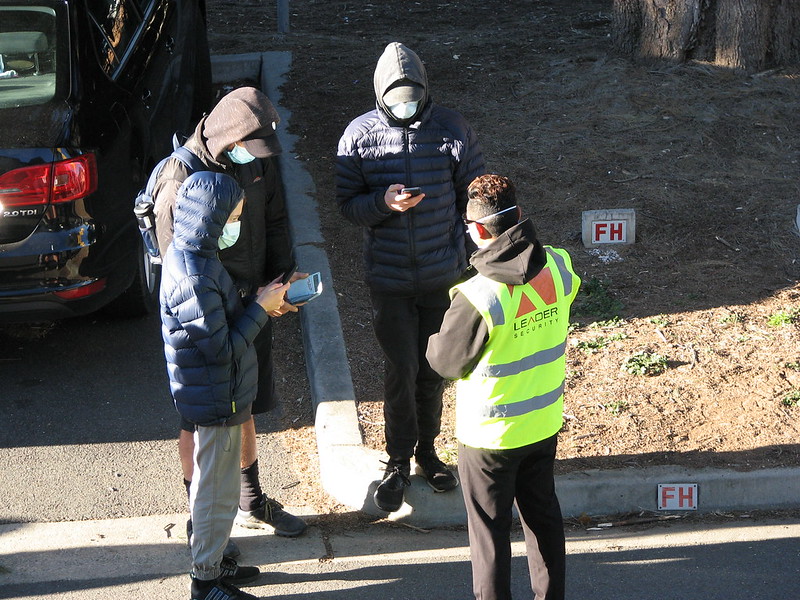 |
| COVID-19 Marshall at Testing Queue in Canberra, by Tom Worthington CC BY 17 August 2021 |
Monday, August 09, 2021
Vaccinated at Clinic on the Edge for Many Possible Futures
Today I had my second AstraZeneca COVID-19 vaccination at the Casey Medical Center in Canberra. I arrived five minutes early and was immediately ushered in for my shot, so that even with the 15 minute period after I was out the door by my original booking time. This was a fast and efficient process.
It is also possible the Australian Defence Force may be needed in its primary role and so personnel would not be available to aid the civil infrastructure. Also some civilian medical personnel and other specialists are military reserve personnel who would be called to duty, so not available for for pandemic duties.

To to get to this suburb on the north western edge of Canberra, I had to drive past a major public vaccination center which is much closer to home. Unfortunately when I went to book 12 weeks ago for my first jab the federal and ACT web systems were not working well. As a result I booked at a private clinic, as that was the only place I could get the booking system to work for. As it was sop difficult to get an appointment, I decide not to change my booking for the second dose, which as made 12 weeks ago at the same time as the first (to make it simple I booked both the same day of the week at the same time).
The suburb of Casey reminds me of the dystopian future depicted in the "Nosedive" episode of the Black Mirror science fiction TV series: rows of neat houses, all built at the same time from the same materials, in the same muted colors. The Casey Medical Center is made of corrugated steel panels and looks like a temporary building quickly erected for a pandemic emergency (or something prefabricated for Antarctica, or Mars). But it is comfortable enough inside.
We have had it easy so far, so get vaccinated now, in case things get worse, a lot worse
For those hesitating about vaccination, please consult your doctor, and if they okay it, go ahead ASAP. Australia has been able to use measures to control the virus under relatively benign national and international conditions, but that may not continue. Natural disasters may require medical and emergency staff currently handling the pandemic to be instead saving lives in floods or fires. Rescue and recovery will then take priority, with hospital beds not available for COVID-19 patients.
It is also possible the Australian Defence Force may be needed in its primary role and so personnel would not be available to aid the civil infrastructure. Also some civilian medical personnel and other specialists are military reserve personnel who would be called to duty, so not available for for pandemic duties.
In addition, there could be cyber attacks on our infrastructure which directly limit medical and vaccination facilities. These could interrupt power supplies long enough for vaccine stocks to be destroyed and stop distribution and booking.
Also it is possible that information warfare could be used to undermine confidence in the authorities and ferment civil unrest. This could see fake information used to discredit officials and the community against each other. This would reduce vaccination rates, and may also case people to stop social distancing, spreading the virus and even attacking the infrastructure used to keep them safe.
One of Australia's major international customers may decide to limit purchases of Australian goods and services, limiting the nations's ability to pay for imports of essential medical supplies.
Any or all of these could happen without warning at any time. While these may sound far fetched, would you have believed a warning about a pandemic 19 months ago? In 2009 the assignment I set my web students at the Australian National University was to design a pandemic web site for Australia. Some of my colleagues thought this a little odd: when would those skills ever be needed?
Thursday, July 15, 2021
Provide Online Informed Consent for COVID-19 Vaccination
The ABS reports that only 73% of Australians would get a COVID-19 vaccination. Of the others, 52% were worried about side-effects and 15% effectiveness. In response, I suggest that Australia's National Cabinet approve the use of online informed consent using multimedia in multiple languages, to streamline COVID-19 vaccination, using any of the vaccines approved for use in Australia for any adult of any age.
The Australian Technical Advisory Group on Immunisation (ATAGI) has advised:
"... AstraZeneca vaccine can be used in adults aged under 60 years where the benefits clearly outweigh the risk for that individual and the person has made an informed decision based on an understanding of the risks and benefits".
And
"Noting the current constrained supply of the Pfizer vaccine, ATAGI also recommends adults under the age of 60 who do not have immediate access to the Pfizer vaccine should consider the benefits and risks of earlier protection through the AstraZeneca vaccine. "
However, that advice has been implemented in a way which makes it very difficult for anyone who does not have a GP with supplies of AstraZeneca, from being vaccinated.
The Australian Government provides a document "Weighing up the potential benefits against risk of harm from COVID-19 Vaccine AstraZeneca" to assist with informed consent. But, this is intended for doctors to help explain to patients. As a result those who don't have a GP to explain it to them cannot give informed consent and so cannot be vaccinated at mass vaccination center.
I suggest National Cabinet decide that a standard audio-visual package in multiple languages be prepared. This would be added to online booking systems, allowing any adult to give informed consent to an AstraZeneca vaccination online. Any adult should be able to walk into any vaccination center at the booked time, show ID and be vaccinated immediately, without the need to speak to anyone, or fill in any paperwork.
Individuals would still have to option to visit their doctor to discuss vaccination. However, I suggest our leaders now need to ask every Australian to accept that the risk, in the interests of their family and the community to get vaccinated now.
Saturday, July 03, 2021
Improved ACT Health COVID-19 Vaccination Booking System
To make an online booking at ACT Government COVID-19 vaccination clinics, clients are required to use the MyDHR system. Previously when I tried to register I found the process confusing and was not able to register. When I tried today, I found the process had improved and I was able to register, but it appears it is still not possible to use this system to book a vaccination online. This differs from private vaccinations clinics, where the patient is shown dates and times they can select from, online, as soon as they are registered in the system.
Medicare Number Format
A problem still exists with the way the patient has to enter the Medicare number on the ACT Government system. This differs from the format used by Federal Government and private providers. It will only be a problem the first time the patient registers with the system. For someone who will regularly attend a clinic for medical treatments, that is not a major problem. But for an emergency vaccination campaign, where each patient will attend only two or three times, difficulties in initially registering are more significant.
Registration
The ACT Government page on vaccinations has a link for patients to register. However, that link doesn't take the patient to the registration screen, but to the login screen. The patient is then asked for their user ID and password they have not yet been issued with, which is confusing. There is a link for registering, but patients are may be confused at this point and never see the link.
 |
| MyDHR One Time Security Code, ACT Health, 3 July 2021 |
Secure Username?
 |
| MyDHR Choose User name, ACT Health, 3 July 2021 |
MyDHR Main Screen
 | |
|
 |
| MyDHR Vaccine Eligibility, ACT Health, 3 July 2021 |
No Medical Records on System
The ACT Government system is intended to provide a comprehensive system for patients of ACT Health, not just vaccinations. So I looked to see what records were recorded. There was not record of my ever being a patient, although I had spent a night in the ICU and received numerous tests. It may be my treatment was too long ago to be worth loading into the new system, but patients will not feel reassured about receiving further treatment, if there is no record of their previous treatment.
Confusing Email
After registering, I received an email with the subject line "Please check your MyDHR account". However, the body of the message said "... you have new information in MyChart.". But what is MyChart? There was no signature block to indicate this message was from the ACT Government, and no contact details to reassure the patient this was a genuine message and help the patient seek further information (the message had a "no reply" address).
Wednesday, May 26, 2021
Help Provide Australian Oxygen Concentrators to COVID-19 Patients in India

Monday, May 17, 2021
Why Are the Federal & ACT COVID-19 Vaccination Booking Websites So Difficult to Use?
 |
| WHO Digital Vaccination Certificate |
Below I detail some changes, and why they are needed. Australia's vaccination rate is currently far below that needed to have everyone eligible offered at least one dose buy the end of the year. There are obvious flaws in the federal and ACT vaccination websites, including incorrect, and misleading formation. By making it harder for the public to get vaccinated, are placing lives, and the economy, at risk. It is suggested changing the government sites to make it easier for the bulk of the population to book a vaccination. It would also be useful to offer something tangible, such as a vaccination certificate, with a QR code.
Suggested Changes
1. Booking Link at Top of Page: Both federal and ACT governments should have a line at the top of their main COVID-19 web pages for booking:
- Fifty or over? Book your COVID-19 vaccination now: 50+ Book!
2. Show online booking sites first: The federal government page should display vaccination centers which have online booking first. Public high capacity clinics should be displayed first, followed by GP clinics, and GPs last.
3. Allow ACT residents to register online with ACT Health: The ACT Government should delete the map from their page until there are more ACT centers for the public to choose from. The Medicare number entry field on the MyDHR registration page should be changed to use the same format as federal government and private medical sites. The restriction that only existing patients can register should be lifted.
Finding Where to Get Vaccinated
A web search using Google for "covid19 vaccine booking", has as the first four responses:
- COVID-19 Vaccine Booking - Book An Appointment (Ad) https://www.health.gov.au/
- COVID-19 vaccinations - Available now in Canberra (Ad) https://www.nhc.coop/
- How will I get my COVID-19 vaccine? | Australian Government ...www.health.gov.au
- Booking your COVID-19 vaccination - COVID-19 - ACT Health www.covid19.act.gov.au
The first two of these are paid advertisements and the next two native responses. The first is to the federal health website, the next a private clinic in Canberra, then a different Federal Government page and lastly the ACT Government. That there are two different federal government pages resulting from the one search is confusing.
Federal Health Website
The first Federal Government page says "... book an appointment if you are eligible ...", but this is below the fold, below the first screen of information, in the middle of a sentence and thus very difficult to see.
 |
The priority in the design of this page appears to be to educate the public as to who is eligible, so as not to overload the system. With the decision to permit all over 50s to book, I suggest this is misplaced. The priority should be on getting people vaccinated and saying "book vaccination".
After three screens the federal system displays the nearest vaccination centers. Here they are for O'Connor, ACT:
 |
| Vaccination centers suggested for O'Connor ACT. |
The screen is headed with "Please use online appointments where available to reduce call volumes to clinics. If you can’t find an appointment or a clinic in your location, please check back in a week.". However, four of the five entries displays are for phone bookings only. Following the instructions given, the user would select the one and only clinic which takes online bookings.
The only entry which has a link for online booking is to the ACT Government clinic. However, this only accepts online booking from previous patents of ACT Heath (and I was unable to make a booking even though I had been a patient).
National Health Co-op
National Health Co-op is a non-government, not-for-profit health service. The web link leads to a vaccinations page, with two buttons, for "Covid 19" and "Flu Shot". This then shows the six locations where a shot can be booked. The details of how to registered and book are left until later.

National Health Co-op COVID-19 Booking details
This is a good design, the user gets to see where they could go, without having to enter a lot of personal details first. However, the information presented contradicts that on the Federal Health web site. The Federal site lists the Co-op's ANU clinic as available for phone bookings only. That clinic is not listed by the Co-op's website and all of those listed can be booked online. It appears the Federal government site is incorrect, listing a clinic which is not available and also not listing those which are.
Second Federal Government Web Page
The second federal government page to appear in the web search results is "How will I get my COVID-19 vaccine?". This has a link for "Book or register for COVID-19 vaccination", but below the fold, so the user has to scroll down to find it. This then links to the COVID-19 Vaccine Eligibility Checker, discussed above. Again the booking link is not prominent, and the page does not appear to be designed to have vaccination booking as a priority.
 |
| Federal how will I get my vaccine page. |
This is not a good design, as the link for booking a vaccination is not prominent.
ACT Health
The ACT Health Booking your COVID-19 vaccination page, has the link "How to book your COVID-19 vaccination" above the fold.

 |
| ACT clinics map |
However, only one of three of the clinics shown are for the general public. As a result showing a map is misleading, not useful. The one clinic shown requires online booking via the ACT Government booking system "MyDHR". This system requires entry of the Medicare number in a format different to that used by the federal government and private providers, and the number is not displayed as it is entered. Also online registration is only available to those who are already patients in the ACT health system (and in some chases even not then).
 |
| MyDHR Registration screen obscuring Medicare number. |
Previously I provided some "Suggested Improvements to ACT Health COVID-19 Vaccination Booking System". Unfortunately so far the ACT Government has not made the suggested improvements. The only response received is a Tweet (3:01 PM · May 14, 2021) from ACT Health:
"Hi, if you have any technical issues when using MyDHR, please call 02 5124 5000 (24 hours a day, 7 days a week). Please refer to our FAQ 'I'm having issues signing up to MyDHR' for other reasons you may be having issues"
While this doesn't address any of the issues, it at least indicates the suggestions have been received by the ACT Government.
Friday, May 07, 2021
Suggested Improvements to ACT Health COVID-19 Vaccination Booking System
To make an online booking at ACT Government COVID-19 vaccination clinics, clients are required to use the MyDHR system. However, the way the client enters their Medicare number is very confusing and only those who have already been clients of ACT Health can make a booking. I suggest the way the Medicare number is entered is made easier, in line with other online systems. Also I suggest the requirement that only existing clients can book be lifted.
The page with information on bookings has an explanation of how to enter the number. However, this is down on the page, below where the user is invited to click to make a booking. As a result it is likely most users will never see the instructions on entering the Medicare number, particularly when using a smart phone.
Medicare Number Problem
The ACT Government instructions on how to enter the Medicare number contradict those of the Federal government. The Federal government says:
"Enter your Medicare card number, followed by your Individual Reference Number"
But the ACT Government says:
"When filling out the Medicare number, please note the format needs to be XXXXXXXXXX-X where the last digit (IRN) is what appears next to your first name on your Medicare card".
Compounding the problem is that the MyHDR registration screen does not display the Medicare number as it is entered.
I suggest the Medicare number be displayed and be entered in two parts: the Medicare number itself, and the IRN.
 |
| MyDHR Registration screen obscuring Medicare number. |
Registration Problem
The MyDHR login page has a "Sign up for MyDHR" button. This then requested the client's name, date of birth and Medicare number.However, registration is not accepted from new clients. The person registering has to have already been to ACT Health. I suggest this be changed to accept registration for anyone with a Medicare card.
Credible, easy to use booking system needed
 |
| Talking on web for Pandemics |
To ensure as many are vaccinated, as quickly as possible, we need easy to use, functioning vaccination booking systems. I suggest the ACT Government make urgent changes to their system to ensure public safety.
Sunday, January 31, 2021
Live Your Life, But Take Precautions
Over Christmas, I left Canberra for a holiday in Queensland, but never got there. The Queensland boarders were closed due to COVID-19, so I stayed in Sydney. Then the Canberra boarder closed and I could not go home. But then, if you have to be stuck somewhere, Sydney is a nice place to be. ;-)
From Sydney, I could still work online, with the help of a mattress (my next webinar for Canada is 11am, Wednesday, all welcome). My doctor faxed scrips for essential medicines to a Sydney pharmacy (there is still a use for fax).
In Sydney, I decided to avoid indoor venues. It became a challenge to find somewhere to shop and be entertained without an enclosed air-conditioned space and within walking distance. When mandatory mask wearing was introduced for Sydney, this was in some ways a relief. I did try going to a concert once, but an hour in a mask, even with an intermission outside, was not a pleasant experience.
Last week the Canberra boarder opened, and I was able to return. This was an anti-climax: I was expecting someone in a hazmat suit to stick something up my nose, but there was no border checkpoint. What I did find confronting was going to a shopping center. As I entered there were people with no masks. I found this shocking and a little frightening. I wanted to shout "What are you doing, don't you know we are in a pandemic!" and run from the building. But I calmed down, and did my shopping.

 I went home in a better frame of mind, thinking my fears irrational and expecting they would have receded after a few days. This would be similar to 18 January 2003, when at the same shopping center car-park, I was confronted by smoke from a firestorm destroying part of Canberra.
However, the next morning, it was reported there were COVID-19 viral fragments detected in Belconnen wastewater. My fears were not entirely irrational after all.
There is a need to get on with life, but also take precautions.
Saturday, August 15, 2020
Optus Wireless Broadband
 |
| Huawei E5577 |
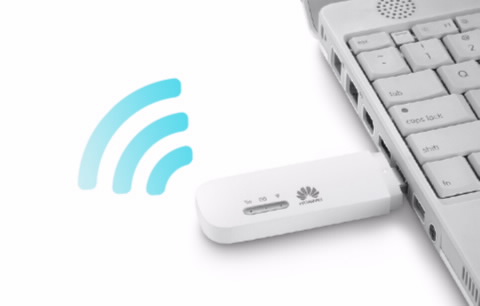 |
| Huawei E8372 |
The Google Internet speed test reported 18.4 Mbps download, 18.4 Mbps upload and Latency of 24 ms for Sydney which is more than I need. However, in Canberra it recorded only 0.53 Mbps download and 0.35 Mbps upload with 75 ms latency. This compared with 3.35 Mbps download, 0.78 Mbps upload and Latency of 45 ms for the Huawei E8372 using the Telstra mobile network. The Optus service was not enough for video conferencing in Canberra, even with the efficient Zoom product, whereas Telstra worked fine.
Overall I find the Huawei E5577 less suitable for my needs than the E8372, and the Optus service less useful than Telstra. The Optus service, as I experienced it, is not suitable for a student (or teacher) who needs Internet access.
Thursday, April 23, 2020
NSW Allows Documents to be Witnessed by Video Conference
Video conferences are now being used routinely in place of face to face meetings during the COVID-19 emergency. However, some have been reluctant to do this due to the lack of explicit law allowing it (although given courts are using video conferences extensively, they are unlikely to rule them invalid).
To help clarify the issue the New South Wales Electronic Transactions Amendment(COVID-19 Witnessing of Documents) Regulation 2020, provides that witnessing of documents can be done by video link.
To help clarify the issue the New South Wales Electronic Transactions Amendment(COVID-19 Witnessing of Documents) Regulation 2020, provides that witnessing of documents can be done by video link.
Sunday, April 12, 2020
Auto visual content for video conference presentations
Many dull video conference presentations are now taking place around the world. Transmitting the video of the speaker is consuming bandwidth for no good purpose. Occasionally
when chairing conferences I search for online content based on what the
presenter is saying, as they are saying it, and put that on screen
behind them for the audience to see. This could be added to video conference systems to enliven dull presentations. A text to speech system would provide content for searches. The Vidnami video editing system already searches out content based on a script, but not in real time.
Modified Street Furniture for Social Distancing from Recycled Plastic
 |
| Table Added to Seat for Social Distancing |
Most street and park seats allow for people to sit closely together. Current health restrictions prevent their use. However, as these restrictions are gradually reduced, it would still be useful to have people keep their distance. This could be done by using a design for street furniture similar to that in mall food halls.
Some food halls have individual seats spaced far enough apart for individuals to use them and not feel to close to a stranger, but close enough that a group can sit together. Street furniture could be designed similarly, with individual seats grouped together. Existing park seats could be modified by adding a table in the middle, reducing them to two separate seats.
A program for modified and new street furniture would be a useful job and economy boosting program. Additions for existing benches, and new furniture, could be made from locally sourced recycled plastic, further boosting jobs and the economy.
Friday, April 10, 2020

Sunday, April 05, 2020
Kmart Queuing for Website: A bad Idea Implemented Badly

I suggest Kmart offer customers a catalog of specials to browse while waiting. Customers could be encouraged to make a note of what they would like to buy while flipping through the catalog. There could also be information about Kmart's efforts to deal with COVID-19, procedures for shoppers in store, and special coupons . This could be provided with efficiently encoded web pages, which place limited load on system, and keep customers engaged while they wait.
Also once I got to the Kmart site, after the predicted two minutes, I found I sub-optimal website implementation. The Google Page Speed Insights test rated this at 30 out of 100, for the mobile version. A few simple changes suggested by the test would improve the experience for customers:
Opportunity and Estimated Savings
Eliminate render-blocking resources 1.06 s
Serve images in next-gen formats 0.15 s
Enable text compression 0.15 s
Diagnostics
Ensure text remains visible during webfont load
Serve static assets with an efficient cache policy 18 resources found
Minimize main-thread work 3.3 s
Reduce JavaScript execution time 2.1 s
Avoid chaining critical requests 20 chains found
Keep request counts low and transfer sizes small 49 requests • 805 KB
Friday, April 03, 2020
DIY Document Camera
 |
| DIY Document Camera |
Much can be done by telephone and video conference. However, occasionally it is necessary to show a client something. For this it is useful to have a document camera. This has a plate which sits on the desk, where you put a document (or small object). There is an arm to hold a camera above, and a light. Audio visual equipment is in short supply, but you can make a document camera out of a web camera and items around the home.
There are numerous articles online about how to make a document camera. I made a prototype from the surplus parts from a drawer unit. You need something for the base: I used the side off a modular basket drawer unit. You need an arm: I used a spare metal rod from the drawer unit (the rod is long enough to balance the weight of the camera on one end). You need a camera: I used a web camera which had a tilt and swivel mount which makes adjustments easier. The components are held togehter with zip ties, but rubber bands, or gaffer tape could be used. So far I haven't needed a light.
No specialized software is needed. If you have two web cameras, then use the one pointed at you first, so the client can see you. Then switch to the document camera, using the setting in your video conference software. When finished with the document, switch back to the other camera.
Subscribe to:
Posts (Atom)