Showing posts with label defence. Show all posts

Thursday, July 02, 2026

Multi-hull Crewed Control Carrier as the Flagship of the Australian Drone Fleet

This is to propose Australia build a fleet of uncrewed drone warships and crewed control ships to one common design. These would be stealthy, to avoid detection by radar. They would be about the size of an offshore patrol vessel, but multi-hull, using the expertise of Austal and Incat in building high speed ferries and warships. In peacetime the lightly armed control ships would perform constabulary duties in the region, without appearing threatening to Australia's neighbors. In wartime, with the drones, they would have the firepower of the largest warships.

The proposed Crewed Control Carrier (CCC) would be much smaller than the UK's Common Combat Vessel (CCV). This is because the CCC, focused on stealth, would not carry any offensive weapons, the launching of which could give away its position. In contrast the drone ships would be larger than most proposals from the UK & USA, as they need to be able to operate un-refueled across the expanses of the Pacific and Indian oceans. While having only defensive armament, the CCC could still be used alone for constabulary duties. The ship's auto-cannons, & short range missiles, would be sufficient to deal with pirates.

As an example, a starting point would be Austal's MRV-80 Multi-Role Vessel. This is to the same trimaran layout as the Independence class littoral combat ships built for the US Navy, but smaller at only 80m. The sides of the ship would be canted inwards, in the style of the experimental Sea Shadow (IX-529), to reduce the radar signature. Retractable panels would cover the helicopter deck, forming a hangar, and reducing the radar cross section. 

The vessels would be made in three versions:

Crewed Control Carrier,
generated with Google AI.
Tom Worthington 2026
1. Crewed Control Carrier: The control ship would have accommodation for up to 50 crew, with a control center for the operation of drone ships, submersibles and aircraft. The flight deck could be used for launching drones, with the provision to carry one crewed helicopter. Small surface drones and submersibles would be launched using the same stern ramp as for rigid inflatable boats. The ships would have short range radar, auto-cannons & missiles for self defence. 

2. Drone Missile Ship: The drone ship would retain the bridge of the command ship, for optional crewed use, but replace the accommodation with additional fuel and missiles. In addition to vertical launch cells, the ship could carry containerized missiles on the flight deck. Unlike other drone missile ship designs, the containers would be covered, when not launching, to reduce the radar cross section.

3. Sensor Ship: The sensor ship would have electronically steerable flat panel radar arrays built into the sloped surfaces for detecting aircraft, ballistic missiles and satellites. In a addition, a long range surface radar would be mounted on a telescopic mast. Like the missile ship, there would be a minimal bridge provided, but the ship would normally be operated remotely, as when actively scanning it would be a very visible target. The missile and control ships could also have receive only antennas to work in concert with the sensor ship.

Tuesday, November 28, 2023

Mini drone carriers

We may see a new class of warships come to prominence: drone carriers. These look like aircraft carriers, but are one quarter the size. At 107m  Damen Shipyard's Multi-Purpose Vessel for the Portuguese Navy is half the length of HMAS Canberra. The ship can launch surface and sub surface drones via a crane, as well as fixed wing drones via a ski-jump equipped through-deck. There are spots for vertical takeoff drones, as well as a rear deck wide enough for a conventional; crewed helicopter.

Compared to a similarly sized Anzac-class frigate, a drone carrier may not look a very effective warship. However, that would be similar to the mistake proponents of battleships made before WWII. The effectiveness of such a ship comes from the drones it carries.

Tuesday, October 03, 2023

Canberra Counter-drone System for Ukraine

The Australian Broadcasting Corporation (ABC) reports that Canberra company, Electro Optic Systems (EOS) is shipping its Slinger counter-drone system to Ukraine. This works very differently from the other Australian anti-drone system, the Brisbane based DroneShield. These place Australia at the forefront of anti-drone technology.

Ghost Gecko Concept
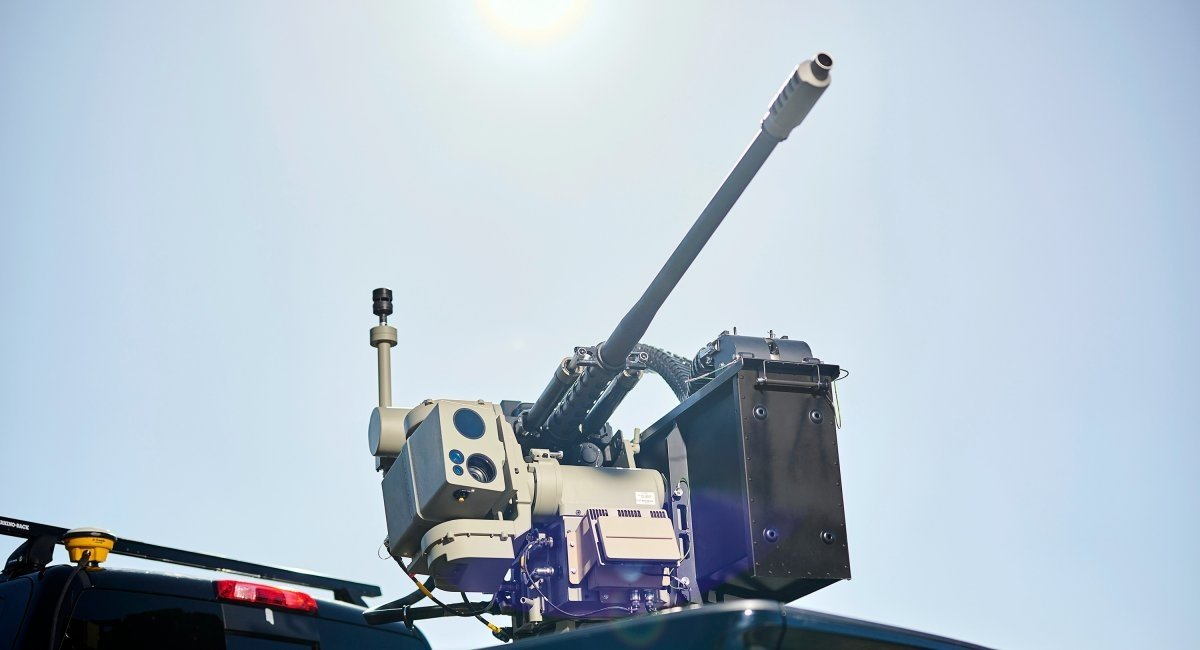
Droneshield jams the drone's electronics using radio signals from a gun shaped hand held transmitter. In contrast, Slinger is EOS' proven remote weapons system (RWS), with a radar added for precision. A cannon with proximity-fuzed fragmentation ammunition is used. This offers an easy upgrade of vehicles already fitted for a RWS (this could be an uncrewed, remotely operated vehicle).

Wednesday, June 21, 2023

Neighborhood Watch Needed for the Region

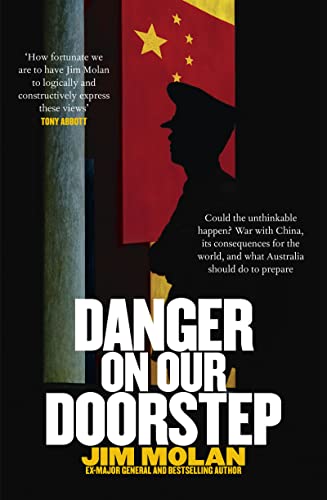
I had the pleasure of meting the late Senator, and former Major General, Jim Molan several times on defence discussion panels in Canberra (I get called in as the defence tech expert). While I did not agree with the Senator's politics, I respected his military experience, and patriotism. Part of his legacy is the book "Danger On Our Doorstep" (HarperCollins, 2022), warning of the potential for war between Australia and China. 

Wednesday, April 27, 2022

Will Australia Defend Taiwan?


Greetings from the ANU Australian Centre on China in the World, where Iain Henry from the ANU Strategic and Defence Studies Centre is speaking on "ANZUS and Taiwan: What are Australia’s obligations?". He went back to the formation of the ANZUS pact, arguing neither Australia or New Zealand wanted to defend Taiwan. The USA argued that an attack on their forces in Japan obliged Australia and NZ to act, but Taiwan was not mentioned.

While an interesting academic argument, I am not sure that the wording of the ANZUS treaty would have much to do with what Australia would do. The only time the treaty has been invoked was by Australia on 14 September 2001, after terrorist attacks on New York and Washington. This was an attack by a non state actor, based outside the Pacific, on the US Atlantic seaboard. If Australia would act similarly over Taiwan would perhaps depend more on the likely reaction of Australian popular opinion, than the wording of the treaty.  

On 24 April Australian PM, Scott Morrison said a Chinese military base at the  Solomon Islands would be a "red line": saying "We won't be having Chinese military naval bases in our region on our doorstep." This is a very serious statement, given the last time a regional power attempted to establish a base around the Solomon Islands was May 1942, resulting in the Battle of the Coral Sea. The USA and Australia met the Japanese Navy, with 13 ships sunk, and more than 1,500 lives lost.


Sunday, April 03, 2022

Strategic Drone Material Stockpile for Australia

The Australian Government has been investing in billions in big weapons systems. But the Ukraine conflict has demonstrated the value of small smart systems. Perhaps there could be government funding to provide an Australian stockpile of carbon fiber, & other materials needed for airborne & underwater drones.

Companies such as Carbonix could buy from the stockpile at a discounted price, to keep the stocks fresh. In time of need, the government would order military drones made using the materials.


The avionics could be made just-in-time by companies like Core Electronics, from a stockpile of components.


This way the military could have a supply of up to date drones, suited to whatever situation arises.


The same could be done for underwater drones (UUVs). Imagine the number of small robot submarines which could have been built with the
$5B Australia is paying for French non-nuclear, non-submarines
. ;-)

Tuesday, May 11, 2021

Australia needs a plan to deescalate tensions in the region

In "China needs to make a plan to deter extreme forces of Australia",  Hu Xijin, editor-in-chief of the Global Times, threatened the use of "...long-range missiles with conventional warheads that target military objectives in Australia ..." (May 07, 2021 11:35 PM). Such a threat is counterproductive and I suggest Australia develop plans to respond in a way which shows resolve, but does not escalate the situation.

In  2003 I was a guest of the Beijing Organising Committee for the Olympic Games (BOCOG) presenting ideas for the Beijing Olympics 2008. Present were local academics, government a business people, including from the People's Daily, who I considered very professional. I had an enjoyable tour of the People's Daily webcasting facility. It is regrettable that staff of the organisation are now issuing threats.

Air raid on Darwin.
During WWII, Australia suffered widespread and sustained attack from the air. However, this did not break the resolve of Australians to defend their country, quite the contrary. 

Conventionally armed ballistic missiles could inflict significant damage, and casualties, on Australian military infrastructure and civilians. The Australian government may wish to acquire anti-missile missiles, for the ships it has already acquired which are fitted-for-but-not-with these. But in any case, as in WWII, an attack on the Australian mainland would increase work with allies, not diminish it.

In the event Australia comes under ballistic missile attack, I suggest we show restraint, and ask our allies not to use the weapons at their disposal to respond in kind. A way to show resolve, without escalating the situation, would be to dismantle the artificial islands constructed by China in disputed territory

Personnel on the artificial islands could be given time to evacuate, with personal belongings. This could be facilitated by coast guard personnel of Australia and its allies. All infrastructure on the islands would then be removed, and the sea walls broken. This would allow currents to wash away the built up sand and return the reefs to their natural state.

Wednesday, March 31, 2021

Australian Fast UAV Carrier with Onboard Additive Manufacturing of Aircraft

Fast UAV Carrier.
Artists impression by
Tom Worthington CC-BY 2021
The Australian Government is reported to be considering investing billions of dollars in a complex guided weapons manufacturing  sovereign capability. However, just having a local subsidiary of an offshore company build an imported product under licence is not a real sovereign capability (as was shown by billions wasted on subsidizing foreign car companies to manufacture in Australia).

Any scheme has to have a strong investment in local capability. I suggest Australia should invest in new technological capabilities, for example, being able to rapidly manufacture custom guided weapons and UAVs for a particular mission. This could include the capability to do this aboard ship and on land at forward bases.

As an example, imagine a miniature aircraft carrier build by one of Australia's multi-hull fast ferry shipyards, with a flight deck for launching UAVs and a factory below to 3D print the jet engines, fuselages and avionics for them. Rather than a commander to have to wait weeks, or years for new weapons to be delivered, they would be manufactured on-board in a few hours, custom designed for the next mission.

Saturday, December 01, 2018

Repairing a RAAF Leather Flying Jacket

In 2014 I purchased an A2 leather flying jacket. Having worn it a lot, it was showing signs of wear. Some would pay extra for the worn-in look, but I decided to carry out some repairs.

There were spots of lighter color, where the leather had worn, some holes in the cloth inside (just above the woven waistband), and the woven cuffs have frayed.

The color of the leather is officially described as "seal brown" (after the sea mammal, not the special forces). But Waproo Dark Brown Raven Oil is a reasonable match for this. I purchased a 50 ml bottle from a shoe repair kiosk, and dyed the shoulder straps, collar, front pockets and front zip flap. There was was only half a bottle left, so I decided to order online a 500 ml bottle. It turned out I only needed about 150ml for the whole jacket. This is a powerful dye, so it is important to keep it off the cloth lining (and anything else you do not want dark brown).


The cuffs I repaired with a darning needle and dark brown DMC Stranded Cotton 3371

The cloth lining was frayed just above the woven stretch cuff at the front bottom of the jacket, on each side, extending about 20 mm up. This is the point where my belt rubs on the inside of the jacket. I repaired it with a "fawn" iron-on patch (polyester cotton). 

I cut the patch length-ways into four strips 23 mm wide. These I ironed onto the cloth lining inside each front side of the jacket, just above the stretch cuff. First I ironed one end of a strip to just next to the zipper, then stretched the jacket out, and kept it stretched while ironing the strip flat onto the fabric. When the patch cooled down I let go, and the fabric puckered around the stretch cuff. It took two overlapping strips to reach the side seam of the jacket. I did not patch the back of the jacket as there was no sign of wear.

The total cost was about $40, and should keep the coat looking good for a few more years.

Wednesday, May 04, 2016

IT matters of interest in the 2016/2017 Federal Budget

From 1996, when the Australian budget was first put on-line, to 2015, I produced a summary of IT related items. This year the Australian Computer Society sponsored a "Budget Insider 2016", so I have not produced my own summary. However, here are some brief comments:

The governments' Youth Jobs PaTH for pre-employment skills training sounds worthwhile. However the government needs to put in place effective measures to prevent fraud in the system, as has happened with the VET-HELP scheme (with several billion dollars lost).

What is not mentioned on education in the budget is how to manage the transformation from classroom to on-line. If Australian institutions do not make this change in the next five to ten years, the current education export industry will collapse and become an education services deficit of about $25B per year. To help prevent that I have prepared a proposal for a train-the-trainer program on Entrepreneurial Skills and Digital Technology. I plan to present this at an international computer education conference later in the year.

The Australian Digital Health Agency (ADHA) is unlikely to be any more successful than the NEHTA (National E-Health Transition Authority) it replaces, in adoption of the e-Health records. After expenditure of more than a billion dollars there is little to show. The project should be abandoned and rethought: What is the government trying to accomplish? How best can it be done? Who has succeeded at this elsewhere?

The Digital Transformation Office (DTO) has been given some more time to prove itself. But I suggest that if it does not start producing some tangible results in the next year, it should, and will, be scrapped.

Saturday, July 04, 2015

Flying Jacket for Australian Prime Minister


For Mr Tony Abbott's visit to the USS Blue Ridge, the Australian Prime Minister wore a Royal Australian Air Force Flying jacket, with RAAF insignia. The PM is not a member of the military and not commander in chief, so it would be preferable for him not to wear a military uniform. The PM should be issued with a flying jacket for military visits, but with civilian insignia.

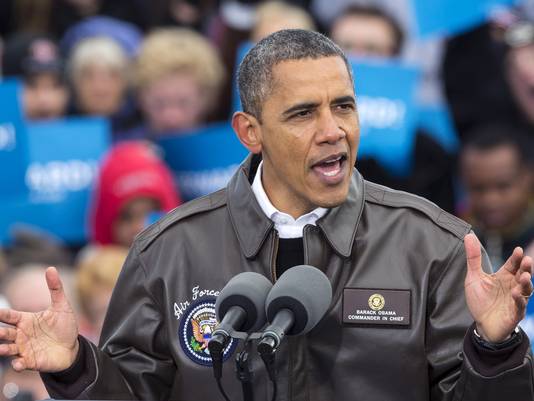
The US President is commander in chief of US armed forces, but even so does not wear military insignia. Instead the POTUS flying jacket has the US Presidential Seal.

Following the US custom, the Australian PM could wear a jacket with the Australian Arms and kangaroo insignia.

Name Patch for Left Side of PMs Jacket

As a member of the Australian Parliament, can use the Australian Arms:


Tony Abbot

Prime Minister of Australia

Kangaroo emblem for Right Side of PM's jacket

The kangaroo emblem is commonly used by the ADF to identify Australian personnel in situations where the Australian flag could be confused with the UK. It is also used by sporting teams and so is suitable for a civilian to wear. The green and Gold of the National Colours would be most suitable:


Australia


Tuesday, May 12, 2015

IT matters of interest in the 2015/2016 Federal Budget

Just about every year since the Australian Federal Budget was first put on the web, I have done a quick search though the documents to find matters of interest in information technology.

IT IN THE BUDGET

The budget search service failed at 10:30pm, reporting "A software error has occurred.". So I used Google to search for "Information Technology", finding seven results (up from four in 2014/2015):

Budget 2015 - Protecting Australia

"The new measures include $296 million to strengthen the capabilities of our intelligence agencies, including updating information technology systems. ...
New legislation requires telecommunication companies to retain metadata for two years. We are providing $131 million to assist the telecommunications industry to upgrade its systems to implement this policy." (Repeated in PDF version of "Protecting Australia - Budget").

Metadata ...Budget 2015 - Overview - Fairness of benefits
"We will invest an initial $60 million to kick start the Welfare Payment Infrastructure Transformation to upgrade the Department of Human Services’ (DHS) information technology to meet the demands of today’s digital world." (repeated in PDF version of "Overview - Budget").

Defence Housing Australia — reform
"The Government will provide $4.0 million over two years from 2015‑16 to undertake a reform of Defence Housing Australia (DHA). This will include a review of DHA's accounting, information technology and business reporting systems to improve transparency of the cost of providing DHA's services, as well as a review of DHA's business plans to support the sustainable delivery of quality and accessible housing and accommodation services. "

Part 3: Capital Measures
Table 3: Capital measures since the 2014-15 MYEFO

Information technology security enhancements for Parliamentarians $6.0M

Information technology security enhancements for Parliamentarians

"The Government will provide $12.9 million over four years from 2015-16 to the Department of Finance to install more secure networking equipment and to provide additional capability for secure wireless infrastructure in electorate offices and Commonwealth Parliamentary Offices connecting to the Parliamentary Computing Network. The replacement of obsolete communications equipment will result in improved information technology security for electorate offices and parliamentary
systems in Parliament House. "


"Some of the overall reductions in staffing levels will be offset by temporary increases in particular areas to manage implementation of policy change or to build infrastructure required to achieve future automation and efficiencies. This includes investment in the information technology systems of the Australian Bureau of Statistics and the first tranche of the Welfare Payment Infrastructure Transformation Programme."


SOME IT HIGHLIGHTS

The "National Broadband Network" (NBN) recieves limited attention for such a large project, with only two mentions, down from four last year and eleven the year before. Curiously I could not find a dollar figure for the NBN, instead "Your Government online":
"The Government is delivering the National Broadband Network faster and at less cost, to enable all Australians to connect to transformative services online. ...
That is why the Government is investing $254.7 million in the Digital Transformation Agenda to transform government service delivery.
This includes the establishment of a Digital Transformation Office to drive the Agenda and ensure that Government services are simpler and easier to use and can be completed from start to finish online.
The first phase of the Agenda will include provisions to:
  • implement a Digital Service Standard to apply to all Government agencies to make services simpler, faster and easier to use;
  • design and deliver more myGov services with an improved digital inbox, ‘tell us once’ services, and a new digital account for businesses that can be accessed using myGov; and
  • a simpler, more consistent and efficient grants administration process across government.
The Agenda will also include the implementation of a Streamlined Business Registration service announced in the Jobs and Small Business package. This will simplify the process of registering a business."


The provision for the "Stage One and establishment of the Digital Transformation Office" is a relatively modest $0.3M.

Pia Waugh, from the Digital Transformation Office  will be speaking at  Open Knowledge Australia's "Open Data and Digital Services: Foundations for a New Information Economy" in Canberra, 2:30pm, 13 May 2015.

In 2013/2014 the Government "recommitted" to "Remote Indigenous Internet Access", but but without an explicit amount of money committed to the program. Last year there were no such programs in the budget.This year there is provision for: " remote Indigenous internet training"  $2.2M.

In 2013/2015 the Government announced it would save $31.2 M over two years by incorporating the functions of the National Health Information Network (NHIN) into the Personally Controlled Electronic Health Record (PCEHR) system. Last year $140.6 million was provided in for the PCEHR. The government  has now renamed the project "My Health Record":
"The Government will invest $485 million to improve the electronic health record system for all Australians."
 This project has already cost many hundreds of millions of dollars for little result. I suggest it requires investigation by the Auditor-General, if not the Commonwealth Director of Public Prosecutions (CDPP).


QUALITY OF THE WEB PAGE

This year budget web site worked well (except the search function). Each year from 1996 to 2006 the budget web site was improved. By 2007-08 it reached a stable design, also used for to 2011/2013, using HTML 4.01 Transitional. The 2014/15 had s similar design using HTML5.  The 2015/2016 website has changed to a more mobile friendly design. The home page scored 91/100 on Google's Mobile PageSpeed Insights for User Experience. The page received a 62 / 100 for Speed, which is not as good as it could be, given the heavy traffic it is likely to experience.

The home page failed a W3C HTML Markup Validation test, with fifteen errors. These are not serious problems and easily fixed, but it is curious that such a high profile page is not tested more thoroughly.

The home page scored a very poor 0 out of 100 on the W3C mobileOK Checker. The total size of the page is  527.2KB (document: 14.6KB - stylesheets: 81.4KB - images: 431.1KB). This much smaller than  2014/2015 when the page ballooned to 17.9MB, but the style-sheets and images could be trimmed.

The budget home page failed a aChecker automated accessibility test (WCAG 2.0 Level AA) but with just two very minor and easily corrected problems.

The Budget is released under a a Creative Commons BY Attribution 3.0 Australia license, in line with open access government policy (commenced 2012/13).

Comments on past budgets:

1996 https://web.archive.org/web/20080521192851/http://www.anu.edu.au/mail-archives/link/link9608/0096.html
1997 https://web.archive.org/web/20080521192851/http://www.anu.edu.au/mail-archives/link/link9705/0315.html
1998 https://web.archive.org/web/20080521192851/http://www.anu.edu.au/mail-archives/link/link9805/0174.html
1999 https://web.archive.org/web/20080521192851/http://www.anu.edu.au/mail-archives/link/link9905/0265.html
2000 https://web.archive.org/web/20080521192851/http://www.anu.edu.au/mail-archives/link/link0005/0358.html
2002 https://web.archive.org/web/20080521192851/http://www.anu.edu.au/mail-archives/link/link0205/0318.html
2004 http://mailman.anu.edu.au/pipermail/link/2004-May/056673.html
2005 http://www.archivum.info/link@mailman.anu.edu.au/2005-05/msg00035.html
2006 http://mailman.anu.edu.au/pipermail/link/2006-May/066486.html
2007 http://www.tomw.net.au/blog/2007/05/it-matters-of-interest-in-20072008.html
2008 http://www.tomw.net.au/blog/2008/05/it-matters-of-interest-in-20072008.html
2009 http://blog.tomw.net.au/2009/05/it-matters-of-interest-in-20092010.html
2010 http://blog.tomw.net.au/2010/05/it-matters-of-interest-in-20102011.html
2011 http://blog.tomw.net.au/2011/05/it-matters-of-interest-in-20112012.html
2012 http://blog.tomw.net.au/2012/05/it-matters-of-interest-in-20122013.html
2013 http://blog.tomw.net.au/2013/05/it-matters-of-interest-in-20132014.html
2014 http://blog.tomw.net.au/2014/05/it-matters-of-interest-in-20142015.html
2014 Changes to Australian Higher Education in the 2014/2015 Federal Budget

Wednesday, April 29, 2015

Designing Defence Hi-Tech in Canberra

Greetings from the famous room N101 at the Australian National University where Merv Davis, CEO of CEA Technologies on defence technology to the software engineering students. CEA designs military radars and communication antennas in Canberra, for submarines, ships and aircraft, most notably the CEAFAR active electronically scanned array radar on Anzac Class Frigates. Merv pointed out the difficulties of being in the military business, with customers reluctant to buy a product without a track record from a relatively small company.

Monday, April 20, 2015

Asia Pacific Security and the USA

Greetings from the Australian National University in Canberra, where Professor Andrew Hurrell, University of Oxford, is speaking on "Global Order after U.S. Hegemony: Challenges for Asia and the Pacific". Professor Hurrell, suggested the greatest challenge for scholars was to conceive what might be a new world order where the USA and other western countries are not dominant. He briefly mentioned concerns such as cyberwar.

Professor Hurrell, discussed how previous assumptions that there would be a stable world order had been overthrown and there would instead be continuing "Westphalian" challenges. Not being a historian, I am not sure what this implies. But it seems to me clear that as US and western economic dominance declines, their global power will also decline. As an example, Australia has decided to join the China backed "Asian Infrastructure Investment Bank", against the wishes of the USA.

China has progressed slowly to have a blue water navy. It may take another decade before it can mass produce aircraft carriers and perhaps even longer to produce aircraft for them. However, Professor Hurrell pointed out there are other forms of power projection. When in Samoa some years ago to teach a course, I noticed that China has given the country an impressive government building. More humorously, the locally employed guard outside the US Peace Corps compound was wearing a People's Liberation Army cap (I assume he got it cheap in the local market). 

Professor Hurrell claimed that domestic politics would become more important in the future, so that national dominance by China and India will be less significant. This sounded to me like someone from an English university hoping for a return to an era when the British Empire would manipulate the internal politics of Asia for its own ends. I suggest the opposite is more likely. At the moment a rag tag non-state group such as ISIS is able to manipulate domestic politics in Australia by the use of Internet based propaganda.

Professor Hurrell had published numerous papers and his latest book is "On Global Order: Power, Values, and the Constitution of International Society" 2008). He is also giving seminar on "Global Governance: Can the Centre Hold?"
at ANU on Wednesday afternoon.

Wednesday, April 15, 2015

War-fighting by Supporting Insurgents


Greetings from the Australian National University Strategic & Defence Studies Centre, where Lieutenant Colonel Ken Gleiman, US Pacific Command/Visiting Fellow, Australian Strategic Policy Institute, is speaking on "The American Counterculture of War: Supporting foreign insurgents and the American discourse of war". LTCOL Gleiman emphasized that he was speaking as an individual scholar. He outlined the USA's history of involvement with insurgencies, arguing that while the USA started as an insurgency (backed by the French government against the British), the US government early on passed laws against its private citizens fighting abroad (although many citizens supported revolutionary movements). LTCOL Gleiman pointed out the term "filibuster" was used to describe a US citizen fighting in a foreign war.  Apart from philosophical objections, most such foreign adventures failed in their military objectives. Despite the law, and lack of success of the ventures, ordinary citizens and US military offices were tolerated and even supported by the US public and some government officials.

Moving on to the last century, LTCOL Gleiman claimed that the Office of Strategic Services (OSS) was the first US government organization authorized to support resistance movements, as late as 1942 in WW2. The OSS' methods were opposed by the US military (and of questionable operational value). The OSS was disestablished after WW2, but quickly replaced with the CIA to oppose communism by supporting insurgent groups around the world. The success of such operations was limited (apart from recently in Afghanistan). As with the OSS, the CIA's methods were not supported by the military.

LTCOL Gleiman contrasted the forms of insurgency the CIA supported with the popular revolutions which overthrew governments in Eastern Europe.

LTCOL Gleiman ended with a diagram from "The Economist" entitled "Traps for Washington", showing the complex interrelationships in conflicts in Libya, Syria, Iraq, Yemen and Egypt.

LTCOL Gleiman suggested that Principal Agency Theory could be applied to supporting insurgents.

This presentation was very useful for putting current conflicts in places such as Ukraine and Syria in perspective.

Thursday, March 19, 2015

Asymmetric Conflicts and the Law

Greetings from the Australian National University in Canberra, where Pnina Sharvit Baruch, Tel Aviv University, is speaking on "Asymmetric conflicts: applying the rules". She discussed her experience in applying the rules of armed conflict when operating against non-state actors. This included questions such as if targeted killing of leaders of non-state organizations engaged in operations against the state. The result seems to me to be to apply some of the decision making process to the military which would normally be carried out by the civilian police force.

Pnina pointed out that the Israel Defense Force legal officers are not in the chain of command of the operational commander and so their decisions cannot be overridden by the commander of an operation.

 As Pnina pointed out the problem with non-state actors is that it is more difficult to work out who are the combatants and who are "civilians". Under the rules of war anyone part of an "organized armed group" is a legitimate target, even if they are not armed. The ICRC suggested that those with a "continuous combat function" are armed forces, but does this include personnel not in uniform training or supporting the combat function.

It seems to me this also has implications for western nations who do have conventional armed forces, but increasingly rely on civilian contractors. A civilian driving a truck load of ammunition to the battlefield might be considered a legitimate target, but what about someone cooking food for ration packs?

A lawful target can include a civilian location which offers a definitive military advantage. So a private home being used for launching rockets is a lawful target, but the family home of a military officer is not. However, if the military officer works from home, issuing commands by phone, is this a target? In the case of cyberwarfare it is likely that military operations will be carried out from homes and civilian offices: are all these targets?

Thursday, January 29, 2015

USA Alone Cannot Defeat Islamic State

Greetings from the Australian National University in Canberra, where Professor Amin Saikali, author of "Zone of Crisis: Afghanistan, Pakistan, Iran and Iraq" is speaking on "The Middle East: Is the ‘Islamic State’ vanquishable?" (there will be a podcast later). Professor Saikal argues that the so-called Islamic State (IS) cannot be defeated by the US-led air campaign. He says a land based imilitary operation will be required and this would be preferably undertaken by local forces, not the USA and its western allies. He also points out that IS promotes itself as a continuation of the Caliphate abolished with the formation of modern Turkey after WW1. But there is still a romantic notion of restoring power to the region. Professor Saikal argues that the appeal of a Caliphate can be countered by the formation of modern democracies respecting human rights. To an outsider it may seem madness that anyone would support a totalitarian theocracy, but it might be more appealing than current totalitarian governments.

In my view an areas where Australia could contribute is in combating IS on-line. There are some suggestions this may be happening with an Australian Cyber Offensive, but also can include more subtle information campaigns. These are important skills our military forces need to learn, in any case, for future conflicts.

Wednesday, January 28, 2015

Climate Change and War

Dr Albert Palazzo, Director of Research in Strategic Plans - Australian Army Headquarters, will speak on "Climate Change and the Future Character of War", at the Australian National University, 6pm, 10 February, 2015. Also on this topic Dr Palazzo has written "Climate change, migration and the importance of the international order" (Lowy Institute for International Policy, 14 May 2014):
"The replacement of the existing world order will have implications for a planet affected by climate change. Without a functioning safety valve, conflict between and within states will become more frequent and more vicious. As the deficit between resource requirement and availability widens, peoples who see their futures in terms of survival will be more prone to move in order to provide for their needs. As the support of the international community lessens, the destabilisation of weak states will become more prevalent and some areas of the world will sink into turmoil and chaos."

Wednesday, January 14, 2015

Can Islamic State Be Defeated?

Professor Amin Saikal will speak on "The Middle East: Is the ‘Islamic State’ vanquishable?" at the Australian National University in Canberra,6pm, 29 January 2015.
The rise of the so-called Islamic State (IS) on vast swathes of territories in Syria and Iraq, and the US-led military response to it, have introduced another complex dimension to an oil-rich but already very volatile Middle East. The old correlation of forces in support of maintaining the status quo, especially following the Iranian revolution more than 35 years ago, has been changing.

A set of new alignments and realignments along multiple regional fault-lines, including sectarian divisions and geopolitical rivalries at different levels, has come to redefine the region and possibly change its traditional political and territorial contours. IS has confronted all the regional states, from the Islamic Republic of Iran to the Kingdom of Saudi Arabia, with a common enemy. Yet, it is the United States and its Western allies that have taken the lead in launching a military intervention to ‘degrade and eliminate’ IS, despite lacking a laudable past record in this respect. This raises a number of questions. Should the problem of IS have been left to the regional actors to handle?

Whilst IS may be containable, can it be defeated? Even if IS is eliminated, what guarantee is there that another extremist group won’t replace it? Can IS become a franchise, as al-Qaeda has? What is the possible best way to deal with religious extremism in the Middle East? What can be expected of the on-going air campaign against IS in terms of its consequences for the region, and the US and its allies? This conversation will focus on these questions in an attempt to unpack the nature of the mess that is the Middle East – a region so turbulent and yet so rich from which the world cannot simply disentangle itself.

Thursday, November 20, 2014

Defence Diplomacy: Is the game worth the candle?

Greetings from the Strategic and Defence Studies Centre at the Australian National University where three distinguished speakers are addressing the question: "Defence Diplomacy: Is the game worth the candle?". Professor Hugh White began by pointing out that the British Fleet visited their German counterparts short before the outbreak of World War One. This defence diplomacy did not prevent war. He argued the idea of using the military for diplomacy in peacetime is appealing. This may work at the tactical level, but not higher. Military officers from different nations can more easily work together if they know each other. But Professor White argued that military officers are not highly enough placed for the most important diplomacy.

In contrast Dr John Blaxland argued that 2014 is not like 1918 and that in South East Asia a military uniform opens doors. This was based in aprt on his experience as Australia’s Defence Attaché to Thailand and Burma from 2008-2010. He expressed concern that the Australian Defense Force had been concentrating in the last few years on operations in the middle east and Afghanistan.


Peter Leahy ex-Chief of Army, described how Peter Cosgrove, then military commander talked his way into East Timor as leader of INTERFET. Australia's relationship with Indonesia was strained by the East Timor intervention, be renewed by Australia's assistance for the 2004 Indian Ocean earthquake. Peter Leahy jokingly emphasized the need for diplomats in the Asian region to play golf and sing karaoke with their counterparts. Australia's new Landing Helicopter Dock Ships (LHD) were nominated by Peter Leahy as a useful for disaster relief and therefore diplomacy. In my view the primary purpose of the LHDs, for amphibious assault, will not be lost on military personnel of the region. The likely result is that military in the region will scramble to acquire a similar capability and also the means to combat it, using submarines. The ability to equip conventional submarines with lithium iron battery technology derived from electric vehicles, increasing their underwater range by five to ten times, is likely to result in a new arms race (in my view).

Professor Nick Bisley pointed put he was the only speaker who had not served in the military or Defense bureaucracy. He noted that Defence Diplomacy where military provides material aid can provide more short term tangible results than high level diplomatic discussions. However, Professor Bisley suggested that this form of diplomacy has only a limited role.

At question time Peter Leahy expressed concern about Australian military officers and units being embedded in allied forces could become too closely enmeshed in the military operations of that country. One of the audience commented that Australian military attaches were assumed to be spies by other nations. Another question was on how much the military could do in the absence of clear national strategic direction. The New Colombo Plan was nominated as a useful form of soft diplomacy (or the "Reverse Colombo Plan" as as Professor White called it).

This was a fascinating discussion of the issues and a much more comfortable one than the previous frightening previous seminar on Possible Use of Nuclear Weapons in Sino-Japanese War

Papers are available: