Greetings from the National Press Club in Canberra, where Dan Tehan MP,
Minister Assisting the Prime Minister for Cyber Security is describing a 'A Cyber Storm'. He is outlining a scenario where a virus introduced to critical systems shuts down the electricity grid, causing widespread deaths and injury. He described this as a "real and present threat". The minister suggested that government, industry and the public can address this threat together. The minister went on to mention that ASD had carried out cyber attacks on ISIS.
Earlier in the year I ran the IT students at the Australian National University through a Hypothetical on Cyberwarfare over the South China Sea. Unfortunately this invented scenario is becoming more likely by the day.
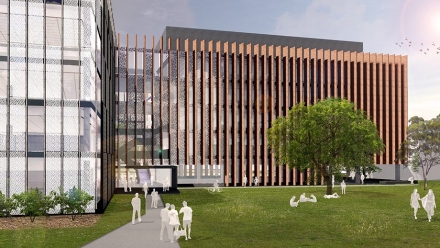
There is a new Australian Cyber Security Innovation Centre being built just outside my office window at ANU. However, as the minister pointed out, this is not just something for IT professionals and federal government. State governments, business and the public have a role.
One of the press questions to the Minister asked if enough defense funding goes to Cyberwarfare. The Minister claimed that "new money" was being put into the military for cyber security and warfare. However, the amounts mentioned were tiny, compared to the amount spent on conventional military systems. One approach I have suggested is a CyberWarfare Battalion, made up of reservist military officers who are IT professionals.
Showing posts with label ANU Research School of Computer Science. Show all posts
Wednesday, November 23, 2016
Wednesday, December 16, 2015
Ruxcon Security Conference Teaching Hacking Techniques in Australia
Greetings from the ANU in Canberra, where Bob "The Builder" Edwards is speaking on "Ruxcon 2015 Computer Security Conference: A Brief Report"his attendance at the Ruxcon 2015 Security Conference in Melbourne. The conference is sponsored by the Australian Signals Directorate (ASD). As well as the usual presentations, the conference has a Black Bag Competition where delegated attempt to covertly access a computer in the conference hotel and Capture The Flag. Presenters discuss how to hack systems, so as to alert system owners to the problems and to better educate security professionals. One point was that computer systems are getting more complex, which opens up more security vulnerabilities.
The interesting question for me is how to have some of the fun and excitement of such events in an educational environment, in a way which is safe. One issue is to make sure that students understand the legal and ethical issues involved. Even when the intention is benign there is the problem of preventing educational experiments escaping and causing damage. One way to address this by having a "Cyber Range" which provides and isolated computer environment to test security. The new Australian SDN Test-Bed, is also intended for security research.
The PM announced a $30M "Cyber Security Growth Centre". It would be interesting to include some contests in this.
Friday, December 11, 2015
How do people ask for information?
Greetings from the famous room N101 at the Australian National University in Canberra, where Professor Douglas Oard, from University of Maryland, is speaking on 'Building Search Engines for the “Bottom Billion”'. The example he gave was of an Indian farmer who had some spots on their crop and wanted help in finding out what it was. The intended interface is a mobile "feature phone".
Professor Oard first described work by IBM India using audio information indexed by numbers which was accessible via a mobile phone. He commented this would not scale and non-literate users do not understand the concept of a hierarchical menu. He then described a method for matching audio called "Query by babbling" (Oard, 2012).
Finding a way to provide information to those with limited literacy is a worthwhile research area. However, there is extensive social science research on verbal communication which the researchers might want to review for insights into how people formate queries. I have come across some of this literature as a student of education, such as Venkataraman and Prabhakar (2014).
Also it happens I spent three weeks in an Indian village and had to communicate with the plumber, the miller and other trades. One insight from this is that they do not use just one language, they use a mix. Also hand gestures play a role.
Smart phones are becoming increasingly affordable and this might provide the opportunity for a visual and audio interface. This interface might also have an educational function, displaying words and teaching written communication, while providing a verbal interface.
Audio interfaces are also useful for those who are literate, but not able to use their hands for typing and do not have sufficient attention to compose a formal audio text query. This applies in formal teams, such as those controlling a metro, military command centers, and flight deck crews. These have been extensive studies of how these people communicate. Part of this is about the formal use of language for directed commands and queries. But part of it is the team members overhearing conversations and acting without being directly asked to do so. Automated systems could be good in this role, where they could eavesdrop on the human conversation, responding and taking action, where appropriate.
Venkataraman, B. & Prabhakar, T. (2014). Changing the Tunes from Bollywood’s to Rural Livelihoods — Mobile Telephone Advisory Services to Small and Marginal Farmers in India: A Case Study, in Ally, M., & Tsinakos, A. (2014).
Professor Oard first described work by IBM India using audio information indexed by numbers which was accessible via a mobile phone. He commented this would not scale and non-literate users do not understand the concept of a hierarchical menu. He then described a method for matching audio called "Query by babbling" (Oard, 2012).
Finding a way to provide information to those with limited literacy is a worthwhile research area. However, there is extensive social science research on verbal communication which the researchers might want to review for insights into how people formate queries. I have come across some of this literature as a student of education, such as Venkataraman and Prabhakar (2014).
Also it happens I spent three weeks in an Indian village and had to communicate with the plumber, the miller and other trades. One insight from this is that they do not use just one language, they use a mix. Also hand gestures play a role.
Smart phones are becoming increasingly affordable and this might provide the opportunity for a visual and audio interface. This interface might also have an educational function, displaying words and teaching written communication, while providing a verbal interface.
Audio interfaces are also useful for those who are literate, but not able to use their hands for typing and do not have sufficient attention to compose a formal audio text query. This applies in formal teams, such as those controlling a metro, military command centers, and flight deck crews. These have been extensive studies of how these people communicate. Part of this is about the formal use of language for directed commands and queries. But part of it is the team members overhearing conversations and acting without being directly asked to do so. Automated systems could be good in this role, where they could eavesdrop on the human conversation, responding and taking action, where appropriate.
References
Oard, D. W. (2012, November). Query by babbling: a research agenda. In Proceedings of the first workshop on information and knowledge management for developing region (pp. 17-22). ACM.
Wednesday, December 09, 2015
Search Engines for Low-literacy Users
Professor Douglas Oard, University of Maryland, will speak on 'Building Search Engines for the “Bottom Billion”', in the famous room N101 at the Australian National University in Canberra, 11am, 11 December 2015.
This is an event in the CSIRO IR & Friends series, in conjunction with RSCS HCC & Friends.
About three quarters of a billion people are functionally illiterate, meaning that they have no more than a very basic ability to read or write. Modern search engines are powerful tools for much of the world’s population, but if we are to build search engines for illiterate and low-literacy users we will need to come at the problem differently. I’ll begin by describing two lines of work on this problem in the broad area known as Information and Communication Technology for Development (variously, ICTD or ICT4D), one that seeks to leverage visual interfaces, numeracy, and limited literacy, and a second that seeks to leverage speech. I’ll then focus the rest of the talk on the work that we have been doing on speech-to-speech retrieval.
The key challenge that we have sought to address is that most illiterate and low-literacy users don’t speak any language for which we have the sorts of highly engineered Large-Vocabulary Continuous Speech Recognition (LVCSR) systems on which much of the recent work on speech retrieval depends. A shared-task evaluation in MediaEval started to tackle that challenge in 2011 using a Spoken Term Detection (STD) evaluation. The results there were promising, showing that systems could often recognize single terms in continuous speech based on examples, without any foreknowledge of the language. In our work, we have sought to build on one of these MediaEval systems to apply this STD capability to perform ad hoc ranked retrieval (i.e., finding recorded content that is most likely to satisfy a user’s information need).
I’ll describe the “Query by Babbling” interaction paradigm that we have been exploring, in which we are exploring what would happen if instead of short queries and long result sets, as is appropriate for text, we had long queries and short result sets, perhaps a better approach for speech.
I’ll then describe a test collection we have built using spoken content from a voice forum site used by farmers in Gujarat, India (speaking in Gujarati), some ranked retrieval systems that we have evaluated using that collection, and the results that we have obtained.
I’ll finish up with a few thoughts on where the remaining hard spots are with this technology, and what I see as next steps to address those challenges. This is joint work with Jerome White (NYU Abu Dhabi), Nintendra Rajput (IBM India Research Lab) and Aren Jansen (at the time at the Johns Hopkins HLTCOE).
Biography
Douglas Oard is a Professor at the University of Maryland, College Park, with joint appointments in the College of Information Studies (Maryland’s iSchool) and the University of Maryland Institute for Advanced Computer Studies (UMIACS). Dr. Oard earned his Ph.D. in Electrical Engineering from the University of Maryland. His research interests center around the use of emerging technologies to support information seeking by end users. Additional information is available at http://terpconnect.umd.edu/~oard/.
Thursday, November 12, 2015
Making the Law an Open e-Book
Greetings from the famous room N101 at the Australian National University where Tom Bruce and Sara Frug from the Legal Information Institute at
Cornell Law School are speaking on how readable the law is for non-lawyers. They have been working with Michael Curtotti and Eric McCreath at ANU. They have recently published papers on " Machine learning for readability of legislative sentences" and "Citizen Science for Citizen Access to Law".
Thursday, August 13, 2015
What People Look at in a Web Search
Ying-Hsang Liu, Lecturer. Charles Sturt University, will speak on "Individual differences, user perceptions and eye gaze in biomedical search interfaces" at the CSIRO ICT Seminar Room, Computer Science and IT Building, Australian National University, Canberra, 4pm, 17 August 2015.
"User search behaviour studies suggest that individual differences, such as domain knowledge, search experience and cognitive styles, are important factors affecting people’s interactions with search systems. However, very few studies have investigated the effect of individual differences on eye gaze for the design of natural search user interface. In this seminar, I will present findings from an eye-tracking study of the biomedical domain experts’ interactions with novel search interfaces. Thirty-two participants searched eight complex questions on four different search interfaces, which are distinguished by whether the Medical Subject Headings (MeSH) terms are presented and how the displayed MeSH terms are generated. Our findings reveal that domain knowledge and search experience significantly affect the users’ areas of interest (AOI) of different interface elements. There is a significant interaction effect between search interfaces and cognitive styles. The implications for search user interface design will be discussed."
Tuesday, August 11, 2015
Measuring Social Dynamics of Social Media
Ian Wood will speak about "On Measuring Social Dynamics of Online Social Media", at the Australian National University in Canberra, 11am 17 August 2015.
"Modelling and measuring social processes such as the dynamics of social identities and norms, community rituals, shared symbols and beliefs etca is an area at once immensely important and immensely difficult. Some progress has been made with modelling such processes, but measuring them has been largely elusive and usually remains the domain of subjective interpretation of social and cultural artifacts.
This work makes some small inroads into methods for quantification of social processes and into the collection of social media data containing the rich dynamics needed to capture their traces. I present a system for the collection of richly dynamic Twitter data using a novel approach to identify a targeted Twitter community. Data was collected from the apro-anaa (pro-anorexia) community operating on Twitter for 2 years 9 months, resulting in a corpus of over 1.2 million tweets from 300 thousand users with records of over 3.2 million changes to users follower lists and profile metadata.
Three methods for investigating aspects of social dynamics are presented with the collected pro-ana data as a test case: an approach to combine Bayesian topic models with word frequency based psychometric tools to identify corpus-relevant contexts of the target psychological phenomena; a Bayesian model, applicable to large data sets, which associates topics generated by topic models of text data with communities inferred by network community detection models; a methodology for identifying linguistic markers of group induction processes."
Saturday, May 30, 2015
Australasian Computer Science Week at ANU in Canberra 2 to 5 February 2016
The Australasian Computer Science Week (ASCW2016) is being hosted by the
Australian National University in Canberra, 2 to 5 February 2016 for the Computing Research and Education Association of Australasia (CORE). Sponsorships and exhibition bookings are now open.
The call for papers for the conferences which make up the week will open 14 August 2015:
Conferences that are part of ACSW 2016:
Conferences that are co-located with ACSW 2016:
The call for papers for the conferences which make up the week will open 14 August 2015:
Conferences that are part of ACSW 2016:
- Asia-Pacific Conference on Conceptual Modelling (APCCM)
- Australasian Computer Science Conference (ACSC)
- Australasian Computing Education Conference (ACE)
- Australasian Information Security Conference (AISC)
- Australasian Symposium on Parallel and Distributed Computing (AusPDC)
- Australasian User Interface Conference (AUIC)
- Australasian Web Conference (AWC)
- Australasian Workshop on Health Informatics and Knowledge Management (HIKM)
- Interactive Entertainment (IE)
Conferences that are co-located with ACSW 2016:
Wednesday, April 29, 2015
Designing Defence Hi-Tech in Canberra
Greetings from the famous room N101 at the Australian National University where Merv Davis, CEO of CEA Technologies on defence technology to the software engineering students. CEA designs military radars and communication antennas in Canberra, for submarines, ships and aircraft, most notably the CEAFAR active electronically scanned array radar on Anzac Class Frigates. Merv pointed out the difficulties of being in the military business, with customers reluctant to buy a product without a track record from a relatively small company.
Thursday, March 26, 2015
Cyber Security Careers at the Australian Signals Directorate
Yesterday I was taking part in a discussion of the role of national security agencies with colleagues from the IT industry. I mentioned how when giving a seminar on computer security at the Cambridge University Computer Lab (UK) I noticed someone in the back row who did not look like a student or academic. They turned out to be from GCHQ, the UK security agency, presumably there to recruit students. Much to my surprise today I walked into seminar room N101 at the ANU Research School of Computer Science (to help get the projector to work) and found it was for staff from the Australian Signals Directorate (ASD) presenting to students on Careers at ASD.
Tuesday, September 30, 2014
Live Coding Performance of Music
The second strangest musical performance I have been to in the last few days was a "Live Coding Visualisation" by Arrian Purcell at ANU in Canberra. The performer sat a computer keyboard and typed in computer code which produced music. While listening to the music we could see the code on screen along with a visualisation.
One performance sounded to me like Philip Glass, mixed with the theme from Peanuts and played by Richard Rodney Bennett. The second started like Tchaikovsky's Piano Concerto No. 1 accompanied by a modem, then became the theme for a TV police drama set in the Hotel California. But Then I don't know much about music. ;-)
Seeing the computer code created on screen did not help much. An icon based interface, with no text might be more interesting. Also as with a piano performance I wanted to see the performers hands on the keyboard.
ps: The strangest performance I have been to recently was an officer cadent at ADFA, in camouflage uniform, playing a classical tune on a cello.
One performance sounded to me like Philip Glass, mixed with the theme from Peanuts and played by Richard Rodney Bennett. The second started like Tchaikovsky's Piano Concerto No. 1 accompanied by a modem, then became the theme for a TV police drama set in the Hotel California. But Then I don't know much about music. ;-)
Seeing the computer code created on screen did not help much. An icon based interface, with no text might be more interesting. Also as with a piano performance I wanted to see the performers hands on the keyboard.
ps: The strangest performance I have been to recently was an officer cadent at ADFA, in camouflage uniform, playing a classical tune on a cello.
Wednesday, May 07, 2014
Apple Wins Technology War in Software Engineering Classroom
Greeting from the famous Computer Sciecne room N101 at the Research School of Computer Science at the Australian National University in Canberra. I am helping teach software engineering to a room full of students. Almost every student had a laptop in front of them. The most common are Apple laptops, followed by Dell. The typical screens are 13 to 15 inches. I can see no Apple iPads and just one Microsoft Surface. My preference is for a 11 to 13 inch laptop, but I have a larger desktop LCD to use. I suspect some students like a large screen to hide behind in the classroom, just as lecturers hide behind the lectern. ;-)
Friday, February 07, 2014
Build your Own $10 Virtual Reality Glasses
Marcus Hutter and Stephen Gould will speak on "Build your Own 3D Virtual Reality Glasses for 10$" at the Australian National University in Canberra, 4pm, 13 February 2014.The DIY 3D Virtual Reality Goggles are built using a smart phone and part of a Student Project.
It occurs to me that this is something which should work well with one of the new smart phones with curved display
. The case to hold the phone could be manufactured with a 3D printer (with the design by the engineering students), the project crowd-funded and entered in the Innovation ACT start-up competition.
It occurs to me that this is something which should work well with one of the new smart phones with curved display
ABSTRACT:
3D television and 3D cinema are becoming wide-spread, but 3D Virtual Reality goggles (or glasses), despite being a many decades old idea, are just receiving increased attention. The few commercial devices available don't sell well, in parts due to price, but a cheap alternative has emerged: A modern SmartPhone, two lenses for under 10$ and some cardboard and glue is all you need to build your own 3D-VR goggles.
Marcus will bring his to the seminar for you to try out, and will share his experience in building and using them. Stephen will discuss potential computer vision applications and student projects. ...
Monday, January 20, 2014
ICT For Green Growth in Developing Nations
Dr Idris Sulaiman will speak on "How ICTs Make A Smarter Green Growth in Emerging Economies", at the Australian National University, 2:30pm, 20 January 2014. 2014-01-20:
Green ICT is as much about the financial motivation as it is about regulatory compliance and reducing the environmental impact of operating ICT and the business a"whether it be commercial, academic or government organisations. This presentation provides an overview on the status of the current technology diffusion in terms of agreening of ICT infrastructure as well as some major areas of how ICTs are agreeninga key areas of economies in the global context particularly in the emerging economies. The presentation also looks at some international award-winning agreena software technologies that have been getting the attention of venture capital players and policy makers alike.
Wednesday, November 06, 2013
Hacking Encryption Keys Demonstrated
Yuval Yarom from University of Adelaide has just demonstrated reading a RSA public key for SSL encryption being used by one user on a shared computer system, by another user's program. This "generic cache side-channel attack" exploits a security weakness in the Intel's X86 computer architecture (but also applies to other company's designs). There are ways to fix this problem, but this will reduce the performance of applications. There is a full paper available.
FLUSH+RELOAD and the Relaxed Security of Read Operations on the X86 Architecture
Yuval Yarom (University of Adelaide)
COMPUTER SYSTEMS SEMINAR
DATE: 2013-11-06
TIME: 14:00:00 - 15:00:00
LOCATION: CSIT Seminar Room, N101
CONTACT: josh.milthorpe@anu.edu.au
ABSTRACT:
FLUSH+RELOAD is a recently developed generic cache side-channel attack technique. It exploits a security weakness in the popular X86 architecture, which allows a spy program to monitor a victim program read from shared memory regions. Unlike previous cache side-channel attacks, the technique targets the last level cache. Consequently, the spy and the victim programs do not need to execute on the same processing core. The technique is not limited to a traditional OS environment and can be applied in a virtualised environment where it can be used to leak information from programs running in co-located virtual machines. In this talk I present FLUSH+RELOAD and the weakness it exploits. I also describe the spy program behind CERT advisory VU#976534 and Mitre CVE-2013-4242 which uses the technique to attack the GnuPG implementation of the RSA encryption. By snooping a single decryption or signature process, the spy program is able to recover over 98% of the secret key bits, effectively breaking the cryptosystem. Further information on the technique can be found in http://eprint.iacr.org/2013/448
Tuesday, February 19, 2013
ANU Online Shop Build by Students
The Australian National University marketing office has not adopted by suggestion for an ANU batik shirt, but they have implemented an Online ANU Shop, with an e-commerce system designed by the ICT students. Particularly popular are the ANU infant T-shirs with new graduates stocking up even before they plan the family. Also the Eucalyptus & Rosellas Scarf looks good, perhaps a batik style shirt could use the same pattern.
Tuesday, January 22, 2013
Software Engineering Internship Requires E-Portfolio
The course Software Engineering Internship (COMP3820), offered by the ANU
Research School of Computer Science, requires students to reflect on
their experience in an Internship Journal (e-Portfolio). This makes up
20% of their assessment, equal to the report by their Industry
Supervisor. The students are intended to be able to demonstrate learning
and professional development through mapped to Engineers Australia
technical competencies. Accreditation by Engineers Australia, requires the equivalent of 12 weeks full-time work experience for each student. This course (COMP3820) satisfies the requirement and makes up one full time semester of study by the student.
The aim of this course is to use the internship experience to enable students to develop their software engineering skills and practice. Students will be placed in industry, working full-time and assessed for academic credit. The internships will be aligned with the aims of the software engineering program. Students will experience a real-life engineering workplace and understand how their software engineering and professional skills and knowledge can be utilised in industry. They will also be able to demonstrate functioning software engineering knowledge, both new and existing, and identify areas of further development for
From: Software Engineering Internship (COMP3820),Shayne Flint, ANU Research School of Computer Science, 2012
Friday, January 11, 2013
National Award for Engineering Excellence
Subscribe to:
Posts (Atom)