Showing posts with label batteries. Show all posts

Wednesday, November 11, 2020

Upgrading a Cordless Drill with Lithium Batteries

Battery technology has improved since 2015, when I replaced the NiCd cells with NiMH in a cordless drill. The cost of the NiCd has dropped and their capacity increased. But most cordless tools now use lithium batteries. Each brand of tool uses its own proprietary battery pack. But I was able to adapt a new lithium battery pack from a budget brand to fit my old drill.

While the battery packs from different brands look different, these mostly contain the same AA size lithium 3.7 volt cells (with more cells used for higher voltages). These cells are a higher voltage and energy capacity than the NiCd cells used in older tools. Whereas it took 10 NICd cells for a 12 Volt battery, it takes only three small Lithium ones. 

Lithium Battery Pack
I considered buying lithium cells and building my own battery into the old cordless drill case. As these lithium cells are much smaller, there is plenty of room. However, the lithium cells have an increased risk of fire if mishandled and need special charging to prevent damage. So instead I bought a 12 Volt Lithium battery designed for a budget range of tools with a matching charger (there is also an 18 Volt range).

DC Socket
The battery and changer cost less than three bare lithium cells would have. The cells are already wired and integrated with charging circuity in the battery pack. It was then a mater of fitting the battery to the drill. I removed the case from the new battery and it then fitted inside the old case. I soldered two wires from the new battery to the contacts of the old case. Two extra wires were needed from the battery to a new DC socket in the bottom of the drill to connect to the charger. The battery was then wrapped in self amalgamating tape to protect it and hold it in place.

DC Plug
To charge the battery I cut the leads off the supplied 15 volt plug-pack and soldered on a simple DC plug. The electronics for regulating charging of the lithium battery are in the circuit board on the battery, so there is no extra electronics required. 

Light Transporters
There are two lights on the battery: red for charging and green for charged. This presented a problem, as when assembled inside the old battery case these lights were not visible. So I drilled two holes in the top of the battery case and fitted Light Transporters. These have a clip which fits over the LEDs on the charger board, and a fiber optic cable to channel the light out.

To ensure that someone did not try to charge the new lithium battery with an old NiCd charger, I peeled the stickers off the discarded lithium case and stuck them over the NiCd ones on the drill. To further reduce the risk, I screwed the battery pack to the drill, so it could not be removed and placed in a NiCd charger by mistake. 

This amount of effort was not really worth it in strict money terms. A new 12 volt drill would have not cost much more than the battery and charger alone. However, there was nothing wrong with my old drill. 

Fitting a new battery would make more sense for more expensive cordless tools, or where you have a range of tools. The most complex part of the upgrade was fitting the new cells inside the old battery case. A simpler approach would be to remove the old cells and fit a short lead with a DC plug on it. Then fit a short lead with a matching DC inline socket to a new lithium battery pack (perhaps with an inline fuse for protection). The battery could be attached to the bottom of the old pack, or just left loose on a short cable.

This approach of using an external battery would be particularly useful if you have multiple tools which are the same voltage, but different brands. The same size plug can be fitted to each tool and then all used with one battery pack and charger.

Digital Multimeter

Please note that fitting a battery requires a reasonable familiarity with electronics. While the voltages are low, there is a risk from batteries exploding, or catching fire, if not wired correctly. I have not described exactly which wire to connect to which contact on the battery. If you are not skilled enough to work this out with a multimeter, yourself, then you should not be attempting this upgrade.

Sunday, November 26, 2017

Autonomous Electric Bus in Canberra

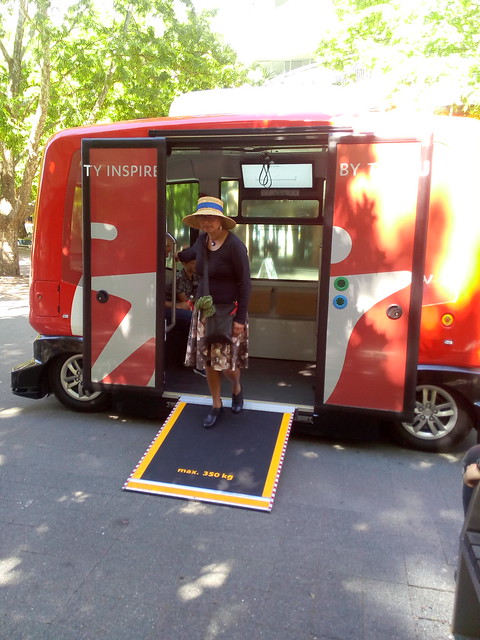
EZ.10 driverless electric shuttle bus from company Easy Mile, on demonstration run in Canberra's city center. Marghanita da Cruz steps out of the bus. The wheelchair ramp has been deployed, as part of a demonstration. This would not normally be used for ambulatory passengers.
Easy Mile EZ.10 Shuttle
Yesterday I went for a short ride on an EZ.10 driver-less electric shuttle bus from company Easy Mile, on demonstration run in Canberra's city center.  The bus traveled a few hundred meters through Canberra' central mall.  While it has a maximum speed of 40 kph, this was done at walking pace, as it weaved in between the street furniture.

The vehicle hold six people sitting in two rows facing each other and with room for another six to stand (or a wheelchair). There are very wide doors making entry easy. The vehicle is higher than it is wide and looks more like a cross between a lift and a golf buggy than a bus.

The ability of the vehicle to find its way between the obstacles in the mall was impressive, with a smaller turning circle than even a mini-van. Also it was able to deal with pedestrians who strayed into its path. When the vehicle's sensors detected a person it would first ring a bell (like that of an old fashioned street car), then slow down and, if the person was not out of the way, stop. No one seemed perturbed or frightened by the vehicle slowing making its way along.

There is also a  wheelchair ramp which can be deployed by the press of a button (the vehicle also kneels to make entry easier).

This would appear a practical form of transport around a university campus (the Australian National Universality could do with a half dozen such vehicles),  or a city center. It would be a useful way to get people to and from light rail and other more conventional forms of public transport.

Tomcar Military Electric Vehicle
While the EZ.10 is imported, this is an industry which Australia could enter. There are already Australian companies making small electric vehicles for farms, factories and the military. Our universities and high-tech companies have the expertise to design the software for the sensors to operate the vehicle.

The EZ.10 shuttle is on an  Australian tour it will be in Canberra today (Sunday) until 12 Noon and 1pm to 3pm, then Cairns from 4 to 8 December and Mooloolaba from 14 to 16 December.

Wednesday, November 30, 2016

Batteries for Smart Grids

Greetings from the Australian National University in Canberra, where Philipp Braun is speaking on how to work out the use of home batteries for solar panels (more formally "Hierarchical distributed optimization and predictive control of a smart grid").

Phillip compared a centralized versus distributed approach. With the centralized approach the electricity authority issues commands to the batteries to charge or discharge, with distributed the controller in each house tries to predict what will be needed. He has worked on an approach combining centralized and distributed approach: the central system sends out a suggested solution, which the local system then modifies.

While interesting, Phillip's approach does not allow for micro-grids. That is coordinating the households in a neighborhood. This is an attractive alternative as it can take into account how the households are physically wired together, as well as local climatic conditions which will effect solar power production and power use. As well as physical constraints making micro-grids practical there are also financial and regulatory reasons to coordinate household power, even if they are near-by.

Phillip is now at ANU, and has published a number of papers.

The Canberra based company Reposit Power, founded by an ANU graduate, produces systems for controlling home batteries. They recently featured in the ABC TV documentary "Battery powered homes".

Friday, September 25, 2015

Adding Battery Storage to Rooftop Solar in Canberra


Last week I dropped in on Dr Lachlan Blackhall, founded Reposit Power in the industrial suburb of Fishwick in Canberra. Lachlan's company is providing technology for Tesla's residential battery storage unit and for other battery systems.
Fishwick is a light industrial area with a mix of car yards, bulk whitegoods stores, sex shops, and high tech startups. In my previous job I visited companies programming the fire-control systems for Australia's warships here. Most of these tech companies are in anonymous light industrial buildings. But prominent in the defense sector in Fishwick is CEA Technologies, which has one of their CEAFAR Active Phased Array Radar mounted on the roof, making it look like the deck of a warship.

Reposit Power's office is less prominent, but he plug-in hybrid car parked out the back is perhaps a hint to what is inside.  Reposit produce software and commission hardware to work between a solar panel, the grid and a local storage battery, to optimize renewable power.

Monday, June 01, 2015

Canberra Start-up to Keep Tesla Charged

The Australian National University has reported that Reposit Power will be supplying software to Tesla for use in its Powerwall home battery system. Reposit Power was co-founded by Dr Lachlan Blackhall, who was awarded his PHD at ANU.  Lachlan was also the driving force behind a program at ANU to encourage students to set up their own companies. Now called "Innovation ACT' and including students of other Canberra universities, the program begins its 2015 challenge next month.

Wednesday, January 14, 2015

Electricity Storage for the Grid

Professor Donald Sadoway (MIT) will speak on "Innovation in Stationary Electricity Storage" at the Australian National University in Canberra, 11am, 22 January 2015.
Massive electricity storage would offer huge benefits to today’s grid, reducing price volatility, improving stability against loss of power, increasing utilization of generation assets by enabling us to design towards average demand instead of peak demand, and deferring the costs of upgrading existing transmission lines. When it comes to tomorrow’s grid, storage is critical to widespread integration of renewables, i.e., solar and wind, which due to their inherent intermittency present challenges for contribution to baseload. Comprising two liquid metals and a molten salt electrolyte, the liquid metal battery has been invented to offer colossal current capability and long service lifetime at very low cost, i.e., the price point of the electricity market. The round-trip efficiency of these batteries is greater than 75% with a duty cycle of 4 h discharge. Fade rates of 0.0002%/cycle have been measured which means retention of >99% of initial capacity after 10 years of daily cycling and 80% of initial capacity after 300 years of daily cycling.

Sunday, January 04, 2015

Replacing Rechargeable Batteries in an Cordless Drill

Battery technology has improved since 2007, when I replaced the batteries in a string trimmer. Recently I replaced the batteries in a low cost cordless drill. You can buy a replacement battery pack or replace the cells yourself. The drill I have had a battery pack with ten NiCd 1300 mAh sub-C cells (as fat as a disposable C size battery, but shorter). I found that AA size "pre charged" (or "Low Self Discharge") rechargeable nickel metal hydride (NiMH) cells are now available with 2300 mAh capacity at a reasonable price. So I could replace the batteries with smaller ones with more capacity and which will hold the charge longer.

Nickel-cadmium (NiCd) batteries can be replaced with NiMH, but you may need a different charger. The Lithium batteries used in laptops and newer power tools require very specialized charging and can explode or catch fire if not charged correctly. Only a Lithium battery specifically designed for the tool should be used. Do not substitute lithium batteries for other types.

The first step should be to ensure the battery to be replaced is discharged (check with a multimeter). Then remove the screws holding the pack together. Remove the sub-C cells (ten x 1.2 Volts for a 12 volt pack). Two cell in my pack were holding the battery's connectors in place and I decided to retain these (while electrically insulating them from the new cells with tape).
Battery Holder
To make up the new pack I wrapped a strip of silicon self amalgamating tape around one AA cell, then added one next to it and wrapped the tape around both, then a third and fourth. Then I soldered the batteries in series, using a soldering iron and insulated wire. This made a flat pack of four cells held slightly apart by the tape to provide some ventilation and cushioning. I then built another pack of four cells and pushed the two together, held by the stickiness of the tape. I then make a pack of the two remaining batteries and stuck them to the eight, wrapping tape around all. I used some closed cell foam to hold the cells in the battery case. If you are not confident with soldering, you can use a battery holder.

Digital MultimeterI tested the battery with a multimeter, to make sure the voltage and polarity were correct (and matched that of the charger). Apart from the drill not working correctly, connecting the batteries the wrong way (negative terminal to positive), may damage the drill, the charger or cause the battery to explode.

Sunday, June 09, 2013

Hand Cranked Torch with Supercapacitor

My Wind-up LED Flashlight stopped working so I replaced the battery with a supercapacitor. This works very well.

The torch was no longer showing any light, no matter how fast I cranked it. So I removed four screws and took the cover off the flashlight.
This revealed a
LR2032 Li-Ion Rechargeable Button Cell in a holder. The cell was reading zero volts with my multimeter.

The dynamo was generating around 4 volts, so it appeared the battery had expired. I did not have a replacement battery to hand, but I did have a 1 Farad 5.5 Volt supercapacitor. The capacitor is a bit smaller in diameter than the button cell and four times as thick, but there was plenty of room for it in the torch case. I soldered the capacitor to the battery holder's terminals and packed in some neoprene tape to hold it in place.

The light works for about three times as long with the super-capacitor as it did with the lithium ion battery when new.

ps: There are numerous  wind-up flashlights available, but I have seen nine which come with a super-capacitor.

Tuesday, May 17, 2011

Buying a New Mobile Phone Battery

The battery in my Sharp GX30i mobile phone now only lasts for about a 20 minute call. This battery is a replacement from Power Mart aka Topscope Pty Ltd, purchased in August 2009 for $19.95, plus $4.50 delivery. The original battery with the phone lasted more than four years, so the replacement only lasting about 20 months is disappointing. However, this is within the expected life of a Lithium Ion battery.

The company Battery Charger are offering a replacement for the SHARP XN-1BT30 battery, at only $7.69 (assuming they still have them). The catch is $10 for Australia Post registered delivery. While I am at it I might as well order another battery for a Motorola U9 as well (for $9.22). The company gets a positive mention in the Whirlpool forum.

I did consider a new smart phone, but the old 2G phone has worked reliably (being dropped many times) and carries out the main function of making phone calls. Also it would be a shame to create more e-waste by throwing out a functioning phone. Also there is an new range of higher function low cost smart phones about to come out, such as the HTC Wildfire S. That should cause the price of existing units such as the Huawei Ideos u8150, to drop to under $100.

Monday, October 04, 2010

Longer Life Rechargeable Batteries

Sanyo Eneloop Power Pack Kit with 8 AA and 2 AAA Batteries, plus 4 C and 4 D Size adaptersSanyo announced an improved version of their Sanyo Eneloop Low Self-Discharge Rechargeable Battery, 6 October 2009 . These are now avialable in Australia and I purchased two AA cells from Dick Smith Electronics in Canberra.

These are Nickel Metal Hydride (NiMH) rechargeable batteries, which can be charged in the same sort of charger as other NiMH batteries. The main advantage advantage is that the Eneloop batteries will keep a charge for years, while normal NiMH batteries only keep a charge for months. The new batteries are claimed to retain 85% of their charge after a year, whereas normal batteries would be 50% discharged. Also they can be recharged 1,500 times, 500 times more than conventional NiMH batteries.

This makes NiMH batteries practical for low current applications, such as running a clock, where they previously they would not be of use.

USB Charger with 2 Sanyo Eneloop AA batteriesAmazon.com adversities the Eneloop in AAA Battery 4 Packs
and the AA batteries in 4 Packs and 8 Packs. There is also mains powered charger with 4 AA batteries and a USB Charger with 2 AA batteries.

There is also a very elaborate "Eneloop Power Pack Kit" 8 AA and 2 AAA Batteries, plus 4 C and 4 D Size adapters.

There is a detailed "Review: Testing Sanyo's Eneloop Low Self-Discharge Rechargeable Battery" avialable, along with a comparison of the new Eneloop against other brand of batteries "Review: Pre-Charged (Low Self-Discharge) Rechargeable Battery Comparison".

It will be interesting to see if the technology is also applicable to batteries for hybrid and electric cars. One of the worrying costs with electric cars is replacing the battery pack. If the battery can be made to last 50% longer, that will reduce the cost. Also a car which can keep the charge longer will be more practical.

Sunday, March 28, 2010

New UPS Battery

When I moved into the Smart Apartment I was one of the first residents. The power would go off occasionally as building work was done. So I installed a small Uninterruptable Power Supply (UPS). This is a SOLA UPS 305 520. It looks like an oversize power board, with three sockets for equipment protected by the UPS and two ordinary power sockets. It has a small gel lead acid battery (Panasonic UP-RW12200CH1) which can supply power to a typical desk top computer for a few minutes while it shuts down in an orderly fashion (there is a data port on the UPS to tell the computer it is on battery power and should shut down). In practice the UPS would run for about half an hour with my modest computer set-up, longer than most power outages.

Recently the power went off and the UPS failed to operate for more than a few seconds. The battery needed replacing (they last only a few years). There is a separate battery compartment with a cover held on by one screw, so they are reasonably easy to replace. Care should be taken with a UPS, as it can generate dangerous high voltages, even when disconnected.

Gel lead acid batteries are sold by electronics shops, so I thought it would be reasonably easy to get a replacement. Unfortunately the commonly available batteries are the same dimensions as the Panasonic, but 10 mm longer. As a result the replacement would not fit in the case.

Rather than buy the battery 10mm larger, I decided to buy an even bigger one. The Panasonic unit has no capacity marking on it but appears to be about 4 AH (Ampere Hours). I noted that there was a sweet spot at 7.5 AH: the smaller batteries did not seem to be much cheaper and the larger batteries got significantly more expensive from this point on. The 12 volt 7.5 AH batteries are the size used by many UPS, home burglar alarms and the like.

So I bought a battery from Adelong in Sydney for AU$22.85. This has the same connectors as the smaller battery. I then just needed to cut a hole in the side of the battery compartment to fit the larger battery. It will not be elegant, but should work longer than the original.

By the way, you should, in general, not replace a rechargeable battery for one of a different voltage or chemistry (don't replace a 6 volt battery with a 12 volt one, or a lead-acid battery with a NiCad one). Also you need to take care you connect the battery terminals the right way around. The gel batteries have no polarised connectors: you can connect it the wrong way around. If you use the wrong battery, or connect it the wrong way, the result could be an explosion and fire. However, for those with the skills and confidence, replacing the battery in the UPS can save a lot of money.

Friday, November 13, 2009

Philips Bodygroom Shaver Disappointing

PhilipsNorelco BG2020 Bodygroom ShaverPhilips Bodygroom Shaver claims to to be able to trim and shave all body zones. The TT2021 model I purchased recently doesn't do either very well. The unit cost AU$66.44 at BigW, but I have since seen units offered at the Shaver Shop for AU$49.95 (some with a cash back offer from Philips as well).

As I discussed in December it would be useful to be able to do hair cutting and shaving with one gadget. When travelling, having to carry a razor to shave and electric clippers to trim my hair is an annoyance. Philips Norelco BG2030 Professional BodyGrooming SystemThere are some grooming kits such as the Phillips (Norelco in the USA) BG2030 Professional BodyGrooming System, which have a common motor body with separate clipper and shaver heads. Instead the TT2021 uses the one head for both.

The TT2021 looks like small oscillating electric razor with a trimmer on each side of the foil. It is not a rotary razor, like the usual Philips ones.

This design is a compromise. The foil area is relatively small and so it takes a long time to use it for shaving. The foil is relatively coarse and does not give a close shave (more of a five o'clock shadow look). The cut hair falls from the foil, making a mess and is not retained in the unit as with shavers.

The two trimmers are close to the foil surface and are activated all the time. This is useful as you can use the trimmers to cut longer hairs with one sweep and the adjust the angle of the unit slightly and cut the short hairs with the foil with the next sweep. However, on any concave curve of the body, either or both of the trimmers come in contact with the skin when you don't want them to, causing uncomfortable scraping.

The two trimmers work well on short relatively stiff hair. They do not work well on longer hair, such as on the head. The teeth of the trimmers are finer than those of hair clippers. If the combs are used these become clogged and have to be cleaned frequently.

I found the
TT2021 only useful for cutting longer hairs on my neck before using my regular shaver. I did not find it usable for cutting hair anywhere else on the body. The unit is not suitable for trimming and shaving all body zones, as claimed by Philips. With this unit you will still need a set of clippers for the head and a razor for the face and other parts of the body. Instead of having one all in one unit, you will end up with an extra unit.

The unit has good points, being well shaped to fit comfortably in the hand and water proof so it can be used in the shower. The charger stand works well. The battery life is very long, but I unfortunately found that out this morning when the switch stuck on and I could not turn the unit off. I will be returning the product to BigW for a refund.

Sunday, June 07, 2009

Aldi Ready to Use Rechargeable Batteries

Aldi Ready to Use Rechargeable BatteriesAldi is advertising AA and AAA Ready to Use Rechargeable Batteries. These are in packs of two for AU$7.99. The AA size are 2000 mAh and the AAA 800 mAh. These appear to be low discharge cells, simialr to SANYO eneloop , Sony Cycle Energy and Duracell Pre Charged. The advantage of these batteries is that they hold a useful charge for about a year and are compatible with chargers and devices which use ordinary nickel metal hydride (NiMH) rechargeable batteries.

Wednesday, May 20, 2009

Cordless drill used for brain surgery

As reported by the ABC and other media, Dr Rob Carson used a DeWalt cordless drill to a hole in the skull of a 12-year-old boy top relieve bleeding to the brain in Maryborough, Victoria.While obviously an emergency measure, cordless tools would seem to be a good choice for this as they would reduce the risk of electrocution. From the photos shown in the media, the unit used appears to be a DEWALT DC759KA 18-Volt Ni-Cad 1/2-Inch Cordless Drill.

Saturday, September 20, 2008

Pre-charged Nimh C Cell Batteries

The low self discharge AA batteries I installed in a String Trimmer seem to have lost their charge after just under a year. This may be because they were left plugged into a dumb charger (the batteries are supposed to be disconnected from the cgarged when the are charged and then hold their charge). Or perhaps a year is all that can be expected in a heavy duty application from these batteries. Sub C cells, which the trimmer originally had, should offer more power.

Tenergy are offering
Pre-charged Nimh C Cells on Amazon.com. The catch is that they are only 3000mAh capacity. It is likely these are actually AA cells fitted into a larger empty metal cylinder to make them up to C cell size. Other C cells are usually 5,000 to 10,000 mHa.

See also:
  1. Pre Charged NiMH batteries
  2. String Trimmers
  3. glue guns
  4. Battery chargers
  5. replacement battery packs

Friday, June 27, 2008

Sony Cycle Energy Rechargeable Batteries

Sony Cycle EnergyNi-MH Rechargeable BatteriesSony are now offering "Cycle Energy" pre-charged, low discharge NiMH Rechargeable Batteries. According to the Wikipedia, these are made by Sanyo. Presumably they are identical to the Sanyo eneloop, but cost a few dollars more.

Monday, January 21, 2008

Low Self Discharge NiMH C Cells

Low Self Discharge NiMH C Cells ( "ready to use" or "pre charged" 4500 mAh) are now being offered on Amazon at US$26 for four. These are branded "Accupower Evolution" and are claimed to have a self discharge rate of 2% per month. This is much lower than the rate for regular NiMH cells of 0.5-1% per day and high capacity cells having the highest self-discharge rates.

I have used smaller AAA and AA low self discharge batteries successfully, but have not yet tried the larger ones. Some tests of the smaller cells by users seem to be inline with the maker's claims.

Accupower are also offering Low self discharge D cells (10,000 mAh) but these do not yet seem to be widely available.

The lower discharge rate batteries might allow the use of smaller batteries in some applications, such as solar home lighting for remote areas using small solar panels. The batteries could be used with efficient LED lights, such as Flexible LED Tape Light emitting diodes (LEDs), to provide light where it is needed. The cost of the batteries and LEDs would be much higher than some alternatives, such as lead acid batteries and fluorescent lights, but because the LEDs can deliver the light where it is needed, the overall cost might be lower.

Friday, January 11, 2008

Solar garden lights an environmental hazard?

Solar garden lightsAccording to a pamphlet I picked up at the hardware store, the rechargable Nickel-cadmium (Ni-Cd) batteries in many solar powered garden lights only last 2 years. Apart from not represeting good value for money, Cadmium is a toxic heavy metal. Ideally a wired light should be used, but failing that, using nickel metal hydride (NiMH) "Pre Charged" would be better.

Monday, November 26, 2007

Replacing the Batteries in a String Trimmer

Cordless Line TrimmerA few weeks ago I replaced the cells in a mobile phone battery with new "pre charged" ones. This worked so well I have just done the same thing with a String Trimmer. This was not easy, but will be worthwhile, as the new battery should have twice the lifetime.

The "pre charged" (or "Low Self Discharge") rechargeable nickel metal hydride (NiMH) cells are available in AAA and AA sizes. They cost more than regular rechargeable batteries, but are claimed to be able to be charged 1,000 times, twice the usual. Also they have a lower self discharge rate. As a result they can be left for months before use.

Cordless Tool Battery PackThe string trimmer (also called a line trimmer), was a few years old and the battery pack was going flat after a few minutes use. The particular unit uses a Ryobi 12 Volt battery, similar to the battery in many cordless tools.

Repacking battery packs for cordless tools is a lot easier than for cell phones, as they are much larger and use standard size cells. The packs for cordless Drills and Garden Tools commonly contain sub-C cells (as fat as a disposable C size battery, but shorter). Higher voltage tools use more cells in their battery pack (1.2 Volts per cell, so 10 for 12 volts).

AA NiMH Pre-Charged Rechargeable BatteriesThe sub-C cells are commonly available with solder tags attached for making up into battery packs. However, I decided to replace them with the smaller
precharged AA cells. These cost about the same as the sub-C cells. They have about 17% less capacity than cheap sub-C cells, but they should outlast the C cells and retain their charge longer. Also, because they are smaller than the original cells, it is easier to pack them into the original battery box of the tool.

Rechargeable batteries should only be replaced with equivalent types (same chemistry). NiMH ones should be replaced with NiMH. Nickel-cadmium (NiCd) batteries can be replaced with NiMH, but you may need a different charger. The smaller "pre charged" AA cells should work fine in all but very high power drain devices in place of sub-C cells.

Lithium batteries used in laptops and some new power tools require very specialized charging and can explode or catch fire if not charged correctly . Only a
Lithium battery specifically designed for the tool should be used. Do not try substituting Lithium batteries for other types.

In this case the line trimmer came with a 12 volt NiCd battery pack. The trickle charger was rated at 300 mA at 12 volts, so I was reasonably sure that it could recharge the
NiMH batteries, without damage.

The first step should be to ensure the battery is discharged. I forgot to do this and was surprised by sparks when I accidentally shorted the terminals with a screwdriver. The next step is to remove the screws holding the pack together (in this case five). Inside were ten sub-C cells glued together, with connecting cables and straps welded on.

One cell was holding the battery connectors in place and I decided to retain this one (while electrically insulating it from the new cells with tape). Prizing out the old cells took some effort as they were glued in place, as well as being attached to each other. With one cell out it was easier to get the others out. I cut the straps connecting the cells together, being careful not to short the battery terminals.

At this point I discovered a small can with two wires attached, taped to one battery. This is a temperature sensor, used by a rapid charger to prevent overheating of the battery. The simple charger I have does not use this sensor, but I decided to retain it anyway and left it attached to the connector.

Battery HolderThe new set of cells fitted with room to spare. I could have used a battery holder to both hold the cells and electrically connect them, but decided not to (which I regretted later).

To hold the cells together I used high temperature glue from a glue gun. This may not be the best approach, but the cells should not get hot enough to melt the glue. I simply put four cells side by side, glued them, did the same to another four and glued that set on to of the first. The last two batteries went on top. I made the pack with some spacing between the cells, both to provide some room for air circulation to cool the cells and so the cells filled the container and did not rattle around.

Digital MultimeterThen I soldered the batteries in series, using a soldering iron and some insulated wire. At this point I regretted not using a battery box, which would have avoided the need for the soldering, which is difficult on the flat terminals of the batteries. With a battery box I would have just had to install each cell and connect two leads from the box.

I then soldered the two leads from the new battery to the old connector of the battery pack. I had some difficulty fitting everything back in the case, but succeeded after a few attempts. I then tested the battery with a multimeter, to make sure the voltage was correct and I had the batteries wired the right way around. Apart from the tool not working correctly, connecting the batteries the wrong way (negative terminal to positive), may damage the tool, the charger ,or cause the battery to explode.

Replacing the battery in the line trimmer showed it was working. I then tried it out on the lawn and then recharged the battery.

Of course, in the end it might have been easier to buy a replacement battery pack. ;-)

See also:
  1. Pre Charged NiMH batteries
  2. String Trimmers
  3. glue guns
  4. Battery chargers
  5. replacement battery packs


Friday, November 02, 2007

Replace your battery to save the planet

Pre Charged NiMH batteriesOne of the hidden environmental costs of modern gadgets, such as mobile phones, PDAs, MP3 players and digital cameras are the batteries used. Rechargeable batteries are better than disposable ones, for devices which are used often. But for devices used occasionally, rechargeable batteries can have a short life. Perfectly usable devices are replaced when they just need a new rechargeable battery.

Common nickel metal hydride (NiMH) rechargeable batteries will only last a few years, or about 500 charges. Also the batteries will self discharge even when not used, so for low power devices or ones you only use occasionally you will find the batteries flat when you go to use the gadget.

I bought some "Pre Charged" NiMH batteries (technically known as "Low Self Discharge Batteries") to replace the pack in a mobile phone. These cost a bit more than premium NiMH batteries (and about three times as much as the cheapest). They are claimed to hold a usable charge for a year and to be rechargeable twice a s many times. So far they are greatly extending the life of the phone. Currently these batteries are only available in AAA and AA sizes.

It should be noted that rechargeable batteries should only be replaced with equivalent types (same chemistry and size). The NiMH ones are reasonably compatible with different brands of chargers. However, Lithium batteries used in laptops require very specialist charging. You should buy a battery which is specially made for your device.

Many rechargeable devices which have custom battery packs can be replaced with third party packs, even after no longer available from the original maker. Also your old batter can be "repacked": the plastic case is prosed apart and new cells inserted. I repacked an old Ericsson phone battery myself, but this is something which should be left to specialists.

First I made sure that I had a spare battery pack in case I broke the pack. Then I checked the voltage and polarity of the pack to make sure I would make the new one the right way. The I prised the plastic case to find it had four extended NiMH AAA cells. I bought four AAA precharged cells. These were slightly shorter than the existing cells. I the had to solder the cells to make the battery and attach the terminals on the case and check the voltage and polarity with a meter.

At this point I made the major mistake of using my hot glue gun to stick the cells in the case. I then found the cover would not fit due to excess glue. I then reheated the glue and tried again. At this point I got a little desperate and so first stood on the pack to close it and then applied a hammer a few times (do not try this at home). Eventually the case closed and the battery worked. At least I found the batteries are reasonably robust. ;-)

Repacking battery packs for cordless tools is a lot easier, as they are much larger. These packs commonly use sub-C cells (as fat as a C size battery, but shorter). The sub-C cells are commonly available with solder tags attached for making up into battery packs. However, it may be worth replacing the sub-C cells, with the smaller
precharged AA cells. In theory this will result in a loss of 40% capacity, as sub-C cells are available with 3300 mAh, whereas the AA cells 2000 mAh. However, the cheaper sub-C cells can be as low as 2400 mAh and are of questionable quality. For about the same cost, high quality AA cells will start out with 17% less capacity, but retain their charge better and outlast the cheaper batteries.

See: Pre Charged NiMH batteries