Showing posts with label solar power. Show all posts

Wednesday, October 11, 2023

Solar Car Palaces to Save the Planet

Solar carport at Addison Road,
Photo by Tom Worthington CC-BY 2022
This is to suggest promoting carports covered with photovoltaic panels (called "Car Palaces"), to reduce greenhouse gas emissions and free up resources to build more accommodation. Currently in Australia, it is common to have houses with one or two car garages built in. As they are built into the house, the same quality of materials intended for people have to be used for cars. Many of these homes then have solar panels installed over the roof cladding. The cladding is commonly tiles, which are difficult to fit solar panels to. The Addison Road Community Center in Sydney has an example of an alternative: a two car solar carport, with charging, built from standard components.

I suggest encouraging, through legislation, marketing, and incentives, homes which have freestanding carports, covered with solar panels. This would have the advantage of lower cost, as the solar panels would provide the roofing. Also the carports could be prefabricated, for quick erection. The carports could also be designed with provision for batteries, electric car charging,  heat pump hot-water system and air conditioner.

The capital, labor, and materials saved could be used to build additional accommodation for the homeless. However, there would need to be regulation, and incentives, to prevent homes simply getting larger. If garages were eliminated, along with underutilized Media Rooms, and spare bedrooms, enough additional accommodation could be built within a few years for all those currently homeless.


Sunday, August 28, 2022

Solar Shed at Addison Road Sydney

Dropping in to the Addison Road Community Center for the Sunday Markets in Sydney today I noticed a new two space carport added in front of the community hall. What looked like a simple structure with a roof and no walls turned out to be a revolutionary development which can save the world. 

The roof is made of photovoltaic solar panels. Let me repeat that: the roof is
 made of solar panels
. This is not the case of a building with a roof, where panels have been added, they are what keeps the rain off and is part of the structure. There are cover-strips with flexible seals to prevent water leaking in between the panels, and channels to carry the cables from each panel, so they don't hang down. 

Saturday, November 27, 2021

Power for the outdoor office

Bicycling through Haig Park in Canberra, I wondered what the people sitting at tables all spaced out under the trees were doing. It turns out this was Outside Offices, by local co-working space Good Work Canberra and the ACT Government. One element which might spoil the calm is a generator. 

Having been the Net Traveler, for more than two decades, I have telecommuted from hot air balloons, warships, and tents. Power problems are largely solved with lithium batters and solar panels. 

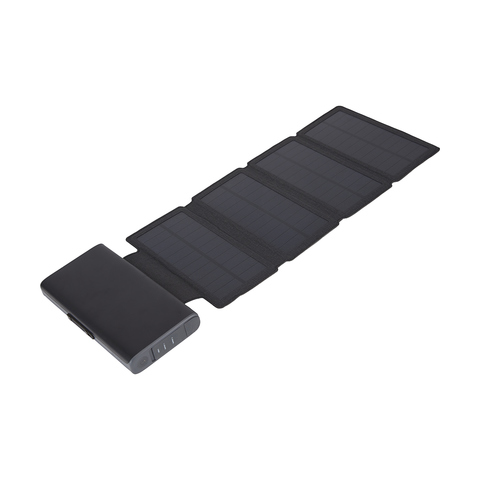
In 2019 I attended the Yaama Ngunna Baaka Corroboree Festival in far western NSW. There were several hundred people camping out. Being a tech person, I took along a collection of solar panels, and power banks, to charge people's gadgets. What proved most useful were power-banks with attached fold-out solar panels. Kmart have one with an 8 Watt solar panel and 15000mAh battery for $55. There are higher power panels and batteries available, but then there is more to carry, and more cables to connect.

Thursday, April 12, 2018

Container Roll-Out Solar System

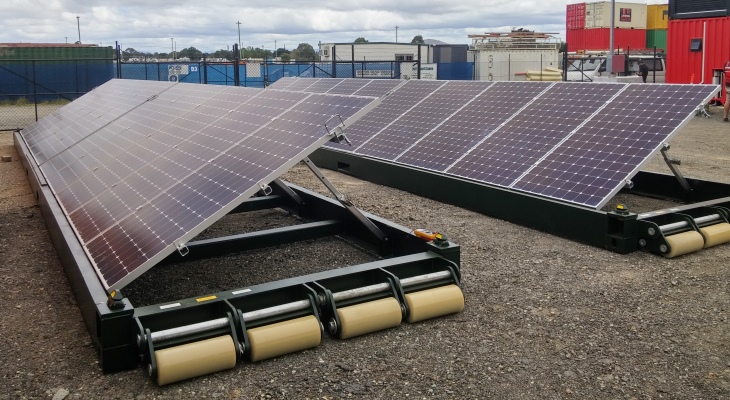
ECLIPS Engineering demonstrated their Container Roll-Out Solar System (CROSS) in Canberra today. These are standard solar panels attached to a hinged framework mounted on a shipping container compatible platform. This can be sued to reduce military fuel use.

The demonstration was held at the Canberra drag-strip, normally used for Street Machine Summernats Car Festival. In place of high speed cars there was a forklift which unloaded the solar panels from a shipping container. 

The system is designed to provide power for military forward bases and mining camps. A stack of platforms is transported to the site in a standard 20 or 40 foot shipping container. The container is stacked with platforms, each fitted with 5 or 10 solar modules. Each platform is slid out, placed on the ground and then the panels hinged up to face the sun.

The panels are standard domestic units, mourned to an aluminum frame with standard brackets. While made of glass, the panels are reasonably robust. The steel platform they are mounted on appears heavy enough to keep the panels in place in the strongest wind.

This appears a workable system for military use, but may be over-engineered for civilian applications. The platform used is derived from one used for transporting tens of tonnes of supplies. The 20 foot unit weighs more than 1,350 kg, of which less than one quarter would be the panels and their frame. A much lighter platform might be developed to hold the few hundred kilos of solar panels. This would particularly useful for transport by air.

Friday, September 25, 2015

Adding Battery Storage to Rooftop Solar in Canberra


Last week I dropped in on Dr Lachlan Blackhall, founded Reposit Power in the industrial suburb of Fishwick in Canberra. Lachlan's company is providing technology for Tesla's residential battery storage unit and for other battery systems.
Fishwick is a light industrial area with a mix of car yards, bulk whitegoods stores, sex shops, and high tech startups. In my previous job I visited companies programming the fire-control systems for Australia's warships here. Most of these tech companies are in anonymous light industrial buildings. But prominent in the defense sector in Fishwick is CEA Technologies, which has one of their CEAFAR Active Phased Array Radar mounted on the roof, making it look like the deck of a warship.

Reposit Power's office is less prominent, but he plug-in hybrid car parked out the back is perhaps a hint to what is inside.  Reposit produce software and commission hardware to work between a solar panel, the grid and a local storage battery, to optimize renewable power.

Saturday, May 02, 2015

Fossil Fuel Lifestyle on a Renewable Budget

Frank Jotzo and Luke Kemp, from the Australian National University, produced the report "Australia can cut emissions deeply and the cost is low" (2015) for the World Wildlife Fund. That is a bold claim to make and, as I encourage my sustainability students to do, I thought it worth doing a back-of-the-envelope calculation to see if it is possible.

Jotzo and Kemp suggest Australia can be carbon neutral by 2050 though:
  1. "Ambitious energy efficiency improvements throughout the economy.
  2. Low carbon electricity supplied by either 100% renewables or a mixture of renewable energy and carbon capture and storage (CCS).
  3. Electrification and fuel switching towards biofuels and gas. 
  4. Reducing non-energy emissions through carbon farming and forestry, process improvements and CCS in energy intensive industrial applications."
But rather than make a whole of nation calculation, can a single householder maintain their lifestyle and be carbon neutral? The back of my ActewAGL electricity bill indicates that a one person household uses about 10 kWh of electricity a month.

A Nissan Leaf electric car has a range of 117 km with a 24 kWh battery, or 0.2 kWh per km. The average car is driven 12,881 km a year, or 1,073 km a month, which would require 220 kWh.

Assuming your job takes another 2010 kWh per employee per year, or 168 kWh a month.

That is in total, per month:
  • Home: 10  kWh
  • Transport: 220 kWh
  • Job: 168 kWh
  • Total: 398 kWh

Annual average solar radiation for the least sunny parts of southern Australia is 12 MJ/m2 per day, or 101 kWh/m2 per month. Assuming photo-voltaic system with 15% efficiency, this would be 15 kWh/m2 per month.

So the householder would need 27 m2 of solar panels. A modest one bedroom, one story home would have a roof area sufficient for this and so be able to generate enough energy for a reasonable Australian lifestyle.

Please note that I have not allowed for the energy needed for food production, manufacture of goods or their transport, nor losses for storage of energy. But also I have not allowed for the savings in energy from multiple dwelling households and use of public transport.

Also there is the issue of cost. Assuming PV solar panels cost $2,000 per kW (including installation) and get 3 hours of peak sun a day, producing 91 kWh a month. To power the single dweller's lifestyle will cost about $8,700 in PV panels. However, if these were installed as part of a manufactured home's roof the cost may come down to $4,400 (and lasting 10 years).

But the householder will also need batteries to store energy, which is where renewable energy becomes expensive. The 24-kWh battery pack for a Nissan Leaf costs $6,500 and is expected to last 8 years. The householder will need 13 kWh a day, even when the sun is not shining. Enough batteries for three days electricity supply would cost $10,600, or  about $111 a month.

However, this all assumes no energy saving measures, which Jotzo and Kemp point out can make a difference. As an example, while the typical one person household in Canberra uses 10 kWh of electricity a month, my energy efficient apartment uses about half that. Also I can walk to work, at my home office or corporate office, most days and so drive my car about one tenth the national average. As I need little more than a computer, my workplace uses about one half the amount typical. Adding up all this, per month:
  • Home: 5 kWh
  • Transport: 22 kWh
  • Job: 76 kWh
  • Total: 103 kWh
This would require a 7 m2 PV panel costing $2,300 and $2,700 of batteries, or $48 a month. There would be enough room on the roof of an three story apartment block for the solar panels to power each apartment.

The above figures are approximate "back of the envelope" calculations. However, they are relatively conservative and suggest a comfortable Australian lifestyle could be carbon neutral using current technology.

Thursday, April 16, 2015

Bankability of Large Solar Arrays

Greetings from the Australian National University where Rhett Evans from UNSW is speaking on
(UNSW SPREE)
"Understanding the technical justification of bankability requirements in large PV installations". He commented that photovoltaic (PV) panels are an immature product at the stage of TVs in the 1960s (bought from a specialist TV store). Also he claimed that almost all of the cost-effectiveness of PV has come from improvements in manufacturing, not from the efficiency of the cells. In his research he concentrates on the technical assessments which underpin large scale solar investment (and what can go wrong). Rhett pointed out that research shows that the major failure cost with PV is not the cells or panels, but the electronics in the inverter.

It occurs to me that PV panels, on their own, may not be a "product" at all. The emphasis has been on making solar cells which can produce electricity at a price to compete with coal fired power stations. However, consumers don't buy power from power stations, they buy it from a distributer after it has been delivered over a distribution network. Much of the cost to the consumer is not the cost of generating the power, but in allowing for peak use, distribution and the cost of selling at the retail level. The cost of electricity to the consumer is made up of (approximately) 45% wholesale, 45% network and 10% retail cost. So for power which the consumer produces for their own use on site will not be subject to the network or retail costs. Also consumers don't want power, they want hot water, cooling, cooking, lighting and gadgets. It might therefore make sense, for example, to provide heating and cooling closely coupled to the PV panels. This may not be worth retrofitting to existing individual bespoke detached houses, bit worthwhile for factory made modular homes and apartment blocks.

One of the implications for Rhett's work on Failure mode, effects, and criticality analysis (FMECA) is that perhaps inverters should be kept separate from PV panels, so they can be easily fixed.

Thursday, March 26, 2015

Redeployable Hybrid Solar/diesel Power Plant

Company Laing O’Rourke has built a 1MW redeployable hybrid solar/diesel power plant. This can be packed up a moved by truck. It would also have application for the military where bases need increasing amounts of power and reducing fuel deliveries increases safety. The Laing O’Rourke's Re-deployable Hybrid Power Product Development Report shows how solar panels are assembled onto frames which can be stacked for transport then quickly erected on site. However, it would be useful for the military if the frames were small enough to be set up by hand, without the need for a crane, and so they would fit in a helicopter.

Friday, December 05, 2014

US Government Continues Criticism of Australian Climate Change Policy

Greetings from the Australian National University where the Light, Energy and the Environment Congress plenary is being held. The US Ambassador introduced Dr. Steven Chu, Professor of Physics and Molecular & Cellular Physiology and former U.S. Secretary of Energy. Dr. Chu was the first energy secretary who was a scientist and was charged with increasing renewable energy use.

This acceptance of the need for action on climate change by the US Government contrasts with Australia, where reports indicate that the Australian Trade and Investment Minister will be sent to climate change talks in Peru, to ensure that the Foreign Minister does not agree to carbon emission reduction measures. The support for Dr. Chu's visit to Australia appears to be a continuation of the criticism of Australia's climate change policy by the US government.

Dr. Chu pointed out that there were significant oil shale deposits yet to be exploited around the world. He also criticized Russia for warning of the environmental effects of shale oil exploitation in Improper while proceeding with it in Russia. He suggested that the world should not wait for this oil to run out before changing to renewable energy sources.

Dr. Chu the drew parallels between anti-smoking campaigns and global warming. The public health problem is that there are decades between the time a person starts smoking and resulting disease. This makes it difficult to first find the cause-effect relationship, then convince the public to act and finally for health to improve. Dr. Chu pointed out that the ratio of isotopes of carbon can be used to show the increase of carbon dioxide in the atmosphere is due to human activity and is not due to natural causes. He pointed out that the effect of increased carbon dioxide levels will take hundreds or a thousand years to recover.

Dr. Chu claimed that wind and solar power will be cheaper than coal and nuclear power within ten years. He pointed out that when the environmental cost of carbon dioxide pollution is included, renewable energy is already cheaper than coal (obviously this does not apply to Nuclear power). Dr. Chu predicted a cost of 50 cents per watt for solar panels by 2020. However, Professor Loren Brandt previously pointed out vulnerability in the Chinese solar industry, which dominates the world market. Also Dr Renate Egan, has pointed out that by 2013 the cost of the PV panels for a domestic solar installation was less than the cost of the system. The installation cost is lower with large scale industrial installations. Dr. Chu mentioned that companies such as Solar City lease domestic roofs for energy production and the regulatory costs could be reduced to make this more efficient. Also he suggested that production line techniques could be sued for installation. But I suggest there is considerable scope for Australian companies to innovate in how to sell and install solar power.

Dr. Chu is also be speaking at the ANU ECI Energy Update, next Tuesday, 9 December 2014.

Monday, November 17, 2014

Canberra's Low Carbon Future

Greetings from the "2014 Solar Oration" Australian National University where Simon Corbell MLA, the ACT Minister for Environment & Sustainable Development is making a few preliminary remarks. He is discussing Canberra’s renewable energy target of 90% by 2020. He emphasized the adverse effects which global warming would have on Canberra, under a "business as usual" scenario without effective carbon emissions reductions. He welcomed the announcement of action by the USA and China, but criticized the Australian government for a lack of action. However, the minister then mentioned the ACT Government's own reverse auction for renewable energy, which is using an approach not significantly different to the process the Australian government proposes to use.

The Oration Speaker is Greg Bourne, Chair of the Australian Renewable Energy Agency. Mr Bourne described the Prime Minister's comments on "Coal is good for humanity" as being "Out of touch". He described failing to act on climate change as "environmental vandalism". He expects the US President's action to have a significant global effect. The audio, slides and text of Mr. Bourne's presentation is available.

But Mr. Bourne is chair of the board of a government agency charged with increasing the supply of renewable energy in Australia. The Australian Prime Minister clearly does not support renewable energy. However, ARENA's mandate comes from the Australian Parliament, not the executive arm of government.

Mr. Bourne discussed the difficulties for fossil fuel producing companies to transition to provide renewable energy. He described this as a process where a renewable project is started in good times, but not sufficiently fudned and cut when there is an economic downturn.

Thursday, June 12, 2014

Chinese renewables sector

Greetings from the Australian National University in Canberra, where Professor Loren Brandt from University of Toronto is speaking on The Chinese renewables sectors: A case of wilting greens?". He pointed out that manufacturing makes up 85 to 90% of Chinese exports.As ell as economists, he argues that engineers are needed in the analysis of China's industry. An overriding issue for the Chinese government is to maintain economic growth. This is an issue, I suggest the current Australian government sees as an overriding issue, placing climate change as a lower order issue. Professor Brandt showed a photo of Beijing smog as an example of the environmental problems. The issue for the Chinese government is to address serious environmental problems without harming economic development. This I suggest becomes a priority for the government when the environmental problem become so severe it causes dissent by the citizens.

Professor Brandt pointed out that Chinese policy promoted solar and wind power and this has been well received by commentators. As well as providing power, China has established significant international renewable energy industries. China provides about two thirds of the world's photovoltaic panels.

However, Professor Bandt cautioned that the rapid growth of the renewable sector caused inefficiencies, with a lack of coordination within the power system and levels of government. Also the incentives for firms cause distortion. Similar problems occur throughout the Chinese economy.

Professor Bandt expressed concern that half of GDP goes to investment. Half of the investment goes to high return investment and half to very low return investments

While renewables have been expanding rapidly in China, but they are still a small proportion of generating capacity. Professor Bandt showed a graph showing that thermal energy (mostly coal) dominates Chinese energy use.This is of relevance to Australia, which no only can continue to sell coal to China, but also technology for increasing the efficiency of coal use, such as CSIRO's Direct Injection Carbon Engine (DICE) and Direct Carbon Fuel Cell (DCFC).

 Professor Band pointed out that within six years China was able to go from foreign firms in China to Chinese firms supplying their own market. This did not seem surprising to me as the Chinese government has policies requiring foreign firms to partner with local firms to encourage technology transfer. A similar transfer has taken place with high speed railway and automotive industries. Other countries, such as Korea, take a similar approach. In some areas foreign firms have been reluctant to supply advanced products for fear of being copied by Chinese firms (particularly in the defence and aerospace industry with Russian military aircraft).

Professor Bandt  pointed out that the wind turbines are installed in the sparsely populated remote north west and north of China, whereas the demand is in the coastal south east. The result is that perhaps 15% of the potential wind generating capacity is not being used. The generated power can't be transmitted to where it is required. This is where, as Professor Bandt pointed out, some engineering knowledge is needed. Apart from increased grid capacity and installing capacity nearer the users, it may be possible to utilize storage to better use renewable capacity. If wind power can be stored it can then be provided when needed

Professor Bandt argued that China's industry success has been based on incremental improvements on existing western technology. I am not sure that such an analysis make much sense. In particular, major improvements can be made with a product with what appear to be small improvements, by improving the manufacturing process. The end product may not look much different, but it will be much cheaper and more reliable. Cost and reliability are very important in the energy industry and in others (such as transport).

Professor Bandt argued  that the Chinese government policy is distorting company's R&D policy by setting priorities which may not match the customer's requirements. He gave the example of incentives for Chinese wind turbine developers to make larger units. However, there are economies of scale with wind turbines, so it makes sense to aim for size. Professor Bandt argued that China's wind turbine companies were not competitive outside China.

In contrast with wind turbines Professor Bandt argued that the photovoltaic panel industry had been successful with exports, perhaps due to less government policy. I suspect this partly because economies of scale and incremental production processes have favoured solar cells.

One aspect which Professor Bandt did not mention was the need for highly trained and experienced staff to design and build products. Also it would be interesting to consider how much of this analysis would apply to the service sector. As an example, how efficient is China's university sector and can it compete with western universities.

Tuesday, June 03, 2014

Nano-Antennas for Military Solar Power and Sensors

Greetings from the Australian National University in Canberra, where Arnold McKinley is speaking on how nano-scale antennas can be used for collecting solar energy. He started with a reminiscence of communicating with ham radio as a child, using a ring antenna. He has been researching how to use a similar antenna but at nano scale for collecting solar energy. The mathematics of how this works is beyond me, but it has some interesting possible uses beyond solar power.The technique might be used to absorb energy to form a stealth coating for an aircraft, which could also act as a sensor. The result would be that the entire skin of the aircraft could act as an antenna.

Tuesday, May 13, 2014

Nano-Antennas for Solar Power and Sensors

Arnold McKinley will speak on how nano-scale antennas can be used for collecting solar energy and other uses for such technology, at the Australian National University in Canberra, 2pm 3 June 2014. Arnold has a background in designing practical devices for the solar power industry and the ability to explain such technical topics clearly. Apart from power, his research could have application in the development of sensors for the military and in remote environmental monitoring.

The Physics and Mathematical Theory of Nano-scaled Ring Resonators and Loop Antennas for Meta-material, Solar, and General Nano-photonic Applications.

Arnold F. McKinley (Centre for Sustainable Energy Systems)

SOLAR SEMINAR SERIES PhD Final Seminar

DATE: 2014-06-03
TIME: 14:00:00 - 15:00:00
LOCATION: Engineering Lecture Theatre
CONTACT: niraj.lal@anu.edu.au

ABSTRACT:
Closed circular rings were never very good antennas for radio frequency communications. But in the early part of this century, someone shrunk one down to millimetre size, put in a single gap, spread out a number of them in a 3-D array and thereby made the first invisibility cloak. Since then closed rings and split-rings (ones with gaps) have been found useful for high definition imaging, radiation beam control, tiny Fresnel lenses, single photon emitters, medical sensors and a host of other applications. I wanted to use them to enhance light capture in solar cells. I was surprised to learn that most of the applications noted, were applied in the microwave region and that no one had developed a general physics or mathematical theory of rings for the teraHertz, infrared and optical regions. This thesis rectifies that by applying low frequency antenna theory to nano-scaled loops; that is, to rings on the order of 300 - 1000 nm in circumference. I am happy to say that we now have an analytical theory that will provide us with the resonances, current distributions and radiation patterns of any sized circular loop, of any useful thickness, with any useful number of gaps, constructed of any material for which we have measured index of refraction data.
This talk will present the physics and the theory of rings in the radio frequency region and show how the theory was extended to the optical region. I will show how the theory was then extended further to incorporate multiple gaps around the periphery. Matlab code was written to perform many different kinds of calculations and I will end by showing calculations of resonances and current distributions for rings made of metal and for rings made of dielectric materials, such as Silicon and Germanium.
In questions and answers we can talk about how these results might be used.

BIO:
Arni holds three Master's degrees, two of them in Engineering from Stanford University. In the 1970's, he worked at Stanford's Institute for Energy Studies and at the Center for the Study of Social Policy at Stanford Research Institute (now called SRI, International). In the 1980's, he taught Physics and Electrical Engineering for four years at San Diego State University and worked at Apple Computer for two years before starting a 25 year computer programming career. His main contracts were with scientific laboratories and academic institutions. His last work before coming to the ANU was with a solar startup company working on micro-inverters for PV modules.

Tuesday, December 10, 2013

Bulk Energy Storage for Renewable Energy

Greetings from the Australian National University Energy Change Institute, where Peter Rood from General Compression is speaking on Bulk Energy Storage. He discussed two types of bulk storage: Pumped-storage hydroelectricity and Compressed Air Energy Storage (CAES). Pumped hydro has a low capital cost where an existing hydro-electric system is used, such as Snowy Hydro's Tumut 3. Natural Gas Fired CAES is added to natural gas turbine power station. At times of surplus power, compressed air is pumped into a reservoir, usually an underground chamber. At times of energy need the compressed air is used to drive the turbine, without the need for natural gas fuel. More advanced systems extract heat from the compressed air and stores it separately in a liquid. The heat is then added back into the air during decompression.

Peter pointed out that as well as supplementing a conventional power station, energy storage can be used to allow a renewable intermittent energy source (such as wind and solar) to be used as a base-load supply.

General Compression uses a electric motor/generator connected to water cooled two stage pistons to compress the air. Interestingly the system uses a hydraulic motor/pump between the electric and air systems. Their pilot system is 2MW, but the system can be expanded.

Peter commented that the engineer technology used is based on that of automotive engines (whereas to me it is reminiscent of steam engines). Perhaps the Australian Government would be interested in a grant to investigate having former automotive workers manufacture this equipment in Australia using surplus capacity at car plants. This would provide Australian jobs as well as lowering Australia's carbon emissions.

Bulk energy storage projects offer unique benefits over smaller distributed storage technologies. Primarily driven by the significantly lower relative costs achieved though economies of scale and the ability to store energy for tens of hours, bulk energy storage projects allow for energy storage to be deployed at the megawatt scale on transmission and distribution networks. Core bulk storage applications include firm renewable energy projects, network level integration of distributed PV generation, and no or low-carbon supply of ancillary services.
Compressed air energy storage (CAES) is one of two primary types of bulk energy storage , the other being pumped hydro, and store energy as compressed air in under or above ground vessels. General Compression is a Boston, USA based technology development company that has developed a near-isothermal compressed air energy storage system. Traditionally CAES projects have used natural gas to add heat to the generation portion of the process, General Compression's technology captures heat generated as electricity is converted to compressed air and reintroduces that heat during the generation process eliminating the need to burn natural gas making the technology fuel & emissions free.

More information, please see http://cecs.anu.edu.au/seminars/more/SID/3429


Tuesday, August 20, 2013

Reducing Military Fuel Use with Solar Power

The US military have tried a number of energy saving programs, under the DoD Facility Energy Strategy. These are for energy reduction and alternate energy production schemes on fixed military bases. There are also deployable systems such as one from Lockheed Martin for the US Air Force Basic Expeditionary Airfield Resources (BEAR) program, which fits in three standard shipping containers. There is a trade-off between the portability of a power system and its cost: at one extreme the power system can be permanently installed on a base, at the other it can be something an individual soldier can carry around (or wear on their uniform).

The Australian Defence Force (ADF) can't afford to spend too much building many such systems. I suggest one "sweet-spot" is for deployable, shipping container sized modules (as used for the US Air Force system). A shipping container sized module can be built in a factory and transported to a military base and set up to operate. When needed, it can be packed up and shipped to a bare base to supply power. Shipping containers can be transported by civilian trucks, trains and ships, as well as military helicopters and fixed wing aircraft.

As a target size I suggest an ISO 20 Foot Shipping container. This is large enough that commercial off the shelf power systems can be used, but small enough to be moved easily. The industry standard for a shipping container allows 30,400 kg maximum
gross weight. However, the RAAF's larget helicopter, the Boeing CH-47 Chinook, can only carry 12,700 kg, allowing for 10,500 kg of equipment in the container. The weight is unlikely to be the limiting factor, as while diesel generators are heavy, solar panels are not.

The USAF containerized power supply requires three containers and considerable setup. This is not ideal for deployment on a military operation, where speed is of the essence and there is limited skilled labor available. I proposed the Australia unit should be usable with one container (but expandable with multiple units). It should be able to be assembled, or disassembled, by one technician who has received three hours of familiarization, supervising four military personnel who have received no special training, in six hours. There should be no tools or additional equipment required, apart from what comes in the container.

Container Contents

The container would have mounted in it a conventional diesel generator, power regulating electronics and a fuel tank (for seven days supply). There would also be space for solar panels, the framework to mount them, cables, tools and manuals.

A container has a volume of 33.1 m³. Assume a design which provides a conventional diesel generator and 20% solar power (a cost effective combination) and seven days fuel supply (on diesel alone). It is then necessary to calculator what capacity system would fir in the container.

Solar Panels

The Sharp NU-A188EY solar panel has a typical output of 188W and is 1328 x 994 x 57.5mm and weighs 16.5kg. Assuming an adjustable stand (which doubles as a cradle in the shipping container) and cables for this doubles the volume and adds 25% to the weight of the panel, this makes volume of 0.15 m³, or 0.807 m³/kw and 110 kg/kw. Assuming the entire container was filled with these panels, there is room for 220, providing 41kw. However, there has to be room for a generator and fuel.

Generator and Fuel

A typical generator set (CAT 300 kVA : 3406C) is 4.3 x 1.1 x 2.2 m,10.2  m³, or 0.034 m³/kw. It weighs 3,454 kg or 12 kg/kw. The fuel required, running at 50% power is 38.5  l/hr. Assume the solar panels replace 25% of the fuel, reducing consumption to 29 l/hr, or 4.9 kl per week, or 0.016 m³/kw and 163 kg/kw (allowing for tank).

Calculating Capacity of a Containerized System


-->


0.807

m³/kw Weight kg/kw
Solar panels 0.807 110
Generator 0.034 12
Fuel 0.016 163
Total 0.857 285


ISO Container

Volume ISO m³ 33.1
Possible kw 37
Volume m³ 32
% total capacity 86%
Equipment kg 10545
Container kg 2200
Total weight kg 12745
CH47 Capacity kg 12700
% total capacity 100%

So allowing for solar panels, generator and one week's fuel, a shipping container could hold a 37 kw power supply. The capacity of the container would be limited by weight, rather than volume.

However, the ADF  already has diesel generators. So a simpler alternative energy supply would be one purely solar powered. This would remove the safety  issues around transporting liquid fuels. An ISO container could hold a 41 kw solar array, which could then be linked to one or more diesel generators.

Cost

Assuming $2,000 per kw for solar panels, mounting hardware and cables. A diesel generator costs about $300 per kw. Allowing for the cost of the container and construction, the cost would be about $200,000 per unit.


-->
Cost $/kw
Solar panels $2,000.00
Generator $302.00
Fuel $25.00


Total per kw $2,327.00
Total for module $86,099.00
Shipping container $5,000.00
Total Materials $91,099.00
Build factor' 200.00%
Total $182,198.00

Number of Containers

A reasonable deployable solar capacity for the ADF to aim for would be 200 shipping container sized modules, producing 7.4 MW, at a cost of $40M. That might sound like a lot of shipping containers and money, but they would all fit in the Navy's two LHD ships, now under construction at a cost of $2B.

Smaller Containers and Modules

Smaller containers might be a more practical option, allowing for more flexible use and transport on smaller vehicles. A ten foot ISO container could hold a 18.5 kw PV system, using a standard military generator such as Advanced Power's 16 kVA, APD016. Also for maximum flexibility, the equipment should not be permanently mounted in the container. The container could have minimum modifications from a standard unit, with a generator and fuel tank which can be removed for separate use. The PV panels which could be in packs which can be carried out by two personnel and set up by hand, with no lifting equipment required.

PV Panels to Supplement Small Generators

An area for research would be solar panels designed to supplement smaller standard military diesel generators, regulate their voltage output and make them "smarter" and more fuel efficient. 727 Watt PV modules with built in power conditioning electronics could be made light enough to be moved by two personnel (about 80 kg). Two modules could be paired with a small diesel generator, such as Advanced Power's 1.3 kW APD1300, or four with the 2.5 kVA, APD2500. These configurations would be small enough to be transported by the Light Cargo Trailer of a Mercedes-Benz G-Wagon and a medium utility helicopter.

Normally connecting a PV array to a generator is a complex process requiring a trained technician. Instead the modules could be fitted with their own electronics and a simple plug and socket to connect in between the generator and the load. There would be no need for any controls on the PV panel: it would be simply plugged in and supplement power from the generator, lowering fuel use and providing a constant voltage for sensitive systems.

Scope for Research

Packing a solar array into an ISO shipping container would require some design and engineering, but is not particularly difficult. Further work could suit the system more for the military environment. In particular commercial solar panels are bright blue with a glass cover. Research could produce a camouflaged panel which was also less liable to breakage.

Thursday, August 15, 2013

Duck Chart Threatens Renewable Energy Expansion

Greetings from the Australian National University in Canberra, where Arnold McKinley, is speaking on "PV-Grid Integration Issues in the United States, Recent Developments, 2013". He showed what a graph of non-renewable energy demand over a day, showing a large dip during daylight hours (when solar panels provide power) and then a steep climb at sunset. The graph resembles a duck, thus the term a "duck chart". This represents a danger to the network as it is difficult to supply the sudden rise in power need during the evening, when the sun goes down (so solar power is not available), just as people get home to cook dinner and demand more power.

There are also problems caused by the rapid changes caused by solar panels as clouds cross the panels. This can cause voltage fluctuations on supply lines. Arnie discusses some low-teach solutions, such as heavier gauge wire to overcome some problems. A higher tech solution is to use smart inverters on the solar panels which help adjust the voltage.

One interesting option presented was power-pole mounted solar panels. This makes use of space the utility company already owns and the panels each have a smart inverter to help regulate the voltage as well as supplement power use.

It occurred to me that not-very-smart appliances in homes might help stabilize the grid. As an example, could smart phones and tablet computers be programmed to stop charging their batteries when the grid is stressed. In addition large power appliances such as air-conditioners could switch to low power.
ABSTRACT: The first global energy crises of 1973 and 1979 initiated a large number of energy studies within the United States that outlined future energy scenarios. Many experts expected a growth in solar and other renewables during the last few decades of the 20th century. That expectation did not occur, primarily because the crises disappeared and the price of oil in the US remained low. Recently, climate change scenarios, a more receptive political climate, and a successful growth in renewables in Europe has set the stage for another possible rise in these technologies in the US. Several global indicators suggest that this time the rise in renewables may be successful. But there are problems. The principle hindrance to PV penetration on the electrical grid comes from the inherited cost of already built power generation facilities, which become less and less needed as PV comes on line. The utilities are worried about paying for them. They are also worried that renewables cannot provide the same level of grid security and stability that traditional fuels have provided. This talk is about the current perspective of several US utilities and Independent System Operators (ISOs) as they speak about these problems in their own words. We will examine the projects that operators in several states have put in place to gather data on the effects that PV actually has on the grid system. We will also discuss projects underway by the Department of Energy and the NREL. Lastly we will talk about an interesting project now underway in Belgium to study the efficacy of micro-grids.
BIO: Arnold McKinley worked as an intern in the Electrical Planning Department at San Diego Gas and Electric company in the early 1970's. In 1977 he led a multi-disciplinary team of faculty, graduate students and industry experts at Stanford University in a study of the US Energy System to the year 2025 for the US Department of Energy. He co-taught a course at San Diego State University on Energy issues in the Physics Department in the early 1980's. From 2005-2009, he worked as Senior Scientist at Apparent, Inc a startup in California on a micro-inverter for PV solar modules. He wrote the internet applications used to browse data from the device and wrote several papers on how micro-inverters can help manage voltage levels and reactive power flow on the electrical grid. His name appears on two of the patents. Since coming to the ANU in 2010 to work on a PhD, he has lectured on renewables and grid integration in several courses.

Monday, July 29, 2013

Majuro Declaration for Climate Leadership

Senator Tony de Brum, Vice-President of the Marshall Islands, is speaking on "Climate change is destroying my country" at the Australian National University in Canberra. Senator de Brum expressed his outrage that the fate of low lying Pacific islands which face inundation is not being addressed in international forums. He reminded the audience of the pain and suffering faced in the past by the people of the Islands from atomic bomb tests. The Marshall Islands are already facing disaster, with a drought followed by flooding from king tides.

The Marshall Islands is proposing a 'Majuro Declaration for Climate Leadership', to be issued at the 44th Pacific Islands Forum, to be hosted in the capital Majuro. The draft declaration will be crowd-sourced on-line via a new website to be released shortly.

The Marshall Islands are installing renewable energy for its outlying islands.

However, I suspect the fight might already been lost to save the most low lying of Pacific islands. Perhaps Australia could come to an accommodation with the pacific countries, temporarily housing refugees there and in return offering all the citizens of those countries dual citizenship with Australia.

Integrating Solar Power Into the US Grid

Arnold McKinley, from the ANU Centre for Sustainable Energy will speak on "PV-Grid Integration Issues in the United States, Recent Developments, 2013" at the Australian National University in Canberra, 4pm, 15 August 2013.
ABSTRACT: The first global energy crises of 1973 and 1979 initiated a large number of energy studies within the United States that outlined future energy scenarios. Many experts expected a growth in solar and other renewables during the last few decades of the 20th century. That expectation did not occur, primarily because the crises disappeared and the price of oil in the US remained low. Recently, climate change scenarios, a more receptive political climate, and a successful growth in renewables in Europe has set the stage for another possible rise in these technologies in the US. Several global indicators suggest that this time the rise in renewables may be successful. But there are problems. The principle hindrance to PV penetration on the electrical grid comes from the inherited cost of already built power generation facilities, which become less and less needed as PV comes on line. The utilities are worried about paying for them. They are also worried that renewables cannot provide the same level of grid security and stability that traditional fuels have provided. This talk is about the current perspective of several US utilities and Independent System Operators (ISOs) as they speak about these problems in their own words. We will examine the projects that operators in several states have put in place to gather data on the effects that PV actually has on the grid system. We will also discuss projects underway by the Department of Energy and the NREL. Lastly we will talk about an interesting project now underway in Belgium to study the efficacy of micro-grids.
BIO: Arnold McKinley worked as an intern in the Electrical Planning Department at San Diego Gas and Electric company in the early 1970's. In 1977 he led a multi-disciplinary team of faculty, graduate students and industry experts at Stanford University in a study of the US Energy System to the year 2025 for the US Department of Energy. He co-taught a course at San Diego State University on Energy issues in the Physics Department in the early 1980's. From 2005-2009, he worked as Senior Scientist at Apparent, Inc a startup in California on a micro-inverter for PV solar modules. He wrote the internet applications used to browse data from the device and wrote several papers on how micro-inverters can help manage voltage levels and reactive power flow on the electrical grid. His name appears on two of the patents. Since coming to the ANU in 2010 to work on a PhD, he has lectured on renewables and grid integration in several courses.

Tuesday, July 02, 2013

Solar Panels to Lower Electricity Prices

Fig. 10. Modeled impact of PV on demand and price in summer 2010. from Retrospective modeling of the merit-order effect on wholesale electricity prices from distributed photovoltaic generation in the Australian National Electricity Market
Greetings from the Downer Community Centre in Canberra, where Dylan McConnell, Senior Research Fellow, Melbourne Energy Institute is discussing "Impact of distributed solar on electricity prices". The event is hosted by SEE-Change.

Dr. McConnell started by displaying a graph showing the rapid take-up in solar energy. He then cited a 2011 Victorian Auditor General's report suggesting that Victorian brown coal generators were worried they would be adversely effected by a reduction in electricity prices. It was not clear to me why researchers at the University of Melbourne would be worried about maintaining the profitability of overseas owned highly polluting brown coal power stations.

Dr. McConnell pointed out that solar power output peaks during the middle of the day, which coincides with the peak period for electricity demand, As a result more solar power will lower the price all generators get for their electricity. There is a very sharp spike in electricity price in the middle of the day. The result is that solar power will adversely black coal generators most, brown coal, gas and hydro electricity.

Dr. McConnell pointed out that the University of Melbourne's model does not include many factors and so does not exactly reflect real prices exactly. In particular the model does not sow the very high mid-day peak. In addition the model does not take into account distribution costs.

What this analysis prompts is the question of what effect solar has on the stability of the network and the amount of reserve generating capacity required. On a cloudy day, alternative generating will be required. More solar power might require more gas generation which can be started at short notice when there is no sun.

Also domestic rooftop generators in Australia are paid based on a fixed amount per KW Hour, not the market price. It would be interesting to see what effect paying based on the market price would be. While individual households might have difficulty selling into this market, the output could be aggregated and sold by an intermediary.

Also if the cost of solar power continues to drop it may be able to provide more of the daytime power. The output from solar power may be useful in supplying the increased demand for home air conditioning.

Dr. McConnell suggested that the reduction in electricity prices caused by solar power might be sufficient to cover the cost of the support schemes currently in place for home solar systems. But if solar power is profitable without a subsidy, then it should be possible to discontinue these schemes and allow home and commercial providers to cover the cost.

Dr. McConnell's paper "Retrospective modeling of the merit-order effect on wholesale electricity prices from distributed photovoltaic generation in the Australian National Electricity Market" with Patrick Hearps, Dominic Eales, Mike Sandiford, Rebecca Dunn, Matthew Wright and Lachlan Bateman in
Energy Policy, July 2013, Pages 17–27.


http://dx.doi.org/10.1016/j.enpol.2013.01.052
In 2007, the time frame for increasing the share of Victoria’s electricity consumption from renewable sources to 10 per cent was extended from 2010 to 2016. A range of factors, such as the interests of existing generators, the renewable energy industry and Victorian electricity consumers, were considered in extending the target. However, the extension occurred primarily to alleviate the concerns of brown coal generators that the 10 per cent target would deliver too much renewable energy generation too quickly,
which would reduce wholesale electricity prices and adversely affect existing
generators.  ...

From: "Facilitating Renewable Energy Development", Victorian Auditor-General, April 2011

Thursday, March 21, 2013

Hanwha Solar's Advanced R&D Laboratory in Silicon Valley

Dr Simeon Baker-Finch, from Hanwha Solar America, will be speaking on "Hanwha Solar's Advanced R&D Laboratory in Silicon Valley", at the Australian National University in Canberra, 10am, 26 March 2013

Hanwha Solar's Advanced R and D Laboratory in Silicon Valley

Dr Simeon Baker-Finch (Hanwha Solar America)

CSES SEMINAR SERIES

DATE: 2013-03-26
TIME: 10:00:00 - 11:00:00
LOCATION: RSISE Seminar Room, ground floor, building 115, cnr. North and Daley Roads, ANU

ABSTRACT:
"Hanwha Solar's Advanced R&D Laboratory in Silicon Valley". A brief history of the lab, its role within Hanwha's global solar strategy, and current projects.
BIO:
Dr Simeon Baker-Finch graduated with a PhD in Engineering from the Australian National University in 2012. His thesis title was "Rules and Tools for Understanding, Modelling and Designing Textured Silicon Solar Cells". Simeon won the University Medal in Engineering in 2008, and was a past recipient of a IEEE Student Award at the PVSC conference in Washington, 2011. He's currently working at Hanwha Solar R&D in Silicon Valley.