
Showing posts with label Singapore. Show all posts
Showing posts with label Singapore. Show all posts
Tuesday, November 04, 2025
History of Singapore Coffee Shops

Friday, November 08, 2024
Printing at the Singapore Writer's Festival

Greetings from the Singapore Writer's Festival. In the foyer outside the official opening there are artists helping delegates print their own stencil onto reclaimed fabric.
Thursday, November 07, 2024
Composting on top of Singapore

This is on top of a multi-story carpark for apartment residents. The beds were originally intended for a decorative garden but has been given over to grow fruit and vegetables for residents.

Sunday, November 20, 2022
PARKROYAL Hotel on Pickering Street Singapore
 |
| ParkRoyal on Pickering in Singapore. Photo by Tom Worthington CC-BY 2022 |
Singapore is leading the way with Biomorphic Architecture, and the PARKROYAL Hotel, 3 Upper Pickering St, is a good example.
Tuesday, November 15, 2022
The Luggage Market Singapore
The Luggage Market in Singapore is worth a visit, if just to see the spectacle. Took me while to work out it is not a market for selling luggage, but one where people bring things (mostly clothes) in a suitcase, open it on the floor and allow others to rummage through.
The Luggage Market in Singapore,
Photo by Tom Worthington CC-BY November 2022
Saturday, November 05, 2022
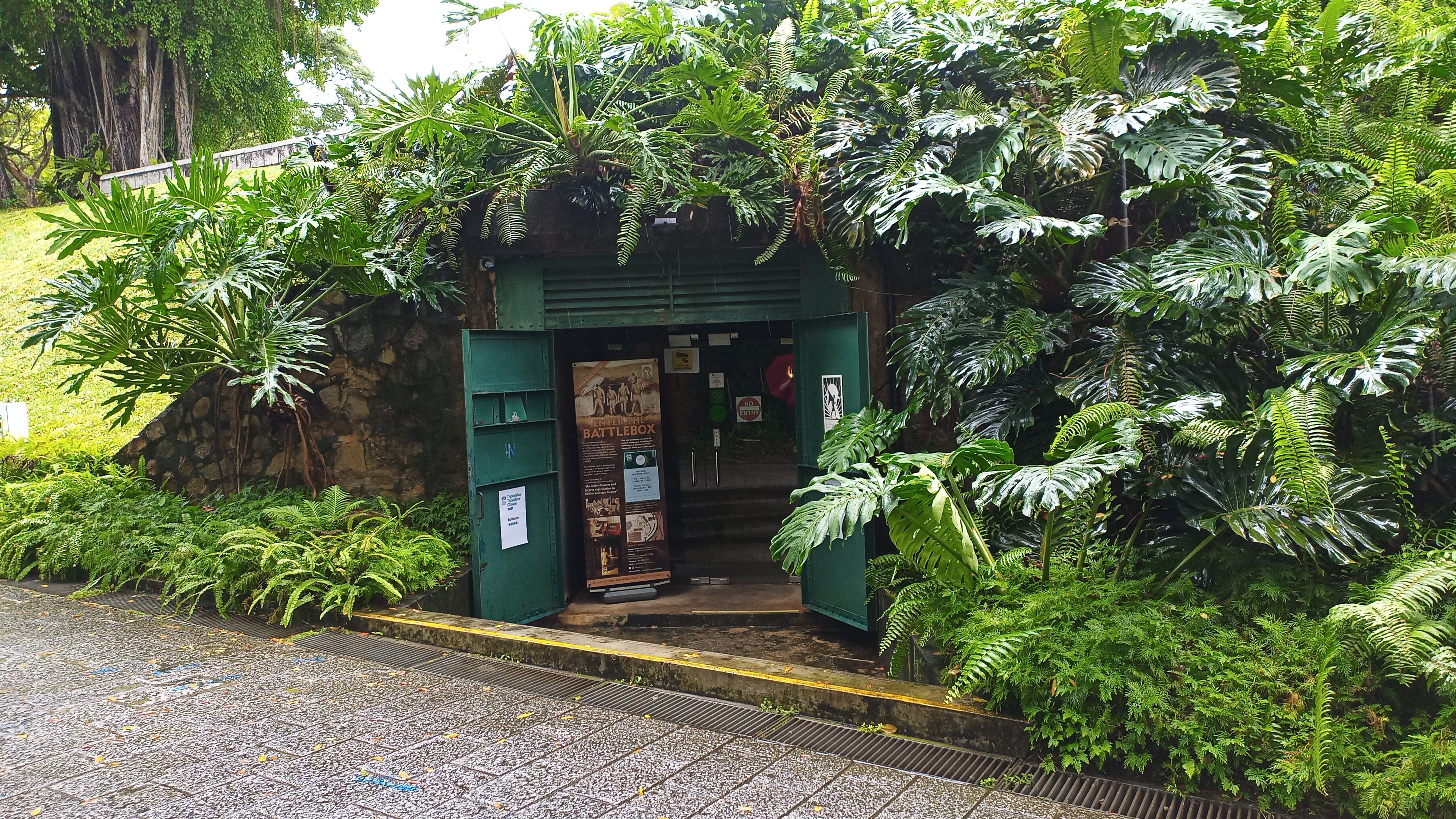
Battlebox Singapore

Tuesday, November 01, 2022
Ez-link isn't easy
The friendly staff at Changi Airport called around until someone came to open the Travelex booth. They quickly handed me my Singtel combined SIM & travel card. Took some time to get the SIM to work, as the number to use was on a label which sealed the card in a bag, and had to be split in half, through the serial number, to open. Tried to top up the travel part of the card, but the MRT station machines only accept Singapore credit cards, no cash. So I had to wait until the staff arrived at 6am. They only take cash, but I had some. With all that done the SIM and the transport works well.
SIMless in Singapore
Greetings from the arrivals hall at Changi Airport Singapore, where I await someone to open a booth to give me the Singtel SIM card I ordered. The two 24 hour Traveled booths remain closed.
Friday, May 10, 2013
Power for Traveling in Singaport and Sri Lanka



I found I had to buy a local power adapter for Sri Lanka
 . There are adapters readily available for about $US2, but these are of questionable safety. The adapters are designed to take UK, European, US and Australian plugs. They have so many and so large holes in them that the plugs are not held firmly and large sparks can be seen when contact is lost.
In Singapore I purchased a Lifetrons 10.5W Travel Adaptor FG-2102PD
 . This is almost a cube with a US/UK,European and Australian socket on one side and plugs for the same folding or retracting into the other sides. It is bulky and cumbersome looking but works okay. The unit is black and when plugged into my laptop cable it looks neat. It also has one high power USB socket and so can be used to charge a phone at the same time.
Saturday, April 27, 2013
MOOCs from Singapore
In the discussion of "MOOCs with Books" in Singapore on Wednesday, it was mentioend that National University of Singapore had joined Coursera, one of the US based Massive Open Online Course (MOOC) consortia.They have a course in "Unpredictable? Randomness, Chance and Free Will", by Valerio Scarani and "Write Like Mozart: An Introduction to Classical Music Composition", by Peter Edwards. Nanyang Technological University (NTU) have an interesting series of articles about e-learning, including MOOCs, in their Momentum Newsletter.
Samsui Woman and Mobile Cinema
As you enter the National Museum of Singapore there is temporary free display area on the right (just next to the gift store). This currently has has an excellent exhibition with " Trading Stories: Conversations with Six Pioneering Tradesmen". This includes "Sanshui Women" originally from Guangdong Province of China, who worked as a female collective in Singapore. Also there is a Mobile Cinema, being a rickshaw with a box on the back containing a movie projector and small screen. For a small fee locals could watch short movie through windows in the box.
Saturday, April 13, 2013
MOOCs with Books Talk in Singapore 24 April
I will be giving a free talk on "MOOCs with Books" in Singapore 24 April 2013, hosted by Pearson. Anyone interested in attending, please contact Teck Chuan, Ang at Pearson Singapore. This is a short version of my talk "Syncronisation of Large Scale Asynchronous e-Learning" for the 8th International Conference on Computer Science & Education (ICCSE 2013),
28 April 2013, in Colombo.
MOOCs with Books
Tom Worthington will discuss the implications of Massive Open Online Courses (MOOCs) for traditional university education. He will outline why he believes textbooks, in the form of eBooks, will still be key to education, be it on-line or in the classroom. Tom will illustrate this with his own globally accredited on-line course run by Australia's leading university.
Tom Worthington is an independent certified computer consultant, and an Adjunct Lecturer in the Research School of Computer Science, College of Engineering and Computer Science at the Australian National University. He teaches ICT sustainability, the design of web sites and use of e-commerce systems. In 1999 Tom was elected a Fellow of the Australian Computer Society (ACS) for his contribution to the development of public Internet policy and he was Canberra ICT Educator of the Year for 2010. Tom an ACS Past President, Honorary Life Member, Certified Professional and a Certified Computer Professional of the society as well as a voting member of the Association for Computing Machinery and a member of the Institute of Electrical and Electronics Engineers.
- What is a MOOC?
- Some MOOC Examples
- Software and Training for MOOCs
- Implications for Universities
- Adapting Traditional Courses for Online Use with books
Thursday, March 21, 2013
MOOCs with Books: Syncronisation of Large Scale Asynchronous e-Learning

This started as a scholarly paper on "Synchronizing Asynchronous Learning". But since submitting the paper last year, I have given a few presentations on how to have large on-line courses scale (both in terms of software and pedagogy), under the title "MOOCs with Books", so I added this to the conference presentation as a postscript. If anyone is interested I can give a practice run of the talk in Canberra, Sydney or Singapore.
Description: On-line learning uses the terms synchronous and asynchronous to describe tools and learning activities. This research looks into the origins of these terms, their use today and asks if these are the correct terms to use and if the use of these terms has held up the development of better tools and techniques. It is proposed that the use of syncronisation of asynchronous learning is particularly applicable to address issues with large scale e-learning, such as Massive Open Online Courses (MOOCs).
Keywords: Asynchronous Learning; Synchronous Learning; Electronic Learning; Web Conference; Videoconferencing; Pedagogy; Massive Open Online Courses, MOOC.
Please cite as:
Worthington, T. (2013). Synchronizing Asynchronous Learning: Combining Synchronous and Asynchronous Techniques. In Proceedings of 2013 8th International Conference on Computer Science & Education (ICCSE), 26 Apr - 28 Apr 2013 , Sri Lanka.
Preprint available at: http://hdl.handle.net/1885/9556
Thursday, February 09, 2012
Singapore Certified Green IT Professional
The Singapore Infocomm Technology Federation (SiTF) offers a course in green ICT in conjunction with authorized commercial partners. There is a four day instructor-led core course, plus a one day elective leading to the "Certified Green IT Professional".
Subscribe to:
Posts (Atom)