 The free exhibition Dream of a Century: the Griffins in Australia’s Capital is at the National Library of Australia in Canberra until 10 June 2013. This has original works by Walter Burley Griffin and Marion Mahony, tracing their work leading up to the winning of the design competition for the plan of the city of Canberra and afterwards in Australia and India. Most striking are the architectural renderings on silk. Also the furniture and stained glass windows designed by Walter Burley Griffin, including Griffin's drafting table, is a must see for Griffin enthusiasts. Last week was the centenary of Canberra and this is one of a number of displays on to commemorate the event. The display of other entries for the design of Canberra, as well as more of Walter and Marion 's work is on display at the nearby Archives Australia office in "Design 29 and the making of Australia’s national capital". The NLA display does not suffer from some of the problems of the Archives: the captions on each work are easy to read (a book of large captions is also available) and there are no augmented reality gimmicks. However, the low light level need to preserve the delicate works makes the architectural renderings very hard to see. The Library might have provided reproductions of the works alongside to show them as they would have been originally
Showing posts with label Griffin. Show all posts
Showing posts with label Griffin. Show all posts
Sunday, March 17, 2013
The Dream of a Century: the Griffins in Australia’s Capital
The free exhibition Dream of a Century: the Griffins in Australia’s Capital is at the National Library of Australia in Canberra until 10 June 2013. This has original works by Walter Burley Griffin and Marion Mahony, tracing their work leading up to the winning of the design competition for the plan of the city of Canberra and afterwards in Australia and India. Most striking are the architectural renderings on silk. Also the furniture and stained glass windows designed by Walter Burley Griffin, including Griffin's drafting table, is a must see for Griffin enthusiasts. Last week was the centenary of Canberra and this is one of a number of displays on to commemorate the event. The display of other entries for the design of Canberra, as well as more of Walter and Marion 's work is on display at the nearby Archives Australia office in "Design 29 and the making of Australia’s national capital". The NLA display does not suffer from some of the problems of the Archives: the captions on each work are easy to read (a book of large captions is also available) and there are no augmented reality gimmicks. However, the low light level need to preserve the delicate works makes the architectural renderings very hard to see. The Library might have provided reproductions of the works alongside to show them as they would have been originally

Thursday, October 11, 2012
Turnbull Advocates A More Compact Liveable Canberra
 Presenting the 2012 Walter Burley Griffin Memorial Lecture at the National Gallery of Australia in Canberra last night, Ms Lucy Turnbull, called for more densely populated Australian cities.
Turnbull is familiar with planning issues, having been the Deputy Chair of the COAG Capital city strategic planning expert advisory panel, Lord Mayor of Sydney and is currently an independent member of the Sydney Metropolitan Development Authority. She praised the work of Canberra's planners is providing a coherent view of the city, which follows on from Walter Burley Griffin and Marion Mahony's design for the city.
Presenting the 2012 Walter Burley Griffin Memorial Lecture at the National Gallery of Australia in Canberra last night, Ms Lucy Turnbull, called for more densely populated Australian cities.
Turnbull is familiar with planning issues, having been the Deputy Chair of the COAG Capital city strategic planning expert advisory panel, Lord Mayor of Sydney and is currently an independent member of the Sydney Metropolitan Development Authority. She praised the work of Canberra's planners is providing a coherent view of the city, which follows on from Walter Burley Griffin and Marion Mahony's design for the city.Turnbull singled out the Affordable Housing work of CIC Australia for praise. She noted that Australia's ageing population will require a new mix of housing stock and more single person houses will be needed. The role of the urban environment to support the innovation sector of the economy was also mentioned.

After the talk I asked Ms Turnbull and Professor Alastair Swayn (ACT Government Architect) if sufficient account was being taken of the effect of high speed broadband on city design. Also I pointed to the innovation precinct forming between the ANU and Civic in Canberra. They mentioned the effect which teleworking is having on cities.
Monday, September 24, 2012
Walter Burley Griffin Memorial Lecture 2012
Ms Lucy Turnbull OA LLB MBA, an independent member of the Sydney Metropolitan Development Authority, will present the Australian Institute of Architects 2012 Walter Burley Griffin Memorial Lecture in Canberra, 10 October 2012.Australian cities before and after Walter Burley Griffin
DATE: Wednesday 10 October
TIME: 5.45 arrival for a 6pm Start
COST: FREE PUBLIC LECTURE
Register
The annual WBGML has been delivered in Canberra since 1961. Over that time it has been given by a number of distinguished individuals from many fields of expertise, including Gough Whitlam, Professor Manning Clarke and Romaldo Giurgola. This year it is our pleasure to host Lucy Turnbull and Alastair Swayn to present the 2012 Walter Burley Griffin Memorial Lecture.
Lucy Turnbull's title for the paper will be 'Australian cities before and after Walter Burley Griffin'.
Lucy is a former Australian politician and former Lord Mayor of Sydney, is a prominent Australian business leader and company director. Turnbull was the first female Lord Mayor of Sydney, between 2003 and 2004 and was Deputy Lord Mayor, between 1999 and 2003. She was the first woman to hold both offices. As Lord Mayor, in 2003 Turnbull awarded laurete Aung San Suu Kyi the keys to the city of Sydney.
With a background in commercial law and investment banking, Turnbull is a Director of Turnbull & Partners Pty. Ltd, a private investment company. Lucy has a longstanding interest in cities and their planning, governance and management. as well as the importance of technological innovation to the national economy. She is an independent member of the Sydney Metropolitan Development Authority which is charged First Government Architect for the Australian Capital Territory with the urban renewal and revitaltisation of several precincts in Sydney, including Redfern-Waterloo.
On 26 January 2011, Turnbull was appointed an Officer in the Order of Australia for her distinguished service to the community, particularly through philanthropic contributions to, and fundraising support for, a range of medical, social welfare, educational, youth and cultural organisations, to local government, and to busines.DATE: Wednesday 31 October
TIME: 5.45 arrival for a 6pm Start ...
COST: Free Public Lecture
Register
Thursday, July 05, 2012
Radio Documentary on Walter Burley Griffin
ABC Radio National will broadcast "The idealists: creating Castlecrag", by Nicole Steinke, 1pm 8 July 2012. This will then be available for download:
Architects and visionaries Walter Burley Griffin and Mahony Griffin never gave up. They came to Australia to create an ideal capital city for our young nation, but were thrown off the project, beaten by the bureaucracy.Already available is "Canberra's original design competition" (By Amanda Smith, ABC Radio, 27 June 2012):Instead of heading home to Chicago, they turned their vast energy towards creating an ideal community on the shores of Sydney Harbour. That community was Castlecrag. During the 1920s and '30s it attracted an extraordinary group of people who pushed the boundaries in the arts, politics, the environment and spirituality.
By Design looks back at the process of selecting the plan for Canberra, won by Walter Burley Griffin. We look at the contenders as well as the winner.Guests
Professor James Weirick, Professor of Landscape Architecture, University of NSW, Sydney
President, Walter Burley Griffin SocietyProfessor Sheridan Burke, Adjunct Professor, University of Canberra
President, International Council on Monuments and sites (ICOMOS), International Scientific Committee on Twentieth Century HeritageDavid Headon, Advisor, Centenary of Canberra, Chief Minister’s Department, ACT Government
Cultural historian ...
Saturday, June 09, 2012
Video of Griffin's Vision of Canberra Today
 The Walter Burley Griffin Society (which I am a member of), has released the video "Canberra - the Griffin vision in the 21st century" for the centenary of Canberra. This describes Walter Burley Griffin and Marion Mahony Griffin's design for the city of Canberra.
Wednesday, November 23, 2011
Report Administration of Canberra's Memorials
The Australian Parliament Joint Standing Committee on the National Capital and External Territories tabled its report Etched in Stone? on the administration of National Memorials in Canberra, 23 November 2011. My submission "Keep the Vision of Parliament Clear", is included in the report as submission number 14.
It is useful that deliberative democracy was recommended by the committee. Unfortunately the report recommends an overly prescriptive process, which duplicates the town planning process which is already in place for Canberra, just for one type of land use (a memorial) Instead the committee could have recommended applying the planning processes which are supposed to be used in Canberra for any land use and then just add the extra processes needed for deciding on national monuments.
Contents
It is useful that deliberative democracy was recommended by the committee. Unfortunately the report recommends an overly prescriptive process, which duplicates the town planning process which is already in place for Canberra, just for one type of land use (a memorial) Instead the committee could have recommended applying the planning processes which are supposed to be used in Canberra for any land use and then just add the extra processes needed for deciding on national monuments.
Contents
- Preliminary pages: Contents, Foreword, Committee Membership, Terms of Reference, List of Abbreviations and List of Recommendations
- Chapters
- Appendices
List of recommendations
National Memorials Ordinance 1928
Recommendation 1
The JSCNCET recommends to the Minister for Regional Australia, Regional Development and Local Government that, rather than attempting to amend the National Memorials Ordinance 1928, the Ordinance be repealed and replaced with a new Commemorative Works Act, as proposed in Chapter 4 of this report.
Reforming the process
Recommendation 2
The JSCNCET recommends to the Minister for Regional Australia, Regional Development and Local Government that, while new systems are put in place, residents of the Australian Capital Territory be immediately appointed to the Canberra National Memorials Committee,
as required under the National Memorials Ordinance 1928; and that these persons have acknowledged expertise in heritage matters, with one to be a member of the ACT Heritage Council nominated by the ACT Chief
Minister.
Recommendation 3
The JSCNCET recommends that, as part of the decision-making process for National Memorials, each proposal for a National Memorial be required to undergo heritage assessment, prior to final approval, including the creation of site specific Conservation Management Plans
and Heritage Impact Statements.
Recommendation 4
The JSCNCET recommends that the National Capital Authority’s Commitment to Community Engagement be applied to the decision-making process for National Memorials, with the NCA to report publicly on the
public consultation process undertaken with regard to each National Memorial proposal.
Recommendation 5
The JSCNCET recommends that proponents of memorials provide resources and funds to conduct public consultation processes as part of the assessment and approval process for new National Memorials.
Recommendation 6
The JSCNCET, recommends that the National Capital Authority review its Commitment to Community Engagement to reflect the principles of deliberative democracy, and that it design and report upon public
consultation processes for each National Memorial in accordance with these principles.
Recommendation 7
The JSCNCET recommends that the proposed Memorials Master Plan incorporate provisions for establishing a wider range of subjects for commemoration with a view to funding them through a combination of private and government subscription.
Recommendation 8
The JSCNCET recommends to the Australian Government that the Government consider the ongoing funding of a national commemoration program, with a particular focus on memorials that are unlikely to be built without government support.
The New Model
Recommendation 9
The JSCNCET recommends that the National Memorials Ordinance 1928 be repealed and replaced with an Australian Commemorative Works Act, based on the United States model. This Act would provide for a two-pass assessment process for National Memorials, the first pass focused on commemorative intent, the second pass on character and location; and that:Recommendation 10
- At the first pass, a motion be introduced to Parliament to approve the commemorative intent of a proposed National Memorial.
- Following the introduction of the motion, the proposal be referred to the JSCNCET for consideration and report, based on the following approvals:
- the memorial proposal be referred to the National Memorials Advisory Committee—a Committee made up of history and heritage experts, with one ACT Government representative, chaired by the National Capital Authority—to ensure that it complied with the Criteria for Commemorative Works in the National Capital
- the National Capital Authority assess the proponent’s budget for the design, construction and maintenance of the proposed National Memorial, and capacity to finance the proposal.
- Once approved by the National Memorials Advisory Committee, and with financial arrangements certified by the National Capital Authority, the JSCNCET would report upon the proposal. The motion would proceed at the pleasure of Parliament, and if passed, the commemorative intent of the proposed National Memorial would be approved.
- Following passage of the motion establishing the commemorative intent of the proposed National Memorial, responsibility for identifying a location for the memorial and initiating a process for its design would pass to the National Capital Authority. This would require memorial proponents to develop a design completion brief and run a public design competition (if necessary); and undertake, in conjunction with the National Capital Authority, the following tasks:
- Identify possible locations
- Conduct mandatory public consultations
- Seek independent expert advice
- Seek planning advice from relevant authorities and, if required, advice from relevant government agencies
- Have assessments made under the Environment Protection and Biodiversity Conservation Act 1999
- Develop draft conservation management plans and/or heritage impact statements for proposed sites, if required
- Develop the budget and business plan for construction, maintenance and associated infrastructure costs.
- At the second pass, assessing design and location, the proposal would be referred to the Joint Standing Committee on the National Capital and External Territories for consideration and approval on behalf of the Parliament. If required, the Committee would be able to invite submissions from the public and undertake public hearings.
- Second pass approval by the JSCNCET would provide the final approval for the proposed National Memorial.
- Commemorative works, as defined by the Act, could be initiated by the Commonwealth or ACT Governments.
The JSCNCET further recommends that the proposed Commemorative
Works Act:Transitional Arrangements for Current Proposals
- Define a ‘commemorative work’, encompassing both National Memorials and National Monuments as currently defined.
- Establish a National Memorials Advisory Committee, consisting of recognised experts in a range of disciplines, including history, heritage, architecture and planning; representatives of veterans, the services and relevant Commonwealth Departments; representatives of organisations with a strong focus on Australian history and culture at a national level; one representative of the ACT Government, appointed on the recommendation of the ACT Chief Minister; and chaired by a representative of the National Capital Authority. Membership to vary depending on the nature of the proposed National Memorial.
- Include the Criteria for Commemorative Works in the National Capital as a schedule to the Act.
- Include a Memorials Master Plan, including a map of existing memorials and potential sites for new memorials in accordance with the Criteria, as a schedule to the Act.
- Require the National Capital Authority to maintain a register (published on a specific National Memorials website) of all National Memorial proposals, including their current status, and all relevant decisions and approvals, along with all supporting documentation, including:
- Independent expert advice
- Public submission
- Reports of public consultations
- Define responsibilities of proponents in meeting design, construction and maintenance costs, including providing ten per cent of the overall costs towards ongoing maintenance of the new National Memorial.
- Prohibit the appearance of donor names or names of relatives on or near National Memorials and National Monuments, except where the specific object of the commemoration—its commemorative intent— is individuals, families of groups that have been found to be worthy subjects of commemoration.
- Exclude minor commemorative works, such as plaques or individual trees outside the Parliamentary Zone, from its operation.
Recommendation 11The JSCNCET recommends to the Minister for Regional Australia, Regional Development and Local Government that the current approved National Memorial proposals stand for the life of their current site reservations, but that these site reservations not be extended beyond their current terms.
From: Etched in Stone? report on the administration of National Memorials in Canberra, Joint Standing Committee on the National Capital and External Territories, Australian Parliament, 23 November 2011.
Wednesday, September 07, 2011
Inquiry into National Memorials in Canberra
The Australian Parliament's Joint Select Committee on the National Capital and External Territories is inquiring into the process for approving National Memorials in Canberra. In particular there is a proposal to build two monuments on the shores of Lake Burley Griffin opposite Anzac Parade. The Walter Burley Griffin Society opposes the monuments as they intrude into the Griffins design for Canberra. So far there have been only two submissions.
Members and friends of the Society,
We are pleased to inform you that an Inquiry by the Joint Select Committee on the National Capital and External Territories has been established to look into the approvals process for National Memorials in Canberra and the proposal to build two large monuments on the shores of Lake Burley Griffin. We have previously alerted you to this proposal and many members kindly wrote expressing their opposition to the proposed WW I and II memorials, believing them to be unnecessary intrusions into the Lake Burley Griffin parklands and the vistas of Anzac Parade and the Parliamentary Triangle; excessive in size; and inappropriate in function, given the deep significance of the Australian War Memorial nearby.
Images of the proposed WW I and II memorials can be found on the proponent’s website: http://www.mdc.org.au/
Details for the inquiry are at http://www.aph.gov.au/house/committee/ncet/memorials/index.htm
Terms of reference are as follows (note especially clause 2):The Committee has been asked by The Hon Simon Crean MP, Minister for Regional Australia, Regional Development and Local Government:
1. To inquire into, and report on:
§ The administration of the National Memorials Ordinance 1928 (the Ordinance), with particular reference on:
§ The membership of the Canberra National Memorials Committee (CNMC);
§ The process for decision-making by the CNMC;
§ Mechanisms for the CNMC to seek independent, expert advice; and
§ Opportunities for improving transparency in the administration of the Ordinance.
§ The appropriate level of parliamentary oversight for proposed National Memorials.
§ The appropriate level of public participation in the development of proposed National Memorials.
2. If changes to current arrangements are recommended, inquire into and report on transition provisions for current proposals for memorials which have not yet been constructed.
We are therefore asking WBG Society members (with our Australia–wide membership) to send even a brief correspondence to this Committee, stating your opposition to the proposed memorials. For background information, please also see the website http://lakewarmemorialsforum.org/index.html
Emails should be sent to the Committee Secretariat at jscncet@aph.gov.au by 9 September 2011.
We hope you are able to assist in this matter of concern.
Regards,
Kerry
info(a)griffinsociety.org
Sunday, March 20, 2011
Marion Mahony Griffin Lecture in Canberra
 The third annual Marion Mahony Griffin Lecture by Rosemarie Willett will be 12 April 2011 in Canberra:
Walter Burley Griffin Society Inc invites you to the third annual
Marion Mahony Griffin Lecture
Tuesday 12 April 2011 at 6.00pm
Canberra Business Event Centre, Regatta Point, Commonwealth Park, Canberra
Marion Mahony Griffin Architect: feisty true believer and free spirit
a talk by Rosemarie Willett, B.Arch. M.B.Env.
Rosemarie’s presentation will engage with Marion as a person, architect and outstanding communicator of architectural ideas. A registered architect in Sydney, Rosemarie came to Canberra in 1983 to work on Parliament House for Mitchell Giurgola and Thorp. In undertaking extensive research on the planning of Canberra, she resurrected her dormant passion for the Griffins’ creative abilities and their connection with the ideas of Louis Sullivan.
Tickets: Members $10; Non-members $15 (seats limited, booking payments essential)
RSVP: 4 April. Enquiries phone 0416 249 002 or email WBGSinfo(a)gmail.com
Please send cheque or money order to The Treasurer, WBGS, 50 Gollan Street, Evatt ACT 2617
Sunday, January 20, 2008
Magic in Castlecrag
 The Walter Burley Griffin Society created magic in Sydney today, with a talk by Jack Perry Brown, Director of the Ryerson & Burnham Libraries of the Art Institute of Chicago. The Institute released a web version of Marion's book The Magic of America, last August and this talk about the book was held in the Haven Amphitheater, designed by Walter Burley Griffin and Marion Mahony Griffin.
The Haven Amphitheatre is at the corner The Scarp and The Barricade, Castlecrag is in a bushland gully with native trees. The seating is on rock terraces, with a wooden deck and bush backdrop.
The Magic of America was completed in 1949 by Marion Mahony Griffin after the death of Walter Burley Griffin in India. The unpublished work is half original text by Marion and half transcripts, newspaper clippings and other materials. Jack Brown argues that it is her final work of art, covering the time of her her husband's work in India, Canberra, Castlecrag and Chicago.
Unfortunately I had to leave the excellent talk early. The question I wanted to ask, but did not get the chance, was could Marion's work now be published. The manuscript was not in a form suitable for use other than for scholarly research. Placing the manuscript on the Internet has made it available for research, but it is still not something readable by a wider audience. Could the material be edited into one or more books suitable for online and print publication? By the time the material which was from other sources (and so would be difficult to obtain copyright clearance to include) was removed the work would be a more manageable size. With other editing, could it it be made into something with more of a conventional narrative, or would that destroy its essence?
The fact that the full manuscript is already available should allow the work to be edited without doing it any great harm. An electronic abridged version could have a switch to allow the reader to see what had been removed. By using online collaborative tools, the editing need not be an overwhelming or lengthy task. By using the approach used in developing open source software, where disagreements between editors could not be agreed, different versions could be produced, with the result being a discussion and analysis of the work, a process and not just one supposedly final result.
Another was to look at the manuscript would be as Marion Mahony Griffin's blog. After all, the Griffin's were early pioneers of multimedia, producing a film promotion for Castlecrag in 1928. ;-)
See also:
Thursday, December 20, 2007
Marion Mahony Griffin's Magic of America
 The Walter Burley Griffin Society will be having a talk Sunday 20 January 3.00pm, by Jack Perry Brown, Director, Ryerson & Burnham Libraries of the Art Institute of Chicago. They released a web version of Marion's book The Magic of America, last August. The talk will be held in the Haven Amphitheater, designed by Walter Burley Griffin and Marion Mahony Griffin:
Walter Burley Griffin Society Inc. invites you to
Marion Mahony Griffin as Author: The Voice of Magic of America
Sunday 20 January 3.00pm
Haven Amphitheatre
corner The Scarp and The Barricade, Castlecrag
Jack Perry Brown, Director
Ryerson & Burnham Libraries
Art Institute of Chicago
will talk about the Art Institute of Chicago's exciting project completed just last August that publishes on the net The Magic of America written by Marion Mahony Griffin when she returned to USA after Walter Burley Griffin's death in India in 1937. It was in part intended as 'a testament to their life and work together'. The website created to publish this important architectural document collates 1400 pages of text with approximately 650 accompanying illustrations from the three known copies of The Magic of America. Go to
www.artic.edu/magicofamerica/
How to get to the Haven: There is no parking at the Haven Amphitheatre so we suggest you leave your car in Rockley Street and walk the 500 metres along The Bulwark to the Haven. Alternatively leave your car near The Citadel and walk about 300 metres down the steps between 17 and 19 The Citadel then follow the roads downhill to the Haven.
Wet weather alternative venue: The Community Centre, Castlecrag.
Further information:
contact Kerry McKillop 02 9958 4516
or info@griffinsociety.org
See also:
Monday, October 01, 2007
Griffin drawings of Canberra displayed

 Two of the original designs for Canberra were displayed by the National Archives of Australia on Sunday. These were two of the works by by Walter Burley Griffin and Marion Mahony Griffin, submitted to the competition for the design of the national capital in 1911. Ian Batterham talked about his work as a conservator, spending years restoring the works.
Ian had previously written a detailed paper on the restoration process: "The Walter Burley Griffin Design Drawings of the City of Canberra".
The twelve Griffin Canberra design drawings were added to the UNESCO Memory of the World in 2003:
There are twelve Walter Burley Griffin (WBG) Canberra design drawings. Standard size is 760 x 1525 mm. The drawings are mostly on cotton cloth and are executed in inks and watercolours. The drawings were created by WBG and his wife Marion Mahony Griffin in 1912 for entry into the Australian Federal Capital Design Competition. The quality of the design as well as the beauty of the drawings resulted in WBG winning the competition. Griffin was appointed Federal Capital Director of Design and Construction in October 1913 and utilized the winning design as the basis for the new city. The design is considered an outstanding example of landscape design, utilising the natural topography and investing the city with ideas prevalent in the City Beautiful and Garden City movements which dominated town planning in the late nineteenth and early twentieth century. The documents are also central to the development - both physical and conceptual - of Australia's national capital. ...Ian gave an interesting summary of the process used to select Canberra as the site of the national capital and then the Griffin entry for the design of Canberra. One of the criteria for the city was "ample water" which is currently an issue due to drought and climate change. Competitors for the design competition were supplied with maps of the location and required to draw their design on this map. In addition the Griffins supplied detailed notes with their entry, preserved by the NAA and available online.
From: The Walter Burley and Marion Mahony Griffin Design Drawings of the City of Canberra, Register no 006, UNESCO, 2003
Also the copy of the telegram received by the Griffins advising them of winning the competition is preserved. It was found in a copy of Marion Mahony Griffin's manuscript "The Magic of America". Marion had written on it "This undertaking awakened the world to town planning in modern times".
Ian explained that the images were prepared first as pencil sketches then made as lithographic prints, water colored by hand, with metallic paint and ink washes. This make conservation difficult, with pencil lines to be preserved as well as ink and paint.
Photographs of the work, taken at the time of receipt in 1912 aided the restoration work. These showed some works had already been damaged with holes in the fabric (the entry was labeled Griffin: 29). The works were lost between 1935 and 1953, then found in a shed in Canberra.
Analysis showed the works were on cotton (not silk or linen , as previously thought). These were originally stretched on wooden frames, but then pasted (with wallpaper paste) onto "masionite" and then "chipboard" causing damage. Three months were needed to clean each work, using an eraser. They were then removed from the boards using a sharpened plastic icing spatula (a line drawing was found on the back of one work). Polyester cloth and BEVA adhesive was used to repair tears and mount the works with a new margin before stretching on frames.
After the talk the two works "City & Environs" and "Section B-A Southerly Side of Water Axis Government Group" were displayed for thirty minutes. The works looked much smaller in reality than in various reproductions.
Ian mentioned the recent interest in Marion Mahony Griffin with the book "Marion Mahony Griffin : Drawing the Form of Nature". As an example the Walter Burley Griffin Society, now attributes Marion as the "delineator" or "artist" for the Canberra works, "envisaged" by Walter; whereas earlier listings, such as by the National Library of Australia, only attribute Walter.
Ian is now working on a project about "Office Copying in the 20th Century". furthering his thesis work on Thermographic Processes (old photocopying).
See also books on:
Tuesday, September 18, 2007
Original Griffin drawings of Canberra on Display
The National Archives of Australia will have "Conserving the Griffins' vision", a talk and showing of some of the original designed for Canberra by Walter Burley Griffin and Marion Mahony Griffin on 30 September 2007:
Ian Batterham has worked as a conservator at the National Archives of Australia for over 25 years, and is an expert on the Marion Mahony and Walter Burley Griffin drawings of Canberra. He will be sharing the journey of these great works: their history, providence and conservation. ..
From: What's on, NLA, 2007
Sunday, September 02, 2007
The Magic of America: Improving the Electronic Edition
On Friday, I suggested some improvements for Marion Mahony Griffin's "The Magic of America: Electronic Edition" prepared by The Art Institute of Chicago. My comments were a little cryptic, so here are some more details. For more tools and techniques see my Writing for the Web course notes.
Splash Screen
The web site starts with a web page having one large image (1024 x 800 pixels, 229 Kbytes). This is commonly referred to as a splash screen as it is designed to impress the reader. However, this page will take 35 seconds to download on a fast dial-up line (56Kbps), which is too long. The image can be made smaller, as the Art Institute is doing, by reducing the color range and compression. However, a better approach is to disassemble the image into its component parts and have the web browser assemble them on the page.
In this case the splash image is a collage of photographs of Marion and Walter (taken from the frontispiece of the book), and Marion's town plan perspective for the City of Griffith ( 1914 in Section 2 of the book, this is a color version of the one referenced in the Griffin Society Database). On this are superimposed the words "Enter", "Marion Mahony Griffin" and "The Magic of America".
The four images could be placed separately on the page. The text could then be added as ordinary text, not as part of the image. On a slow link the web browser would then display the text quickly and the images would follow along when available. The user would be able to read the text without having to wait for the images.
However, a better option would be to bypass the splash page and make the home page of the site, the one the reader sees first. Smaller versions of the artwork from the splash page could be incorporated to improve the look of the page. The splash page could be retained for use in presentations and publicity, but would not be seen by the average reader.
Divide the Document into Smaller Web Pages
The digital text of the document is provided in four large web pages, corresponding to the four sections of Marion's work. Each of these is about 1.3 Mbytes of HTML (5,381 Mbytes in total). This is far too large for fast downloading. As well as making it slower for the reader, it wastes resources on the web server, as most readers will be just casually browsing and will not scroll down past the first screen-full. I suggest the document be divided into the parts listed in the table of contents, with about 83 web pages, each of about 65 Kbytes, or the equivalent of 9 A4 pages.
It would be possible, but not useful, to go to the extreme and make each of the more than 1,400 pages of the typescript original a separate web page. The O'Reilly Google Hacks book suggests a successful web site should have at least 100 content pages. Such a web site is about the same size as the average book, with each web page the equivalent of three printed pages.
The web pages of Magic of America have the typical 50/50 ratio of text to formatting for a book derived web page. As an example Section 2 has 1,692 Kbytes of HTML, containing 837 Kbytes of plain text, the rest being HTML markup. This section is 447 pages in the original manuscript, the digital text is the equivalent of 204 A4 pages (about the same size as if it was typeset for printing). So if this was divided into 3 printed pages per web page, the result would be 68 web pages. While cumbersome to produce manually, this would be be feasible, but the text does not divide into logical 3 page components.
The table of contents for Section 2 has 26 parts. If each of these were a web pages, they would be on average 9 printed pages per web page, with a logical topic for each. This would seem a reasonable compromise.
It should be noted that the way the document is divided into web pages for delivery to the reader need not imply that it is stored this was on the web server. The electronic original can be kept as larger, or smaller, files, which are assembled by the web server as required.
Virtually Typeset The Magic of America
Both the facsimile typescript and the digital text provided by The Art Institute of Chicago are valuable scholarly resources for research. However, neither is easy to read as a work of literature and do not do justice to the author, or her topic. Web formatting techniques could be applied to the digital text could give it more of the look of a book, without altering the underlying source material. Scholars could switch off the added formatting to see the original.
The manuscript was produced on a manual typewriter, with hand written annotations and graphics pasted in. All this is useful information for the scholar, but difficult to read. The digital text is presented in one size font, left justified, with white space between paragraphs. There are numerous bracketed notes indicating where the original typescript page breaks were. The images ages are inserted as thumbnails, left justified with no text flowing around them.
It would be possible to use Cascading Style Sheets (CSS) to modify the look of the page to make it more like a typeset book. This could be done while retaining all of the information needed by the scholar. By default a book-like version of the digital text could be displayed for the general reader, with options for the scholar to see the extra notes.
A simple compromise would be to:
In this way compromises between showing the historically accurate typescript original and a readable corrected work can be avoided: both can be provided, in the one document, for the relevant readers.
Tags for Marion's Blog
In many ways the typescript original of The Magic of America a series of largely unrelated items from different sources pasted together. Turing this into a conventional book will have lost some of the flavor of the original. The work is in some ways is more suited to a web log (blog), where the separate components have their own existence and can be read and assembled in different ways, depending on the interests of the reader. This could be done by tagging the components of the original work with metadata. The tags would be useful to scholars researching the work, to ordinary readers and to artists interpreting it.
One way the work could be accessed is as a multimedia interactive work. Parts of the work could be selected based on the tags and presented, either online directly for one reader, or as part of a live performance. The components could be selected by the reader, or preselected by a narrator. The narration could be by a person or persons on a stage with parts of the work display on a large screen or on a desktop screen. SMIL and other web technologies could be used to transform the original work for multimedia display.
A fitting location for a live performance would be the Capitol Theatre, Melbourne, designed by Walter Burley Griffin and now a web equipped university lecture hall, or the New Theatre, Sydney, which is fitted with seats removed from the Capitol Theatre in Melbourne, 25 years ago.
This might allow the underlying poetry of Marion Mahony Griffin's work to escape from the limited linear format she was confined to. One way to aid this would be for the The Art Institute of Chicago to place a Creative Commons license on the work, to allow reuse.
Splash Screen
The web site starts with a web page having one large image (1024 x 800 pixels, 229 Kbytes). This is commonly referred to as a splash screen as it is designed to impress the reader. However, this page will take 35 seconds to download on a fast dial-up line (56Kbps), which is too long. The image can be made smaller, as the Art Institute is doing, by reducing the color range and compression. However, a better approach is to disassemble the image into its component parts and have the web browser assemble them on the page.
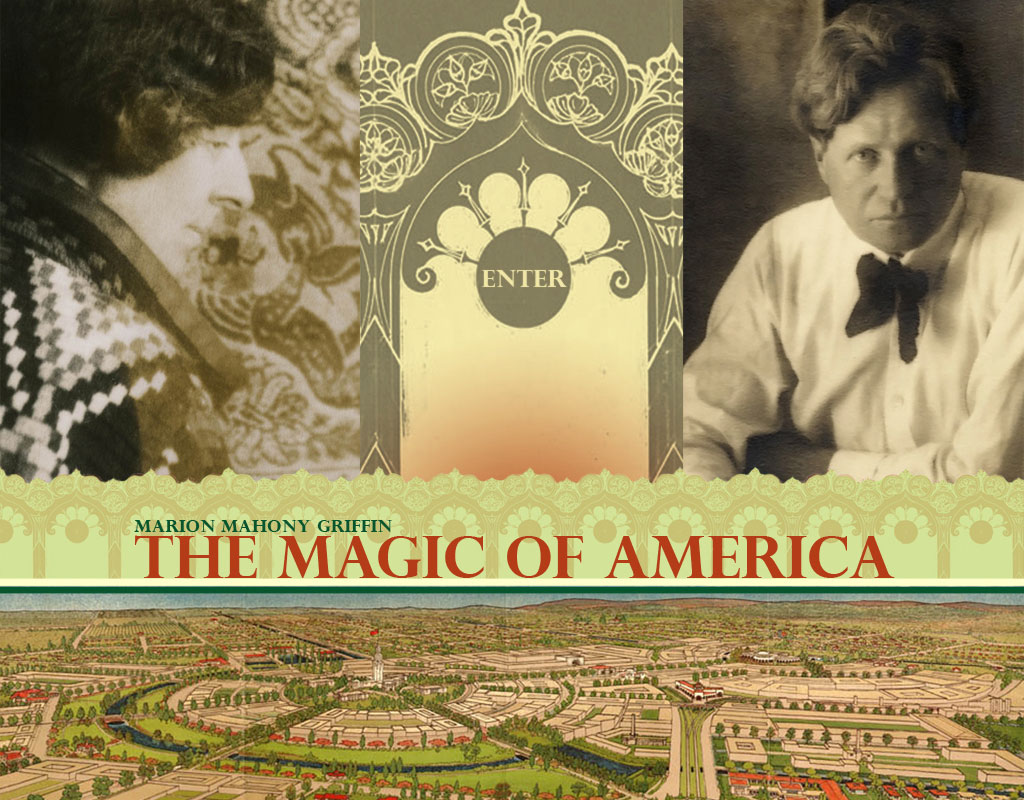
In this case the splash image is a collage of photographs of Marion and Walter (taken from the frontispiece of the book), and Marion's town plan perspective for the City of Griffith ( 1914 in Section 2 of the book, this is a color version of the one referenced in the Griffin Society Database). On this are superimposed the words "Enter", "Marion Mahony Griffin" and "The Magic of America".

The four images could be placed separately on the page. The text could then be added as ordinary text, not as part of the image. On a slow link the web browser would then display the text quickly and the images would follow along when available. The user would be able to read the text without having to wait for the images.
However, a better option would be to bypass the splash page and make the home page of the site, the one the reader sees first. Smaller versions of the artwork from the splash page could be incorporated to improve the look of the page. The splash page could be retained for use in presentations and publicity, but would not be seen by the average reader.
Divide the Document into Smaller Web Pages
The digital text of the document is provided in four large web pages, corresponding to the four sections of Marion's work. Each of these is about 1.3 Mbytes of HTML (5,381 Mbytes in total). This is far too large for fast downloading. As well as making it slower for the reader, it wastes resources on the web server, as most readers will be just casually browsing and will not scroll down past the first screen-full. I suggest the document be divided into the parts listed in the table of contents, with about 83 web pages, each of about 65 Kbytes, or the equivalent of 9 A4 pages.
It would be possible, but not useful, to go to the extreme and make each of the more than 1,400 pages of the typescript original a separate web page. The O'Reilly Google Hacks book suggests a successful web site should have at least 100 content pages. Such a web site is about the same size as the average book, with each web page the equivalent of three printed pages.
The web pages of Magic of America have the typical 50/50 ratio of text to formatting for a book derived web page. As an example Section 2 has 1,692 Kbytes of HTML, containing 837 Kbytes of plain text, the rest being HTML markup. This section is 447 pages in the original manuscript, the digital text is the equivalent of 204 A4 pages (about the same size as if it was typeset for printing). So if this was divided into 3 printed pages per web page, the result would be 68 web pages. While cumbersome to produce manually, this would be be feasible, but the text does not divide into logical 3 page components.
The table of contents for Section 2 has 26 parts. If each of these were a web pages, they would be on average 9 printed pages per web page, with a logical topic for each. This would seem a reasonable compromise.
It should be noted that the way the document is divided into web pages for delivery to the reader need not imply that it is stored this was on the web server. The electronic original can be kept as larger, or smaller, files, which are assembled by the web server as required.
Virtually Typeset The Magic of America
Both the facsimile typescript and the digital text provided by The Art Institute of Chicago are valuable scholarly resources for research. However, neither is easy to read as a work of literature and do not do justice to the author, or her topic. Web formatting techniques could be applied to the digital text could give it more of the look of a book, without altering the underlying source material. Scholars could switch off the added formatting to see the original.
The manuscript was produced on a manual typewriter, with hand written annotations and graphics pasted in. All this is useful information for the scholar, but difficult to read. The digital text is presented in one size font, left justified, with white space between paragraphs. There are numerous bracketed notes indicating where the original typescript page breaks were. The images ages are inserted as thumbnails, left justified with no text flowing around them.
It would be possible to use Cascading Style Sheets (CSS) to modify the look of the page to make it more like a typeset book. This could be done while retaining all of the information needed by the scholar. By default a book-like version of the digital text could be displayed for the general reader, with options for the scholar to see the extra notes.
A simple compromise would be to:
- Use the text descriptions in the menu, in place of numbers, to make it a usable table of contents. Thus " Number 2" would be replaced with "2. Melson River Bottom Flower Garden".
- Retain the left justified text and paragraph white space. But use bold, italics, and different text sizes in place of the uppercase and underlining used in the typescript.
- Enlarge the images to half the screen width (about five times the current size or about VGA 640 x 480 pixels). Center the images on the page, with the caption underneath. Use a different type style for the captions.
- Reduce the notes to a symbol which can be clicked on, or moused over, to obtain the details,
- Make the links to the facsimile pages an in-line symbol, so they do not beak up the pages as much.
In this way compromises between showing the historically accurate typescript original and a readable corrected work can be avoided: both can be provided, in the one document, for the relevant readers.
Tags for Marion's Blog
In many ways the typescript original of The Magic of America a series of largely unrelated items from different sources pasted together. Turing this into a conventional book will have lost some of the flavor of the original. The work is in some ways is more suited to a web log (blog), where the separate components have their own existence and can be read and assembled in different ways, depending on the interests of the reader. This could be done by tagging the components of the original work with metadata. The tags would be useful to scholars researching the work, to ordinary readers and to artists interpreting it.
One way the work could be accessed is as a multimedia interactive work. Parts of the work could be selected based on the tags and presented, either online directly for one reader, or as part of a live performance. The components could be selected by the reader, or preselected by a narrator. The narration could be by a person or persons on a stage with parts of the work display on a large screen or on a desktop screen. SMIL and other web technologies could be used to transform the original work for multimedia display.
A fitting location for a live performance would be the Capitol Theatre, Melbourne, designed by Walter Burley Griffin and now a web equipped university lecture hall, or the New Theatre, Sydney, which is fitted with seats removed from the Capitol Theatre in Melbourne, 25 years ago.
This might allow the underlying poetry of Marion Mahony Griffin's work to escape from the limited linear format she was confined to. One way to aid this would be for the The Art Institute of Chicago to place a Creative Commons license on the work, to allow reuse.
Friday, August 31, 2007
Marion Mahony Griffin's The Magic of America Online
The full text of "The Magic of America" by Marion Mahony Griffin, is now available free online. Best known as the wife of Walter Burley Griffin, architect of Canberra, Marion was an architect in her own right. The Magic of America is a 1,400 page manuscript, which was never published.
Marion Mahony Griffin's text is difficult to read at the best of times, being part biography and part scrapbook. The priority in conversion to electronic format was to preserve the format of the typewritten original, complete with handwritten notes and pagination. The web site allows for the reader to swap between the facsimile and digitized text versions of any page.
However, there are improvements which could be made to the electronic version. The web site initially loads a large graphic "splash page". While attractive, this takes a long time to load, particularly for those with a slow Internet connection, as for example those in India wanting to read about Walter Burley Griffin's work there.
The digitized text is provided as a large web page, the equivalent of 200 printed pages. This decreases response time on a slow connection and the text should be divided into smaller sections. Small thumbnails of images have been used, but these are perhaps too small and lack "alternate text" for blind readers and search engines.
What might be useful would be to apply the advanced technology, such as the Digital Scholar's Workbench, to transform the manuscript to a high quality typeset electronic document, with the appearance of a modern work. The information of interest to scholars could then be hidden from the average reader, to produce something which would be more readable and accessible. The scholar could press a button to select the additional information they required.
Web technologies could be applied top the same source data to transform it into a multimedia interactive work, to tell a story, in a more fluid way. This might allow the underlying poetry of Marion Mahony Griffin's work to escape from the limited linear format she was confined to. This work could be combined with a live performance, in the Capitol Theatre, Melbourne, designed by Walter Burley Griffin and now a web equipped university lecture hall, or the New Theatre, Sydney, which is equipped with seats removed from the Capitol Theatre in Melbourne, 25 years ago.
See also:
"The Magic of America," a typescript of over 1,400 pages with approximately 650 accompanying illustrations, was written and compiled by Marion Mahony Griffin (1871-1961), architect, designer, delineator, and artist. In 1911 she married Walter Burley Griffin (1876-1937), architect, landscape designer, and city planner. Their architectural practice spanned almost four decades on three continents, and "The Magic of America" was meant, in part, to be a testament to their life and work together."The Magic of America: Electronic Edition." was prepared by The Art Institute of Chicago, Ryerson & Burnham Libraries (Archives). This is an extensive piece of scholarly work, requiring different sources to be knitted together. As well as searchable digital text, a facsimile original and supplementary material is provided, including a list of related websites. It is panned to add a database of the images in 2008.
From: "The Magic of America: Electronic Edition.", The Art Institute of Chicago, 2007
Marion Mahony Griffin's text is difficult to read at the best of times, being part biography and part scrapbook. The priority in conversion to electronic format was to preserve the format of the typewritten original, complete with handwritten notes and pagination. The web site allows for the reader to swap between the facsimile and digitized text versions of any page.
However, there are improvements which could be made to the electronic version. The web site initially loads a large graphic "splash page". While attractive, this takes a long time to load, particularly for those with a slow Internet connection, as for example those in India wanting to read about Walter Burley Griffin's work there.
The digitized text is provided as a large web page, the equivalent of 200 printed pages. This decreases response time on a slow connection and the text should be divided into smaller sections. Small thumbnails of images have been used, but these are perhaps too small and lack "alternate text" for blind readers and search engines.
What might be useful would be to apply the advanced technology, such as the Digital Scholar's Workbench, to transform the manuscript to a high quality typeset electronic document, with the appearance of a modern work. The information of interest to scholars could then be hidden from the average reader, to produce something which would be more readable and accessible. The scholar could press a button to select the additional information they required.
Web technologies could be applied top the same source data to transform it into a multimedia interactive work, to tell a story, in a more fluid way. This might allow the underlying poetry of Marion Mahony Griffin's work to escape from the limited linear format she was confined to. This work could be combined with a live performance, in the Capitol Theatre, Melbourne, designed by Walter Burley Griffin and now a web equipped university lecture hall, or the New Theatre, Sydney, which is equipped with seats removed from the Capitol Theatre in Melbourne, 25 years ago.
See also:
Thursday, December 21, 2006
e-Stores in French, German and Japanese
 Amazon has a facility for setting up your own "store" to sell their products on commission. After setting up one for Amazon.com (the US based site in English), I set one up with the German, French and Japanese sites. This was challenging, as I don't speak any of these languages. The Japanese site offers an English interface for shoppers, but not for the resellers. The German and French sites offer no English at all.
I used a web translation service to translate the Amazon interface to English. That wasn't so hard for German and French, but more difficult for Japanese. It was not just a matter of word translation, as an example, I found that postal addresses are entered the opposite way around than in English (with state, city, street instead of street, city and state). But I managed to get through all that.
To see what it looked like, I then translated the sites back to English from French, German, and Japanese.
 After carefully translating headings and sub headings into each of the languages I discovered when translated back they were all nonsense. So I put the captions in English. The hope is that English speakers will be attracted to the site for products which they can't get at the US Amazon site (the Japanese seem to be obsessed with AI fuzzy logic rice cookers). This even applies to the UK Amazon, which is in English, but has different products to the US Amazon.
 As an example the US amazon has a poor selection of high speed models of toy trains. This is because the USA doesn't have many real high speed trains. In contrast the UK Amazon offers models of the Eurostar and German Amazon the ICE and Thalis very fast trains.
Apart from that I created speciality stores on subjects from Accessible Web Design to Walter Burley Griffin. Full list:
- Accessible Web Design: Web site testing and General Accessibility for web pages.
Australian Bush Hats: Hats, Oilskin Coats, Saddles, Boots and Books of Australian Outback.
- Canberra: History, Travel and Architecture of the city of Canberra.
Car PCs: Build a PC for your car. Books and parts with a step by step guide to building a personal computer into a car for entertainment, GPS navigation and car diagnostics. With: Car PCs, LCD Screens and On Board Diagnostics (OBD)Equipment.
- Film, TV and Video Games Industry: Books on Film Making, TV Production, Games Industry, Electronics, Cameras and Photography.
- GPS Car Navigation Systems: Units, Books and DVDs on the Global Positioning System (GPS).
- Home Office Products: Computer and telecommunications equipment for your small or home office. With ADSL Modems, Routers, VOIP, Skype Phones, Wi-Fi, Printers, Scanners, PCs, Add-ons, Software, UPS and Fire Safes.
- Computer Education Products: Books and other training materials for the International Computer Driving Licence (ICDL/ECDL) computer literacy standard.
- Military Technology: Books on UAVs, F-35 Joint Strike Fighter Program, Network Centric Warfare, airborne early warning and control aircraft.
- International Sporting Events: Clothes, Books, DVDs and Related Products
from the Olympic Games and other events. Robots: Robot kits, books and videos. Build and program your own robot or see how others have done it. With: Lego Mindstorms and the iRobot Roomba Robotic Vacuum.
- RSS Feeds: Books about RSS and Atom Feeds, Podcasting and Blogging
- Smart Apartment: Home Automation, Fuzzy Logic Products, Home Theatre and Wide Screen TV.
- Trains: Train Books, Model Railways, Rail Travel Books and DVDs
- Universal Service
- USB: Universal Serial Bus (USB) devices and information.
- Walter Burley Griffin and Marion Mahony Griffin: Architects of Canberra, town planners and landscape architecture.
Wednesday, November 29, 2006
Walter Burley Griffin Society Web Site
On 14 November the Walter Burley Griffin Society launched its new web site. This has information on the work of both Walter Burley Griffin and his wife Marion Mahony Griffin. The Griffins are best known for the design of the city of Canberra, but also undertook other town planning, architecture, and landscape design work in Australia, the USA and India.
From a web design point of view, the new web site for the society is a workman like effort, but not very exciting. It passed a Level 1 automated Web Accessibility Guideline test . It failed level 2 and 3 tests, but with only a few minor issues.
The web site gives a brief overview of the Griffin's life and work and the activities of the Walter Burley Griffin Society. The major, and most interesting, content is the Gallery, which has an extensive database of the Griffins work in Australia, the USA and India. Unfortunately the gallery has a very clumsy interface, making it difficult to navigate the extensive information.
But the major failing of the site is that it does not emphasize the first priority of any membership based organisation: signing up new members. The membership form is hidden away at the bottom of the web page on the "About Us" page, where almost no one will be able to find it. The society does not accept on-line applications, or even by fax, and requires the form to be printed out and sent by mail (that is PAPER mail). It almost appears that the society does not want any new members.
The WBG Society have created a good database about the Griffins work and an okay web site, but perhaps suffer from a lack of business skill which also plagued the Griffins.
ps: Back in July I tried to auction the chairs from the Griffin designed Capitol Theatre in Melbourne. It is a long story.
From a web design point of view, the new web site for the society is a workman like effort, but not very exciting. It passed a Level 1 automated Web Accessibility Guideline test . It failed level 2 and 3 tests, but with only a few minor issues.
The web site gives a brief overview of the Griffin's life and work and the activities of the Walter Burley Griffin Society. The major, and most interesting, content is the Gallery, which has an extensive database of the Griffins work in Australia, the USA and India. Unfortunately the gallery has a very clumsy interface, making it difficult to navigate the extensive information.
But the major failing of the site is that it does not emphasize the first priority of any membership based organisation: signing up new members. The membership form is hidden away at the bottom of the web page on the "About Us" page, where almost no one will be able to find it. The society does not accept on-line applications, or even by fax, and requires the form to be printed out and sent by mail (that is PAPER mail). It almost appears that the society does not want any new members.
The WBG Society have created a good database about the Griffins work and an okay web site, but perhaps suffer from a lack of business skill which also plagued the Griffins.
ps: Back in July I tried to auction the chairs from the Griffin designed Capitol Theatre in Melbourne. It is a long story.
Tuesday, October 31, 2006
Triple boot lectern in Tasmanian Oak
 The Australian National University's Hitech RSISE presentation room has a new lectern. At a glance this looks like a piece of arts and crafts era antique furniture, perhaps something by Marion Mahony and Walter Burley Griffin for Newman College. But under the elegant Tasmanian Oak top it has built in a triple boot Apple mac computer running Apple's Unix based OS X operating system, Ubuntu Linux and Microsoft Windows XP.
  There are USB slots on the desktop for USB Flash Drives. There is a full step by step description of the construction of this unit by Matt Gray is available.
Hi-tech lecterns are not new. IBM sold one in 1954:
To meet the needs of public speakers in business and elsewhere, IBM's Time Equipment Division brought to market in 1954 a state-of-the-art multifunctional lectern. The lectern offered a number of useful features, including a clock with edge-lighted dial, a speech time warning light, indirect table lighting with control switch, a speech timer with edge-lighted dial, satin chrome side-mounts for microphones, push-button elevation of the lectern, push-button adjustment of the table's angle, and a removable console unit. ... The base section provided ample cabinet space for installing additional equipment, such as a tape recorder, amplifier, record player or TV monitor.One enhancement for then ANU lectern might be a screen of the front of the lectern. Often if I am sitting in front row of the audience I have trouble looking at the screen beside the presenter. Also it is embarrassing to not appear to be looking at them, but at the screen instead. A screen on the front of the lectern would allow the audience to look at the presenter and the presentation slides at the same time. For a small audience, it may be all that is needed, providing a self contained system.
From: The IBM Lectern, IBM
The screen mounted behind a tinted sheet of plastic, so it is invisible when not in use. One of the wide screen LCD panels would do, or even an LCD TV (the resolution of the screen need not be very high as the audience will not be too close). For an Access Grid room, such as used by Grangenet, you could use three small LCD panels.
Perhaps I need to get Matt to build one for my Smart Apartment.
Wednesday, October 26, 2005
Marion Mahony Griffin
 Last night attending a talk by Christopher Vernon, one of the authors of the new book "Marion Mahony Griffin : Drawing the Form of Nature"
Marion Mahony Griffin was the wife of Walter Burley Griffin, architect of Canberra. Marion was an architect in her own right and there is debate by historians as to how much of the work attributed to Walter (and to Frank Lloyd Wright) was actually by Marion. Christopher's thesis is that Walter and Marion's work was a genuine collaboration. They worked with, influenced and were influenced by others, so it not a simple case of: the plans were his and the drawings hers.
This may seem a long way from my usual work on IT, but issues of collaboration and intellectual property arise regularly. IT people are taking a technical legal and social approach to solving the problem, with things like the Creative Commons.
I am a bit of a Griffin fan and I gave a talk to the students of the "new Bauhaus" architecture school a few years ago linking the early plan of Canberra to telecommunicatons.
One of the sad facts is that the major buildings designed by Griffin in Australia were rubbish incinerators, mostly now demolished. Last week in Sydney I happened to pass the site of one of Griffin's incinerators in Glebe. A small building remains on the site, (see photo).
Speaking of buildings, the Canberra meeting was help from the "Shine Dome", located on one of the central parts of Griffin's Canberra plan. The building looks like something from a 1950s science fiction film. It has a domed lecture hall with seats like those of an FJ Holden, complete with a transmission hump on the floor.
Subscribe to:
Posts (Atom)