
Showing posts with label Innovation. Show all posts
Showing posts with label Innovation. Show all posts
Thursday, January 17, 2019
Online program to help Australian Businesses With China Market

Tuesday, September 11, 2018
Sydney Technology Innovation Precinct

In my closing address to the 1998 Information Industry Outlook Conference, in Canberra I proposed using the Cambridge model for Australian innovation precincts.This has now been done in Canberra, next to the ANU.
Wednesday, December 06, 2017
Canberra Start-up Overnight Success Decades in the Making
Ken Kroeger, Executive Chairman of Seeing Machines gave a virtuoso presentation on the origins, accomplishments and future of this Canberra startup at an Australian Computer Society meeting last night. Seeing machines makes head and eye tracking technology to check drivers of vehicles and pilots of aircraft are paying sufficient attention.
Seeing Machines was spun off ANU research in 1999, around the same time I join the Computer Science faculty. I saw vehicles with weird cameras attached around the university and this was part of research into driver aids. Occasionally I have been an experimental subject having my eye gaze tracked. But from then, until now, I did not know the depth and breadth of what Seeing Machines has attempted and accomplished.
Ken demonstrated Seeing Machines technology using a volunteer from the audience. He also described the ways the company attempted to commercialize the technology, with several "pivots" where they changed direction. Curiously, one large market for Seeing Machines is autonomous vehicles. There are now cars being offered which can drive themselves, but only in very limited conditions. The driver has to be paying attention to be able to take over when the automated system can't. The Seeing Machines system helps with this by making sure the driver is looking at the road and the vehicle instruments and is not reading a book, or asleep.
In retrospect a successful hi-tech product can sound very simple: put a couple of cameras in a box with a small computer and bolt it to the dashboard of a vehicle. But Ken took us through some of the complications of sun glinting off the driver's spectacles to mining companies which jump start start trucks with an electric welder and clean the cab with a high pressure hose, thus destroying the electronics.
One of the remarkable things about Seeing Machines is that after a decade they are still in business, another is that they are now an "overnight" success. Perhaps most remarkably, while their industrial partners are in the USA, manufacturing in Asia and financing in the UK, the research and development is still based in Canberra, a short distance from the Australian National University campus.
Seeing Machines was spun off ANU research in 1999, around the same time I join the Computer Science faculty. I saw vehicles with weird cameras attached around the university and this was part of research into driver aids. Occasionally I have been an experimental subject having my eye gaze tracked. But from then, until now, I did not know the depth and breadth of what Seeing Machines has attempted and accomplished.
Ken demonstrated Seeing Machines technology using a volunteer from the audience. He also described the ways the company attempted to commercialize the technology, with several "pivots" where they changed direction. Curiously, one large market for Seeing Machines is autonomous vehicles. There are now cars being offered which can drive themselves, but only in very limited conditions. The driver has to be paying attention to be able to take over when the automated system can't. The Seeing Machines system helps with this by making sure the driver is looking at the road and the vehicle instruments and is not reading a book, or asleep.
In retrospect a successful hi-tech product can sound very simple: put a couple of cameras in a box with a small computer and bolt it to the dashboard of a vehicle. But Ken took us through some of the complications of sun glinting off the driver's spectacles to mining companies which jump start start trucks with an electric welder and clean the cab with a high pressure hose, thus destroying the electronics.
One of the remarkable things about Seeing Machines is that after a decade they are still in business, another is that they are now an "overnight" success. Perhaps most remarkably, while their industrial partners are in the USA, manufacturing in Asia and financing in the UK, the research and development is still based in Canberra, a short distance from the Australian National University campus.
Wednesday, November 08, 2017
Woden Valley to Silicon Valley: Lessons for IT startups

Yohan criticized the fragmented nature of the Australian government presence in Silicon Valley with federal and state organizations having separate initiatives, in contrast to the Swiss government. One successful Australian government initiative is the Australian Landing Pad @ WeWork, San Francisco. From the photos Yohan showed WeWork SF looks much the same as WeWork Sydney.
Yohan pointed out that people skills are needed as well as technical skills for a successful startup. He also pointed out that successful entrepreneurs are open about their business and willing to to talk to budding start-ups.
Yohan was positive about Standford University and its Product Realization Lab. This is available to students in any discipline and supports traditional fabrication (wood and metalwork) as well as hi-tech. There is now a modest ANU MakerSpace in Canberra. One of my teams of ANU Techlauncher students used the 3D printer to make a case for their project.
Yohan pointed to the Alchemist Accelerator as emphasizing the customs of business. But he pointed out that rules about punctuality differ between cultures. Yohan also pointed out that investors invest in the team of talent as much as they do the idea.
Gabe Sulkes then talked about his work as the Landing Pad Manager for Austrade. He was live on-line from the USA and, for once, the network held up. ;-)
Tuesday, November 07, 2017
ACS Accelerator Hub for Sydney

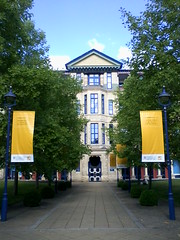 Further afield the Centre for Entrepreneurial Learning at
 University of Cambridge is in an old hospital (over-refinished in post-modern style). This is not just a matter of fashion: innovation depends on people meeting and learning to work together. The trappings of corporate culture can disrupt innovation and not in a good way.
Tuesday, June 13, 2017
Venture Capital Effect
 Greetings from the Mural Hall of Parliament House Canberra, where The Venture Capital Effect is being launched. This report is from the Australian Private Equity and Venture Capital Association, so is very pro-VC.
This is of interest to me as I help students undertaking start-ups at the Australian National University. Some of these are extra-curricular activities such as the Innovation ACT competition, while others are part of their degree program through ANU Techlauncher.
Unfortunately all the MPs had to go to a division, just they were getting up to speak at the event. Perhaps one new venture could be an electronic voting system for Parliament, so MPs need not be in the chamber. ;-)
Tuesday, February 28, 2017
Sydenham Station Creative Hub

Being initiated by local government, the Sydenham Creative Hub is essentially a land planning activity. It is proposed to keep the current general industrial zoning, while allowing restaurants, cafes, bars and businesses:
"... but only where the consent authority is satisfied that the business premises and/or office premises will be used for a creative purpose such as media, advertising, fine arts and craft, design film and television, music, publishing, performing arts, cultural heritage institutions or other related purposes...".What seems to be lacking from the plan is any concept of how to attract or support businesses, apart from helping with planning approval. There do not appear to be any targets for the project attracting business. I suggest the project needs a plan, with a budget and a projection it will be revenue positive for the council within a realistic time-frame.
The Council might want to also involve some local business students in working on aspects of the project beyond zoning. Also a workshop to work out a better name than the "Sydenham Station Creative Hub" (or just drop "Station"). The Council might also catalog the vocational training available in the area: brewers and other creative need training and certification.
ps: John Whelan, of the Inner West Council Economic Development Unit proved that this local council can, literally, organize a drinking session in a brewery. ;-)
Saturday, December 26, 2015
Building a Local Entrepreneurial Community

As the name suggests, the book is for those building, a local startup community. As in Canberra, this can involve entrepreneurs (and those wanting to be), governments, universities, investors (be they angels or otherwise), mentors and service providers (in a gold rush those who provide shovels do well).
The book is 224 pages and based on the author's experience in Boulder USA, referred to as the "Boulder Thesis". Unfortunately the book is very USA-centric. As an example it is not explained until the second chapter what "Boulder" is (a city of 100,000 people in the state of Colorado, USA). The author suggests Boulder may have the highest density of entrepreneurs per head of adult population of any city in the world. However, I suspect that some small university cities may have higher entrepreneurial density. As an example, Cambridge (UK) has a population of about 130,000 and significant start-up activity.
In Chapter two the author takes us through Boulder's pre-Internet start-up era, the Internet bubble and its intimidate aftermath. In Chapter three we learn some theory of what makes for a vibrant startup community and then it is straight into the "Boulder Thesis":
"1. Entrepreneurs must lead the startup community.This would seem to be a useful guide for any community: it should be lead by people from the community, by people with a long term commitment and be inclusive. However, I suggest it is unrealistic to expect everyone to commit to a twenty year plan. There has to be scope for people who have a year or two, a week or two, or an hour or two. If only those with total, long dedication are included, then most people and particularly those with family and other commitments, will be excluded.
2. The leaders must have a long-term commitment.
3. The startup community must be inclusive of anyone who wants to participate in it.
4. The startup community must have continual activities that engage the entire entrepreneurial stack."
From: Startup Communities: Building an Entrepreneurial Ecosystem in Your City, Brad Feld, 2012, Chapter 3.
In Chapter four Feld argues that the leaders in a start-up community must be the entrepreneurs, but "The best startup communities are loosely organized and consist of broad, evolving networks of people." He is skeptical of the value of government officials who are officially supposed to help with start-ups, such as economic development directors. He sees government programs as well intentioned but not long term enough to be of real value, with staff who do not understand entrepreneurship.
Feld sees government as not being good at investing in entrepreneurial activity. In general I would agree with this. One exception is the ACT Government's investment in the Canberra Innovation Network (CBRIN). The government provided office space and funding for some training and start-up competitions. CBRIN's office and its activities have the low cost, start-up feel to them, not like a glossy government development department. As well as inculcating people from the private sector and the universities with the entrepreneurial spirit, CBRIN also changed with teaching retiring public servants how to move to the private sector. This has the subtle effect of spreading the entrepreneurial approach throughout the public sector.
Also in Chapter four Feld expresses skepticism over the idea that startups need to be near a major university. However, he does agree that human capital (students and university academics) are useful, particularly students. This would agree with the main thesis of the "Cambridge Phenomenon", that the students and staff were important to the development of start-ups around the University of Cambridge (UK).
Feld is less impressed with the usefulness of research facilities at universities or of the formal transfer of licensed research results for commercialization. When I visited the University of Cambridge om years ago to discuss that issue, I found an interesting form of creative ambiguity: no one seemed to agree as to who owned the IP from research. Rather than be a negative, this seemed to provide flexibility for start-ups.
Feld also seems ambivalent as to the role of venture capital investors, seeing them as essential, but often at cross purposes with the entrepreneurs. He is more positive about mentors, almost idealizing them. It has taken me years to be comfortable is the role of mentor to student start-up projects. I was never sure how firm I should be in what advice I gave the students. When I noticed that my students were winning start-up competitions, I stopped worrying so much and assumed I must be doing something right.
A group which Feld mentions only briefly are the service providers, who provide legal, accounting, marketing and staffing advice to start-ups. In events at CBRIN I have met quite a few people from these companies. They seem ready to provide some free advice, in the hope of getting paid work later.
Surprisingly Feld spends more time on the role of large companies, such as Google and Microsoft in helping start-ups. Google has an R&D office in Sydney and comes to Canberra a couple of times a year to recruit university graduates. Many of these people end up in Sydney. Google hosts IT related meetings in its Sydney office (such as the Sydney Linux User Group, lovingly known as SLUG).
The most fun part of Feld's book and the fun part of start-ups is chapter seven on "Activities and Events". He discusses the Young Entrepreneurs' Organization (now known as the Entrepreneurs' Organization) and the Boulder Denver New Tech Meetup, Boulder Open coffee Club, Boulder Startup-weekend, CU New Venture Challenge, Boulder Startup Week, Entrepreneurs Foundation of Colorado (EFCO). The point here seemed to be about getting people together in person.
Curiously what is lacking from Feld's analysis, given that many start-ups are about the Internet, is the use of the Internet for collaboration. While I agree it does help for people to meet in person, at least once, many cannot spend time at face to face events. There seems to be a lack of discussion of on-line tools, as if this would undermine the start-up ethos.
One of the impediments to the entrepreneurial community is the jargon. For example, what is an "accelerators"? For startups, this is a short term program designed to provide the venture with advice, training. In chapter eight Feld gives the example of the Techstars accelerator program. He contrasts these accelerators with "Incubators" being set up to help businesses at any time, whereas an "accelerator" is a fixed term program the start-up is run through. There may be accelerators and incubators associated with each other, for example the KILN Incubator and the GRIFFIN Accelerator are both run out of the Canberra Innovation Network office. As Feld pints out there can also be accelerators run out of universities, although I have seen one example where the accelerator office were very neat and tidy, not nothing seemed to be happening there.
In chapter 9 Feld addresses the role of universities, starting with something called the "Silicon Flatirons Center" at the University of Colorado Law School. The significance of "Flatiron" was lost on me, but this seems to be a center for technology policy research. The problems with limiting examples to Boulder is most apparent in this chapter of Feld's book. The University of Colorado Boulder no doubt shares problems of engagement with entrepreneurial engagement, limited entrepreneurial programs and siloing of programs with other institutions. But there are universities elsewhere in the world which have overcome these problems. Feld's solution is the students. In Canberra this is shown by the enthusiasm with which they have taken up the Innovation ACT program, where students (and other) can form teams and compete to produce a business plan for a startup and ANU TechLauncher, where students undertake a project course to produce a product or service (with the help of alumni as mentors).
The point at which I started to disagree with Feld was chapter ten "The Difference Between Entrepreneurs and Government". He says "Great entrepreneurs are intensely self-aware... Entrepreneurs fail often and own it; government leaders rationalize why something didn’t go their way." However, this criticism of government could be applied to an established organization, public or private. No one running an organization is going to want to admit they do not know what they are doing or have made a mistake. It is very easy for an Entrepreneur who has no customers to say something went wrong, it is much harder for someone running a service lived depend on.
Feld says "Entrepreneurs work bottom up and government works top down". As he says Government has hierarchy, infrastructure, staff and rules. However, there is innovation in the public sector and it does happen bottom up. This innovation usually happens despite the organization structure and rules, not because of it. As an example in the mid 1990s a group of public servants set out to introduce the Internet to the Australian Government. This was not done as a result of any central mandate, quite the opposite (it was done in contravention of central mandate). Part of the process was to change the minds of the senior management and lastly to allow the political level to take credit, retrospectively. That might sound subversive, but it is how change happens in government and large private sector organizations. This is not usually acknowledged but is not secret. As an example I gave a talk about it in Canberra in 1995: "Internet in Government" and this was reported in the media as "The cabal that connected Canberra" (1995) and detailed in Peter Chen's 2000 ANU PHD thesis. An interesting experiment is currently being conducted by the Australian Government, with the creation of the Digital Transformation Office. The DTO aims to create "Simpler, clearer, faster public services". The immense challenge is to do this while keeping government reliable and equitable. DTO might benefit from running internal entrepreneur programs and training, or joining in those provided for students and the public.
Working in and around bureaucracies is an area which is perhaps neglected in the education of entrepreneurs. Many revolutionary business ideas depend on having laws changed. An example are share applications such as Uber and AirBnB, where individuals provide a service to others. Building an IT system to make this possible is the easy part, the difficulties come in getting around the many of laws covering the existing commercial providers of such services. Entrepreneurs might be able to learn from the way public servants effect change.
In chapter twelve Feld.
Reference
Feld, B. (2012). Startup communities: Building an entrepreneurial ecosystem in your city. John Wiley & Sons.
Friday, December 18, 2015
Wind Turbine Global Control Center Opens in Canberra Innovation Precinct


ps: In 2010, my student Sam Fernandes, undertook "Project Cervantes: Can a web server be powered by a wind turbine?". The answer was "no", but he found, that under ideal conditions 40% of the power for a data centre could be provided by the wind.
Monday, October 26, 2015
Sydney Silicon Harbor Proposal
 |
| ATP Sydney 1998 |
In 2002 design students and staff from the "new" Bauhaus Dessau in Germany, visited Sydney and undertook a planning exercise for the area now known as the bays precinct. They were interested in the role of computers and telecommunications in the city, so I gave them a talk on Canberra's fibre optic broadband system entitled Canberra: Encircled by Light. As a footnote to this I proposed reusing the old Canberra power-station as a hi-tech centre.
The results of the Bauhaus study were published in 2003, as the book "Serve City: Interactive urbanism" by Neil Leach, Wilfried Hackenbroich and Regina Sonnabend, available in the libraries of the University of Sydney and Western Sydney and from Amazon.com.
 " by Neil Leach, Wilfried Hackenbroich and
Regina Sonnabend,
" by Neil Leach, Wilfried Hackenbroich and
Regina Sonnabend, Sydney hi-tech company Atlassian have suggested that the existing Australian Technology Park (ATP) which is in a repurposed railways workshop in Redfern would be more more viable. It does seem odd that the NSW government would be proposing establishing a new tech park, when they already have one languishing on the other side of the city.
In my closing address to the 1998 Information Industry Outlook Conference, I used the ATP to illustrate how Australia could create a cultured image to market its information industries. Rather than Silicon Valley, I suggested that Australia should model its hi-tech start-up strategy on Cambridge (England) and the so-called "Cambridge phenomenon".
An area which is growing organically into a hi-tech center is around UTS in Ultimo. This has the new UTS Innovation Building and the adjacent Fishburners Co-working Space.
Monday, August 31, 2015
Technology Park for Sydney
David Swan reports in The Australian newspaper today "Atlassian push to revive Sydney’s Australian Technology Park" (31Unlocking Sydney’s Innovation Potential" said to include gnomonic modeling of a technology park by PwC. I mentioned ATP in my "Building Arcadia: Emulating Cambridge's High Technology Success" (1998). However, ATP lacks a nearby university campus, to feed the innovation process. In contrast Canberra has a technology zone, which I have christened the "Canberra Start-up Business Boomerang", between ANU and the CBD.
Monday, August 17, 2015
Tools for IT Startups

Fernando cautioned against premature expansion of a new business. He argued that the business should first carry out experiments to see if they are solving a real problem before making a large investment. With new on-line tools a business does not have to big to start out. Fernando pointed out that Facebook started out with students at just one university as customers and then added others. He has a set of recommended tools for test, build, measurement, and learning.
One of Fernando's insights was to experiment to see how long it takes the user to "get" your product. As an example, a user has to have about 14 friends in a social media product for it to be useful.
Sunday, July 12, 2015
How to Start a Business in Canberra
 Recently I was asked how to start a business in Canberra and how to get funding.
This should not be difficult, as we have a new local
government/university joint facility in Canberra, specifically to help
startups: the "CBR Innovation Network" (CBRIN). The hard part is understanding how it operates and all the start-up jargon.
Recently I was asked how to start a business in Canberra and how to get funding.
This should not be difficult, as we have a new local
government/university joint facility in Canberra, specifically to help
startups: the "CBR Innovation Network" (CBRIN). The hard part is understanding how it operates and all the start-up jargon.For a start, what is "CBR"? This is the international code for Canberra's airport (just as "LAX' is the code for Los Angeles International Airport). The ACT Government decided to base its marketing of Canberra around use of this abbreviation. This seems a little odd as Canberra's airport does not have any scheduled international flights, so apart from a few plane spotters no one knows what "CBR" is. As a result I tend to spell out the name "Canberra Innovation Network" (and suggest the abbreviation CBRIN be pronounced "See-Brin").
CBRIN's strength is that it provides many start-up services in the one place, provided by specialist organizations. As a result it is very confusing for the novice entrepreneur to work out what are all the services and which organisations provide what.
CBRIN has an office on the top floor of the ACT Heath building in Canberra's CBD. This is an excellent location, between the ANU campus and the corporate offices of the city, in the center of a cluster of computer companies, private education providers, research organizations. Most importantly, CBRIN is near good bars and restaurants (which research shows is important to the start-up process). However, if you go in the front door of the building you end up in what looks like a hospital waiting room (better to go in the side door and take the lift to the top floor).
CBRIN has:
- Events space: This is a large room where events and workshops are held. It can be hard to find, down a long corridor on the west dies of the floor (follow the noise to the function). Last week I attended Matt Fenwick Life Without Lanyards. book launch and a workshop for the CBR xPS project in the CBRIN events space and the first monthly "First Wednesday Connect" last week. This is the way people are introduced to CBRIN.
- Co-working space: The co-working space is an open plan office with long benches for individuals and small groups to work on their start-up. The co-working space is managed by the non-profit organization Entry 29. This is where start-ups start, after being introduced to CBRIN. The co-working space is more than just a low cost shared office: the idea is to foster work relationships between the members. Entry29 members can use the co-working spaces in other cities, when traveling, such as Fishburners Sydney and Spacecubed Perth. (apparently it is obligatory for co-working spaces to have silly names).
- Incubator: The incubator is a step up from the co-working space, with each start-up having its own office area, but still located open plan with others. At this stage the start-up is expected to need more tailored and individual business advice. CBRIN's incubator is called "Kiln Incubator".
- Accelerator: The accelerator is a process, not a physical space. A start-up in the accelerator program will most likely be located in the incubator space, but also gets expert help and funding for a limited time, in return for giving up a share of the ownership of the business. CBRIN has associated with it the Griffin Accelerator.
Wednesday, July 08, 2015
Building a Private Sector Future for Canberra
Greetings from the Canberra Innovation Network (CBRIN) office where I am attending a workshop on the CBR xPS project. This project is sponsored by the ACT Government to help public servants who want to move the private sector. The reason for the ACT Government to do this is presumably change the tradition that when people leave the public service they move out of Canberra, taking their money with them. Canberra therefore needs viable private sector options for people to work in Canberra and also help public servants to transition. My interest in this is that I am designing course material to help those who want to be innovators and entrepreneurs.
Wednesday, July 01, 2015
First Wednesday Connect Canberra Startup Meeting
Greetings from the Canberra Innovation Network (CBRIN) office, where the inaugural "First Wednesday Connect" is being held. Start-up companies are giving quick pitches for their ventures, but the main aim of the evening is for people from business, government and academia to meet each other. This has been useful, as I met Kelly Brown from Nexia, who are helping out with training the startups (I am designing an on-line course for them as well).
Tuesday, April 14, 2015
Application to Helping New Employees
Greetings from the Canberra Innovation Network, in the heart of the Canberra Start-up Business Boomerang, where Welcomer Chairperson Kate Lundy is launching the WelcomeAboard product. This is an on-line service to help organizations take on new employees. The idea is to take the tedium of paper form filling out of taking on a new employee, with all the details of their bank account (where they want to be paid), tax details and superannuation. The service is designed to work with clod based accounting packages, such as Xero.
Friday, March 20, 2015
Cambridge Phenomenon's Fifty Years of Innovation
Greetings from the UNSW Campbelltown Library. Seeking more content for my innovation course, I have tracked down the only copy of Kirk, Cotton and Gates
(2012) in an Australian public library. In doing so I feel I am back on a journey started twenty years ago. In 1996 I spent several sessions in the ANU library, reading one of the few copies of the report "The Cambridge Phenomenon" (Segal Quince & Partners, 1985) in Australia. I very much had the sense I was holding a precious commodity to which I had limited access. I made extensive notes, appropriately enough on a Cambridge Z88 portable computer. These notes became Appendix A "The Cambridge Phenomenon - Summary of the Report" in Worthington (1999). I have had to drive three hours to read the sequel: I hope it is worth it.
The new the book is much glossier than the original. The forward is by Bill Gates (There is a Microsoft Research Lab at Cambridge, adjacent to the new Cambridge University Computer Lab). The preface is by Charles Cotton, founder of Cambridge Phenomenon Limited (which appears to have been set up just to write this book) and mentions the Hauser Forum (in the West Cambridge Research and Development Park).
There is a two page diagram "Cambridge Ideas Change the World" which is also available on-line as a PDF document. This takes some liberties with history to place Cambridge at the center of developments in Genomics, Monoclonal Antibodies, Computing and Software. As an example, the Computing time line starts with Charles Babbage and his Difference Engine in the 1800s (was this done at Cambridge?), then Alan Turing before getting on to firmer ground with the 1946 EDSAC computer which was built at Cambridge. The last step in this is the formation of ARM at Cambridge in the 1990s (I visited there a few years after the company was formed and wish I had bought some shares).
The introduction of the book is on firmer ground starting with Tim Eiloart founding Cambridge Consultants in 1960. The authors estimate that 4,000 technology companies have been set up around Cambridge since the 1960s, with 1,400 in 2012 and 48,000 employees.
The chapter on the early days acknowledges Cambridge Scientific Instrument Company, found by Horace Darwin in 1881 to make precision instruments, but it was not until the 1960 that conditions were right to make such companies more than a rarity.
The next chapter "Growing Pains: 1970 - 1979" covers Sinclair Radionics, which made the Sinclair Executive calculator, Also Arcorn Computers Ltd. The Mott Report (1969) lead to the Trinity Science Park. The Bolton Report (1971) resulted in government policies to encourage "small Firms".
The authors attribute Matthew Bullock at Barclays Bank in Cambridge with discovering a "triangle of activity between the river, Bridge Street and Jesus Lane" (Kirk, Cotton & Gates, 2012, p. 44). However, looking at a map of Cambridge, I am not sure where this triangle is. Bullock with Jack Lang of Topexpress (one of the companies in the triangle) then invited staff of the other companies to meet informally.
Kirk, Cotton & Gates (2012, p. 45) describe how some of these staff had been students and staff at the Cambridge University Computer Lab and meetings in the Eagle pub acted as a replacement for previous university common room discussions. Outcomes included changes to planning laws to allow R&D functions in commercial, rather than industrial, premises. Bullock identified Cambridge as an area for Barclays to invest in due to improved transport combined with the industry startups.
The next chapter "Putting the Phenomenon on the Map: 1960-1989" starts with a brief description of the first Cambridge phenomenon report (Segal Quince & Partners, 1985). Given that the later work has a name very similar to the first, this work gets remarkably little acknowledgement or analysis. I had assumed that the new report was by some of the same authors, or the same consulting company, or by people in some way associated with the first, but I could find no connection in the text. There appear to be just five paragraphs in this chapter of a book of 244 pages summarizing the previous study. The rest of the chapter describes the rise of various companies, most notably Acorn Computers making the BBC Microcomputer. The chapter ends by discussing the slow start for the Trinity Science Park.
Strangely the next chapter "Momentum: 1990-1999" has a large photo of the Cambridge Judge Business School, with no explanation of what this has to do with technology startup companies (p.66). I recall seeing this building in Trumpington Street on my way to talk to Andy Hopper at the the much more modest Olivetti Research Laboratory (ORL) in 1996. After reading the original Cambridge Phenomenon I had set out to see what it was all about in person.
At this point, about one quarter of the way through, I lost interest in the book and went for lunch at the UWS Cafe. After a lunch of fish and noodles I came back to the library to consider what I had read. The remainder of the book appeared to be the same detailed catalog of companies and funders as before. What was lacking was an analytical analysis of the reasons for this development which was in the original report.
This is not an updating of the original report, more catalog of what happened later. I suggest anyone interested in the how and why of tech startups should read the original report. You can then read 2012) which gives a good summary of the second report.
Is there anything from this book for my innovation course? Not
really. The idea of an informal way for people from different startup firms to meet is useful. The concept of new companies starting in a small area in proximity to a university is not new, but worth restating.
Such an area is now forming in Canberra, on the western edge of the ANU campus and has been referred to as the "Canberra Innovation Precinct". However, the area is now expanding to cover much of the western side of Canberra's CBD. Given the shape of this precinct, it could be called the "Canberra Start-up Business Boomerang": from Marcus Clarke Street extending east to London Circuit, and from Barry Drive in the north to Gordon Street in the south. At the center of this, both geographically and strategically, is the Canberra Innovation Network (CBRIN). Also it should be noted that this is not far from where the Griffins' first plan for Canberra (1912), had marked as the location for the "Technology" building of the national university.
The Wig and Pen Bar, which was across the road from CBRIN, and serves as the equivalent of the Eagle pub in Cambridge, has moved slightly further away to the foyer of the ANU Music School.
A Google Scholar search finds more than one million references to the "Cambridge phenomenon". Miao and Hall (2014) look at the more ‘cultivated’ Chinese science parks, as a contrast to Cambridge.
The new the book is much glossier than the original. The forward is by Bill Gates (There is a Microsoft Research Lab at Cambridge, adjacent to the new Cambridge University Computer Lab). The preface is by Charles Cotton, founder of Cambridge Phenomenon Limited (which appears to have been set up just to write this book) and mentions the Hauser Forum (in the West Cambridge Research and Development Park).
There is a two page diagram "Cambridge Ideas Change the World" which is also available on-line as a PDF document. This takes some liberties with history to place Cambridge at the center of developments in Genomics, Monoclonal Antibodies, Computing and Software. As an example, the Computing time line starts with Charles Babbage and his Difference Engine in the 1800s (was this done at Cambridge?), then Alan Turing before getting on to firmer ground with the 1946 EDSAC computer which was built at Cambridge. The last step in this is the formation of ARM at Cambridge in the 1990s (I visited there a few years after the company was formed and wish I had bought some shares).
The introduction of the book is on firmer ground starting with Tim Eiloart founding Cambridge Consultants in 1960. The authors estimate that 4,000 technology companies have been set up around Cambridge since the 1960s, with 1,400 in 2012 and 48,000 employees.
The chapter on the early days acknowledges Cambridge Scientific Instrument Company, found by Horace Darwin in 1881 to make precision instruments, but it was not until the 1960 that conditions were right to make such companies more than a rarity.
The next chapter "Growing Pains: 1970 - 1979" covers Sinclair Radionics, which made the Sinclair Executive calculator, Also Arcorn Computers Ltd. The Mott Report (1969) lead to the Trinity Science Park. The Bolton Report (1971) resulted in government policies to encourage "small Firms".
The authors attribute Matthew Bullock at Barclays Bank in Cambridge with discovering a "triangle of activity between the river, Bridge Street and Jesus Lane" (Kirk, Cotton & Gates, 2012, p. 44). However, looking at a map of Cambridge, I am not sure where this triangle is. Bullock with Jack Lang of Topexpress (one of the companies in the triangle) then invited staff of the other companies to meet informally.
Kirk, Cotton & Gates (2012, p. 45) describe how some of these staff had been students and staff at the Cambridge University Computer Lab and meetings in the Eagle pub acted as a replacement for previous university common room discussions. Outcomes included changes to planning laws to allow R&D functions in commercial, rather than industrial, premises. Bullock identified Cambridge as an area for Barclays to invest in due to improved transport combined with the industry startups.
The next chapter "Putting the Phenomenon on the Map: 1960-1989" starts with a brief description of the first Cambridge phenomenon report (Segal Quince & Partners, 1985). Given that the later work has a name very similar to the first, this work gets remarkably little acknowledgement or analysis. I had assumed that the new report was by some of the same authors, or the same consulting company, or by people in some way associated with the first, but I could find no connection in the text. There appear to be just five paragraphs in this chapter of a book of 244 pages summarizing the previous study. The rest of the chapter describes the rise of various companies, most notably Acorn Computers making the BBC Microcomputer. The chapter ends by discussing the slow start for the Trinity Science Park.
Strangely the next chapter "Momentum: 1990-1999" has a large photo of the Cambridge Judge Business School, with no explanation of what this has to do with technology startup companies (p.66). I recall seeing this building in Trumpington Street on my way to talk to Andy Hopper at the the much more modest Olivetti Research Laboratory (ORL) in 1996. After reading the original Cambridge Phenomenon I had set out to see what it was all about in person.
At this point, about one quarter of the way through, I lost interest in the book and went for lunch at the UWS Cafe. After a lunch of fish and noodles I came back to the library to consider what I had read. The remainder of the book appeared to be the same detailed catalog of companies and funders as before. What was lacking was an analytical analysis of the reasons for this development which was in the original report.
This is not an updating of the original report, more catalog of what happened later. I suggest anyone interested in the how and why of tech startups should read the original report. You can then read 2012) which gives a good summary of the second report.
The Canberra Start-up Business Boomerang
Such an area is now forming in Canberra, on the western edge of the ANU campus and has been referred to as the "Canberra Innovation Precinct". However, the area is now expanding to cover much of the western side of Canberra's CBD. Given the shape of this precinct, it could be called the "Canberra Start-up Business Boomerang": from Marcus Clarke Street extending east to London Circuit, and from Barry Drive in the north to Gordon Street in the south. At the center of this, both geographically and strategically, is the Canberra Innovation Network (CBRIN). Also it should be noted that this is not far from where the Griffins' first plan for Canberra (1912), had marked as the location for the "Technology" building of the national university.

The Wig and Pen Bar, which was across the road from CBRIN, and serves as the equivalent of the Eagle pub in Cambridge, has moved slightly further away to the foyer of the ANU Music School.
Other Works on the Cambridge Phenomenon
A Google Scholar search finds more than one million references to the "Cambridge phenomenon". Miao and Hall (2014) look at the more ‘cultivated’ Chinese science parks, as a contrast to Cambridge.
Moog (2002) comments "Knowledge intensive new firms often result from high educated, academic founders or directly from academic institutions".
WESTHEAD (1988) points out that the phenomenon of closely clustered high tech firms may not be able to be replicated. may not be replicated. Benneworth and Groen (2010) describe how more formal university entrepreneurship programmes, which grew up partly as a response to the Cambridge Phenomenon, act as gateway to wider entrepreneurship system outside the university.
Yuehua. (2002) concludes that developed countries' experience of science parks is applicable to developing countries.
Garnsey, Lorenzoni and Ferriani (2007), detail the formation of ARM, as a spin-off of Acorn Computers. Ahmed (2013, pp. 122-139) has a useful chapter on "Entrepreneurs, Spinning Out, Making Money andLinking with Industry", with case studies on Shape Data Ltd, Acorn/ARM, Sintefex Audio, Bango,, RealVNC, Sophos plc, Jagex, blinkx, Camrivox, Green Custard, The Raspberry Pi Foundation XenSource and Rapportive. Also there is a section on how the computer lab supported these developments. Unfortunately this 179 page e-book has very high resolution color images which makes it a 9.5mbuyte download (a version with smaller images would be more useful for students).
Curiously some of these works cite my own summary of the "Cambridge phenomenon" (Worthington, 1999), rather than, or in addition to, the original report. Livesey, Sullivan, Hughes, Valli, and Minshall (2008) in a Cambridge University Economics and Policy Working Paper quote me accusing the the Australian government of believing “if a
high technology/ science park is created, with suitably high-tech buildings, then high
technology firms will be attracted to move in from somewhere.”
Garnsey, Lorenzoni and Ferriani (2007), detail the formation of ARM, as a spin-off of Acorn Computers. Ahmed (2013, pp. 122-139) has a useful chapter on "Entrepreneurs, Spinning Out, Making Money andLinking with Industry", with case studies on Shape Data Ltd, Acorn/ARM, Sintefex Audio, Bango,, RealVNC, Sophos plc, Jagex, blinkx, Camrivox, Green Custard, The Raspberry Pi Foundation XenSource and Rapportive. Also there is a section on how the computer lab supported these developments. Unfortunately this 179 page e-book has very high resolution color images which makes it a 9.5mbuyte download (a version with smaller images would be more useful for students).
Curiously some of these works cite my own summary of the "Cambridge phenomenon" (Worthington, 1999), rather than, or in addition to, the original report. Livesey, Sullivan, Hughes, Valli, and Minshall (2008) in a Cambridge University Economics and Policy Working Paper quote me accusing the the Australian government of believing “if a
high technology/ science park is created, with suitably high-tech buildings, then high
technology firms will be attracted to move in from somewhere.”
References
- Ahmed, H. (2013). Cambridge Computing: The First 75 Years. Retrieved from http://www.cl.cam.ac.uk/downloads/books/CambridgeComputing_Ahmed.pdfBenneworth, P., & Groen, A. (2010). " No longer the sparkling new idea": anchoring university entrepreneurship programmes in academic, entrepreneurial and regional policy networks. Retrieved from http://doc.utwente.nl/73396/1/Benneworth.pdf
. (2012). Viewpoint: The Cambridge Phenomenon, five decades of success. BBC News UK. Retrieved from http://www.bbc.com/news/technology-17982595
Garnsey, E., Lorenzoni, G., & Ferriani, S. (2007)Speciation through Entrepreneurial Spin-off: The Acorn-ARM story. Retrieved from http://www.researchgate.net/profile/Elizabeth_Garnsey/publication/222423713_Speciation_through_entrepreneurial_spin-off_The_Acorn-ARM_story/links/0deec52945dd7279bf000000.pdfKirk, Kate & Cotton, Charles & Gates, Bill, 1955- (2012). The Cambridge Phenomenon : 50 years of innovation and enterprise. Third Millenium, London
Livesey, F., O’Sullivan, E., Hughes, J., Valli, R., & Minshall, T. (2008). A pilot study on the emergence of university-level innovation policy in the UK. Centre for Economics and Policy Working Papers. Retrieved from http://www.ifm.eng.cam.ac.uk/uploads/Research/CIG/UniversityInnovationStrategy_FinalReport_RELEASE_140308.pdfMiao, J. T., & Hall, P. (2014). Optical illusion? The growth and development of the Optics Valley of China. Environment and Planning C: Government and Policy, 32(5), 863-879. Retrieved from http://eprints.gla.ac.uk/98479/1/98479.pdf
Moog, P. (2002). Human capital and its influence on entrepreneurial success. Historical Social Research/Historische Sozialforschung, 157-180. Retrieved from http://www.ssoar.info/ssoar/bitstream/handle/document/3395/ssoar-hsr-2002-no_4__no_102-moog-human_capital_and_its_influence.pdf?sequence=1- Segal Quince & Partners (1985). The Cambridge phenomenon : the growth of high technology industry in a university town. Segal Quince & Partners, Cambridge
Trani, E. P., & Holsworth, R. D. (2010). The indispensable university: Higher education, economic development, and the knowledge economy. R&L Education.WESTHEAD, D. P. (1988). SWP 30/88 NEW MANUFACTURING FIRMS AND NEW FIRM FOUNDERS IN WALES, 1979-1985. Retrieved from https://dspace.lib.cranfield.ac.uk/bitstream/1826/576/2/SWP3088.pdf
Worthington, Tom (1999). Net traveller : exploring the networked nation (Ed. 1.0). Australian Computer Society, Dickson, A.C.T Retrieved from http://tomw.net.au/nt/
Yuehua, Z. (2002). A developing economy oriented model for science park management. Retrieved from http://ro.uow.edu.au/cgi/viewcontent.cgi?article=1989&context=theses
Tuesday, February 17, 2015
Bringpeer: Building a Better Social Network for University Students
Last year I mentored the "Bringpeer team" in the Innovation ACT competition. The idea was to building a better social network for university students, starting with the Australian National University (ANU). The team did not win the competition, but the ANU saw enough promise in the idea to support the start-up. The product was launched during "O-week", with more than three hundred students signed up so far.
I will be speaking on "Innovations in teaching innovation", at the CSIRO ICT Centre, Center, Australian National University in Canberra, 4pm, 27 April 2015.
I will be speaking on "Innovations in teaching innovation", at the CSIRO ICT Centre, Center, Australian National University in Canberra, 4pm, 27 April 2015.
Friday, February 13, 2015
Company Accelerator Program Launched in Canberra
Greetings from the Canberra Innovation Network (CBRin), where the ACT Chief Minister Andrew Barr is officially launching the Griffin 2015. The chief minister said he would "twist the arms" of the owners of surplus office space in the Canberra city center to make it available for startup companies. Perhaps Canberra could emulate Leichhardt Council's excellent "Renew Leichhardt" initiative, which offers property owners incentives to make surplus space available (including at the Italian Forum).
Wednesday, February 04, 2015
Shift Index Looking Beyond Short Term Business Metrics
Hagel III et al. (2011) attempt to find a way to measure the way
technology, and in particular digital technology, transforms business and
the economy. They describe the effect of digital technology as the "Big
Shift" and develop a "Shift Index" to measure it. This index is intended
to measure longer term trends than is usual with most short term
business metrics. The authors make the point that the digital
adoption rate for is "two to five times faster than previous infrastructures, such as electricity and telephone networks" (2011, p.21). Their "shift index" measures the effect of three waves of this adoption:
Hagel III et al. seem to want to replace a romantic notion of the efficiency of large 20th century firms with an equally unrealistic view of 21st century ones: "largely propelled by individuals, especially the younger workers, who put digital technologies, such as social media, to their most effective use" (Hagel III et al., 2011, p. 24). In this new age firm, management is to play a supporting role, finding "passionate employees" and "providing them with platforms and tools". Stripped of the new age language, this sounds like the traditional role of management: to identify staff with potential and give the the tools to apply their skills. Also the idea of staff having to step outside the boundaries of the organization in order to get the job done is hardly a new one.
Hagel III et al.'s message about productivity seems to become a little confused when discussing "creative cities" (2011, p. 24). They comment that "Talent is migrating to the most vibrant geographies and institutions because that is where individuals can improve
their performance more rapidly by learning faster." which is hard to argue with (but has been the case for thousands of years). They have identified the top and bottom ten creative cities (but only in the USA) and point out that the top ones outpaced the bottom for population growth, as if this is a good thing. The authors seem to think that bigger cities are in some way better. But the ADC Cities Report: Enhancing Liveability (Report part 1 & Report part 2, 22 October 2010), sets the optimal size for a city at 250,000 to 300,000 people.
- Foundation Index: "... reflects new possibilities and
challenges for business as a result of new technology
capability and public policy shifts." - Flow Index: " is characterized by the increasing flows of capital, talent, and knowledge across geographic and institutional boundaries"
- Impact Index: "reflects how well companies are exploiting foundational improvements in the digital infrastructure by creating and sharing knowledge"
Hagel III et al. seem to want to replace a romantic notion of the efficiency of large 20th century firms with an equally unrealistic view of 21st century ones: "largely propelled by individuals, especially the younger workers, who put digital technologies, such as social media, to their most effective use" (Hagel III et al., 2011, p. 24). In this new age firm, management is to play a supporting role, finding "passionate employees" and "providing them with platforms and tools". Stripped of the new age language, this sounds like the traditional role of management: to identify staff with potential and give the the tools to apply their skills. Also the idea of staff having to step outside the boundaries of the organization in order to get the job done is hardly a new one.
Hagel III et al.'s message about productivity seems to become a little confused when discussing "creative cities" (2011, p. 24). They comment that "Talent is migrating to the most vibrant geographies and institutions because that is where individuals can improve
their performance more rapidly by learning faster." which is hard to argue with (but has been the case for thousands of years). They have identified the top and bottom ten creative cities (but only in the USA) and point out that the top ones outpaced the bottom for population growth, as if this is a good thing. The authors seem to think that bigger cities are in some way better. But the ADC Cities Report: Enhancing Liveability (Report part 1 & Report part 2, 22 October 2010), sets the optimal size for a city at 250,000 to 300,000 people.
References
Hagel III, J., Brown, J. S., Kulasooriya, D., Bhatia, S., Lally, M., Wong, J., ... & Lu, S. J. (2011). The 2011 Shift Index Measuring the forces of long-term change. Deloitte Center for the Edge, 1(2011), 17. Available online at http://www2.deloitte.com/content/dam/Deloitte/nl/Documents/center-for-the-edge/deloitte-nl-center-for-the-edge-shift-index.pdf
Subscribe to:
Posts (Atom)