Showing posts with label autonomous underwater vehicle. Show all posts

Thursday, March 16, 2023

Plan C for AUKUS Submarine Project: Buy Just Three Submarines Armed with Drones

On 4 Mar 2023 the Australian government announced a plan to acquire three US Virginia class nuclear-powered submarines from 2030, with modified UK Astute "AUKUS" class submarines built in Australia from 2040. If there are delays with the AUKUS class, Australia has the option to purchase another two Virginia class submarines from the USA. However, I suggest the Australian government have a third option ("Plan C"): accelerate the development of drones, to arm the submarines and operate alongside them. If the drones prove successful, Australia could stop acquisition at three Virginia class, not purchase any more crewed submarines, and not build any. 

The largest of the drones would be ocean going robot submarines, capable of conducting surveillance, launching weapons, and perhaps even carrying small raiding parties. The robot submarines would be small enough to be transported by cargo aircraft, and could be maintained from, and carried on Australian made high speed transport ships. 

The smaller drones would be the size of mini, lightweight, and full size torpedos. Some drones would operate as smart mines, then attack as torpedos. Others would provide aerial surveillance, and attack. These drones could be launched from submarines, ships, and aircraft.

Friday, May 27, 2022

Optionally Crewed Submarines for the Australian Navy?

In the 2022 Australian election campaign, the Australian Liberal Party has proposed an "Autonomous undersea warfare capability for Australia's navy" as part of its electoral platform (5 May 2022). The Liberal Party lost the election, but there is merit in the new government implementing this idea. Rather than a purely autonomous craft, I suggest optionally crewed submarines, with the ability to carry about seven people (three crew and four special forces passengers). Australia could acquire a dozen such submarines and two submarine tenders to support them, for the cost of one Collins size boat. This would also ease staffing, as the submarines would require far fewer crew.

The proposed submarines would be eXtra Large Autonomous Underwater Uninhabited Vehicles (XLAUVs), designed to operate in Australia's large maritime region. These could be developed using an engineering approach similar to that of the SpaceX Dragon spacecraft. SpaceX took the approach of first proving an uncrewed cargo version of their spacecraft, before adding manual controls and seats. With a submarine this would allow for more rapid development and operational use.

Such a small craft could be used for the same primary roles as a full size submarine:  surveillance, deployment of mines, and delivery of special forces. They would not be carry large conventional torpedoes, for a direct attack. However, they could deploy self-propelled smart mines in this role, with the submarine leaving the vicinity before the attack, to increase its chances of survival.

Cosmos-class submarine
Pakistan Navy, 
CC BY-SA 4.0, 2018 
Mini-subs, such as the Cosmos-class submarine, are about 110 tons, with a complement of 14, allowing for 6 crew, and 8 special forces passengers. XLAUVs under development are about half this size. They would be able to be operated with a smaller crew, as the autonomous systems would require less manual supervision.

XLAUVs and mini-submarines have a shorter range than conventional and nuclear submarines. The range can be extended by the use of submarine tenders, to refuel, rearm, and exchange crews, closer to the area of operation. The tenders would be able to be designed and made in Australia, derived from Australian stealthy warship and fast military transport ship designs developed for the US military. 


Friday, May 06, 2022

Robot Submarines for Australian Navy

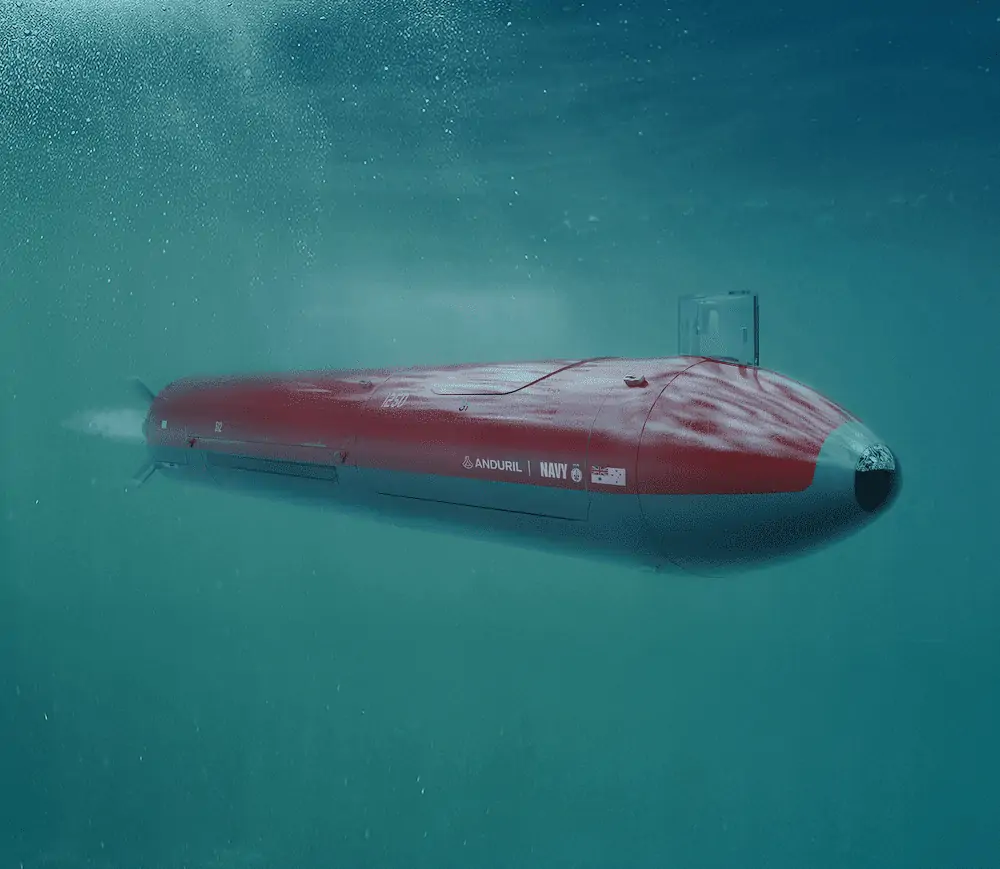
The Australian Liberal Party has proposed an "Autonomous undersea warfare capability for Australia's navy" as part of its electoral platform (5 May 2022). Unlike many political promises, this is a very detailed proposal for the Defence Department and the company Anduril. Interestingly the Australian arm of the company was formed only a month ago, and the parent company in 2017, and appears to have limited experience building large long endurance robot submarines. 

The proposed submarines would be eXtra Large Autonomous Underwater Uninhabited Vehicles (XLAUVs). These are the size of crewed mini submarines used in WWII, and can cross an ocean, thus suited to operation in Australia's large maritime region. Unlike smaller torpedo sized AUVs, the XLAUVs can't be launched from a submarine, and would normally be supported by a specially fitted out submarine tender vessel. However some US nuclear submarines have the capability to carry an external cargo, and may be able to transport a XLAUV covertly to its launch point. The XLAUV may in turn launcher smaller AUVs, and  UAVs, as well as conventional torpedoes, mines, and missiles.

XLAUVs are conceptually similar to the Boeing MQ-28 Ghost Bat UAV aircraft being developed for the RAAF. The ADF would need to develop tactics and train personnel for operating this equipment and learn how to use it effectively, at the same time it is developed. Support personnel, and equipment would also be required. In the case of the XLAUV surface ships would need to be acquired, built, or adapted in support. Oil industry support ships, which the RAN now has two of, may prove useful in this role. Australian designed fast ferries could also be used to deploy and replenish the robots.

If development proceeds well, the XLAUV may render the proposed Australian nuclear submarines obsolete even before they are ordered. The XLAUVs would be superior in the surveillance role to a nuclear submarine, being more stealthy. They would also be superior to deny large ocean areas via the threat of attack. They would not be able to provide as heavy conventional salvo attack as a larger submarine, however, that is not a role Australia is likely to require. In geopolitical terms XLAUVs may have an advantage by not appearing as threatening  as large nuclear submarines, while actually being militarily more useful. Australia could support and supplement the robot submarines with a small number of conventionally powered, crewed boats, such as the Korean KSS-III.

Monday, October 10, 2016

UAVs Over the Indian Ocean

The India and China at Sea: Competition and Coexistence in the Indo-Pacific Conference is underway at the ANU in Canberra. The topic of the role of aircraft carriers and submarines came up in the first session so I asked the panel if Unmanned Aerial Vehicles (UAVs), and Autonomous Underwater Vehicles (AUVs) would render large vessels obsolete, changing the balance of power in the Indian Ocean.

Within the next ten years, I suggest, countries in the region, including China, will be able to mass produce small, long range, low cost drones on the production lines set up for smart-phones and consumer appliances. India will be able to harness its skilled IT workforce to program their own drones manufactured in the new high hi-tech industrial corridors being built with Japanese funding.

These low cost robot aircraft and submarines will make make aircraft carriers and submarines as useful as the battleship HMS Prince of Wales, was for defending Singapore. This powerful ship was commissioned in January 1941, but sunk by aircraft in December 1941, two days after leaving Singapore.

One of the conference panel thought Chinese anti-ship ballistic missiles more of a threat than drones. The other panelist pointed out that India is the major customer for Israeli UAVs. With the signing of arms limitations agreements, India will be able to acquire armed UAV technology from Israel.

I suggest UAV/AUV technology, unlike ballistic missiles, is not something easily regulated. At the annual Australian UAV Challenge, teams of hobbyists and students test their technology in the field. In last years challenge, teams had to scan for a survivor on the ground and drop supplies to them. In this years challenge, teams had to coordinate two aircraft, with one acting as an airborne communications relay for the other.

Much of the software developed for the UAV Challenge is open source. It is not difficult to imagine the same software being used for a flock of military UAVs to search the ocean for warships,  relaying the coordinates to a flotilla of armed AUVs. This is something a mid-level country, with IT and engineering graduates could implement.

Sunday, August 10, 2014

James Cameron's Submarine Made in Sydney

The one person submarine which James Cameron  used to film ‘Deepsea Challenge 3D’ was build in the inner Sydney suburb of Leichhardt. The Deepsea Challenger (DCV 1) is a 7.3 m tall, one person submarine built by Ron Allum's "Acheron Project", which was located in a street I often go past on my way to the local shops. With that project over, Ron Allum's Deep Sea Systems Pty Ltd has moved a few km to build deep sea submarines at the Sydney suburb of St Peters. The technology used has potential application in military and commercial Autonomous Underwater Vehicles (AUVs), as used in search and recovery Malaysia Airlines Flight 370.

Instead of a steel frame with components bolted on, the DCV 1 is made of a composite material (syntactic foam: glass spheres embedded in epoxy resin). The batteries, which make up a significant part of a submarine, are mounted within the foam. As this foam can be poured in a mould, it raises the possibility of relatively low cost, mass production of AUVs.

An AUV could be made by placing the electrical and electronic components (motor, batteries, sensors and computer) in a mould, connecting the cables and then pouring in syntactic foam to make the hull and hold everything in place. For military applications, this would have the advantage of a craft made mostly of plastic and so difficult to spot with a metal detector.

The Australian Department of Defence is planning to acquire up to twelve long range submarines, in the Collins-class submarine replacement project. Perhaps instead the ADF could acquire six smaller vessels equipped to launch and recover torpedo sized AUVs. These AUVs could collect information and some could also be equipped with a warhead to act as a torpedo or mine. The UAVs could travel into enemy waters, collect information and, if necessary, attack a ship. This would be a relatively low cost system, as when not used in an attack, the AUVs would be reusable.

Tuesday, September 22, 2009

Missions for Unmanned Undersea Vehicles

Cover: A Survey of Missions for Unmanned Undersea Vehicles A Survey of Missions for Unmanned Undersea Vehicles (Robert W. Button, John Kamp, Thomas B. Curtin, James Dryde, RAND, 2009) provides a surprisingly detailed and open account of the types of robot submarines the US military do, and might, use. The book suffers from some excess of military acronyms, but is readable by the enthusiast, as well as the specialist. The section on gliders, which can travel thousands of kilometers and remain underwater for months, running on a small battery, should be of particualr interest. A 200 Kbyte Summary and the full 3 Mbyte Full document are available for download for free (I read the paperback edition which can be purchased from RAND).

Contents

  1. Introduction
  2. UUV Missions
  3. UUV Subsystems and Technologies
  4. Evaluation of UUV Missions
  5. Summary and Recommendations
  • Appendix A: UUV Market Survey
  • Appendix B: Models Used in This Analysis and Their Implications

The research described in this report was sponsored by the U.S. Navy and conducted within the Acquisition and Technology Policy Center of the RAND National Defense Research Institute, a federally funded research and development center sponsored by the Office of the Secretary of Defense, the Joint Staff, the Unified Combatant Commands, the Department of the Navy, the Marine Corps, the defense agencies, and the defense Intelligence Community. ...

From: A Survey of Missions for Unmanned Undersea Vehicles. Robert W. Button, John Kamp, Thomas B. Curtin, James Dryde, RAND, 2009

Sunday, August 30, 2009

Robots at war

"Wired for war : the robotics revolution" (Singer, P. W. 2009) is a very readable book about the use of robots in modern warfare. It suffer from having a very US centric view of the field and providing a few too many anecdotes. But it is an easy read for someone needing an overview.

Singer starts with anecdotes about the use of bomb disposal robots in Iraq. He describes the origins and different development philosophies of the two major companies supplying the US defence department. Having attended a seminar by Professor Rodney Brooks, an Australian from Adelaide and one of the founders of iRobot, I can see that Singer's analysis is insightful.

What is missing is the discussion of the development of robotics outside the USA and the role of the scientific research community. As an example, the Aerosonde UAV, which is now being marketed to the military, was developed in Melbourne, (Australia), for taking meteorological measurements (thus the name "Aero-sonde". The aircraft was later adapted for other remote sensing and military applications.

Aerosonde pioneered small long endurance autonomous UAVs (having flow across the North Atlantic). Previously it was assumed that UAVs small enough for a person to lift would only have a range of a few hours.

One problem with innovation is having something too different from the competition. Aerosonde faced this with their early models which were controlled from an ordinary laptop computer. This removed the need for specialised control units. But rather than being seen as an advantage, this counted as a disadvantage in the logic of military procurement. With the Aerosonde Mark 4.7, released in March, there has been effort to provide compatibility with military UAV systems, such as NATO STANAG 4586 standards for UAV ground stations (also see the STANAG-4586 LinkedIn Group).

Aerosonde also pioneered the idea of UAVs being provided as a service, rather than individual aircraft purchased by the customer. This idea is yet to take off with UAV customers, but with widespread use, it appears an idea who's time has come. This concept is not discussed in Singer's book.

Earlier in the year the Australian and US Defence Departments announced the Multi Autonomous Ground-robotic International Challenge (MAGIC 2010). This is a competition researchers to build a fleet of cooperating autonomous ground vehicle systems (robots) for military and civilian emergency use. These will be tested in Australia in November 2010.
Friday, August 22, 2008

Robot Sub Protects Pope

REMUS 100 AUV autonomous underwater vehicleAccording to a media report 'Operation Testament' to protect the Pope at the recent Sydney World Youth Day included a miniature robot submarine to check for underwater bombs in Sydney harbour.
A torpedo-shaped autonomous underwater vehicle was used to scan the base of Sydney Harbour at Barangaroo prior to the Pope’s arrival in July. Dubbed ‘Operation Testament’, approximately nine kilometres of the sea floor was surveyed in six passes using a Remus 100 AUV. ...

From: 'Operation Testament' protects the Pope, Ry Crozier , ItNEWS, 20 August 2008 12:34PM