Showing posts with label publicsphere. Show all posts

Monday, April 02, 2012

Near Real Time Public Opinion Analysis for the Australian Government

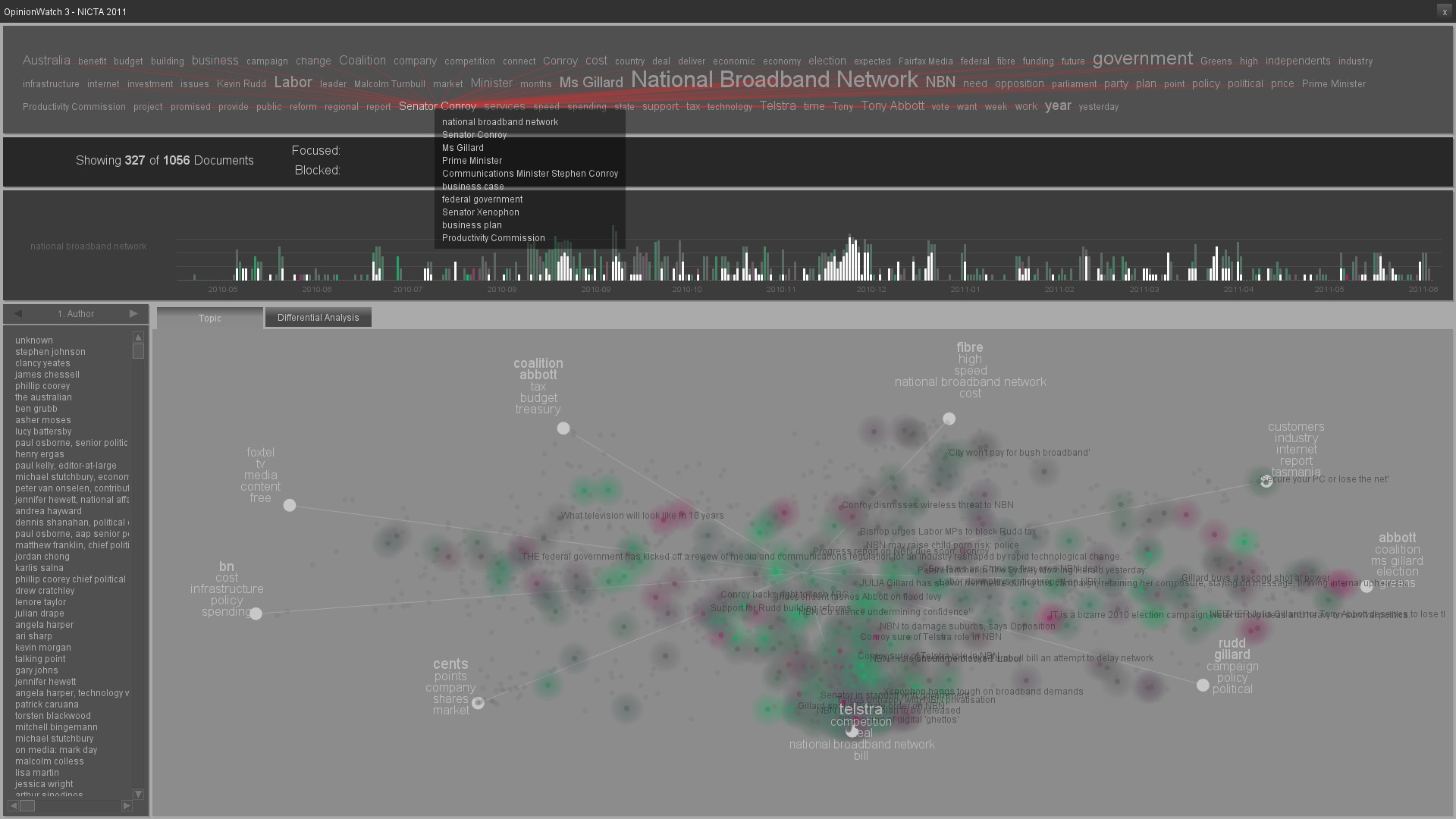
Screen Shot from NICTA OpinionWatchGreetings from "IR and friends" at CSIRO on the Australian National University campus in Canberra, where Paul Rivera and William Han from NICTA are demonstrating "OpinionWatch". This is a system for analysis of public opinion. It was tested with data from Senator Lundy's Public Sphere Process , at Defence Joint Decision Support Centre and recently demonstrated to the Prime Minister. The idea is to be able to get an overall impression of what the community thinks on an issue without having to conduct expensive opinion polls or long consultation processes. The software can sift through thousands of documents and carry out an analysis of the general sentiment of the authors.

One interesting outcome of a demonstration analysis of public statements from the Prime Minister and the Opposition Leader is that Tony Abbot's comments about climate change is very focused on "carbon tax" whereas Julia Gillard is using a much broader range of terms (which perhaps, I suggest, is why the PM is not winning in the opinion polls: the message is too confusing).

From a technical point of view the software is interesting in that it has a HTML5 interface and so should be usable on a tablet computer or smart phones. However, the interface currently presents far too much information to be usable on a mobile device and I have suggested it be redesigned to present less data, bolder. As well as make it usable on a smaller screen than should make it easier to understand when presented to a group on a projection screen.

One application for the software might be the analysis of the submissions to parliamentary inquiries, or even just the analysis of the topic of the inquiry in public blogs. Currently the Parliamentary Library prepares summaries of issues of interest to MPs, but these generally cover the facts of the situation, not the sentiment and take considerable work from expert information analysis to prepare.

ps: The former Parliamentary Librarian will speak at ANU, 4 April 2012, 11am.

Saturday, March 17, 2012

Gov 2.0 For Chinese Political Reform

Occasionally I am asked to speak to Chinese government delegations visiting Canberra, about eGovernment. The latest was in February on "Framework for e-Government: Security, Green ICT and Data Management" (安全,绿色ICT和数据管理). Last week China's Premier, Wen Jiabao, called for pushing ahead with political reforms ("Wen to carry on reforms", China Daily, 15 March 2012). I suggest that Chinese political reform could be furthered using electronic government (e-Government or Gov 2.0) techniques. In particular public sphere techniques (公共领域) can be used to involve citizens in policy making.

All governments, regardless of political system, worry about public consultation, as this may be a platform for criticism of the government. However, there are techniques to focus the discussion on positive outcomes. On a visit to help with the Beijing Olympic 2008 Website, I visited the offices of the People's Daily newspaper, which has a studio equipped for live web casting. Clearly the facilities and technical expertise are available for policy consultation online, what is needed are the administrative procedures and training.

Wednesday, October 26, 2011

Democracy with Web 2.0

Greetings from the AGM of Computing Assistance Support & Education Inc (CASE) where Pia Waugh, policy adviser to Senator Kate Lundy, speaking on Engaging in Democracy with Web 2.0. Pia started by pointing out that the Australian Government issued a Declaration of Open Government (DOG). She showed some of the winners from the government sponsored Mashups, including Know Where You Live.

Pia then showed Senator Lundy's website, produced using Wordpress and designed to have a relatively simple layout. She pointed out that Open Australasia's enhanced version of Hansard is used.

Pia then discussed citizen centric services, noting that Australia had been a leader in on-line government. The idea is to put the citizen at the centre of the design of services, rather than a structure based on government agencies. For me, the issue how much of this can be done via software mashups and how much requires the government to be restructured. An examples are an australia.gov.au account, which the citizen to deal with multiple government services with one account.

Pia then discussed participatory government, using the example of the Public Sphere process she developed for Senator Lundy. She emphasized the need for consultation with the public to be conducted sincerely. In the latest example a 106 page Submission on Digital Culture (6MB PDF) was created for the National Cultural Policy.

Pia suggested that using on-line tools two people could conduct a substantial public consultation over three months. This is far less than the staffing needed for a traditional process.

Thursday, October 06, 2011

ICT Sustainability Book Visible on iTunes?

My book "ICT Sustainability: Assessment and Strategies for a Low Carbon Future" is available on Apple iTunes. But at the Digital Culture Public Sphere, someone when to buy it and could not find it on the Apple store. I was able to point them to it via a direct link and then they could download the preview and buy the book. B but a search on "ICT Sustainability" did not find it. Is there something else I have to do to get the book search-able?

NeXT Computer Part of Steve Jobs Legacy

The news of the passed away of Steve Jobs went around around the Digital Culture Public Sphere, here in Sydney very rapidly. Senator Lundy paid tribute. Stilgherrian collected comments from delegates, including Alan Noble (Google Sydney) for later publication. One of Steve Jobs works which should be remembered is the NeXT Computer. The NeXT was a failure commercially, but some of its features were incorporated in later Apple Macs, particularly the Mac OS X operating system using Unix features from NeXT. The world's first web server and web browser is said to have been developed by Tim Berners-Lee on a NeXT.

Revitalizing Regional Australia With the Arts

Greetings from Digital Culture Public Sphere, in Sydney, where Simon Crean, Minister for the Arts, started his talk by using the example of revitalization of the Newcastle city center through the arts. The Minister released a National Cultural Policy discussion paper 11 August 2011 and input is invited from the community.

The Minister mentioned the Bangarra Dance Comany's recent performance of "Belong" (which I attended at the Sydney Opera House). At the other cultural extreme, the Minister mentioned Baz Luhrmann's 3D filming of The Great Gatsby. He pointed out that this involves digital technicians, as well as traditional film production staff.


Australian Universities Teach Innovation

At Digital Culture Public Sphere, Craig Wilson, from Sticky Ads, asserted that Australian universities are not teaching the skills needed for the digital age, including innovation. But I suggest some are. I am mentoring a group of students in the joint ANU/University of Canberra "Innovation ACT" program. The students learn about how to take an idea through to a business. Also students now learn how to communicate on-line (I mark their forum postings as part of courses, such as "ICT Sustainability").

Market analysis of the Australian book industry

The federal government's Book Industry Strategy Group (BISG) has released "Cover to cover: A market analysis of the Australian book industry". This is a 134 page report (1.3 Mbyte PDF) report prepared by Jeremy Thorpe at PWC for the Department of
Innovation, Industry, Science and Research.

The report makes the point that books are the most popular on-line product in Australia and books are in transition from physical paper goods to electronic eBooks. One problem with the current inquiry, which the report reflects is that most of those in the current "Book Industry" are unlikely to be part of future industry, so they may not be the best people to consult. The creative part of the industry, in preparation of content, will not change much, but most of the manufacturing, distribution and retail of the paper book industry is rapidly becoming redundant. Even where paper books are still made and sold, they will not be printed or sold the way paper books are now.

This report is timely as at the moment I am taking part in Senator Lundy's Digital Culture Public Sphere, looking at government policy on the on-line contribution to culture. While the games industry and digital video are well represented, I seem to be the only one here interested in "books".

Unfortunately the report is distributed in a difficult to read PDF format. Here is the table of contents and Executive Summary:

Contents
Important notice
Executive summary
Glossary
INDUSTRY SIZE AND POTENTIAL
  • Current and historic performance
  • Key segments
  • Key sub-sectors
  • Print books and eBooks
  • International comparison
  • Factors likely to affect the future eBook market
  • Relative performance of the Australian book industry
  • Projecting the future eBook market
INDUSTRY COMPETITIVENESS AND GLOBAL OPPORTUNITIES
  • The competitiveness of the Australian book industry
  • Production – book authoring
  • Production – book publishing
  • Production – book printing
  • Distribution
  • Point of sale
  • Opportunities
  • Opportunities and challenges of online book sales Challenges
  • Exports, investment and innovation
  • Australia’s book exports
  • Department of Innovation, Industry, Science and Research
  • Investment and innovation
BUSINESS MODELS
  • Examples of traditional business models
  • Publishers
  • Printers
  • Booksellers
  • Distributors
  • Emerging business models 8 Business models need to address consumer purchasing drivers
  • Price and differentiation
  • Product experience
  • Familiarity and trust
  • Options for improved business models
  • Improving the distribution of books
  • Individual sector changes
Appendices
  • Appendix A Terms of Reference
  • Appendix B Bibliography
...

Executive summary
Books are an enabler of creativity: they provide a means of connecting authors and content developers with readers, allowing for the dissemination and germination of ideas, across both space and time.

The production, distribution and sale of books in Australia – in short, the country’s book industry – is thus an important enabler of Australia’s creative economy.

The market for books, however, is on the cusp of potentially paradigmatic change. Digitisation has provided new ways for consumers to produce, purchase and read books. It is also shifting the industry’s focus away from the production of a physical good (i.e. a print book) to the production of content (i.e. the prose composed by authors).

This shift is encouraging a re-conceptualisation of what constitutes a ‘book’ and where the boundaries should be drawn (if at all) between print and electronic books and apps, websites and other means of digital content delivery.

Furthermore, the market for books is increasingly a globalised one.

Australians are buying more and more books online, as they are other retail goods. A bookstore in Sydney now has to compete with not only its rivals down the street, but also the likes of Amazon and Book Depository. These online giants are also challenging the business models of publishers, as the latter were traditionally the only source of imported books into Australia.

As a result of these factors, there is uncertainty about how Australia’s book industry will continue to contribute to the country’s creative potential. Recognising this, the Australian Government has established the Book Industry Strategy Group (BISG). Comprising of representatives from across the book industry supply chain, the BISG is tasked with developing “a comprehensive strategy for securing Australia’s place in the emerging digital book market, while making the Australian book industry more efficient and globally competitive.”

To support the BISG in achieving this goal, the Department of Innovation, Industry, Science and Research (DIISR) commissioned PwC Australia (PwC) to undertake a detailed study of the Australian book industry. The purpose of this study is to provide the BISG with a foundation of evidence about:
  • the current and historic performance of the Australian book industry and expectations about its future potential
  • the competitiveness of the book industry supply chain (taking into consideration such factors as online retailing, investment and innovation, and exports), and
  • traditional business models, how these have changed and are changing in the new digital environment, and options for improving business models in the Australian context (see Appendix A for the complete Terms of Reference).
The study is primarily informed by a comprehensive desktop review of publicly available and confidential data. It also draws on the findings of a consumer survey of 1,000 Australians, commissioned specifically for the purposes of the study. The key findings of the study are outlined below.

Industry size and potential
  • We estimate the total value of books sold in Australia during 2010 was $2.3 billion. Trade book sales are estimated to have been worth $1.5 billion and educational book sales $820 million.
  • Online book sales are estimated to have been worth $280 million in 2010, or 12 per cent of the total book market. According to a survey of 1,000 Australians, 53 per cent of books purchased online in 2010 were bought from overseas online booksellers.
  • Adjusted for inflation, the total value of books sold in Australia increased by an annual average of 1.1 per cent from 2001 to 2010. Relative to other retail industries, the Australian book industry underperformed over the past decade. It performed more favourably, however, when compared against other creative industries in Australia and overseas book industries.
  • Australians purchased approximately $35 million worth of eBooks in 2010, which is equal to 1.5 per cent of the total value of book sales for that year. The eBook market in Australia is projected to reach between $150 million and $700 million in 2014, representing between 6 per cent and 24 per cent of total estimated book sales.
Industry competitiveness and global opportunities
  • The available evidence suggests that Australian book publishers are reasonably efficient and competitive relative to their international peers. The competitiveness of Australia’s book printers is impeded by high input costs, under-utilisation of printing capacity, and the strong Australian Dollar.
  • Distribution is widely seen as impeding the competitiveness of the Australian book industry. Fragmentation and a lack of agreed standards are seen as they key problems limiting the efficiency of Australia’s book distribution system.
  • Lengthy delivery times and insufficient availability of eBook titles are seen as impeding the competitiveness of Australia’s booksellers (‘bricks and mortar’ and online).
  • The available evidence suggests that overseas online booksellers are generally able to sell books published overseas at prices (including delivery) that are cheaper than those charged by Australian online booksellers. The price competitiveness of Australian booksellers is affected by the GST, the exchange rate, wholesale book prices, and postage costs.
  • Our initial analysis suggests that an Australian business posting a book-like parcel to an Australian address would pay approximately 90 per cent more than a British business would to post the same package to the same address.
  • Opportunities from online retailing include greater market penetration, reduced costs and (for authors) more viable self-publishing options. Online retailing does have the potential, however, to marginalise elements of the book industry, increase competitive pressures on booksellers, and challenge the primary business model of trade book publishers.
  • Australia’s English-language advantage and its existing trade links with the emerging economies of China and India provide opportunities for greater exports. Publishers could aim to overcome the ‘tyranny of distance’ in market development by establishing a common promotional mechanism.
  • Existing industry structures, the novelty of the eBook market and a lack of a mechanism to encourage and enable industry collaboration are seen as key factors impeding investment and innovation in the book industry.
Business models
  • As new supply chains emerge – particularly around the delivery of print books via online overseas booksellers and eBooks – pressures will increase on traditional business models – primarily ‘bricks and mortar’ booksellers, printers and print book distributors.
  • To support the development of alternative business models and ensure the sustainability of the book industry, Australia’s book distribution system needs to be improved. This could be achieved by consolidating print distribution, establishing an industry body tasked with improving supply chain efficiency, and establishing an industry-owned eBook wholesaler.
  • Options to improve business models for publishers could involve entering into international agreements to share global rights, competing directly for global rights, and controlling costs through centralisation. Experimentation will remain a priority for book publishers.
  • Consolidation and embracing print on demand offer means of improving the competitiveness of Australia’s book printers.
  • Booksellers could seek to mitigate a strong Australia Dollar and the market presence of major overseas online booksellers by focusing on differentiation and leveraging people’s affection for books and bookstores.

Wednesday, October 05, 2011

Universities Australia e-Press

For the Digital Culture Public Sphere in Sydney, 6 October 2011I have suggested support to reinvogorate the Australian book publishing industry. Australian government measures in this area have been ineffective so far as they have equated "publishing" with "printing". The e-book is making printing printing increasingly irrelevant to publishing. So in the Digital Culture Wiki being created as part of a submission to the National Cultural Policy, I have proposed:

  • Support for Book Publishing: In the rush to video and digital on-line work the role of the humble book in Australian culture has been forgotten. However, the book is being re-borne as the e-book and Australia can have a viable e-publishing industry. This industry can be supported by Australia's libraries and universities. This will enhance the traditional role of the library as a resource for authors, for allowing them not only to research their work but prepare it for publication, submit it and also offer a not-for-profit service for free open access publishing. This will provide savings, for libraries which currently are required to purchase access to the works written by their clients.
  • Reform of university presses: Currently the Australian government subsidizes non-profitable university publishers. These publishers produce works on paper which are not available to most of the Australian population. Under a revised system, universities would merge their presses into "Universities Australia e-Press" with the mission to produce cultural works on-line for free, for community benefit. ANU ePress would be used as the model for the new organization.

Australian Digital Culture On-line Policy Forum Live On-line from Sydney

The Digital Culture Public Sphere in Sydney, 6 October 2011 will be streamed live online. It is tol consider input on digital arts and industries for the National Cultural Policy discussion paper. I am helping out with the moderating for the event.

Monday, October 03, 2011

Australian Cultural Policy Development

A National Cultural Policy discussion paper was issued by the Mister for Arts Simon Crean, 11 August 2011. Comment is invited until 21 October 2011. Senator Lundy is conducing an on-line and face-to-face "Digital Culture Public Sphere" to collect input for the policy.

The discussion paper is available as a web site, and in two versions as PDF: 2 Mb PDF and 1 MB PDF Print version. It is not clear why the print version is smaller, nor why it is needed at all. Neither of the PDF documents are well formatted for reading on-line. This is not just a minor quibble, as one issue for national cultural policy is the role of digital media. If the staff administering the Arts portfolio cannot format an electronic document correctly, they may not be equipped to understand how this technology is impacting on Australian cultural industries.

Digital Culture in the Discussion Paper

The paper makes the point that "More than 70 per cent of the Australian population have access to
the internet.", also that:
"Emerging technologies present opportunities for Indigenous communities to use new media to present their art, language and culture to wider audiences and to enable traditional cultural practices to be transmitted to future generations."
Opportunities for Education Industry in Digital Culture

The report also makes the point that Australia has a relatively well educated population and "Australia needs to encompass this audience whose expectations of opportunity and access are sophisticated and high.". However, the report fails to make the point that the relationship between education and cultural content is not one way: cultural materials for education is a multi-billion dollar industry which Australia is well equipped to take part in. As more education moves out of the classroom and onto the Internet the opportunities will increase. Addressing this market will also ensure Australia keeps its international student market and the export income they provide.

Table of Contents of the Discussion Paper
  1. Message from the Minister
  2. Introduction
  3. Background
  4. The National Cultural Policy – developing a vision for Australia's future
  5. Australia in the 21st century – some additional context

Wednesday, September 28, 2011

Australia's first enhanced eBook?

Greetings from the National Library of Australia in Canberra, where cultural historian and folklorist Warren Fahey is talking about his book "Australian Folk Songs and Bush Ballads". This is claimed to be Australia's first "enhanced" eBook.

A representative of the NLA did a gushing introduction about ebooks. Warren provided an entertaining history of his involvement with technology, starting with the crystal wireless and tin cans and string telephone. He then talked about his involvement with bush music and the ABC. But so far no explanation as to what an "enhanced eBook" is. I assumed it had digital audio files, along with images and text.

Warren went on to explain how he obtained a copy of his own field folk song recordings from the NLA and converted them to a suitable format for the eBook.

Warren used what appeared to be an Apple iPad for a demonstration of the eBook. He showed what looked like a traditional book format, with video displayed like a still image (click on the image to play the video) and audio controls (click the play button). The audio used seemed to be short excerpts, with links to on-line stores to purchase the full recording.

Warren said that volume was 600 Mbytes, due to the sound files. The publisher is splitting the book into volumes.

What was a little confusing was that I could only find an Amazon Kindle eBook edition of the book on-line. Warrne explained that Amazon refused to carry a Kindle eBook with links to Apple iTunes (for the audio). So a different edition had to be produced with different links in it.

This is a brave attempt at an "enhanced" eBook. But I am not sure that including the audio files in the eBook file is worth the effort. Instead the files could be downloaded from the web as required.

Warren ended by discussing what effect eBooks will have on book publishing and distribution. This provides a world market for the author, but cheaters challenges for the local bookstore and library.

At question time I asked what Warren's next ebook would be like. He said he wanted to do a book for children, being the 21st century of the Coles funny picture book for kids.

Someone asked how the cost of producing an enhanced ebook compared to a PDF ebook. Warren replied it was must more expensive by PDF ebooks were so static and dull.

This appears on topic for Senator Kate Lundy's Digital Culture Public Sphere on-line and in Sydney, 6 October 2011.

Tuesday, September 20, 2011

Senator Lundy Elected Honorary Membership of Australian Computer Society

Senator Kate Lundy was awarded Honorary Member of Australian Computer Society in recognition for her advocacy of the Internet, Gov 2.0, open source and ICT innovation on 15 September 2011. This honor is well deserved, with Senator Lundy working on the application of IT for community benefit and on introducing her fellow parliamentarians to the technology, since election in 1966. Even before this the Senator worked on community and non-profit IT use, as we discussed over lunch, I interviewed the then Senate candidate, over lunch on a sunny spring day in September 1995.

One of the Senator's most important achievements is the "Public Sphere" events have directly lead to the adoption of on-line processes for public consultation by the Australian Government. The first of the "Public Sphere" processes, which blends face to face with on-line processes for consultation on public policy.m The first Public Sphere on High Speed Broadband, was run at the ANU, in conjunction with the School of Computer Science, 7 May 2009.

Public Sphere 2: Government 2.0 lead to the creation of a Government 2.0 Task Force and reforms to Australian Government processes, including the introduction of open access to government information.

Public Sphere 3 is on the topic "Digital Culture", with a Live Event 6 October 2011, in Sydney and on-line.

What is less well know is the Senator's role on Parliamentary committees introducing IT to the committee processes and the members offices.

Senator Lundy also received the International e-Democracy Award 2010.

Wednesday, September 07, 2011

Australian Digital Culture On-line Policy Forum

Senator Kate Lundy is running a Digital Culture Public Sphere on-line and in Sydney, 6 October 2011. This will consider input on digital arts and industries for the National Cultural Policy discussion paper, released by Simon Crean, Australian Minister for the Arts, on 11 August 2011.

There was a Book Industry Strategy Group (BISG) set up by Senator The Hon Kim Carr, Minister for Innovation, Industry, Science and Research, in 15 February 2010. But that seems to be more about propping up the declining paper based printing industry, not mainstream digital publishing.

On the 11th August 2011 Minister Crean released a discussion paper seeking public input on a National Cultural Policy. This consultation will help determine a 10 year strategic vision to ensure our arts, cultural and creative endeavours resonate with a 21st century, globally competitive, internationally celebrated and culturally diverse Australia.

The National Cultural Policy itself covers three major sectors:

  • traditional core arts such as opera, dance, theatre, literature, music, visual arts and craft,
  • creative industries such as games development, film, animation, media content, architecture, fashion, design & publishing,
  • cultural heritage such as the work done by cultural institutions (regional metro & national galleries, libraries, archives & museums) and Australia’s Indigenous culture.

The Office of Senator Kate Lundy in collaboration with the Office of Minister Simon Crean is running a Digital Culture Public Sphere consultation to look specifically at the digital arts and industries as well as opportunities for cultural institutions around digitisation, public engagement and collaboration. This consultation will result in a submission that will be presented directly to the Minister as part of the broader National Cultural Policy consultation.

“The Digital Culture Public Sphere consultation is a breakthrough exercise in bringing together ideas and projects, working them through and providing a rich base of information and pathways for Australia’s digital cultural challenges and opportunities. It will provide a valuable contribution to the National Cultural Policy Consultation which is an important opportunity to examine how the Australian Government should support arts and culture in the 21st century,” said Minister Crean.

“We are laying the foundations for the broad cultural arts and industries in Australia at a time when high speed broadband will provide a platform to use our cultural collections and creative skills for new applications, education and research services. I welcome contributions from the digital arts and industries as well as cultural institutions across Australia”.

Wednesday, July 27, 2011

ACT Government Virtual Community Cabinet

The ACT Government ran a "Virtual Community Cabinet" using Twitter 26 July 2011. For an hour Chief Minister Katy Gallagher and other ministers answered questions as @ACTVCC.

This is an excellent initiative, but the government should take it further and use a format like ABC TV's Q&A ("Qanda") program. That is live video streaming and a live audience, as well as the Twitter feed. That way the virtual community cabinet could be blended with a live face to face one, rather than run separately. This could the same technology and techniques as Senator Lundy's "Public Sphere" events.

Also the ACT Government needs to create a web page about the community cabinets in general and put details of the virtual ones there as well. The law requires that records of these meetings are kept (as with any government meeting). I teach how to keep electronic records at the ANU. Most of these records can be placed on the web site and made public. This could be modeled on the Queensland Government Community Cabinet.

Thursday, May 26, 2011

Metadata in the Public Sphere

Day 2 of the the Meta 2011 Conference at ANU University House in Canberra included myself on "Designing for Democratic Dialogue: More than Mating iPads", followed by with Senator Lundy on "Public Sphere" and Chris Winter, from the ABC on "Developing an ABC Program Information Model - the WCMS project".

Thursday, March 10, 2011

Learning and Dialogue Building

Royal Roads University Learning and Innovation CentreFormer Canadian military college, Royal Roads University, is constructing a Learning and Innovation Centre building. One floor will be a "Centre for Dialogue", intended to carry out a similar function to that of the Wosk Centre at Simon Fraser University.

However unlike the Wosk centre, which is essentially a conterence centre with very specalsied discussion rooms for face to face interaction, the LIC building will be primarily a teaching centre for traditional lectures and computer meditated communication, with dialogue as a secondary role.

The building is designed by Jensen Chernoff Thompson Architects and their early plans for the building are avialable. Interestingly, the university has used its Moodle Learning System to provide details of the project and as a forum for consultation on the project. The general public can view the documents and "RRU Campus Progress Discussion".

This model of a combined learning and dialogue centre, using online education tools which I have suggested for a Dialogue and Learning Centre in Canberra. Instead of having rooms and systems which are purpose built for public discussion and which therefore will be unused most of the time, the design of a learning centre is adapted for occasional dialogue use. This allows the unviersity to have a useful teaching facility and to have a fully staffed facility with computer systems ready for use as a dialogue centre.

Friday, February 11, 2011

Broadening Public Discussion

Today I attended a meeting at the Moot Court at the Australian National University in Canberra from 12:30pm to 4pm. Fourteen people from academia, government and industry were discussing the creation of the "Australia Forum", a project for enabling public policy discussion. I attended for the School of Computer Science at ANU which researches the technology for such forums and also has hosted some. I wrote a blog post summarising my understanding of the background of the project.

The "Moot Court" is a room in the Law Faculty which simulates a court for training lawyers. This was selected as the best space for the meeting as it has furniture which can be arranged into a circle.

After acknowledging the original inhabitants of the land the chair asked us to sum up what our contribution could be in one sentence. I explained I was from ANU Computer Science and teach using online forums, help design physical spaces for this. Also I pointed out CS has hosted such events in room N101 for Senator Lundy and others.

As with a real dialogue, the difficult part is working out who everyone is and where their points of view come from. The task is to work out what we are attempting to achieve and what we have in common.

The Australian Forum is over ten years old (although I only heard of it for the first time last week). The ANU's Australian Centre for Dialogue also has been in existence for several years. There is obvious possible synergies between the two projects.

One of the difficulties is understating exactly what is proposed. It could be a convention centre or a web site, or something in between. Also it is not clear if the philosophy of "dialogue" requires any particular physical or virtual infrastructure.

Unfortunately much of the original promotional material developed for the Australia Forum is based on the idea of a symbolic building in Canberra. This makes the project look like the Canberra building industry asking for a government handout to build an expensive building which will hardly ever be used. The project has evolved to include a more flexible and virtual approach. But this is not yet reflected in the promotional material.

I spent an hour trying to work out what was wrong with a project which apparently worthwhile project and how to fix it. Senator Lundy then arrived and mentioned the NBN and Public Sphere. These were the missing piece of the puzzle. Not everyone agrees that the NBN is the best way to get broadband across the community, but most would agree if you have the broadband it can be of great use for community consultation. Senator Lundy's Public Sphere process provides a methodology for carrying out such processes.

Senator Lundy described the meeting "in the round" she attended recently in Geneva. This was the Universal Periodic Review at the United Nations Human Rights Council. These international forums have a very structured process. The Senator suggested using online tools to help make these processes more flexible. Also the Senator raised the idea of Australia hosting such international forums.

Senator Lundy suggested that any forums need a strong nexus with political issues of the day. This will then supplement the political process, not compete with it. Digital tools can provide a more granular approach to discussion. That discussion can take place from formulation of public policy through to its implementation.

Pia Waugh pointed out that we want human synthesis of the conversation, not just automation. I pointed out that we now use these techniques for teaching at university. There are approaches to this which are well tested and can be applied to broader public discussion.

The Australian Forum is planning to put out its next planning document in the next few months. In the interim, those who want to get a taste for what a well run Internet enhanced face-to-face meetings are like, can attend the free BarCamp Canberra 2011, being held at ANU, 19 March

Sunday, February 06, 2011

Australia Forum

Model of the proposed Austrlaian Centre for Dialogue Building, design by Alicia BaylThe "Australia Forum", is a proposal from the Canberra Business Council for a venue in Canberra for meetings, dialogue, cultural events and occasions of national importance. There is a Scoping Study available for the project. This complements the Austrlaian National University's "Australian Centre for Dialogue Project". There is a Vision and Mission Statement (PDF) and a brief explanatory movie. I was asked to provide some input on how computer mediated communication could be used to encourage discussion. This blog post has my initial thoughts on the project.

The Australian facility would be modelled on the Morris J Wosk Centre for Dialogue at Simon Fraser University. In 2007 an architectural competition was held for the design of a proposed $26M (later $30M) "Centre for Dialogue", to be a building built in Canberra. This would be located in parkland, sited similarly to the House of World Cultures Berlin and the Zappeion Athens. The completion was won by Alicia Bayl. However, it appears that since then the project has been modified to incorporate online dialogue, linking multiple physical locations. This is a useful development.

The forum could take advantage of the expertise, technologies and infrastructure in place for "blended" learning (combining online learning and face-to-face classes). This would allow educational information systems and buildings to be used for the forum. It would also also combine the functions of teaching about the use of such forums into conducting them.

A few initial thoughts:

1. PUBLIC SPHERE

Senator Kate Lundy has run a series of "Public Sphere" events which use live face to events, blended with online forums, for developing public policy.

The first Public Sphere event "High Bandwidth for Australia" was hosted by the ANU Department of Computer Science in the computer equipped room N101 in the Computer Science.

In the past I have used Moodle (the same e-learning software as now used at ANU) for part of the online consultation mechanism. Following on from this I suggest using a "learning commons" as the physical venue for the forum. Having a physical venue helps bring focus to the discussion, which if entirely online can seem a little too "virtual".

2. LEARNING COMMONS

From the Australia Forum project material it appears that the original idea was to have a purpose built building for the forum. That then changed to a virtual forum, due to the cost and complexity of a purpose built facility. I suggest a middle path: use a dual purpose facility, which could also function as a learning commons for an educational institution.

Most of the time the space would be used for teaching (including teaching about the forum) and only occasionally used for the "Australia Forum". The venue could be electronically linked to other such spaces, nationally and internationally, for a distributed discussion.

Using a learning commons as the basis for the forum building would also allow the latest technology and designs to be used. IT support and ideas on how to lay out physical spaces having made rapid advancement in the last few years. Part of this advancement was research sponsored by the Australian
Government on learning commons.

A "learning commons" is the trendy term for a building with a mix of open plan teaching areas and classrooms, equipped with extensive computer facilities. I will be speaking on "The dos and dont's in developing learning commons" at the 2nd Annual Learning Commons Development and Design Forum in Brisbane, 20 March 2011.

In 2008 ANU was considering a conference centre as part of the City West development. In response to a request for input, I suggested a triple purpose conference, training and decision support centre. The idea was that the centre would be used day to day for university teaching. Occasionally it would be reconfigured for commercial and academic conferences. In a national disaster, the centre would become a high-tech command and control facility for emergency operations.

As far as I am aware, it was decided not to proceed with the conference centre at City West. The University of Canberra opened a more modestly scaled Teaching and Learning Commons this month, on the mezzanine above their refurbished refectory. I attended the first event to use the facility.

3. AUSTRALIA FORM AS AN UN-CONFERENCE

The first use of the UoC teaching commons was for "Recent Changes Camp 2011: Canberra", an "un-conference".

An "un-conferecne" is similar to an academic symposium, but with more flexibility as to topic and discussion and with Internet support.

Several such events have been run at ANU. The ethos of these, along some of the support software and organisational techniques were applied to Senator Lundy's Public Sphere series. I suggest this could be explored further for the Australia Forum.

4. SOFTWARE FOR DIALOGUE

Modern educational techniques emphasise the use of discussion between the students. This is supported in Learning
Management Systems. In particular Martin Dougiamas built this into his Moodle software, now used by ANU. The ANU College of Engineering and Computer Science is now a leader in this field with its Engineering 'Hubs and Spokes' Project. I use Moodle with mentored and collaborative techniques for postgraduate courses at ANU.

As we prepare Australians for the dynamic opportunities and challenges ahead new forms of engagement will be needed. Australia’s best future will be shaped through dialogue – and through facilities and technologies that are enabling, democratic and globally connected.

Capital cities around the world are embracing the need in the 21st century need high quality secure venues catering for international dialogue, trade and significant national events. These are important elements of national infrastructure and the positioning of capitals. Centres of this nature are also the learning hubs of the future – pivotal places in terms of economic development and knowledge transfer from research institutions.

Our National Capital, Canberra, is the meeting place of the nation. It is also a rare centre of knowledge and research, with far reaching global relationships. Canberra is a capital with unparalleled assets and opportunities.

Now the need is clear – for a truly national meeting place in the Capital – one that will meet the future needs of Australia and Australians themselves, and realise the rich potential that exists.

That is the vision for the Australia Forum. ...

From: "Australia Forum", Canberra Business Council, 2010


ps: I viewed the explanatory video for the "Centre for Dialogue" with some amusement. The location proposed for the building is the same as one used in the Australian TV comedy "The Hollowmen". In series 2, episode 2, "Edifice Complex" a building is proposed at this location with no purpose other than to boost the ego of a Prime Minister. ;-)

Saturday, July 24, 2010

Put the Australian Climate Change Citizens Assembly On-line

On Friday the Australian Prime Minister announced a Citizens Assembly on Climate Change ("Moving forward together on Climate Change") . About 150 people will be selected from the census and electoral rolls to spend a year examining what to do about climate change.

It would be easy to see this as a cynical political trick to put off unpopular decisions until after an election. However, as the the conference "Democratizing Climate Governance Conference" I attended last week at the Australian National University in Canberra detailed, simply stating there is a problem does not necessarily produce the required action. This week the Democrats decided they did not have sufficient votes in the US Senate to introduce a cap-and-trade carbon reduction scheme. Providing more facts on climate science is unlikely to change the situation. As well as taking the advice of climate scientists on global warming, we also need advice from economists, social and political scientists on how to act on that advice. The Prime Minister's proposal may be one way to do that.

There are limitations to the prime minister's proposal: The ALP government has to be re-elected next month for the scheme to be implemented and it does not have the support of the opposition, nor the Greens Party (which is likely to hold the balance of power).

There is no provision for such an assembly in the Australian Constitution. This body will have now formal power, apart from the limited advisory role provided for in specific legislation introduced to create it.

The assembly will be limited to considering the government's market-based approach to carbon emissions, which has already been rejected by Parliament. The assembly will not be permitted to consider alternatives, such as a tax on carbon, or energy saving incentives. An example of such alternatives would be a 5% reduction in emissions through better use of ICT (including use of the National Broadband Network), as I teach in Green ICT.

There is no mention in the proposal of the use of technology for making the assembly more efficient, representative or open to the wider community. It seems likely the assembly will use a similar process to the cumbersome processes used by the Australian Parliament and used for the 2020 Summit held by the former Rudd government. With these the representatives travel to one location (usually Canberra) for a few days of verbal, face-to-face discussions and then leave again. Only one person can talk at a time and less than 200 can be accommodated in one forum. Due to the limited communications only one proposal can be considered at a time.

One option would be to provide Internet based technology to enhance the operation of the assembly. There could still be face to face meetings, but between and during these, online forums could be provided. Many more citizens could then follow and take part in the discussion online. Many more proposals could be considered simultaneously. Rather than having most of the time taken up with set peace speeches, presentations could be pre-recorded and Podcast.

Some of these techniques were used with the "Public Sphere" Internet assisted process. We have learnt a lot about how to run such blended events since I helped run the first Public Sphere at the Australian National University in 2009.

My colleagues at the ANU Engineering 'Hubs and Spokes' Project have been working on technology for teaching in a "blended" mode: this combines podcasts and discussions online, with face to face discussions, which can also be enhanced by using technology such as "clickers" (wireless hand held devices to quickly get audience input). This technology could be applied to a citizens consultation process.