Showing posts with label WW II. Show all posts

Sunday, November 29, 2015

Mum's Army Goes Tivoli at the New Theatre in Sydney

Last night I attended the musical "Dinkum Assorted"(book, lyrics and music by Linda Aronson) at the New Theatre, Newtown Sydney. This is set in country NSW during the later stages of World War II. With most men serving overseas, the local biscuit factory is staffed by women, who also act as air raid wardens.

The first half of the play is reminiscent of the BBC TV show "Dad's Army" with civilians taking on a paramilitary role, some reluctantly, some relishing the power. Meantime the issues of those profiting from war and the tensions of missing loved ones and the temptation of snapshots of US airmen billeted nearby) bring a more serious tone.

The second half gets a little slapstick (also like Dad's Army), then serious and then turns into something like the old Tivoli theater. Choreographer Alyssha Clarke has done a wonderful job whipping the case into a chorus line of Rockettes, while Vocal Coordinator Kieran Fox has the cast singing up a storm.


The set by David Marshall-Martin evokes an old tin shed factory. A simple platform doubles as a local hill. The factory equipment is not entirely convincing (also reminiscent of Dad's Army) and the prop animals in the show are just silly.

This was a fun night and something the New Theater does well: entertainment with a social message. Younger audience members can enjoy this just as entertainment, those of us older may better understand some of the stories our mothers told us about WWII.

"Dinkum Assorted is on at the New Theater in Sydney until 19 December 2015. My ticket was courtesy of the New Theater.

Tuesday, February 11, 2014

Lessons from WWII for US - Australian Military Relations


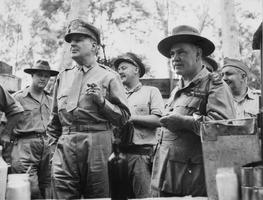
Greetings from the Australian National University in Canberra, where Dr Peter J. Dean, Senior Lecturer at the Australian Command and Staff College, is speaking on "Allies of a kind: United States and Australian military relations in the South West Pacific, 1942-43". He related how US General Douglas MacArthur refused to set up a unified command with the Australian Army in WWII and had a largely US staffed HQ, with Australian General Sir Thomas Blamey having a separate Australian land HQ. Both US and Australian officers had little regard for the other. Dr Dean explained this as partly a matter of different culture.The lowest point was the "Battle of Brisbane", where US and Australian troops rioted in Brisbane in November 1942. However, Dr Dean argue that relationships at lower levels were good and improved overall from late 1942, as US and Australian forces trained and fought together. Australia first tried to adopt US amphibious doctrine, but this then had to be adapted to suit the available military resources, incorporating elements of UK doctrine. Rather than a frontal assault using overwhelming force, an indirect approach was used.

This lesson of training with allies is a less learned and I have seen it first hand at a joint military exercise. The amphibious warfare which the Australian military undertook in the later stages of WWII are very relevant to today. Australia has HMAS Choules (L100) a landing ship and ordered two Canberra class Landing Helicopter Dock Ships. However, it will take considerable work for these to work effectively with the Australian army and RAAF helicopters. Australian forces will need to adopt the same indirect doctrine of WWII when operating on their own, but be able work with the US Marines direct assault approach when operating in collation.

One practice from WWII which may be useful are mobile training units. The usual custom is for military units to travel to a training centre, where a fixed staff conducted the training. As an alternative the trainers can go to where the troops are. IT can now be applied to this training, with simulator modes built into the equipment.

War Studies Seminar, No.3: Allies of a kind: United States and Australian military relations in the South West Pacific, 1942-43

Strategic & Defence Studies Centre

Tuesday, 11 February 2014 from 6:00 PM to 7:00 PM (EST)

Acton, ACT


The War Studies Seminars are open to the public and are to showcase the latest research on the history, character, conduct and effects of war.
Coalition warfare, complicated as it is by different strategic priorities and cultural differences, is always fraught with difficulties. The interactions between the United States and Australia in the Southwest Pacific Area during the Second World War were no exception. Examinations of this have generally focused on the two senior military commanders in theatre, General Douglas MacArthur and General Sir Thomas Blamey.
Frequently overlooked are the relationships further down the chain, where commanders and their troops had to develop workable joint doctrine and procedures to conduct always difficult amphibious operations, as well as operate together on the battlefield.
This seminar will explore the nature of the Australian–US military relations during 1942 and early 1943, and investigate the extent to which these unexpected partners were able to forge an effective working relationship.
Dr Peter J. DeanGuest speaker
Peter Dean is a Fellow in the Strategic and Defence Studies Centre as well as a Senior Lecturer at the Australian Command and Staff College, Australian National University.  In 2011 he was a Research Associate at the United States Studies Centre (Sydney University) and a Visiting Fellow at the Centre For Australian and New Zealand Studies (Georgetown University, Washington DC). His major research and teaching interests are in Australian military history and defence studies. Peter is the author of a biography of Australia’s most important operations staff officer, The Architect of Victory: The Military Career of Lieutenant-General Sir Frank Horton Berryman, 1894-1981, (Australian Army History Series, Cambridge University Press, 2011), editor of; Australia 1942: In the Shadow of War (Cambridge University Press, 2012), Australia 1943: The Liberation of New Guinea (Cambridge University Press, 2013) and Australia's Defence: A New Era? (Melbourne University Press, 2014).

Wednesday, January 22, 2014

US - Australian Military Relations in the South West Pacific

Dr Peter J. Dean, Senior Lecturer at the Australian Command and Staff College, will speak on "Allies of a kind: United States and Australian military relations in the South West Pacific, 1942-43", at the Australian National University in Canberra, 6:00 PM, 11 February 2014.

War Studies Seminar, No.3: Allies of a kind: United States and Australian military relations in the South West Pacific, 1942-43

Strategic & Defence Studies Centre

Tuesday, 11 February 2014 from 6:00 PM to 7:00 PM (EST)

Acton, ACT


The War Studies Seminars are open to the public and are to showcase the latest research on the history, character, conduct and effects of war.
Coalition warfare, complicated as it is by different strategic priorities and cultural differences, is always fraught with difficulties. The interactions between the United States and Australia in the Southwest Pacific Area during the Second World War were no exception. Examinations of this have generally focused on the two senior military commanders in theatre, General Douglas MacArthur and General Sir Thomas Blamey.
Frequently overlooked are the relationships further down the chain, where commanders and their troops had to develop workable joint doctrine and procedures to conduct always difficult amphibious operations, as well as operate together on the battlefield.
This seminar will explore the nature of the Australian–US military relations during 1942 and early 1943, and investigate the extent to which these unexpected partners were able to forge an effective working relationship.
Dr Peter J. DeanGuest speaker
Peter Dean is a Fellow in the Strategic and Defence Studies Centre as well as a Senior Lecturer at the Australian Command and Staff College, Australian National University.  In 2011 he was a Research Associate at the United States Studies Centre (Sydney University) and a Visiting Fellow at the Centre For Australian and New Zealand Studies (Georgetown University, Washington DC). His major research and teaching interests are in Australian military history and defence studies. Peter is the author of a biography of Australia’s most important operations staff officer, The Architect of Victory: The Military Career of Lieutenant-General Sir Frank Horton Berryman, 1894-1981, (Australian Army History Series, Cambridge University Press, 2011), editor of; Australia 1942: In the Shadow of War (Cambridge University Press, 2012), Australia 1943: The Liberation of New Guinea (Cambridge University Press, 2013) and Australia's Defence: A New Era? (Melbourne University Press, 2014).