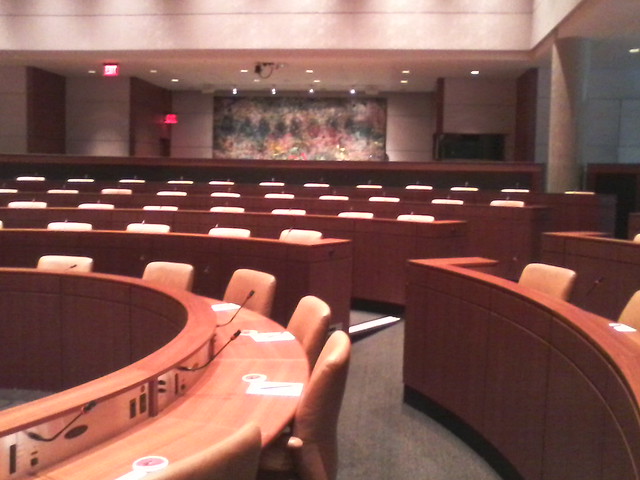
At Parliament House Canberra today, I attended the
Gov 2.0 lunch with Alison Michalk on Community management . Also
Professor Rachel K. Gibson, Institute for Social Change, University of Manchester, said a few words on research in the UK and Australia on use of Internet in election campaigns.
Alison Michalk on Community management
Alison,
Quiip Director and Community Manager, said: "
People will come for the information but they will stay for the relationships". People will be initially attracted to on-line forums for formal information, but they will only stay if the connect with interesting people.
Alison argued that the people selected for managing an on-line project are most important, the technology less so. Community managers ensure a productive on-line forum. A "leader" mitigates risk. They enforce the legal rules as well as the less formal customs and positive behaviour. As a "participant" the manager observes. It occurs to me these are the same skills we teach tutors for on-line education discussion forums (and also teach to the students). It is something we should be teaching school students. Craig commented that
BangThe Table runs training for its product, but which also teaches some of the skills.
Alison pointed out that there are legal risks with user generated on-line content. One way to reduce the risk is by building loyalty and trust with participants. There are risks to the participants of the forum, as well as the organisation hosting it.
One of the audience asked why there was not a law stopping Defence personnel from posting denigrating comments on Facebook. This seemed an odd question to me, there are laws about what you can say to who, which clearly apply on-line as much as anywhere. Also there are specific rules which apply to Australian Defence Force personnel. More than 15 years ago I wrote a couple of circulars at HQADF to make it clear that such rules applied online and it was only a matter of days before I had a call from the Military Police investigating someone.
Alison recommended the flicker and yahoo answers guidelines. She warned against "sock-puppeting" where there appears to be two people having a discussion, but it is really just the one person. It occurs to me this is a modern version of the "Socratic Dialogue".
Alison recommended post-moderation in general, but there may be some higher risk topics requiring each post to be approved in advance.
There is an "
Australian Community Managers" Facebook group run by Alison for those interested.
Professor Rachel K. Gibson on E-Participation in electionsProfessor Gibson talked about the research she is doing with ANU on the question of if the Internet has changed election campaigns. The question is if there are "Citizens Initiated Campaigns". She is presenting a seminar
on "
What is ‘E-Participation’?" at ANU in Canberra,
4pm, 19 April 2011.
Rachel used the example of the "My Barack" campaign website. I was skeptical as if this was really citizen driven, or just the usual party machine applying new tools to an old centrally run campaign agenda.
It occurs to me that the sort of DIY tools in the Barack Obama campaign are online equivalents of traditional local grassroots political party tools. It may be that there will be a brief opening up of such activities until the central party machines work out how to take tight central control.
Rachel commented that green voters were more active on-line in Australia and Liberal Democrats in the UK. She suggested this was because small parties have less money and so have to make more use of low cost tools. However, I suggest that the Greens and Liberal Democrats have a less centralised structure which allows grass roots membership participation.