Greetings from the National Museum of Australia where the Canberra Branch is celebrating the 50th anniversary of its formation (as the Canberra Computer Society in 1965, with Trevor Pearcey as chair and Don Overheu as Vice Chair). The ACT Chief Minister opened the event and noted some of the government's recent initiatives to assist the STEM in Canberra. A special presentation was made to Mr Barry W. Smith, founding Secretary of the Canberra Computer Society (who started in computing 57 years ago). It turned out that a photo of a computer at the Australian National University from 1964 showing someone sitting at a console was of a much younger Barry Smith, who also introduced computing courses at the university. Barry was then presented with honorary membership of the ACS.
ps: In 1993 I named a fictional data center in honor of Don Overheu. In 1996 I had the honor of being elected president of the ACS.
Showing posts with label History of Computing. Show all posts
Showing posts with label History of Computing. Show all posts
Tuesday, February 17, 2015

Wednesday, February 09, 2011
Memorial Service for Professor John Bennett
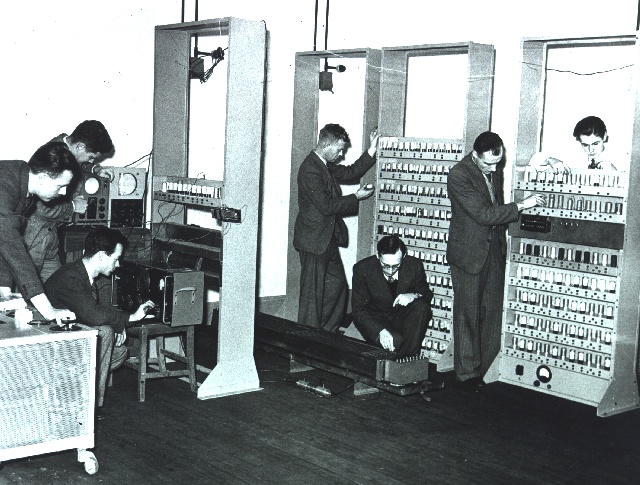
The Australian Computer Society (ACS) reported the death of its founder Professor John Bennett AO, on 9 December 2010. John helped to build one of the first computers in the world, EDSAC, at Cambridge University (UK) with Maurice Wilkes, before working on computers in Australia.
During my time as President of ACS I bumped into John a few times. On one occasion I was in a queue of people going in to the Lucas Heights nuclear reactor. I noticed John in the queue (he was hard to miss) he made a comment about how after World War II some of his colleagues stayed in radar, some went into computing (as he did) and others into nuclear power.
In 1996 I visited the Cambridge University Computer Lab and handed the head of the lab, Professor Robin Milner, a copy of 'Computing in Australia - The development of a profession'. He looked at the cover of the book said "Ah! young John Bennett!". I had no idea what Professor Milner was talking about, until I looked at the book cover, saw John had edited it and then realised that he had studied in this lab 50 years ago.
Some information I collected on John Bennett for the ACS:
- First ACS President 1966.
- JRPIT special edition "A Tribute to John Benett" 2001.
- "John Makepeace Bennett – An Inspiration", by Jenny Edwards, JRPIT, 2001
- "John Bennett", Profiles in ICT series, Information Age
- Bennett, John M. (John Makepeace) (1921-), National Library opf Australia "Trove" entry.
- EDSAC 99 - Fiftieth anniversary of the EDSAC Computer, by John M. Bennett, 1999 (includes photo of J.M.Bennett working on EDSAC I, in 1947)
- Bennett J.M., Broomham R., Murton P.M., Pearcey T., Rutledge R.W. (eds.) (1994) 'Computing in Australia - The development of a profession' Hale & Iremonger in association with the Australian Computer Society Inc, 1994
- 124 publications attributed to John Benett
Tuesday, December 21, 2010
Vale John Bennett
The Australian Computer Society (ACS) reported the death of its founder Professor John Bennett AO, on 9 December 2010. John helped to build one of the first computers in the world, EDSAC, at Cambridge University (UK) with Maurice Wilkes before working on computers in Australia.During my time as President of ACS I bumped into John a few times. On one occasion I was in a queue of people going in to the Lucas Heights nuclear reactor. I noticed John in the queue (he was hard to miss) he made a comment about how after World War II some of his colleagues stayed in radar, some went into computing (as he did) and others into nuclear power.
In 1996 I visited the Cambridge University Computer Lab and handed the head of the lab, Professor Robin Milner, a copy of 'Computing in Australia - The development of a profession'. He looked at the cover of the book said "Ah! young John Bennett!". I had no idea what Professor Milner was talking about, until I looked at the book cover, saw John had edited it and then realised that he had studied in this lab 50 years ago.
Some information I collected on John Bennett for the ACS media release:
- First ACS President 1966.
- JRPIT special edition "A Tribute to John Benett" 2001.
- "John Makepeace Bennett – An Inspiration", by Jenny Edwards, JRPIT, 2001
- "John Bennett", Profiles in ICT series, Information Age
- Bennett, John M. (John Makepeace) (1921-), National Library opf Australia "Trove" entry.
- EDSAC 99 - Fiftieth anniversary of the EDSAC Computer, by John M. Bennett, 1999 (includes photo of J.M.Bennett working on EDSAC I, in 1947)
- Bennett J.M., Broomham R., Murton P.M., Pearcey T., Rutledge R.W. (eds.) (1994) 'Computing in Australia - The development of a profession' Hale & Iremonger in association with the Australian Computer Society Inc, 1994
- 124 other publications attributed to John Benett
Monday, October 11, 2010
Gunyah of Historical Artefacts
 One of the more curious exhibits at the World Computer Congress was the "Gunyah of Historical Artefacts". This was a display of historic computing equipment, including the world's first laptop computer, with early computer pioneers on hand to explain its use. This completed the History of Computing conference run by IFIP Working Group WG9.7. I sat down and felt like part of the display. ;-)
 A colour 15 page "Handbook of Exhibits" was produced, along with videos and talks by pioneers. Some of the artefacts were: Payen Arithmometer, ATL Totalisator, Brunsviga Nova 13Z/18, PDP-8 Computer, ASR-33 Teletype, PDP-10 KA-10 Console, EDUC-8 Microcomputer, MONECS Operating System, Exidy Sorcerer Home Computer, Ethernet Cable, Dulmont Magnum (world's first laptop and Austrlaian designed), Booklets from the 1908s "National Computer Education Program", Telecom Australia Computerphone, MicroBee Home Computer.
Unfortunately none of this material was provided online and so few will ever see it. One lesson these computer pioneers appear not have learnt from history is that this is a technology for communication, not only over space, but over time.
Sunday, September 05, 2010
Vale Michele Huston
Michele Huston, Director of Web Publishing at the National Library of Australia, passed away 2 September 2010 (as reported by Tony Barry and on the Australian Library and Information Association website). While perhaps best known as the wife of Australian Internet pioneer Geoff Huston, Michele Huston was one of the largely unacknowledged pioneers of the Internet to Australia. In the 1990s she worked at The Australian National University to connect schools in Canberra. As well as provide a service for education, this introduced many public servants, MPs and other decision makers in Canberra to the Internet through their children.
An slide show from Michele on her work at the NLA, with accompanying audio:
"The Australian Capital Territory Education Information Network (ACTEIN) program is a local university initiative to introduce the Internet to primary and secondary schools in the Australian Capital Territory. The physical connectivity is based on low cost accessible technologies, and most schools use IP dial-up as their access to the Internet. The program's main direction is not the provision of Internet access itself, but in attempting to address the issue of how the Internet can be put to work in the classroom, consequently the ACTEIN Program has a strong emphasis on technical and training support to accompany the Internet access."Michele was awarded a BSc (hons) in Physics and Maths from The Australian National University in 1979. She worked as a Project Officer at the ANU, on projects such as the ANU's Institutional repository. She was Web Manager at the Australian War Memorial (while continuing to teach Website Construction to the computer science students at ANU), before joining the National Library of Australia as Director of Web Publishing, a position she held until her death on 2 September 2010.
From: "Introducing the Internet into Australian Schools, A Case Study: The ACTEIN Program", Michele Huston, Outreach Officer, Centre for Networked Information and Publishing, Australian National University, presented at Internet Society INET'95: Conference.
An slide show from Michele on her work at the NLA, with accompanying audio:
"Who are the people around me and what are they doing? This is not usually a question that you'd expect a library catalogue to be able to answer but users are coming to libraries with new skills and different expectations. Skills that they have learned on sites such as Flickr, eBay, Facebook, Wikipedia and Amazon where you can interact with other people who share your interests.
This presentation will explore a niche for libraries in a networked world by drawing on examples from successful websites."
From: "Enhancing catalogues with user input", Michele Huston, Director, Web Publishing, National Library of Australia, for "Web 2.0 and its potential for the library community", 27 November 2007, National Library of Australia (and audio).
Thursday, September 02, 2010
World Computer Congress 2010 Proceedings
Nine volumes of proceedings of the World Computer Congress 2010 can be ordered now. The congress itself itself doesn't start until 20 September in Brisbane. The volumes are for nine of the conferences being held by IFIP at the congress (more to follow):
- History of Computing: Learning from the Past: IFIP WG 9.7 International Conference, HC 2010 by Arthur Tatnall
- Security Privacy - Silver Linings in the Cloud: 25th IFIP TC 11 International Information Security Conference, SEC 2010 by Kai Rannenberg, Vijay Varadharajan, and Christian Weber
- Cultural Computing: Second IFIP TC 14 Entertainment Computing Symposium, ECS 2010 by Ryohei Nakatsu, Naoko Tosa, Fazel Naghdy, and Kok Wai Wong
- Theoretical Computer Science: 6th IFIP WG 2.2 International Conference, TCS 2010 by Christian S. Calude and Vladimiro Sassone
- E-Government, E-Services and Global Processes: Joint IFIP TC 8 and TC 6 International Conferences, EGES 2010 and GISP 2010 by Marijn Janssen, Winfried Lamersdorf, Jan Pries-Heje, and Michael Rosemann
- Key Competencies in the Knowledge Society: IFIP TC 3 International Conference, KCKS 2010 by Nicolas Reynolds and Márta Turcsányi-Szabó
- E-Health: First IMIA/IFIP Joint Symposium, E-Health 2010, Held as Part of WCC 2010, Brisbane, Australia, September 20-23, 2010, Proceedings by Hiroshi Taked
- Human-Computer Interaction: Second IFIP TC 13 Symposium, HCIS 2010 by Fabio Paternó and Annelise Mark Pejtersen
- Enterprise Architecture, Integration and Interoperability: IFIP TC 5 International Conference, EAI2N 2010 by Peter Bernus, Guy Doumeingts, and Mark Fox
Subscribe to:
Posts (Atom)