Showing posts with label Bangladesh. Show all posts

Wednesday, November 24, 2010

e-Government for Developing Nations

ICT Management Handbook - A Guide for Government officers in Bangladesh, by Gregor, S., Imran, A., and Turner, T.
Greetings from the National Centre for Information Systems Research (NCISR) at the Australian National University in Canberra. I am taking part in a planning meeting for teaching e-Government to public servants. This is in conjunction with the Bangladesh Public Administration Training Centre (BPATC). BPATC is the official trainer for civil servants of the Bangladesh government and also trains senior staff in other public organisations. ANU previously provided a course for Bangladesh with part funding support from AusAID (with a book of the course published "ICT Management Handbook - A Guide for Government officers in Bangladesh".). The intention is to build on this with new and expanded courses. This may include some of my course-ware on Electronic Data Management and Green ICT.

In the past it was assumed that a lack of IT infrastructure was holding back e-Government in developing countries. However, ANU research shows that it is a lack of knowledge of how to use the technology for the business of government. In particular administrators need to understand this is not just about replacing manual clerical systems with computers, but also changing their decision making processes.

Very little technical infrastructure is needed to implement e-Government. Developing nations are skipping over generations of technology and adopting wireless mobile cloud based systems. This technology can be used by government, if appropriate security policies are observed. The expensive and cumbersome infrastructure of desktop computers, servers and bespoke software can be avoided, by agencies using mobile computers and free open source software.

However, the hardware and software is not the main issue, it is training staff to do the business of government differently. In that respect developing nations are not necessarily behind western countries. The solution for both is the same: empower key staff with education.

One issue which is common across the world is how to structure a course for working people. An ANU course is normally over 13 weeks, requiring about 8 hours of time from the student each week (some in class and some personal study). Courses can alternatively be run intensively over a number of weeks. This much study can be daunting, particularity for people who have not undertaken formal study for some years. It is therefore tempting to provide very short non-assessed courses, but these may not deliver the needed rigour and not be able to allow the students to demonstrate that they have learned what was expected.

Other issues are the delivery mode of materials, such as use of Powerpoint and a text book. In my view electronic formats and online delivery have advantages, but access to the technology will have to be considered carefully. One approach would be to supply the student with a netbook computer with built in wireless access for the course. The netbook would cost about a few hundred dollars and the data access abut $10.

Wednesday, April 29, 2009

eGovernment in Developing Nations

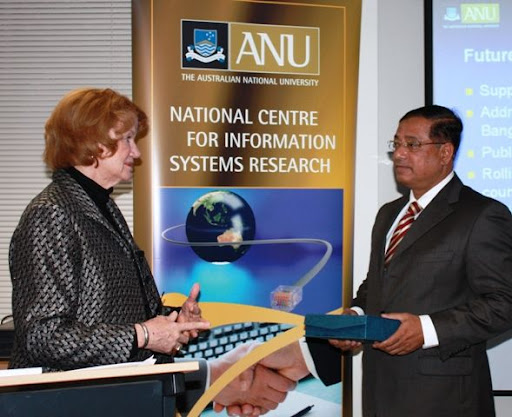
Professor Shirley Gregor and His Excellency HE Lt Gen Masud Uddin Chowdhury, The High Commissioner of Bangladesh. Photo by Obaidul HuqeGreetings from the completion ceremony for the eGovernment capacity building through knowledge transfer in Bangladesh project (PSLP eGov), being held at the Australian National University in Canberra. Present are His Excellency HE Lt Gen Masud Uddin Chowdhury, The High Commissioner of Bangladesh to Australia and dignitaries of the ICT community including AGIMO, NICTA, Professor Gregor who oversaw the project and Ahmed Imran who did much of the work. The project involved preparing training materiel for Bangladesh government officials and conducting training forums. One of the more useful output is the "ICT Management Handbook: A Guide for Government officers in Bangladesh". The handbook is based on AGIMO's handbook for the Australian Public Service. There are other items from the course available on the web. It is likely that the program will be expanded to other developing nations through AusAid. Also later versions may include a component on sustainability from my ANU Green ICT course.

ICT Management Workshop/Training Resources

Module 1

4 Introduction to eGovernment [PDF]

4 eGovernment Management Lifecycle [PDF]

Further Readings

Module 2

4 ICT Business Case [PDF]

Further Readings

  • A Guide to ICT Sourcing for Australian Government Agencies. Developing and Executing an ICT Sourcing Strategy. Second Edition. September 2007. AS/NZS 4360:2004 Risk Management
  • Business Case Guide. A Guide to developing ICT business cases with comprehensive planning and analysis of the project’s demand, value and costs. September 2006.

Web Links:

Module 3

4 PSLP Project Management [PDF]

Further Readings

Project Management Bodies

General Project Management Resources
ProjectMinds Gantthead – the online community for IT project managers

Module 4

4 Managing the Outcomes [PDF]

Further Readings

  • Weill, P. and J.W. Ross (2004) IT governance: How Top Performers Manage IT Decision Rights for Superior Results, Watertown, MA: Harvard Business School Press.
  • Weill, P. and J.W. Ross (2005) “A Matrixed Approach to Designing IT Governance”, Sloan Management Review (46)2, pp. 26-34.
From: "ICT Management Handbook - A Guide for Government officers in Bangladesh", Training Resources, PSLP 2008


Photos by Obaidul Huqe available.

Monday, January 26, 2009

ICT Management Handbook for Developing Nations

ICT Management Handbook - A Guide for Government officers in Bangladesh, by Gregor, S., Imran, A., and Turner, T.At the lunch for Professor Geoff Walsham, at the ANU National Centre for Information Systems Research (NCISR), Ahmed Imran handed me a brochure for the eGovernment capacity building through knowledge transfer in Bangladesh project (PSLP eGov). This is AusAID funded project to improve transparency and efficiency in the Bangladesh public sector. Two deliverables from the project are the report "A Strategic Pathway to Success" and the training course "ICT Management Handbook - A Guide for Government officers in Bangladesh". Unfortunately I was unable to find a copy of "eGovernment for Bangladesh", but the content of the ICT Management course are provided online.

ICT Management is a 14 hour course. It consists of four modules, each 3.5 hours:
  1. Introduction to eGovernment
  2. The ICT Business Case
  3. Project Management
  4. Managing the Outcome
Presentation slides and additional readings, are provided for each module. Unfortunately the slides are provided as excessively large PDF files (3.8 Mbytes for eight pages).